


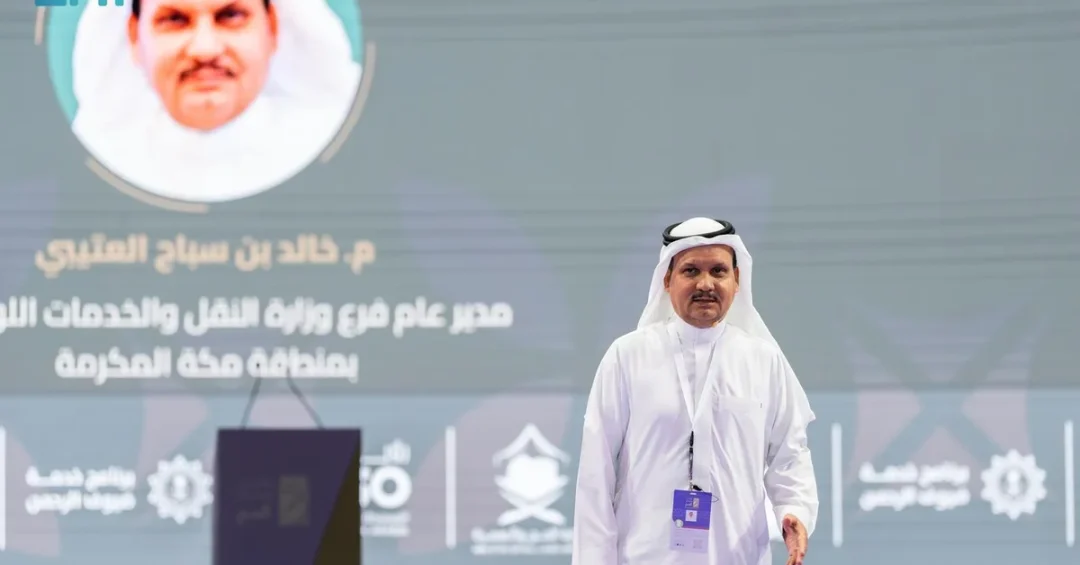
The Ministry of Transport and Logistic Services has unveiled a comprehensive package of road infrastructure projects and technological innovations designed to serve Hajj and Umrah pilgrims, presented during the Hajj Conference and Exhibition held in January 2025. Eng. Khalid Al-Otaibi, Director General of the Ministry’s branch in the Makkah Region, detailed these initiatives during the four-day event, which ran from 13 to 16 January, underscoring the Kingdom’s commitment to enhancing every stage of the pilgrim journey through world-class infrastructure and forward-thinking engineering.
The announcement reflects a broader national effort to elevate the pilgrim experience, aligning transportation development with the goals of Saudi Vision 2030. The projects range from completed road networks and bridges to experimental technologies such as surface cooling and flexible rubber asphalt, all aimed at improving safety, easing congestion, and enriching the spiritual journey for millions of visitors. How does a nation prepare for what is among the largest annual gatherings of humanity? The answer lies in meticulous planning, sustained investment, and a clear strategic vision.
Context and Background
Every year, millions of Muslims from around the world travel to the Kingdom of Saudi Arabia to perform Hajj and Umrah, making the pilgrimage one of the most significant logistical undertakings on the global calendar. The Ministry of Transport and Logistic Services, under the leadership of Minister Saleh bin Nasser Al-Jasser, has long recognized that seamless mobility is central to the success of these sacred journeys. The Hajj Conference and Exhibition, held annually in Jeddah, serves as a vital platform for government entities, private sector partners, and international stakeholders to coordinate efforts and showcase innovations ahead of each pilgrimage season.
The 2025 edition of the conference brought together experts and officials to discuss infrastructure readiness, crowd management, and technological integration. Eng. Al-Otaibi’s presentation highlighted how the Ministry’s strategy begins at the very entry points to the Kingdom, where road infrastructure plays a critical role in managing the flow of pilgrims from airports, seaports, and border crossings toward Makkah and the holy sites. This end-to-end approach ensures that pilgrims encounter efficiency and safety from the moment they arrive until they complete their rituals and depart.
For international observers, the scale of these preparations offers insight into Saudi Arabia’s broader capabilities in infrastructure development and project management. The Kingdom’s experience in managing the Hajj has become a model for large-scale event logistics, and the technologies being tested and deployed in Makkah and the holy sites often find applications in other mega-projects across the country, including those under the Vision 2030 umbrella. Is there any greater test of a nation’s infrastructure than the safe movement of millions within a confined geography and a fixed timeframe? The Ministry’s work suggests that Saudi Arabia is not only meeting this test but setting new global benchmarks.
Key Details
Eng. Al-Otaibi provided a detailed overview of the specific projects and initiatives that have been completed or are underway in the Makkah region. Among the notable road projects completed in 2024 were a single road stretching 18.6 kilometers, a dual road spanning 231 kilometers, an expressway of 34.2 kilometers, and 33 bridges. These additions to the road network significantly enhance connectivity between the holy sites, the city of Makkah, and the surrounding regions, facilitating the smooth movement of pilgrims and residents alike.
Ongoing projects include the dualization of the Al-Jumum Al-Zima Road, which has reached 83 percent completion with 59 kilometers already finished. Additionally, the Bisha/Ranyah/Al-Khurmah Road to the Taif/Riyadh Expressway, totaling 313 kilometers, has been completed, further strengthening the arterial network that links Makkah to other major cities and entry points. These infrastructure improvements are designed not only for the Hajj season but also to support year-round Umrah traffic and the economic development of the region.
Innovation lies at the heart of the Ministry’s approach. Eng. Al-Otaibi detailed several pioneering initiatives, including a surface cooling project aimed at reducing temperatures on roads and pedestrian areas, the development of flexible rubber asphalt to improve durability and reduce noise, and the application of white coating on pedestrian walkways at the holy sites to reflect sunlight and enhance comfort. A 300-meter pedestrian crossing beneath the Eastern Ring Road in Arafat was constructed to separate pedestrian and vehicle traffic, significantly improving safety and movement efficiency. These efforts are set for expansion during the Hajj season of 1446 AH, demonstrating the Ministry’s commitment to continuous improvement and pilgrim welfare.
International and Regional Impact
The enhancements to Makkah’s transport infrastructure have implications that extend well beyond the Kingdom’s borders. Pilgrims from more than 180 countries rely on these networks, and their experiences shape international perceptions of Saudi Arabia’s hospitality, organizational capacity, and modernity. By investing in advanced road technologies and smart traffic management, the Ministry is not only serving pilgrims but also reinforcing the Kingdom’s position as a global leader in managing large-scale religious tourism. The successful execution of these projects during Hajj seasons strengthens Saudi Arabia’s reputation as a reliable and capable host for millions of international visitors.
Regionally, the improvements support the broader integration of transport networks across the Gulf Cooperation Council (GCC) states. Many pilgrims travel overland from neighboring countries, and enhanced road links between Makkah and border crossings facilitate smoother transit. Furthermore, the technologies and methodologies developed for the Hajj—such as flexible rubber asphalt and surface cooling—could be adapted for use in other hot-climate regions, offering potential export opportunities for Saudi engineering expertise. The Ministry’s work thus contributes to regional connectivity and positions the Kingdom as a source of innovation in sustainable infrastructure.
Economic and Strategic Significance
The economic dimensions of these transport projects are substantial. Improved roads reduce travel times and vehicle operating costs, lower accident rates, and enhance the overall efficiency of logistics during the Hajj season. For the private sector, including transportation companies, hotels, and retail businesses, reliable infrastructure translates into higher service quality and increased revenue. The Ministry’s investments also create jobs in construction, engineering, and maintenance, supporting local economies in the Makkah region and beyond. Moreover, the seamless movement of pilgrims encourages repeat visits for Umrah, contributing to the growth of the religious tourism sector, which is a key pillar of Vision 2030.
Strategically, the transport enhancements align with the National Transformation Program and the Pilgrim Experience Program, both central to Vision 2030. These programs aim to increase the number of pilgrims and Umrah performers to 30 million annually by 2030, while constantly improving the quality of services. By upgrading infrastructure, the Ministry is directly enabling these targets. The focus on safety, sustainability, and innovation also reflects the Kingdom’s commitment to sustainable development and smart mobility, setting a standard for future mega-events in Saudi Arabia, such as Expo 2030 and the FIFA World Cup 2034.
Vision 2030 Alignment
The Ministry of Transport and Logistic Services’ projects for Hajj and Umrah are a clear manifestation of Saudi Vision 2030’s objectives to diversify the economy, enhance public services, and position the Kingdom as a global hub for tourism and logistics. The emphasis on advanced materials, smart design, and environmental considerations underscores the Vision’s commitment to sustainability and quality of life. As Saudi Arabia continues to welcome increasing numbers of pilgrims, these infrastructure investments will ensure that the spiritual journey remains safe, comfortable, and memorable, reflecting the nation’s dedication to serving the guests of God.
Looking ahead, the Ministry’s ongoing and planned projects will further integrate with other Vision 2030 initiatives, including the expansion of the Two Holy Mosques and the development of new transportation modes such as the Haramain High Speed Railway. The Kingdom’s ability to manage the complexities of Hajj logistics serves as a testament to its growing capabilities and its unwavering commitment to excellence. With each completed road, bridge, and innovative pilot, Saudi Arabia moves closer to realizing its ambitious vision, demonstrating to the world that it is a nation of progress, faith, and hospitality.
20 Questions
Q1. What was the main focus of Eng. Khalid Al-Otaibi’s presentation at the Hajj Conference and Exhibition?
A1. Eng. Khalid Al-Otaibi, Director General of the Ministry of Transport and Logistic Services branch in Makkah, presented key road infrastructure projects and innovative initiatives aimed at serving Hajj and Umrah pilgrims, emphasizing efficiency, safety, and technological advancement.
Q2. When and where was the Hajj Conference and Exhibition held?
A2. The Hajj Conference and Exhibition was held from 13 to 16 January 2025 in Jeddah, Saudi Arabia, bringing together officials and experts to discuss preparations for the pilgrimage season.
Q3. What are some of the innovative projects mentioned by Eng. Al-Otaibi?
A3. Innovations include a surface cooling initiative to reduce road temperatures, the development of flexible rubber asphalt, and the application of white coating on pedestrian walkways at holy sites to improve comfort and durability.
Q4. What is the purpose of the 300-meter pedestrian crossing beneath the Eastern Ring Road in Arafat?
A4. The pedestrian crossing separates pedestrian and vehicle traffic, enhancing safety and facilitating smoother movement for pilgrims in the Arafat area during Hajj.
Q5. How many bridges were completed in the Makkah region in 2024?
A5. According to Eng. Al-Otaibi, 33 bridges were completed in the Makkah region in 2024 as part of the road infrastructure development efforts.
Q6. What is the length of the dual road completed in 2024?
A6. A dual road stretching 231 kilometers was completed in the Makkah region in 2024, significantly improving connectivity and traffic flow.
Q7. What ongoing project was mentioned, and what is its completion status?
A7. The dualization of the Al-Jumum Al-Zima Road is ongoing, with 59 kilometers completed, representing 83 percent of the project.
Q8. What is the length of the Bisha/Ranyah/Al-Khurmah Road to Taif/Riyadh Expressway, and is it completed?
A8. The road totals 313 kilometers and has been completed, enhancing the arterial network linking Makkah to other major cities.
Q9. How do these projects aim to enhance the pilgrim experience?
A9. The projects improve road safety, reduce congestion, and provide more comfortable conditions through innovations like cooling surfaces and white coatings, making the pilgrimage smoother and more spiritually focused.
Q10. What role does the Ministry of Transport and Logistic Services play in Hajj and Umrah?
A10. The Ministry oversees the planning, development, and maintenance of transport infrastructure, ensuring efficient movement of pilgrims from entry points to holy sites, and continuously innovating to improve service quality.
Q11. When will the expansion of these initiatives take place?
A11. The expansion plans are set for the Hajj season of 1446 AH, which corresponds to 2025, building on the successful implementation of pilot projects.
Q12. How do these projects align with Saudi Vision 2030?
A12. They support Vision 2030 goals by enhancing infrastructure, boosting religious tourism, improving quality of life, and positioning Saudi Arabia as a global leader in managing large-scale events.
Q13. What is the significance of the surface cooling initiative?
A13. The surface cooling initiative aims to lower temperatures on roads and walkways, improving comfort for pilgrims and reducing heat-related stress, especially during the hot Hajj season.
Q14. What is flexible rubber asphalt, and why is it used?
A14. Flexible rubber asphalt is a modified pavement material that enhances durability, reduces noise, and provides better performance under heavy traffic and high temperatures, suitable for Makkah’s climate.
Q15. How does the white coating on pedestrian walkways help pilgrims?
A15. The white coating reflects sunlight, reducing surface temperatures and creating a more comfortable walking environment for pilgrims at the holy sites.
Q16. What was the length of the single road completed in 2024?
A16. A single road stretching 18.6 kilometers was completed in the Makkah region in 2024, contributing to improved local connectivity.
Q17. What is the length of the expressway completed in 2024?
A17. An expressway of 34.2 kilometers was completed in the Makkah region in 2024, facilitating faster and safer travel.
Q18. How do these transport projects impact the local economy?
A18. They create jobs, support local businesses, reduce logistics costs, and boost religious tourism, contributing to economic diversification and regional development in line with Vision 2030.
Q19. What other Vision 2030 initiatives complement these transport projects?
A19. The Pilgrim Experience Program, the expansion of the Two Holy Mosques, and the Haramain High Speed Railway work in tandem to enhance pilgrim services and achieve the goal of 30 million pilgrims annually by 2030.
Q20. What is the Ministry’s overall commitment as stated by Eng. Al-Otaibi?
A20. Eng. Al-Otaibi underlined the Ministry’s commitment to enhancing the visual landscape, improving road service efficiency and quality, reducing traffic congestion, and increasing safety standards for all pilgrims.
Reader Feedback
We value your thoughts. Please share your feedback on this article.
Your feedback helps us improve our coverage.
Related articles
 Islamic Fiqh Academy Chief Meets Cameroon Minister
 Saudi Religious Affairs President Meets Malaysian Minister
 Saudi Arabia Launches Mining Innovation Studio at FMF 2025
 Saudi, Thai FMs Chair First Coordination Council in Bangkok
 Final Qualifiers for Holy Quran Memorization Competition to Commence in Sri Lanka
 Jazan Border Guard Foils Smuggling of 22,500 Narcotic Tablets