


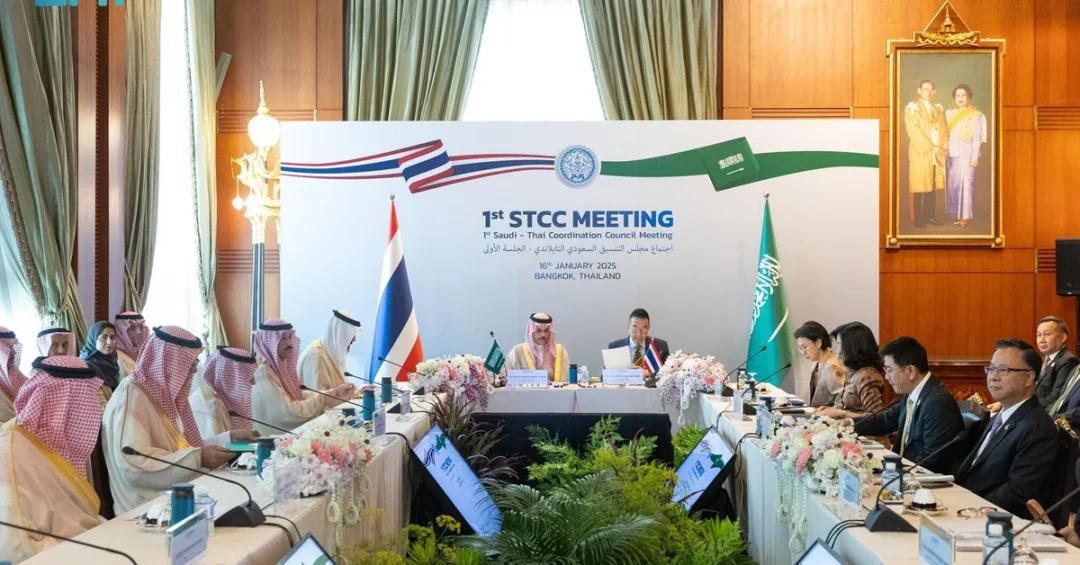
Saudi Minister of Foreign Affairs Prince Faisal bin Farhan bin Abdullah and Thai Minister of Foreign Affairs Maris Sangiampongsa co-chaired the first meeting of the Saudi-Thai Coordination Council in Bangkok on January 16, 2025, marking a new institutional phase in relations between the Kingdom of Saudi Arabia and the Kingdom of Thailand. The meeting was announced through the Saudi Press Agency, the Kingdom’s official news authority, and produced more than 70 joint initiatives across politics, security, defense, energy, economy, investment, education, culture, and tourism. Could this first council session become the blueprint for Saudi Arabia’s expanding network of strategic partnerships in Asia?
The gathering in Bangkok follows the full restoration of diplomatic ties between Riyadh and Bangkok in 2022, after more than three decades of suspended relations. That restoration, initiated during the visit of Thai Prime Minister Prayut Chan-o-cha to Riyadh in January 2022 and reinforced by Crown Prince Mohammed bin Salman’s official visit to Thailand in November 2022, set the stage for an upgraded bilateral framework. The Coordination Council, agreed upon by both governments, is designed to serve as the central institutional mechanism that turns high-level political goodwill into measurable cooperation. For Saudi Arabia, the council complements a wider diplomatic strategy of building structured, long-term partnerships across the Indo-Pacific, while for Thailand it represents a gateway to Gulf investment, energy security, and expanded market access.
Context and Background
Why does the timing of this first council meeting matter so much for both capitals? The answer lies in the speed with which Riyadh and Bangkok have moved from restoring relations to institutionalizing them. In less than three years, the two countries have exchanged high-level visits, signed agreements in energy, tourism, and labor, and steadily rebuilt the commercial and people-to-people links that had been dormant for a generation. The Saudi-Thai Coordination Council now formalizes that momentum, creating a permanent structure with specialized subcommittees rather than relying on ad hoc contacts between ministries.
The council’s mandate covers an unusually broad range of sectors: political coordination, security and defense dialogue, energy cooperation, economic and investment ties, education, culture, and tourism, among other fields of mutual interest. This breadth reflects the shared understanding that Saudi-Thai relations are not limited to any single file. Energy, for instance, connects Saudi Arabia’s role as a leading global oil producer with Thailand’s growing demand for secure supplies, while tourism links Saudi Arabia’s Vision 2030 goal of welcoming 150 million visits annually by 2030 with Thailand’s world-class hospitality sector.
Both ministers emphasized during the meeting the importance of sustained joint efforts and expressed satisfaction with the outcomes of the committee sessions that preceded the council’s first gathering. According to the Saudi Press Agency, the sessions generated over 70 joint initiatives, a figure that signals how much practical work has already been prepared. It also indicates that the council is not a ceremonial body but a working platform with a detailed pipeline of projects ready for implementation.
Key Details of the First Council Meeting
What exactly did the two foreign ministers agree to in Bangkok? At the conclusion of the meeting, Prince Faisal bin Farhan and Minister Maris Sangiampongsa signed the minutes of the first meeting of the Saudi-Thai Coordination Council, formally recording its decisions and the direction of its future work. The co-chairs also underscored the importance of implementing the recommendations and initiatives of the committee heads, with support from the council’s general secretariat, and expressed their anticipation for the second council meeting, which will be hosted in Saudi Arabia.
A second agreement signed on the same day deepened the institutional dimension of the relationship. The two sides signed a cooperation program between the Saudi Ministry of Foreign Affairs, represented by the Prince Saud Al-Faisal Institute for Diplomatic Studies, and the Thai Ministry of Foreign Affairs, represented by the Devawongse Varopakarn Institute of Foreign Affairs (DVIFA). Named after two historic figures in Saudi and Thai diplomacy, the two institutes will exchange expertise in diplomatic training, research, and capacity building, preparing a new generation of diplomats for the demands of a more connected world.
The meeting also highlighted the role of the council’s committees and general secretariat in maintaining momentum between ministerial sessions. By reinforcing coordination among the subcommittees, the two governments aim to amplify the council’s effectiveness as an institutional mechanism framing bilateral cooperation. The structure allows technical teams to work continuously on energy, investment, education, and cultural files, while foreign ministers provide political direction at the top. For observers of Saudi diplomacy, this architecture mirrors the Kingdom’s approach in other strategic relationships, where long-term frameworks replace one-off engagements.
International and Regional Impact
How does a Saudi-Thai council in Bangkok resonate beyond the two countries? Southeast Asia is one of the fastest-growing regions in the world, with a combined economy of more than three trillion dollars and a population exceeding 680 million people. For Saudi Arabia, deeper ties with Thailand offer a bridgehead into ASEAN markets, supply chains, and investment opportunities that align with the diversification goals of Vision 2030. Thailand, in turn, gains a structured channel to Gulf capital, energy resources, and the Kingdom’s expanding tourism and logistics sectors.
The meeting also carries weight for regional diplomacy more broadly. Saudi Arabia has steadily expanded its Asian partnerships through bodies such as the Gulf Cooperation Council-ASEAN framework and bilateral strategic dialogues with countries including Indonesia, Singapore, and now Thailand. A functioning coordination council with Bangkok strengthens the Kingdom’s reputation as a reliable institutional partner, capable of translating political declarations into concrete programs. For Thailand, hosting the first session underscores its ambition to act as a regional hub connecting ASEAN with the Middle East, a role that complements its own economic and logistics strategies.
Economic and Strategic Significance
Which economic files are most likely to move first? Energy and investment stand at the top of the agenda. Saudi Arabia is a pivotal supplier in global oil markets and a major investor through the Public Investment Fund, while Thailand is a manufacturing and agricultural powerhouse with significant demand for energy security and outbound investment opportunities. The 70-plus initiatives prepared by the committees are expected to cover trade facilitation, industrial cooperation, and joint ventures in sectors ranging from petrochemicals to food processing and digital services.
Tourism and aviation also offer immediate potential. Saudi Arabia welcomed more than 100 million visitors in 2023, surpassing its original Vision 2030 target ahead of schedule, and is now aiming for 150 million visits by 2030. Thailand, one of the world’s most visited countries, is a natural partner for joint tourism promotion, cultural exchange, and aviation connectivity. Direct flights between Riyadh, Jeddah, and Bangkok have expanded, and further growth in business travel, religious tourism, and leisure travel would create measurable economic value for both economies. Education and cultural cooperation, anchored by the new institute-to-institute program, will support these commercial ties with the human connections that make partnerships durable.
Vision 2030 Alignment
How does the Saudi-Thai Coordination Council advance Vision 2030? The council’s sectoral coverage maps closely onto the reform program’s core pillars: a diversified economy, a globally engaged foreign policy, and a vibrant society open to the world. By institutionalizing cooperation with a key Asian economy, Saudi Arabia strengthens the non-oil dimensions of its growth, expands export and investment channels for Saudi businesses, and reinforces its position as a hub linking the Middle East, Asia, and beyond.
The diplomatic training program between the Prince Saud Al-Faisal Institute for Diplomatic Studies and the Devawongse Varopakarn Institute of Foreign Affairs adds a long-term dimension that Vision 2030 emphasizes: investing in human capital. As the council prepares for its second meeting in Saudi Arabia, the two governments have created a framework capable of delivering results across energy, trade, tourism, education, and culture for years to come. The first meeting in Bangkok, announced through official Saudi channels, is therefore more than a diplomatic milestone. It is a working commitment, backed by more than 70 initiatives, to build a partnership that serves the aspirations of both nations’ leaders and peoples.
20 Questions
Q1. What is the Saudi-Thai Coordination Council?
A1. It is a bilateral institutional framework agreed by Saudi Arabia and Thailand to organize cooperation across politics, security, defense, energy, economy, investment, education, culture, and tourism. It operates through specialized committees and a general secretariat.
Q2. Who co-chaired the first council meeting?
A2. Saudi Minister of Foreign Affairs Prince Faisal bin Farhan bin Abdullah and Thai Minister of Foreign Affairs Maris Sangiampongsa co-chaired the first meeting in Bangkok on January 16, 2025, as reported by the Saudi Press Agency.
Q3. Where was the first meeting held?
A3. The first meeting of the Saudi-Thai Coordination Council was held in Bangkok, the capital of Thailand, reflecting the council’s rotating hosting arrangement and Thailand’s role as the inaugural host.
Q4. How many joint initiatives came out of the committee sessions?
A4. The committee sessions produced over 70 joint initiatives spanning various fields, according to the Saudi Press Agency. These initiatives form the practical pipeline for the council’s future work.
Q5. What did the two ministers sign at the meeting?
A5. They signed the minutes of the first meeting of the Saudi-Thai Coordination Council. They also signed a cooperation program between the two foreign ministries’ diplomatic institutes.
Q6. Which institutes signed the diplomatic cooperation program?
A6. The Prince Saud Al-Faisal Institute for Diplomatic Studies represented the Saudi Ministry of Foreign Affairs, while the Devawongse Varopakarn Institute of Foreign Affairs (DVIFA) represented the Thai Ministry of Foreign Affairs.
Q7. Where will the second council meeting be held?
A7. The second meeting of the Saudi-Thai Coordination Council will be hosted by Saudi Arabia, as confirmed by the two co-chairs, continuing the council’s rotating hosting pattern between the two kingdoms.
Q8. When were Saudi-Thai diplomatic relations fully restored?
A8. Full diplomatic relations were restored in 2022, following Thai Prime Minister Prayut Chan-o-cha’s visit to Riyadh in January 2022 and Crown Prince Mohammed bin Salman’s visit to Thailand in November 2022.
Q9. What sectors does the council cover?
A9. The council covers politics, security, defense, energy, economy, investment, education, culture, tourism, and other areas of mutual interest, making it one of Saudi Arabia’s broadest bilateral cooperation frameworks.
Q10. Why is the council important for Saudi Arabia?
A10. It institutionalizes relations with a major Southeast Asian economy, supports Vision 2030 diversification goals, expands investment and trade channels, and strengthens Saudi Arabia’s network of structured partnerships across Asia.
Q11. Why is the council important for Thailand?
A11. It gives Thailand a structured channel to Gulf investment, energy supplies, and Saudi Arabia’s growing tourism and logistics markets, while reinforcing Bangkok’s ambition to connect ASEAN with the Middle East.
Q12. What role does the general secretariat play?
A12. The general secretariat supports the implementation of recommendations and initiatives approved by the committee heads, helping maintain continuity between ministerial meetings and ensuring that agreed programs are carried out.
Q13. How does the council relate to Saudi Vision 2030?
A13. Its sectoral coverage aligns with Vision 2030’s economic diversification, global engagement, and human capital goals, helping expand non-oil cooperation, trade, investment, and cultural exchange with a key Asian partner.
Q14. What does the diplomatic institute program involve?
A14. The program between the Prince Saud Al-Faisal Institute and DVIFA focuses on diplomatic training, research, and capacity building, preparing diplomats from both countries for a more connected and complex international environment.
Q15. How do energy ties fit into the partnership?
A15. Saudi Arabia is a leading global energy producer, while Thailand has significant and growing energy demand. Energy cooperation is a core file within the council’s committees and supports Thailand’s supply security.
Q16. What tourism opportunities does the partnership create?
A16. Both countries are major tourism destinations. Cooperation can expand aviation links, joint promotion, cultural exchange, and visitor flows, supporting Saudi Arabia’s goal of 150 million visits annually by 2030.
Q17. What economic value could the 70 initiatives deliver?
A17. The initiatives are expected to facilitate trade, encourage joint ventures, and open investment channels in sectors such as petrochemicals, food processing, digital services, and tourism, benefiting both economies over time.
Q18. How does the council fit Saudi Arabia’s broader Asian strategy?
A18. It complements Saudi engagement with ASEAN and bilateral dialogues with countries such as Indonesia and Singapore, reinforcing the Kingdom’s role as an institutional partner linking the Middle East and Asia.
Q19. What was the significance of the 2022 restoration of ties?
A19. It ended more than three decades of suspended relations, reopening embassies, trade, and travel, and created the political foundation on which the Coordination Council and its committees were later built.
Q20. What happens next for the Saudi-Thai Coordination Council?
A20. Committees will implement the over 70 initiatives with support from the general secretariat, while both sides prepare for the second council meeting in Saudi Arabia, expected to review progress and set new goals.
Reader Feedback
We value your thoughts. Please share your feedback on this article.
Your feedback helps us improve our coverage.
Related articles
 Final Qualifiers for Holy Quran Memorization Competition to Commence in Sri Lanka
 Jazan Border Guard Foils Smuggling of 22,500 Narcotic Tablets
 Saudi FM Meets Thai Parliamentary Leaders in Bangkok
 Saudi Arabia Chairs Global Broadcasting Unions Meeting
 IsDB Concludes Consultative Forum for 10-Year Strategy
 Saudi Authority, SAMI-AEC Sign MoU to Upgrade Holy Mosques Security Tech