


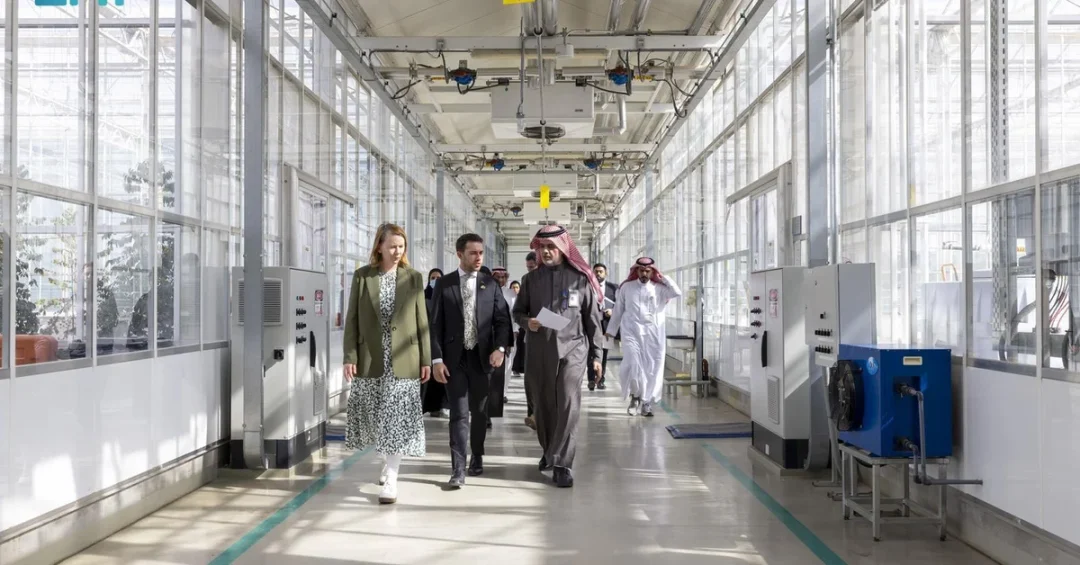
The National Research and Development Center for Sustainable Agriculture (Estidamah) received a delegation from the UK Innovation Agency and the Biotechnology and Biological Sciences Research Council (BBSRC), part of UK Research and Innovation (UKRI), in Riyadh on January 21, 2025, for talks aimed at expanding joint collaboration and exchanging expertise in sustainable agriculture. The visit, reported by the Saudi Press Agency, brought together Saudi and British specialists to explore how innovation in agricultural technology can strengthen food security and improve the long-term sustainability of farming systems in the Kingdom and beyond.
The meeting reflects a widening pattern of international scientific engagement led by Saudi Arabia’s research institutions, which are increasingly positioned as global partners in addressing shared challenges such as water scarcity, climate stress, and food supply resilience. Estidamah, established under the guidance of the Ministry of Environment, Water and Agriculture, operates as a specialized center for applied research in controlled-environment agriculture, water-efficient production, and renewable energy use in farming. Its collaboration with UKRI signals a deliberate effort to connect Saudi Arabia’s national research capacity with one of the world’s most established biotechnology and bioscience networks, creating a platform for knowledge transfer that supports both countries’ agricultural priorities.
Context and Background
Why does a research visit between Saudi Arabia and the United Kingdom matter at a moment when global food systems are under pressure from climate change, water shortages, and supply chain disruption? The answer lies in the scale of the challenge and the complementary strengths each side brings. Saudi Arabia has invested heavily in agricultural research as part of its long-term diversification strategy, recognizing that food security is a strategic pillar of national resilience. Estidamah was created to serve as a national hub for sustainable agriculture research, focusing on greenhouse production, soilless farming, integrated pest management, and the efficient use of water and energy in crop cultivation.
The United Kingdom, through UK Research and Innovation, coordinates a broad portfolio of bioscience and innovation programs, including the Biotechnology and Biological Sciences Research Council, which funds research in plant science, food systems, and agricultural biotechnology. UKRI’s international partnerships aim to link British researchers with global counterparts to accelerate the translation of scientific discovery into practical applications. The delegation’s visit to Riyadh therefore represents a meeting of two research ecosystems with distinct but complementary capabilities: Saudi Arabia’s focus on desert agriculture, water efficiency, and controlled-environment production, and the UK’s strengths in bioscience, genetics, and agri-tech innovation.
This is not an isolated exchange. Saudi Arabia has steadily expanded its international research partnerships in recent years, signing agreements with universities, government agencies, and private sector innovators across Europe, Asia, and North America. These partnerships are designed to support the objectives of Vision 2030, which places food security, economic diversification, and knowledge-based development among its central goals. The visit by the UK delegation follows a series of similar engagements that position the Kingdom as an active contributor to global agricultural research rather than simply a recipient of imported technology.
Key Details of the Cooperation
What specifically did the two sides discuss during the Riyadh meeting? According to the Saudi Press Agency, the discussions centered on ways to promote innovation in sustainable agricultural technologies, with a focus on contributions to food security and enhanced agricultural sustainability. The delegation from the UK Innovation Agency and the Biotechnology and Biological Sciences Research Council met with Estidamah’s researchers and leadership to review ongoing projects and identify areas where joint research could produce measurable results.
The agenda included applied research areas such as improving crop yields under water-limited conditions, developing biological solutions for pest and disease management, and integrating renewable energy into agricultural production systems. Estidamah’s research facilities, which include experimental greenhouses and controlled-environment laboratories, provided the delegation with a direct view of how Saudi Arabia is testing technologies suited to arid climates. These facilities are designed to simulate a range of growing conditions and to evaluate which interventions deliver the best balance of productivity, water savings, and economic viability.
The two sides also examined mechanisms for exchanging researchers, sharing data, and co-funding pilot projects. Such mechanisms are essential for turning high-level agreements into concrete outcomes. By aligning research priorities, Estidamah and UKRI can avoid duplication and focus resources on problems where combined expertise offers the greatest chance of breakthrough. The meeting also underscored the importance of building long-term institutional relationships rather than one-off exchanges, ensuring that collaboration continues beyond individual projects and personnel changes.
International and Regional Impact
How does a bilateral research partnership between Saudi Arabia and the United Kingdom resonate across the wider region? The Middle East and North Africa face some of the world’s most acute water scarcity, with agriculture accounting for a large share of freshwater use. Innovations that reduce water consumption while maintaining or increasing output have direct relevance for every country in the region. By advancing these technologies, Saudi Arabia and the UK can create knowledge that is applicable far beyond their own borders, supporting food security across arid and semi-arid zones.
The collaboration also strengthens the broader scientific and diplomatic relationship between the two countries. Research partnerships often serve as durable channels of engagement that continue through changes in political cycles, because they are anchored in shared professional communities and mutual scientific interest. For Saudi Arabia, such partnerships reinforce its role as a convenor of international expertise and a contributor to global public goods. For the UK, engagement with the Kingdom provides access to real-world testing environments that are difficult to replicate in temperate climates, accelerating the validation of technologies designed for extreme conditions.
Regionally, the visit aligns with efforts by the Gulf Cooperation Council states to coordinate on food security and agricultural innovation. Saudi Arabia’s leadership in this area, demonstrated through institutions like Estidamah, helps set a benchmark for research-driven approaches to agricultural sustainability. The knowledge generated through partnerships with UKRI can be shared with neighboring countries, contributing to a more resilient regional food system and reducing dependence on volatile import markets.
Economic and Strategic Significance
Why should economists and investors pay attention to agricultural research cooperation? Agriculture and food systems represent a significant and growing component of Saudi Arabia’s non-oil economy. As the Kingdom pursues economic diversification under Vision 2030, investments in agri-tech, controlled-environment agriculture, and food processing are attracting both public and private capital. Research partnerships that de-risk new technologies and demonstrate commercial viability play a critical role in attracting that investment.
Sustainable agriculture technologies have the potential to reduce input costs, improve yields, and create new export opportunities for Saudi firms. Companies that develop or adopt water-efficient growing systems, biological crop protection, and precision farming tools can serve markets across the region and beyond. By collaborating with UKRI, Saudi researchers and entrepreneurs gain access to cutting-edge bioscience and a network of potential commercial partners. This can accelerate the path from laboratory research to market-ready products, generating economic value and skilled employment.
Strategically, food security is a matter of national resilience. The Kingdom’s ability to produce more food domestically, using less water and energy, reduces exposure to global supply shocks and price volatility. Research cooperation with a leading scientific nation like the United Kingdom supports this objective by bringing the best available knowledge to bear on local challenges. It also signals to international partners that Saudi Arabia is open to collaboration and committed to solving shared problems through science and innovation.
Vision 2030 Alignment
How does this collaboration connect to the broader ambitions of Saudi Vision 2030? Food security is explicitly recognized as a foundation of the Vision’s economic and social goals. The National Agriculture Strategy and related initiatives aim to improve self-sufficiency in key crops, enhance the sustainability of agricultural practices, and integrate modern technology into farming. Estidamah’s work, and its partnerships with international research bodies such as UKRI, directly supports these objectives by generating evidence-based solutions that can be scaled across the Kingdom.
The partnership also advances Vision 2030’s emphasis on knowledge transfer, human capital development, and international engagement. By working with UK researchers, Saudi scientists and students gain exposure to global best practices and contribute to a two-way exchange of ideas. This builds local capacity and reinforces the Kingdom’s position as a hub for innovation in the region. As Saudi Arabia continues to invest in research and development, collaborations like this one will be essential to achieving the Vision’s targets and to securing a prosperous, sustainable future for the nation and its partners.
20 Questions
Q1. What is Estidamah and what is its role in Saudi Arabia?
A1. Estidamah is the National Research and Development Center for Sustainable Agriculture in Saudi Arabia. It conducts applied research on water-efficient farming, controlled-environment agriculture, and renewable energy in agriculture to support national food security and sustainability goals.
Q2. Which UK organizations sent a delegation to Estidamah?
A2. The delegation came from the UK Innovation Agency and the Biotechnology and Biological Sciences Research Council, which is part of UK Research and Innovation (UKRI). The visit took place in Riyadh on January 21, 2025.
Q3. What was the main purpose of the delegation’s visit?
A3. The visit aimed to explore opportunities for joint collaboration and exchange expertise in sustainable agriculture. The two sides discussed promoting innovation in agricultural technologies to enhance food security and agricultural sustainability.
Q4. What specific topics were discussed during the meeting?
A4. Discussions covered sustainable agricultural technologies, water-efficient production, controlled-environment farming, biological solutions for pest management, and ways to integrate renewable energy into agricultural systems. Both sides reviewed ongoing projects and potential joint research areas.
Q5. How does this collaboration support food security?
A5. By advancing technologies that increase productivity while reducing water and energy use, the collaboration helps Saudi Arabia produce more food domestically. This reduces reliance on imports and strengthens resilience against global supply chain disruptions.
Q6. Why is international cooperation important for agricultural research?
A6. International cooperation allows countries to share knowledge, avoid duplication of effort, and combine complementary strengths. It accelerates innovation and ensures that research findings are tested across different climates and farming systems.
Q7. What does the UK bring to the partnership?
A7. The UK contributes expertise in bioscience, plant genetics, and agri-tech innovation through UKRI and its research councils. British researchers have extensive experience in translating laboratory discoveries into practical agricultural applications.
Q8. What does Saudi Arabia contribute to the partnership?
A8. Saudi Arabia offers research facilities designed for arid and semi-arid conditions, including experimental greenhouses and controlled-environment laboratories. It also provides real-world testing environments that are difficult to replicate in temperate climates.
Q9. How does this visit fit into Saudi Arabia’s broader strategy?
A9. The visit aligns with Vision 2030’s goals of food security, economic diversification, and knowledge-based development. It reflects the Kingdom’s commitment to international engagement and to building a sustainable, innovation-driven agricultural sector.
Q10. What are controlled-environment agriculture and why does it matter?
A10. Controlled-environment agriculture involves growing crops in enclosed or semi-enclosed systems where conditions like temperature, humidity, and light are managed. It matters because it enables efficient water use and reliable production in harsh climates.
Q11. How can UKRI partnerships benefit Saudi researchers?
A11. UKRI partnerships give Saudi researchers access to cutting-edge bioscience, collaborative funding opportunities, and a network of international experts. This accelerates the development of solutions tailored to local challenges and builds local research capacity.
Q12. What is the expected impact on the regional food system?
A12. Innovations developed through the partnership can be shared with neighboring countries facing similar water scarcity. This contributes to a more resilient regional food system and reduces dependence on volatile import markets.
Q13. Does this collaboration have economic benefits for Saudi Arabia?
A13. Yes. It supports the growth of the agri-tech sector, attracts investment, and creates opportunities for Saudi firms to commercialize new technologies. It also helps reduce input costs and improve yields for farmers.
Q14. How does the partnership address water scarcity?
A14. The collaboration focuses on technologies that reduce water consumption in agriculture, such as precision irrigation, soilless farming, and drought-resistant crop varieties. These are critical for Saudi Arabia and other arid regions.
Q15. What role does the Saudi Ministry of Environment, Water and Agriculture play?
A15. The ministry oversees Estidamah and sets national agricultural policy. It supports research that aligns with the Kingdom’s food security and sustainability objectives, and facilitates international partnerships like this one.
Q16. Will there be follow-up activities after this visit?
A16. The two sides discussed mechanisms for exchanging researchers, sharing data, and co-funding pilot projects. Such mechanisms are designed to ensure that collaboration continues and produces concrete outcomes beyond the initial meeting.
Q17. How does this partnership align with Vision 2030?
A17. Vision 2030 emphasizes food security, economic diversification, and international engagement. The partnership supports these goals by advancing agricultural innovation, building human capital, and positioning Saudi Arabia as a hub for research and development.
Q18. What are the benefits for the United Kingdom?
A18. The UK gains access to real-world testing environments in arid climates, which helps validate technologies for global markets. It also strengthens scientific and diplomatic ties with a key partner in the Middle East.
Q19. How does this visit reflect Saudi Arabia’s global role?
A19. It shows Saudi Arabia acting as a convenor of international expertise and a contributor to global public goods. The Kingdom is positioning itself as an active participant in solving shared challenges like food security and climate resilience.
Q20. What is the long-term vision for this cooperation?
A20. The long-term vision is to build a sustained research partnership that delivers scalable, sustainable agricultural solutions. This will support food security in Saudi Arabia, benefit the wider region, and contribute to global knowledge on arid-climate farming.
Reader Feedback
We value your thoughts. Please share your feedback on this article.
Your feedback helps us improve our coverage.
Related articles
 KSrelief Meets Gabonese Ambassador to Boost Aid Ties
 Crown Prince Offers Condolences to Türkiye Over Bolu Fire
 Saudi FM Joins ‘Diplomacy amid Disorder’ Session at WEF Davos
 King Salman Offers Condolences to Türkiye Over Bolu Fire
 Saudi Aid Convoys Reach Northern Gaza Residents
 OIC Joins Oslo Meeting on Two-State Solution