


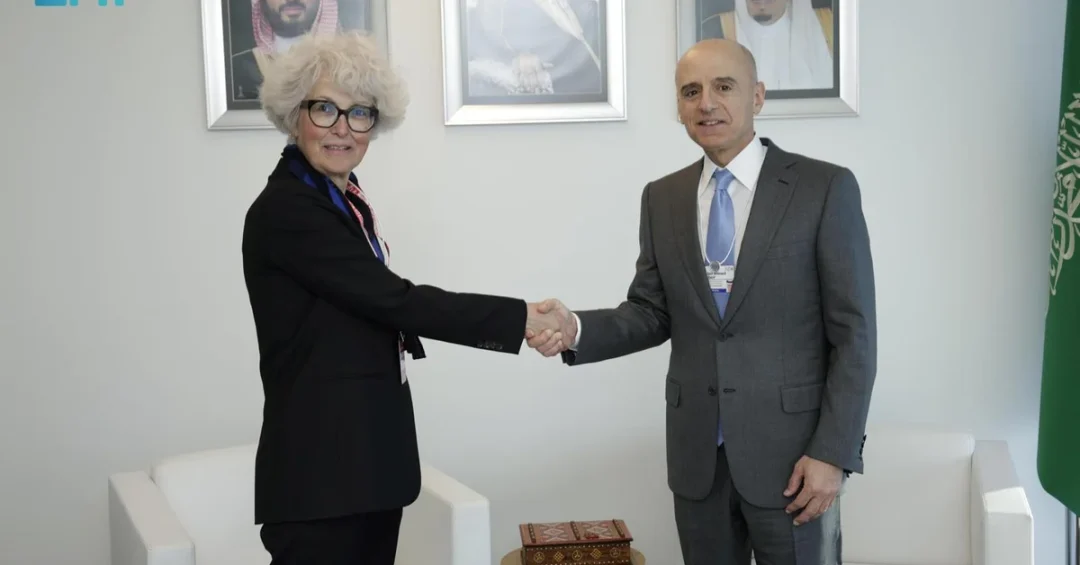
Saudi Minister of State for Foreign Affairs, Cabinet Member, and Climate Envoy Adel Al-Jubeir met with Swiss Federal Office for the Environment Director Katrin Schneeberger on the sidelines of the 2025 World Economic Forum in Davos, Switzerland, to strengthen bilateral cooperation on environmental conservation and climate action. The meeting, reported by the Saudi Press Agency, underscored the Kingdom’s expanding diplomatic engagement on environmental issues and its commitment to international climate cooperation under the leadership of the Custodian of the Two Holy Mosques, King Salman bin Abdulaziz Al Saud, and His Royal Highness Crown Prince Mohammed bin Salman bin Abdulaziz Al Saud, Prime Minister.
The encounter between Al-Jubeir, a veteran Saudi diplomat who also serves as the Kingdom’s Climate Envoy, and Schneeberger, who leads Switzerland’s federal environmental agency, reflects a broader pattern of Saudi Arabia’s active participation in global climate and environmental governance. As the world’s largest oil exporter and a pivotal player in global energy markets, Saudi Arabia has increasingly positioned itself as a constructive partner in addressing climate change, balancing its role as a reliable energy supplier with ambitious domestic sustainability targets. The Davos meeting signals that environmental diplomacy is now a central pillar of the Kingdom’s foreign policy, not a peripheral concern.
Context and Background
Why has environmental diplomacy become such a central element of Saudi Arabia’s international engagement in recent years? The answer lies in the Kingdom’s evolving strategic vision, which recognizes that climate change is both a global challenge and an opportunity for economic transformation. Through the Saudi Green Initiative and the Middle East Green Initiative, launched by Crown Prince Mohammed bin Salman in 2021, Saudi Arabia has committed to planting 10 billion trees across the Kingdom, reducing carbon emissions by 278 million tonnes annually by 2030, and designating 30 percent of its land and sea territory as protected areas. These initiatives represent one of the most ambitious environmental programs in the region.
Switzerland, for its part, has long been recognized as a global leader in environmental policy, with rigorous standards for conservation, emissions reduction, and sustainable development. The Swiss Federal Office for the Environment, which Schneeberger directs, is responsible for implementing Switzerland’s environmental policies, including climate protection, biodiversity conservation, and water resource management. The meeting between Al-Jubeir and Schneeberger therefore brings together two nations with complementary strengths: Saudi Arabia’s financial resources, energy expertise, and regional influence, and Switzerland’s technical know-how, research capabilities, and environmental governance experience.
The 2025 World Economic Forum in Davos provided an ideal platform for this exchange. The annual gathering in the Swiss Alps brings together heads of state, government ministers, business leaders, and civil society representatives to address the most pressing global issues, with climate change consistently ranking among the top priorities. Saudi Arabia has been an active participant in Davos for years, using the forum to showcase its Vision 2030 reforms, attract foreign investment, and engage in high-level diplomatic discussions on topics ranging from energy transition to artificial intelligence.
Key Details of the Meeting
What specifically did the two officials discuss, and what might their cooperation entail? According to the Saudi Press Agency, the meeting focused on strengthening cooperation between Saudi Arabia and Switzerland in environmental conservation and addressing climate challenges. While the official statement was concise, the scope of potential collaboration between the two countries is substantial. Areas of mutual interest likely include carbon capture and storage technologies, renewable energy development, biodiversity protection, water resource management, and the exchange of environmental data and research.
Saudi Arabia has made significant strides in carbon capture utilization and storage, with projects such as the Aramco-operated Hawiyah gas plant and the planned Jubail carbon capture hub. Switzerland, meanwhile, has pioneered carbon pricing mechanisms and has extensive experience in alpine ecosystem conservation, which could offer valuable lessons for Saudi Arabia’s efforts to protect its unique desert and coastal environments. The two countries could also collaborate on green hydrogen, an emerging energy sector in which Saudi Arabia is positioning itself as a global leader through projects like the NEOM Green Hydrogen Company.
Al-Jubeir’s dual role as Minister of State for Foreign Affairs and Climate Envoy makes him uniquely positioned to bridge diplomatic and environmental agendas. Since his appointment as Climate Envoy in 2021, he has represented Saudi Arabia at numerous international climate forums, including the Conference of the Parties (COP) meetings. His meeting with Schneeberger is consistent with his mandate to build partnerships that advance the Kingdom’s climate goals while protecting its economic interests. The Swiss Federal Office for the Environment, under Schneeberger’s leadership, has emphasized international cooperation as a key pillar of Switzerland’s environmental strategy.
International and Regional Impact
How does this bilateral meeting fit into the broader landscape of global climate diplomacy? The Saudi-Swiss engagement comes at a critical moment for international climate action. Following the COP28 summit in Dubai, where Saudi Arabia played a constructive role in negotiations, and ahead of future COP meetings, countries are under pressure to accelerate their decarbonization efforts while ensuring energy security and economic stability. Saudi Arabia’s approach, which emphasizes a balanced transition that includes both renewable energy expansion and continued investment in hydrocarbon production, has found resonance among many developing nations and energy producers.
The Kingdom’s environmental diplomacy also serves broader regional objectives. Through the Middle East Green Initiative, Saudi Arabia is coordinating with neighboring countries to combat desertification, reduce carbon emissions, and promote sustainable development across the Middle East. Partnerships with countries like Switzerland, which possess advanced environmental technologies and expertise, can accelerate these regional efforts. Moreover, such collaborations demonstrate that Saudi Arabia is a willing and capable partner in global environmental governance, countering narratives that portray oil-producing nations as obstacles to climate action.
For Switzerland, cooperation with Saudi Arabia offers access to one of the world’s largest economies and a key player in global energy markets. Swiss companies specializing in environmental technology, renewable energy, and sustainable infrastructure could find significant opportunities in the Saudi market, particularly as the Kingdom invests hundreds of billions of dollars in Vision 2030 projects. The meeting between Al-Jubeir and Schneeberger thus has the potential to catalyze economic and technological exchanges that benefit both nations.
Economic and Strategic Significance
What economic and strategic interests underpin Saudi Arabia’s environmental diplomacy? The Kingdom’s commitment to sustainability is not merely a matter of international goodwill; it is deeply intertwined with its economic diversification agenda. Vision 2030 aims to reduce Saudi Arabia’s dependence on oil revenues by developing new sectors such as tourism, technology, and renewable energy. Environmental sustainability is a cross-cutting theme in these efforts, from the development of carbon-neutral smart cities like NEOM to the promotion of eco-tourism in destinations such as the Red Sea Project and AlUla.
Saudi Arabia’s investments in clean energy are substantial and growing. The Kingdom targets 50 percent of its electricity generation from renewable sources by 2030, with major solar and wind projects underway. The NEOM Green Hydrogen Company is building the world’s largest green hydrogen plant, which will produce up to 600 tonnes of green hydrogen per day. These projects not only advance environmental goals but also create jobs, attract foreign investment, and position Saudi Arabia as a leader in the emerging green economy. Cooperation with Switzerland, a hub for green finance and environmental innovation, could enhance these efforts.
Strategically, the meeting reinforces Saudi Arabia’s role as a bridge-builder in international affairs. By engaging with a diverse range of partners, including European nations like Switzerland, the Kingdom demonstrates its commitment to multilateralism and constructive dialogue. This approach aligns with the leadership’s vision of a Saudi Arabia that is open to the world, active in global problem-solving, and respected for its contributions to shared challenges.
Vision 2030 Alignment
How does the Al-Jubeir-Schneeberger meeting exemplify the objectives of Saudi Vision 2030? The Vision, launched in 2016, is a comprehensive blueprint for transforming Saudi Arabia’s economy and society. Among its key themes are environmental sustainability, international cooperation, and the diversification of the Kingdom’s global partnerships. The meeting in Davos directly advances these goals by fostering collaboration on environmental conservation, a priority area under the Vision’s Quality of Life program and the Saudi Green Initiative.
Furthermore, the engagement reflects the Vision’s emphasis on proactive diplomacy and global leadership. Saudi Arabia under Vision 2030 seeks not only to participate in international forums but to shape agendas and build coalitions. The Kingdom’s climate diplomacy, exemplified by Al-Jubeir’s role as Climate Envoy and the hosting of major environmental events, positions Saudi Arabia as a constructive force in global environmental governance. As the world transitions to a more sustainable future, Saudi Arabia is determined to be at the forefront, leveraging its resources, influence, and partnerships to contribute to solutions while securing its own prosperous future.
20 Questions
Q1. Who met with Swiss Federal Office for the Environment Director Katrin Schneeberger?
A1. Saudi Minister of State for Foreign Affairs, Cabinet Member, and Climate Envoy Adel Al-Jubeir met with Katrin Schneeberger on the sidelines of the 2025 World Economic Forum in Davos, Switzerland.
Q2. Where did the meeting take place?
A2. The meeting took place in Davos, Switzerland, during the 2025 World Economic Forum, an annual gathering of global leaders to discuss pressing international issues including climate change.
Q3. What was the main focus of the meeting?
A3. The meeting focused on strengthening cooperation between Saudi Arabia and Switzerland in environmental conservation and addressing climate challenges, according to the Saudi Press Agency.
Q4. Who is Adel Al-Jubeir?
A4. Adel Al-Jubeir is Saudi Arabia’s Minister of State for Foreign Affairs, a Cabinet Member, and the Kingdom’s Climate Envoy, with a long career in diplomacy including service as Ambassador to the United States.
Q5. Who is Katrin Schneeberger?
A5. Katrin Schneeberger is the Director of the Swiss Federal Office for the Environment, the agency responsible for implementing Switzerland’s environmental policies and international environmental cooperation.
Q6. Why is Saudi Arabia engaging in environmental diplomacy?
A6. Saudi Arabia engages in environmental diplomacy to advance global climate action, diversify its economy under Vision 2030, and position itself as a constructive partner in addressing shared environmental challenges.
Q7. What is the Saudi Green Initiative?
A7. The Saudi Green Initiative is a national program launched in 2021 to plant 10 billion trees, reduce carbon emissions by 278 million tonnes annually by 2030, and protect 30 percent of Saudi land and sea areas.
Q8. What is the Middle East Green Initiative?
A8. The Middle East Green Initiative is a regional effort led by Saudi Arabia to coordinate environmental action across the Middle East, including tree planting, emissions reduction, and sustainable development projects.
Q9. How does this meeting align with Vision 2030?
A9. The meeting aligns with Vision 2030’s goals of environmental sustainability, international cooperation, and economic diversification, reinforcing Saudi Arabia’s commitment to global climate action and sustainable development.
Q10. What areas of cooperation could Saudi Arabia and Switzerland pursue?
A10. Potential areas include carbon capture and storage, renewable energy, biodiversity conservation, water resource management, green hydrogen, and the exchange of environmental research and technology.
Q11. What is Switzerland’s role in global environmental policy?
A11. Switzerland is a global leader in environmental policy, with rigorous standards for conservation, emissions reduction, and sustainable development, and its Federal Office for the Environment implements these policies domestically and internationally.
Q12. What is the significance of the World Economic Forum for Saudi Arabia?
A12. The World Economic Forum provides Saudi Arabia a platform to showcase Vision 2030 reforms, attract foreign investment, and engage in high-level diplomatic discussions on energy transition, climate change, and technology.
Q13. How does Saudi Arabia balance oil production with climate goals?
A13. Saudi Arabia pursues a balanced energy transition, expanding renewable energy and carbon capture while maintaining oil production to ensure global energy security and fund economic diversification.
Q14. What are Saudi Arabia’s renewable energy targets?
A14. Saudi Arabia aims to generate 50 percent of its electricity from renewable sources by 2030, with major solar and wind projects underway across the Kingdom.
Q15. What is the NEOM Green Hydrogen Project?
A15. The NEOM Green Hydrogen Project is a $8.4 billion facility in NEOM that will produce up to 600 tonnes of green hydrogen per day, positioning Saudi Arabia as a leader in clean hydrogen.
Q16. How does environmental cooperation benefit Saudi-Swiss relations?
A16. Environmental cooperation strengthens bilateral ties, opens economic opportunities for Swiss companies in Saudi Arabia, and enhances both countries’ contributions to global climate action.
Q17. What is Saudi Arabia’s stance on international climate agreements?
A17. Saudi Arabia is a party to the Paris Agreement and actively participates in COP negotiations, advocating for a balanced approach that considers economic development and energy security alongside emissions reduction.
Q18. How is Saudi Arabia addressing desertification?
A18. Saudi Arabia is addressing desertification through the Saudi Green Initiative and Middle East Green Initiative, which include large-scale tree planting, land restoration, and sustainable water management projects.
Q19. What role does Adel Al-Jubeir play as Climate Envoy?
A19. As Climate Envoy, Adel Al-Jubeir represents Saudi Arabia at international climate forums, builds partnerships to advance the Kingdom’s climate goals, and integrates environmental objectives into foreign policy.
Q20. What does this meeting signal about Saudi Arabia’s global role?
A20. The meeting signals Saudi Arabia’s emergence as a proactive leader in global environmental governance, committed to multilateral cooperation and sustainable development under Vision 2030.
Reader Feedback
We value your thoughts. Please share your feedback on this article.
Your feedback helps us improve our coverage.
Related articles
 Saudi Ministry to Host ASEAN Islamic Conference in Thailand
 Saudi Arabia Takes Part in 10th Arab Finance Ministries’ Deputies Meeting in Abu Dhabi
 Saudi FM Meets Azerbaijan’s Ecology Minister in Davos
 Shura Council Meets UN Women Executive Director in Riyadh
 MWL Offers Condolences to Turkiye over Bolu Resort Fire
 Justice Minister Meets Chinese Ambassador to Saudi Arabia