


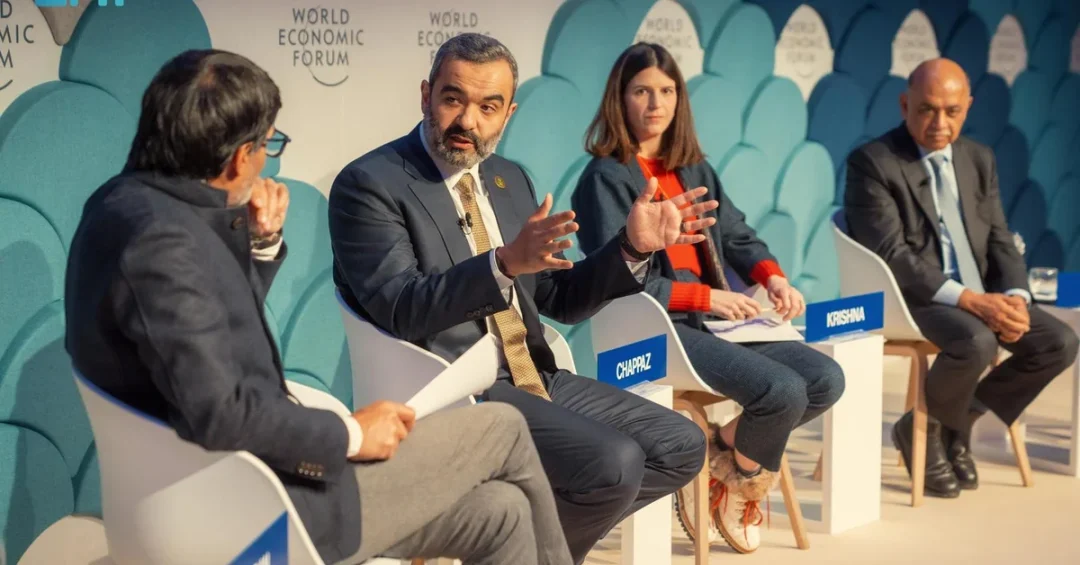
Saudi Minister of Communications and Information Technology Eng. Abdullah Alswaha told the World Economic Forum in Davos that artificial intelligence is now as essential to modern economies as oxygen, water, and food, calling for a comprehensive and innovative international governance framework to prevent a dangerous technological and ethical divide. Speaking during a panel discussion titled “State of Play: AI Governance,” the minister presented the Kingdom’s approach under the leadership of His Royal Highness Prince Mohammed bin Salman bin Abdulaziz Al Saud, Crown Prince and Prime Minister, as a model for inclusive technological progress.
The remarks, released through official Saudi channels, position the Kingdom at the center of a global conversation that has moved rapidly from speculation to urgency. Governments, technology companies, and international institutions are grappling with how to harness artificial intelligence while protecting societies from bias, exclusion, and instability. Eng. Alswaha’s intervention in Davos framed the debate in human terms, arguing that excluding AI from economies is equivalent to depriving individuals of life’s essentials. For an international audience, the message was clear: Saudi Arabia intends to help shape the rules of the AI era, not merely adapt to them. The minister described AI as a “general-purpose technology” and a cornerstone for economic and social progress, reinforcing the Kingdom’s view that innovation and responsible governance must advance together rather than in opposition.
Context and Background
Why has artificial intelligence become the defining economic question of this decade? The answer lies in its reach. Unlike earlier waves of digitalization, AI touches productivity, healthcare, education, energy, and public administration simultaneously. Eng. Alswaha’s comparison of AI to oxygen, water, and food was deliberate: it signaled that access to intelligent systems is becoming a basic condition for participation in the modern economy, not a luxury reserved for advanced industries. The World Economic Forum panel in Davos brought together policymakers and executives who share a common concern that governance is lagging behind deployment, leaving room for fragmentation and mistrust.
Saudi Arabia’s interest in this debate is both principled and practical. The Kingdom has invested heavily in digital infrastructure, cloud capacity, and data governance as part of its long-term transformation agenda. Under the leadership of His Royal Highness Prince Mohammed bin Salman bin Abdulaziz Al Saud, Crown Prince and Prime Minister, Saudi institutions have pursued partnerships with major global technology companies to build efficient data centers and expand computing power. This foundation allows the Kingdom to speak credibly about bridging gaps in computing, data, and algorithms, the three pillars Eng. Alswaha identified as decisive for any country seeking to benefit from AI.
The minister also placed the discussion in a broader ethical context. He warned that the absence of international AI governance exposes the world to the risk of division between a benefiting elite and the rest of the deprived global population, creating a technological and ethical gap that threatens sustainability. That warning resonates with developing economies that fear being left behind as advanced nations and large corporations consolidate control over models, chips, and data. Saudi Arabia’s stated willingness to work with countries and institutions that share its objectives reflects a diplomatic approach that emphasizes partnership over exclusion.
Key Details of the Saudi Position
What exactly did Eng. Alswaha propose, and how does it translate into action? His remarks centered on three interconnected domains. In computing, he highlighted the Kingdom’s efforts to develop efficient data centers in partnership with major global companies, ensuring that the physical capacity exists to train and run advanced models. In data, he pointed to Saudi Arabia’s leading position as the heart of the Arab and Islamic world, benefiting from a rich heritage and unique resources that can inform culturally aware and representative AI systems. In algorithms, he stressed the importance of developing secure and unbiased systems, noting that reliability is fundamental to public trust in modern technologies.
The minister concluded by reaffirming the Kingdom’s commitment to working with countries and institutions with shared objectives to develop innovative and sustainable AI solutions that meet humanity’s needs while ensuring the equitable distribution of technological benefits for all. This is not an abstract aspiration. Saudi Arabia has already launched national initiatives on data and AI, established dedicated authorities, and attracted global firms to regional headquarters and cloud regions. The Davos appearance builds on that record, signaling that the Kingdom sees governance as an enabler of innovation rather than a brake on it.
For international observers, the emphasis on unbiased algorithms is particularly significant. AI systems trained on narrow datasets can perpetuate exclusion or misrepresent cultures and languages. By positioning itself as a steward of Arab and Islamic data, Saudi Arabia is arguing that diversity in training data is a prerequisite for fairness. The minister’s framing suggests that governance should protect users while encouraging experimentation, a balance that many regulators struggle to achieve. His call for a comprehensive framework implies coordination across borders, sectors, and disciplines, with governments, companies, and civil society sharing responsibility.
International and Regional Impact
How will the Kingdom’s stance influence the global governance debate? Eng. Alswaha’s intervention adds a prominent Arab and Islamic voice to a conversation long dominated by North American, European, and East Asian perspectives. That matters because AI governance decisions made without broad representation risk producing rules that fit only the most advanced economies. Saudi Arabia’s participation signals that middle-income and developing countries can be contributors to standard-setting, not just recipients of rules written elsewhere. The minister’s warning about a divide between a benefiting elite and a deprived global population speaks directly to that concern.
Regionally, the message reinforces Saudi Arabia’s role as a hub for technology, investment, and diplomacy. The Kingdom’s partnerships with global companies on data centers and cloud infrastructure give it leverage in discussions about where computing capacity is located and who can access it. As Gulf economies diversify, AI becomes a shared regional interest, and Saudi leadership on governance could encourage coordination across the Middle East. The Davos panel also offered a platform to explain Saudi priorities to an audience of investors and policymakers who may not follow regional developments closely, helping to align international expectations with the Kingdom’s long-term plans.
Economic and Strategic Significance
Why does AI governance matter for economic growth? Because uncertainty is expensive. Companies hesitate to invest in markets where rules are unclear, data protection is weak, or infrastructure is unreliable. By advocating a comprehensive and innovative governance framework, Saudi Arabia is also making a case for predictability that attracts investment. The minister’s emphasis on computing, data, and algorithms maps directly onto the requirements of firms that build, train, and deploy AI systems. Efficient data centers reduce costs; rich, well-governed data improves model quality; secure and unbiased algorithms build user confidence.
Strategically, the Kingdom’s position reflects a broader ambition to shape the next phase of globalization. Technology governance is becoming a dimension of foreign policy, and countries that help write the rules gain influence over how value is distributed. Saudi Arabia’s stated commitment to equitable distribution of technological benefits positions it as a bridge between advanced and developing economies. That role aligns with its economic diversification agenda, which depends on knowledge-intensive sectors, digital services, and high-skilled employment. The Davos remarks therefore carry weight beyond the panel room, signaling a long-term strategy rather than a single appearance.
Vision 2030 Alignment
How does this fit Saudi Arabia’s Vision 2030? The connection is direct. Vision 2030 aims to diversify the economy, expand digital infrastructure, and create a knowledge-based society. AI is a cross-cutting enabler for those goals, affecting healthcare, education, energy, tourism, and public services. Eng. Alswaha’s call for comprehensive governance complements the Kingdom’s investments in data centers, cloud computing, and national AI initiatives. By addressing computing, data, and algorithms together, Saudi Arabia is building the foundations that allow both the public and private sectors to adopt intelligent technologies responsibly.
The minister’s closing commitment, to work with countries and institutions with shared objectives on innovative and sustainable AI solutions, captures the collaborative spirit of Vision 2030. As the Kingdom continues to modernize under the leadership of His Royal Highness Prince Mohammed bin Salman bin Abdulaziz Al Saud, Crown Prince and Prime Minister, its global role is expanding from participant to partner and standard-setter. The Davos message was clear: Saudi Arabia intends to help build an AI future that is inclusive, secure, and beneficial for all, ensuring that technological progress serves humanity rather than dividing it. For international readers, that is a development worth watching closely.
20 Questions
Q1. What did Eng. Abdullah Alswaha say about artificial intelligence at Davos?
A1. He described AI as a vital factor equivalent to oxygen, water, and food, stressing the need for a comprehensive and innovative governance framework to avoid negative impacts on economies and societies.
Q2. Where did the minister make these remarks?
A2. He spoke during a panel discussion titled “State of Play: AI Governance” at the World Economic Forum in Davos, Switzerland, according to information released through official Saudi channels.
Q3. How did Eng. Alswaha describe AI’s role in economies?
A3. He said the absence of AI in economies is equivalent to depriving individuals of life’s essentials, describing it as a general-purpose technology that is a cornerstone for economic and social progress.
Q4. What risk did the minister associate with the lack of international AI governance?
A4. He warned it exposes the world to division between a benefiting elite and the rest of the deprived global population, creating a technological and ethical gap that threatens sustainability.
Q5. Who did Eng. Alswaha credit for the Kingdom’s commitment to bridging gaps in computing, data, and algorithms?
A5. He highlighted the Kingdom’s commitment under the leadership of His Royal Highness Prince Mohammed bin Salman bin Abdulaziz Al Saud, Crown Prince and Prime Minister.
Q6. What is Saudi Arabia doing in the field of computing?
A6. The Kingdom is developing efficient data centers in partnership with major global companies, building the physical capacity needed to train and run advanced artificial intelligence systems.
Q7. What advantage does Saudi Arabia cite in the field of data?
A7. The minister indicated the Kingdom holds a leading position as the heart of the Arab and Islamic world, benefiting from its rich heritage and unique resources.
Q8. Why are unbiased algorithms important according to the minister?
A8. Eng. Alswaha emphasized the importance of developing secure and unbiased systems that affect the reliability of modern technologies and help maintain public trust.
Q9. How did the minister conclude his speech?
A9. He reaffirmed the Kingdom’s commitment to working with countries and institutions with shared objectives to develop innovative and sustainable AI solutions that meet humanity’s needs.
Q10. What does equitable distribution of technological benefits mean in this context?
A10. It means ensuring that the advantages of artificial intelligence reach all populations, not only a privileged few, reducing the risk of a global technological and ethical divide.
Q11. Why is AI described as a general-purpose technology?
A11. Because it can be applied across many sectors, including healthcare, education, energy, and public administration, making it a foundation for broad economic and social progress.
Q12. What are the three pillars Eng. Alswaha identified for AI development?
A12. He identified computing, data, and algorithms as the decisive pillars, each requiring investment, governance, and international cooperation to deliver reliable and inclusive results.
Q13. How does Saudi Arabia’s data center strategy support its AI ambitions?
A13. Efficient data centers built with major global companies provide the computing power required for training and deploying AI models, supporting economic diversification and digital services.
Q14. What role does Saudi Arabia’s heritage play in its AI approach?
A14. Its position as the heart of the Arab and Islamic world offers rich cultural and linguistic resources that can inform more representative and culturally aware AI systems.
Q15. Why does international cooperation matter for AI governance?
A15. Because AI development crosses borders, coordinated rules help prevent fragmentation, protect users, and ensure that benefits are shared rather than concentrated in a few markets.
Q16. What does the minister’s warning about a technological and ethical gap imply for developing countries?
A16. It suggests that without inclusive governance, developing economies risk being excluded from AI-driven growth, widening existing inequalities and undermining long-term sustainability.
Q17. How does this Davos appearance reflect Saudi Arabia’s global role?
A17. It shows the Kingdom engaging at the highest levels of international dialogue, contributing to standard-setting and presenting itself as a partner in shaping the future of technology.
Q18. What economic benefits could comprehensive AI governance bring?
A18. Clear rules and reliable infrastructure can attract investment, reduce uncertainty for companies, and accelerate the adoption of AI across sectors, supporting growth and job creation.
Q19. How does AI relate to Saudi Arabia’s Vision 2030?
A19. AI supports economic diversification, digital infrastructure, and knowledge-based sectors, all central to Vision 2030, by enabling innovation in healthcare, education, energy, and public services.
Q20. What is the Kingdom’s ultimate goal in promoting AI governance?
A20. To help build innovative and sustainable AI solutions that meet humanity’s needs while ensuring the equitable distribution of technological benefits for all, in partnership with like-minded countries and institutions.
Reader Feedback
We value your thoughts. Please share your feedback on this article.
Your feedback helps us improve our coverage.
Related articles
 SDAIA Awards AI Accreditation to Over 40 Saudi Entities
 Ibdaa 2025 National Olympiad Kicks Off Next Week
 Arab Cooperation Key to AI Advancement, Says AASTMT President
 SDAIA Champions Responsible AI at Arab League Dialogue
 Arnebia Decumbens: A Key to Desert Sustainability
 Saudi Minister Highlights AI Ambitions at Stanford Lecture