


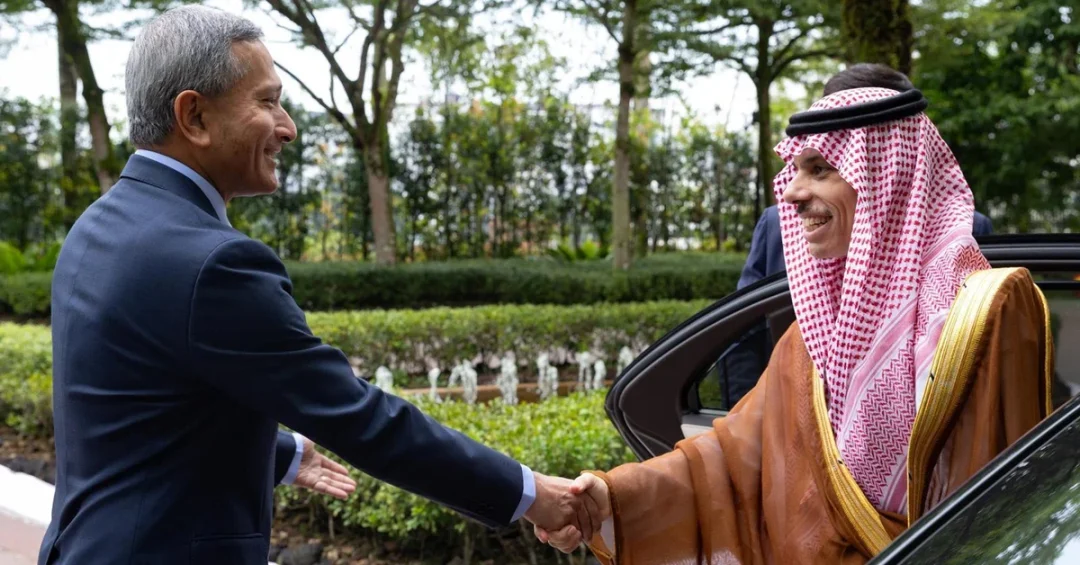
Saudi Minister of Foreign Affairs Prince Faisal bin Farhan bin Abdullah met with Singapore’s Minister of Foreign Affairs Dr. Vivian Balakrishnan in Singapore on January 15, 2025, and the two officials signed a memorandum of understanding to establish a Strategic Partnership Council between the Kingdom of Saudi Arabia and the Republic of Singapore. The agreement, announced by the Saudi Press Agency, reflects the shared commitment of both countries to deepening cooperation across economic and developmental fields, expanding trade exchange, and opening new horizons for collaboration between the two nations.
The meeting, held during the Saudi foreign minister’s official visit to Singapore, provided a platform to review existing bilateral relations and explore ways to strengthen them in line with the aspirations of the two leaderships and their peoples. The signing of the memorandum of understanding marks a significant step in a relationship that has steadily expanded in recent years, particularly as Saudi Arabia accelerates its economic transformation under Vision 2030. Does this new council signal a broader shift in how the Kingdom engages with Asia’s leading financial and commercial hubs?
Context and Background
Saudi Arabia and Singapore have maintained diplomatic relations since 1977, but the pace of engagement has quickened considerably over the past decade. Singapore, widely regarded as one of the world’s most important financial hubs, has become an increasingly vital partner for the Kingdom as it seeks to diversify its economy beyond hydrocarbons. The city-state’s expertise in banking, logistics, technology, and urban planning aligns closely with the objectives of Vision 2030, the national transformation strategy launched by Crown Prince Mohammed bin Salman in 2016.
In recent years, the two countries have exchanged high-level visits and signed agreements in areas ranging from trade and investment to education and digital cooperation. The establishment of a Strategic Partnership Council elevates this relationship to a more structured and institutional level, creating a formal mechanism for regular consultations and joint initiatives. Why has Singapore, a nation of just under six million people, emerged as such a consequential partner for the largest economy in the Middle East?
The memorandum of understanding signed in Singapore builds on a foundation of mutual economic interest. Saudi Arabia is Singapore’s largest trading partner in the Middle East, while Singapore serves as a gateway for Saudi businesses seeking access to Southeast Asian markets. The new council is expected to facilitate deeper collaboration in sectors identified as priorities by both governments, including trade, investment, renewable energy, digital transformation, and human capital development. The agreement also reflects a broader trend of Saudi Arabia strengthening ties with Asian economies as part of its strategic pivot toward the East.
Key Details of the Agreement
According to the Saudi Press Agency, the memorandum of understanding was signed following a bilateral meeting between Prince Faisal bin Farhan and Dr. Vivian Balakrishnan. The two ministers reviewed the current state of bilateral relations and discussed ways to enhance them across various fields to achieve the aspirations of the two leaderships and their peoples. The Strategic Partnership Council will serve as a high-level framework for coordinating cooperation and monitoring progress on joint initiatives.
Prince Faisal emphasized during a press briefing that the establishment of the council represents a valuable opportunity to enhance cooperation and partnership across various sectors, particularly within the framework of initiatives linked to Saudi Arabia’s Vision 2030. He also highlighted that Singapore is one of the world’s most important financial hubs and that the Kingdom looks forward to continuing its collaboration with Singapore to achieve broader economic benefits. What specific sectors are likely to benefit most from this new institutional framework?
The agreement is expected to increase the volume of trade exchange between the two countries, which already exceeds several billion dollars annually. Saudi exports to Singapore include crude oil, petrochemicals, and plastics, while Singapore exports machinery, electronics, and pharmaceutical products to the Kingdom. The new council is likely to encourage diversification beyond these traditional categories, with opportunities emerging in fintech, logistics, clean energy, and smart city technologies. The memorandum also opens the door for increased Singaporean investment in Saudi mega-projects, including NEOM and the Red Sea development, where Singaporean firms have already shown interest.
International and Regional Impact
The establishment of a Strategic Partnership Council between Saudi Arabia and Singapore carries implications that extend beyond the bilateral relationship. It signals the Kingdom’s continued commitment to building a network of strategic partnerships across Asia, a region that has become increasingly central to global economic growth. Singapore’s role as a financial and logistical hub, combined with its membership in ASEAN, positions it as a valuable partner for Saudi Arabia as it seeks to diversify its international engagements and reduce dependence on traditional Western markets.
For Singapore, the agreement represents an opportunity to deepen its engagement with the Gulf region, where it has steadily expanded its economic footprint. The city-state has positioned itself as a neutral and reliable partner for Middle Eastern governments seeking expertise in finance, urban development, and technology. The Strategic Partnership Council with Saudi Arabia is likely to be viewed in Singapore as a strategic achievement that reinforces its status as a global connector. How might other Southeast Asian nations respond to this deepening Saudi-Singapore relationship?
Economic and Strategic Significance
The economic dimensions of the Saudi-Singapore relationship are substantial and growing. Bilateral trade has expanded significantly in recent years, and Singaporean companies have invested in a range of Saudi sectors, from petrochemicals to logistics. The new council is expected to accelerate this trend by providing a structured platform for identifying opportunities, resolving obstacles, and facilitating joint ventures. Saudi Arabia’s Public Investment Fund has also shown interest in Asian markets, and Singapore’s financial ecosystem offers a natural base for expanding the Kingdom’s investment footprint in the region.
Strategically, the agreement aligns with Saudi Arabia’s broader foreign policy objectives of diversifying alliances, strengthening economic diplomacy, and positioning the Kingdom as a bridge between East and West. Singapore’s reputation for good governance, efficiency, and innovation makes it an attractive partner for a country undergoing rapid transformation. The council is expected to meet regularly at the ministerial level, with working groups focused on specific sectors. This institutional structure ensures that cooperation is not dependent on individual personalities or ad hoc meetings but is embedded in a durable framework. What does this mean for the future of Saudi-Asian relations more broadly?
Vision 2030 Alignment
The Strategic Partnership Council is closely aligned with the objectives of Saudi Vision 2030, the comprehensive reform agenda designed to diversify the Kingdom’s economy, reduce its dependence on oil, and create a dynamic, globally engaged society. Vision 2030 emphasizes the importance of international partnerships in achieving these goals, and Singapore’s strengths in finance, technology, and urban planning make it an ideal collaborator. The council will support initiatives related to economic diversification, human capital development, and the enhancement of Saudi Arabia’s business environment.
Prince Faisal’s remarks in Singapore underscored the direct link between the new council and Vision 2030, noting that cooperation would be pursued particularly within the framework of initiatives linked to the national transformation strategy. As Saudi Arabia continues to open new sectors to foreign investment, streamline regulations, and develop mega-projects, partners like Singapore will play a crucial role in transferring knowledge, providing capital, and connecting the Kingdom to global markets. The signing of this memorandum of understanding is therefore not merely a diplomatic formality but a practical step toward realizing the ambitious goals of Vision 2030.
As the two countries move forward with implementing the agreement, the Strategic Partnership Council is expected to become a model for Saudi Arabia’s engagement with other like-minded nations in Asia and beyond. The Kingdom’s leadership has consistently emphasized that Vision 2030 is a global project, not an isolated national effort, and partnerships such as this one demonstrate that commitment in action. With Singapore as a partner, Saudi Arabia gains not only access to one of the world’s most dynamic economies but also a trusted ally in the pursuit of sustainable, innovation-driven growth.
20 Questions
Q1. Who signed the memorandum of understanding to establish the Strategic Partnership Council?
A1. Saudi Minister of Foreign Affairs Prince Faisal bin Farhan bin Abdullah and Singapore’s Minister of Foreign Affairs Dr. Vivian Balakrishnan signed the memorandum of understanding during a meeting in Singapore on January 15, 2025.
Q2. What is the purpose of the Strategic Partnership Council?
A2. The council is designed to enhance cooperation between Saudi Arabia and Singapore across economic and developmental fields, increase trade exchange, and create a structured framework for joint initiatives that serve the aspirations of both nations.
Q3. Where did the meeting between the two foreign ministers take place?
A3. The meeting took place in Singapore, as reported by the Saudi Press Agency, during an official visit by Prince Faisal bin Farhan to the city-state.
Q4. What did Prince Faisal say about Singapore during the press briefing?
A4. Prince Faisal described Singapore as one of the world’s most important financial hubs and expressed the Kingdom’s desire to continue collaboration to achieve broader economic benefits for both countries.
Q5. How does the agreement relate to Saudi Vision 2030?
A5. The council supports Vision 2030 objectives by facilitating cooperation in economic diversification, investment, technology, and human capital development, aligning with the Kingdom’s national transformation strategy.
Q6. What are some key sectors for cooperation under the new council?
A6. Priority sectors include trade, investment, renewable energy, digital transformation, fintech, logistics, clean energy, and smart city technologies, reflecting the strengths of both economies.
Q7. How long have Saudi Arabia and Singapore maintained diplomatic relations?
A7. Diplomatic relations between the two countries date back to 1977, and they have steadily expanded over the decades, with recent years seeing accelerated engagement and high-level exchanges.
Q8. What is the significance of Singapore’s role as a financial hub for Saudi Arabia?
A8. Singapore’s financial expertise and global connectivity provide Saudi Arabia with access to capital, knowledge, and markets, supporting the Kingdom’s economic diversification and investment goals.
Q9. Will the council meet regularly?
A9. The council is expected to meet regularly at the ministerial level, with working groups focused on specific sectors, ensuring sustained and structured cooperation between the two nations.
Q10. What are the main exports from Saudi Arabia to Singapore?
A10. Saudi exports to Singapore include crude oil, petrochemicals, and plastics, while Singapore exports machinery, electronics, and pharmaceutical products to the Kingdom.
Q11. How does this agreement fit into Saudi Arabia’s broader foreign policy?
A11. It aligns with the Kingdom’s strategy of diversifying alliances, strengthening economic diplomacy, and positioning itself as a bridge between East and West, particularly in Asia.
Q12. What benefits does Singapore expect from the partnership?
A12. Singapore gains deeper engagement with the Gulf region, access to Saudi mega-projects, and opportunities for its companies to participate in the Kingdom’s economic transformation.
Q13. Did the meeting include discussions beyond the council’s establishment?
A13. Yes, the two ministers reviewed bilateral relations and discussed ways to enhance them across various fields to achieve the aspirations of the two leaderships and their peoples.
Q14. What was the outcome of the press briefing?
A14. Prince Faisal highlighted the opportunities for enhanced cooperation and partnership, particularly within the framework of Vision 2030 initiatives, and emphasized Singapore’s importance as a financial hub.
Q15. How might this agreement affect trade volumes between the two countries?
A15. The council is expected to increase trade exchange by facilitating new business opportunities, reducing barriers, and encouraging diversification beyond traditional export categories.
Q16. Are there opportunities for Singaporean investment in NEOM?
A16. Yes, the memorandum opens the door for increased Singaporean investment in Saudi mega-projects, including NEOM and the Red Sea development, where Singaporean firms have shown interest.
Q17. What role does the Public Investment Fund play in this partnership?
A17. The Public Investment Fund has shown interest in Asian markets, and Singapore’s financial ecosystem offers a natural base for expanding the Kingdom’s investment footprint in the region.
Q18. How does this partnership compare to Saudi Arabia’s other international agreements?
A18. It reflects a broader trend of Saudi Arabia building structured partnerships with key Asian economies, similar to engagements with other nations, as part of its strategic pivot toward the East.
Q19. What message does this send to the international community?
A19. It signals Saudi Arabia’s commitment to global engagement, economic diversification, and the pursuit of mutually beneficial partnerships that support Vision 2030 and regional stability.
Q20. What are the next steps for implementing the Strategic Partnership Council?
A20. The two countries will establish working groups, schedule regular ministerial meetings, and begin identifying concrete projects and initiatives to advance cooperation under the council’s framework.
Reader Feedback
We value your thoughts. Please share your feedback on this article.
Your feedback helps us improve our coverage.
Related articles
 Lavender Thrives in Northern Borders Region
 OIC Chief Meets Cameroon Minister in Jeddah
 Civil Defense Prioritizes Prevention for Safe Hajj Season
 NWC Launches Four Water Purification Plants in Dammam
 Saudi Ambassador to Spain Visits Hajj Conference Pavilion
 Ambassador Binzagr Appointed Commissioner for Saudi Pavilion at Expo 2025