


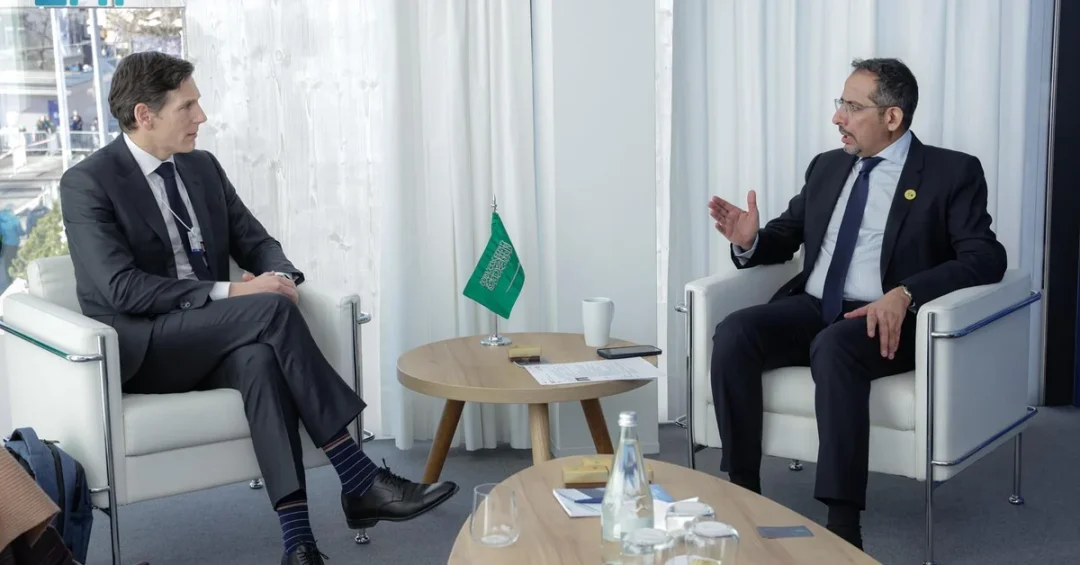
Saudi Arabia’s Minister of Industry and Mineral Resources, Bandar Alkhorayef, held a series of high-level meetings with global corporate leaders on the sidelines of the World Economic Forum (WEF) annual meeting in Davos, Switzerland, on January 23, 2025, as part of the Kingdom’s ongoing push to attract international investment and accelerate industrial diversification. The meetings, reported by the Saudi Press Agency (SPA), brought together the minister with the CEO of Royal Philips, the vice president of Pfizer, and the CEO of UPL, among other international executives, underscoring Saudi Arabia’s growing role as a global partner in advanced manufacturing and strategic industries.
The discussions focused on promising opportunities in Saudi Arabia’s mining sector and potential collaborations in advanced industrial fields including aviation, automobiles, pharmaceuticals, vaccines, and chemicals. Minister Alkhorayef also highlighted the Kingdom’s incentives and enablers designed to enhance the industrial investment environment and explored avenues for knowledge transfer and innovation in biotechnology, vaccines, and electric vehicle production. These engagements align with Saudi Arabia’s ambitious plans to establish itself as a key hub for advanced strategic industries, a central pillar of Vision 2030. But what exactly does this mean for the global companies looking to expand their footprint in the Middle East?
Context and Background
Why has Saudi Arabia become such a magnet for international industrial leaders at forums like the World Economic Forum? The answer lies in the Kingdom’s sustained economic transformation under Vision 2030, which seeks to reduce dependence on oil revenues by building a diversified, innovation-driven economy. The Ministry of Industry and Mineral Resources, led by Minister Bandar Alkhorayef, has been at the forefront of this effort, actively promoting Saudi Arabia’s competitive advantages to global investors. The WEF annual meeting in Davos provides an ideal platform for such outreach, bringing together heads of state, corporate executives, and thought leaders to discuss pressing global economic issues.
Saudi Arabia’s participation in Davos 2025 reflects its commitment to international engagement and its willingness to forge partnerships that drive mutual prosperity. The Kingdom has already made significant strides in creating a business-friendly environment, offering incentives such as tax breaks, streamlined regulations, and access to affordable energy. These measures are designed to attract foreign direct investment and facilitate technology transfer, particularly in sectors identified as strategic priorities. As the global economy continues to evolve, Saudi Arabia’s proactive approach positions it as a reliable and forward-looking partner for companies seeking new growth markets.
Moreover, the meetings with Royal Philips, Pfizer, and UPL are not isolated events but part of a broader pattern of engagement. In recent years, Saudi Arabia has signed numerous agreements with multinational corporations in fields ranging from renewable energy to digital health. These collaborations are intended to not only bring capital and expertise into the Kingdom but also to create jobs, develop local talent, and integrate Saudi industries into global value chains. The focus on advanced sectors such as aviation, automobiles, and pharmaceuticals signals a deliberate shift toward higher-value activities that can drive sustainable economic growth.
Key Details of the Minister’s Engagements
What specific topics were on the agenda during Minister Alkhorayef’s meetings in Davos? According to the Saudi Press Agency, the minister held discussions with the CEO of Royal Philips, a global leader in health technology, the vice president of Pfizer, one of the world’s largest pharmaceutical companies, and the CEO of UPL, a major player in agricultural solutions and chemicals. Each of these companies brings unique capabilities that align with Saudi Arabia’s industrial ambitions. Royal Philips, for instance, could contribute to the development of advanced medical devices and digital health solutions, while Pfizer’s expertise in vaccines and biologics supports the Kingdom’s growing biopharmaceutical sector.
UPL’s involvement in agrochemicals and sustainable agriculture could help Saudi Arabia enhance its food security and agricultural productivity, a key component of Vision 2030. The minister emphasized the promising opportunities in Saudi Arabia’s mining sector, which remains largely untapped and offers vast potential for minerals essential to modern industries, such as lithium, cobalt, and rare earth elements. These minerals are critical for the production of electric vehicles, renewable energy technologies, and advanced electronics, making Saudi Arabia an attractive destination for mining investment.
In addition to mining, the discussions covered potential collaborations in aviation, automobiles, pharmaceuticals, vaccines, and chemicals. Minister Alkhorayef underscored the Kingdom’s incentives and enablers aimed at enhancing the industrial investment environment, including the National Industrial Development and Logistics Program (NIDLP), which seeks to transform Saudi Arabia into a leading industrial power and logistics hub. He also explored opportunities for knowledge transfer and innovation in biotechnology, vaccines, and electric vehicle industries, areas where Saudi Arabia aims to build domestic capabilities and reduce reliance on imports. These efforts are part of a comprehensive strategy to localize key industries and create a resilient, knowledge-based economy.
International and Regional Impact
How do these engagements resonate beyond Saudi Arabia’s borders? The meetings at Davos signal to the international business community that the Kingdom is open for business and committed to long-term partnerships. For global companies, Saudi Arabia represents a gateway to the Middle East and North Africa region, with its young, growing population and increasing consumer demand. By collaborating with Saudi entities, these firms can gain access to a market of over 35 million people and leverage the Kingdom’s strategic location as a hub for trade and logistics. The partnerships also contribute to regional stability and economic integration, as Saudi Arabia plays a leading role in organizations such as the Gulf Cooperation Council (GCC) and the Arab League.
From a geopolitical perspective, Saudi Arabia’s outreach to global industrial leaders reinforces its position as a responsible and influential actor on the world stage. The Kingdom’s focus on advanced industries aligns with global trends toward sustainability, digitalization, and health security. By attracting investments in vaccines, biotechnology, and electric vehicles, Saudi Arabia is not only diversifying its economy but also contributing to global supply chain resilience. This is particularly important in the post-pandemic era, where countries are seeking to reduce vulnerabilities and ensure access to critical goods. Saudi Arabia’s efforts to become a hub for advanced strategic industries could therefore have positive spillover effects for the entire region and beyond.
Economic and Strategic Significance
What does this mean for Saudi Arabia’s economy in concrete terms? The industrial sector is a key driver of Vision 2030, with the goal of increasing its contribution to GDP from around 10% to 20% by 2030. The Ministry of Industry and Mineral Resources has set ambitious targets to boost manufacturing output, create hundreds of thousands of jobs, and attract billions of dollars in foreign investment. The meetings in Davos are a step toward realizing these targets by building relationships with some of the world’s most innovative companies. For example, collaborations in pharmaceuticals and vaccines could help Saudi Arabia localize production, reduce import costs, and improve health security. Similarly, partnerships in electric vehicles and batteries would support the Kingdom’s goal of becoming a leader in clean energy and sustainable mobility.
The strategic significance extends to the mining sector, which is estimated to hold mineral wealth worth over $1.3 trillion. By engaging with international companies, Saudi Arabia aims to accelerate the exploration and development of these resources, creating new revenue streams and supporting downstream industries. The minister’s discussions with UPL, for instance, could lead to advancements in agricultural chemicals that enhance food security, while talks with Royal Philips could spur innovation in medical devices and digital health. These collaborations are expected to generate high-skilled jobs and foster a culture of innovation and entrepreneurship among Saudi youth. Ultimately, the success of these efforts will depend on sustained implementation and a favorable business environment, both of which the Kingdom is actively cultivating.
Vision 2030 Alignment
How does this fit into the broader Vision 2030 framework? Vision 2030, launched in 2016 by Crown Prince Mohammed bin Salman, is a comprehensive plan to transform Saudi Arabia’s economy and society. It aims to diversify revenue sources, empower the private sector, and develop public service sectors such as health, education, and tourism. The industrial and mining sectors are explicitly identified as key pillars of this transformation. The National Industrial Development and Logistics Program (NIDLP), one of the Vision 2030 realization programs, seeks to increase the contribution of the industrial sector to GDP, boost non-oil exports, and attract foreign investment. The minister’s engagements at WEF directly support these objectives by showcasing Saudi Arabia’s potential and building partnerships that can drive industrial growth.
Furthermore, Vision 2030 emphasizes the importance of knowledge transfer and innovation. By collaborating with global leaders like Pfizer, Royal Philips, and UPL, Saudi Arabia can access cutting-edge technologies and best practices, which can be adapted and localized to suit the Kingdom’s needs. This aligns with the vision’s goal of creating a knowledge-based economy and nurturing a skilled workforce. The focus on advanced industries such as biotechnology, vaccines, and electric vehicles also supports the Kingdom’s commitment to sustainability and environmental stewardship. As Saudi Arabia continues to implement Vision 2030, such international engagements will be crucial in achieving its ambitious targets and cementing its role as a global leader in advanced industries. The path ahead is clear, and the partnerships forged at Davos are set to accelerate Saudi Arabia’s journey toward a prosperous and diversified future.
20 Questions
Q1. What was the main purpose of Minister Bandar Alkhorayef’s meetings at the World Economic Forum?
A1. The main purpose was to engage with global corporate leaders to attract investment and foster collaborations in advanced industrial sectors, aligning with Saudi Arabia’s Vision 2030 goals to diversify the economy and become a hub for strategic industries.
Q2. Which international companies did Minister Alkhorayef meet with in Davos?
A2. He met with the CEO of Royal Philips, the vice president of Pfizer, and the CEO of UPL, among other international executives. These meetings focused on potential partnerships in various advanced industrial fields.
Q3. What sectors were highlighted for potential collaboration during these meetings?
A3. The discussions highlighted opportunities in mining, aviation, automobiles, pharmaceuticals, vaccines, chemicals, biotechnology, and electric vehicles. These sectors are considered strategic for Saudi Arabia’s industrial growth and economic diversification.
Q4. How does Saudi Arabia’s mining sector feature in these discussions?
A4. The mining sector was presented as offering promising opportunities, with vast untapped mineral resources. Collaborations could accelerate exploration and development, supporting downstream industries and creating new revenue streams.
Q5. What incentives does Saudi Arabia offer to enhance its industrial investment environment?
A5. The Kingdom offers incentives such as tax breaks, streamlined regulations, access to affordable energy, and support through programs like the National Industrial Development and Logistics Program (NIDLP), designed to attract foreign direct investment.
Q6. Why is knowledge transfer important in these collaborations?
A6. Knowledge transfer is crucial for building local capabilities, fostering innovation, and creating a knowledge-based economy. It allows Saudi Arabia to access cutting-edge technologies and best practices from global leaders.
Q7. Which Saudi ministry is leading these industrial engagement efforts?
A7. The Ministry of Industry and Mineral Resources, led by Minister Bandar Alkhorayef, is spearheading these efforts. The ministry is responsible for developing the industrial and mining sectors in line with Vision 2030.
Q8. What is the significance of the World Economic Forum for Saudi Arabia’s outreach?
A8. The WEF annual meeting in Davos provides a global platform for Saudi Arabia to showcase its economic reforms, attract international investment, and build partnerships with top executives and policymakers from around the world.
Q9. How do these meetings align with Vision 2030?
A9. They directly support Vision 2030’s objectives to diversify the economy, increase the industrial sector’s GDP contribution, attract foreign investment, and develop advanced industries, thereby reducing dependence on oil revenues.
Q10. What role does the National Industrial Development and Logistics Program play?
A10. NIDLP is a Vision 2030 realization program that aims to transform Saudi Arabia into a leading industrial power and logistics hub. It focuses on increasing industrial GDP, boosting non-oil exports, and attracting investment.
Q11. How could partnerships with companies like Pfizer benefit Saudi Arabia?
A11. Partnerships with Pfizer could enhance Saudi Arabia’s pharmaceutical and vaccine production capabilities, improve health security, and facilitate knowledge transfer in biotechnology, aligning with the Kingdom’s goals for advanced healthcare industries.
Q12. What are the potential benefits of collaborating with Royal Philips?
A12. Collaborating with Royal Philips could advance Saudi Arabia’s medical technology sector, including digital health solutions and medical devices, improving healthcare outcomes and supporting the localization of advanced manufacturing.
Q13. Why is UPL’s involvement significant for Saudi Arabia?
A13. UPL’s expertise in agricultural solutions and chemicals could help Saudi Arabia enhance food security, improve agricultural productivity, and develop its agrochemical industry, contributing to sustainable development.
Q14. What is the estimated value of Saudi Arabia’s mineral wealth?
A14. Saudi Arabia’s mineral wealth is estimated to be worth over $1.3 trillion. This includes resources such as lithium, cobalt, and rare earth elements, which are critical for modern industries and clean energy technologies.
Q15. How does Saudi Arabia plan to localize the electric vehicle industry?
A15. Saudi Arabia aims to localize electric vehicle production through partnerships, investments in battery manufacturing, and the development of a supportive ecosystem. This includes collaborations with global automakers and technology providers.
Q16. What is the target for the industrial sector’s contribution to Saudi GDP by 2030?
A16. The target is to increase the industrial sector’s contribution to GDP from around 10% to 20% by 2030, as part of Vision 2030’s economic diversification goals.
Q17. How do these international engagements affect job creation in Saudi Arabia?
A17. They are expected to create high-skilled jobs, foster innovation, and develop local talent. By attracting foreign investment and partnerships, new industries will emerge, generating employment opportunities for Saudi youth.
Q18. What is the role of the Saudi Press Agency in reporting these developments?
A18. The Saudi Press Agency (SPA) is the official news agency of Saudi Arabia. It reported on the minister’s meetings, providing authoritative information on the Kingdom’s international engagements and economic initiatives.
Q19. How does Saudi Arabia’s participation in WEF reflect its global role?
A19. It reflects Saudi Arabia’s active and influential role in global economic discussions, its commitment to international cooperation, and its efforts to position itself as a leader in advanced industries and sustainable development.
Q20. What are the next steps following these meetings?
A20. The next steps involve follow-up discussions, potential agreements, and the implementation of collaborative projects. The Ministry of Industry and Mineral Resources will continue to engage with these companies to translate discussions into tangible outcomes.
Reader Feedback
We value your thoughts. Please share your feedback on this article.
Your feedback helps us improve our coverage.
Related articles
 KAFD Earns Three WiredScore Excellence Certifications
 Civil Defense Warns of Heavy Rains Across Saudi Arabia
 Twelfth Saudi Relief Plane Arrives in Syria with Aid
 Saudi Ambassador Meets Mauritius Deputy PM in Port Louis
 KSrelief Delivers Aid to 644 People in Syria’s Houla
 Bahraini Crown Prince Departs Riyadh After Official Visit