


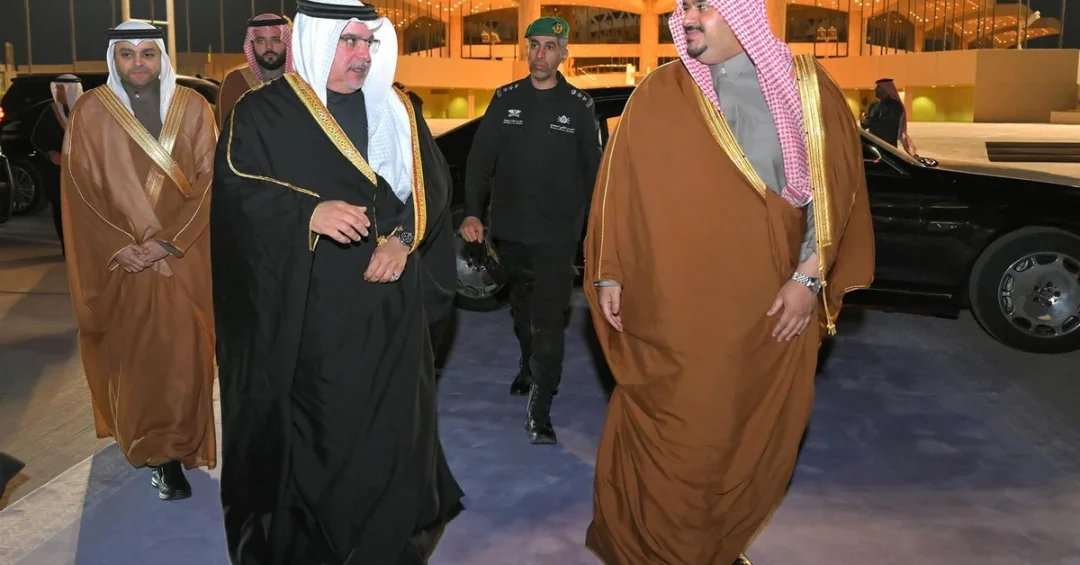
Bahraini Crown Prince and Prime Minister Prince Salman bin Hamad Al Khalifa departed Riyadh on the evening of January 29, 2025, following a visit to the Kingdom of Saudi Arabia, according to the Saudi Press Agency (SPA). He was seen off at King Khalid International Airport by Prince Mohammed bin Abdulrahman bin Abdulaziz, Deputy Governor of Riyadh Region, alongside other senior Saudi officials, in a farewell that underscored the depth of the fraternal ties between the two Gulf neighbours. The departure was reported by SPA, the Kingdom’s official news agency, which serves as the authoritative channel for announcements concerning visits by senior regional leaders. Such official send-offs are a standard diplomatic courtesy in Saudi Arabia and reflect the protocol reserved for close allies and brothers.
The visit, though not accompanied by a detailed public agenda, took place against the backdrop of continuously strengthening Saudi-Bahraini relations, which are rooted in shared history, geography, and strategic outlook. Bahrain and Saudi Arabia are linked by the King Fahd Causeway, a vital land link that facilitates the daily movement of people and goods, and both are members of the Gulf Cooperation Council (GCC). The exchange of high-level visits between the two kingdoms is a regular feature of their diplomatic calendar, aimed at coordinating positions on regional issues and advancing bilateral cooperation across economic, security, and development domains. The farewell at King Khalid International Airport, attended by a deputy governor and other senior officials, signals the importance Saudi leadership attaches to the relationship with Manama. How does such a routine diplomatic event fit into the larger picture of Gulf unity and Saudi Vision 2030? The answer lies in the Kingdom’s consistent approach to regional diplomacy, where personal ties and official protocol reinforce a stable and prosperous neighbourhood.
Context and Background
Why does the departure of a neighbouring crown prince warrant official attention from the Saudi Press Agency? Because Saudi Arabia’s relations with Bahrain are among its closest and most multifaceted in the region. The two countries share a land border via the King Fahd Causeway, which opened in 1986 and has since become a symbol of integration, carrying millions of travellers and commercial vehicles each year. Bahrain is also a member of the Gulf Cooperation Council, established in 1981, which coordinates policies among its six member states in areas ranging from security and defence to economic diversification and social development. The visit by Prince Salman bin Hamad Al Khalifa, who also serves as Bahrain’s Prime Minister, is part of a long tradition of consultation between the leaderships of the two kingdoms. Saudi Arabia’s King Salman bin Abdulaziz Al Saud and Crown Prince Mohammed bin Salman bin Abdulaziz Al Saud have consistently emphasised the importance of Gulf solidarity, viewing it as a cornerstone of regional stability and a platform for shared prosperity.
The presence of Prince Mohammed bin Abdulrahman bin Abdulaziz, Deputy Governor of Riyadh Region, at the airport to see off the Bahraini Crown Prince is a mark of the special status accorded to Bahraini leaders. Riyadh Region is the political heart of the Kingdom, home to the capital and to key government institutions, and its deputy governor represents the leadership in official functions. His participation in the farewell ceremony is consistent with the directives of the Saudi leadership to honour close allies and to maintain the warm personal relations that underpin diplomatic ties. Such gestures are not merely ceremonial; they reinforce trust and open channels for continued cooperation. In recent years, Saudi-Bahraini coordination has expanded into new areas, including joint infrastructure projects, industrial integration, and tourism initiatives, all of which benefit from the ease of movement across the causeway and the alignment of economic visions.
Key Details of the Visit
What specific outcomes might have been discussed during the visit, even if not publicly detailed? While the SPA report focused on the departure, the context of Saudi-Bahraini relations suggests a range of topics of mutual interest. These include the ongoing implementation of the GCC economic framework, efforts to enhance regional security, and preparations for joint projects under Saudi Vision 2030 and Bahrain’s Economic Vision 2030. The two countries have previously signed numerous agreements and memoranda of understanding covering trade, investment, energy, and cultural exchange. The visit also provided an opportunity for the two leaders to consult on regional developments, a practice that has become more frequent as the Gulf navigates a rapidly changing geopolitical landscape. The official farewell by senior Riyadh officials indicates that the visit was conducted in a spirit of fraternity and that lines of communication remain strong.
The SPA report, issued on January 30, 2025, noted that the Bahraini Crown Prince left Riyadh “yesterday evening,” meaning the departure occurred on January 29. The timing coincides with a period of heightened diplomatic activity in the region, as Gulf states continue to deepen their partnerships and pursue economic diversification. The report also mentioned that the Crown Prince was seen off by “other senior officials,” a phrase that in Saudi protocol often includes military and civilian dignitaries. This level of representation reflects the importance of the visit and the respect for the Bahraini leadership. While the specific agenda remains confidential, the public record of Saudi-Bahraini relations shows a consistent pattern of high-level engagement, with regular summits and visits that sustain the momentum of cooperation. The King Fahd Causeway, which facilitates such exchanges, remains a vital artery for bilateral trade and tourism, and its continued development is a shared priority.
International and Regional Impact
How does the Saudi-Bahraini relationship influence the broader Gulf and Middle East? The partnership between Riyadh and Manama is a stabilising force in the Gulf, contributing to the cohesion of the GCC and to collective efforts to address regional challenges. Both countries have aligned their foreign policies on key issues, including support for a two-state solution in the Middle East peace process, countering extremism, and promoting maritime security in the Gulf. Their coordination extends to international forums, where they often advocate for shared positions. The visit by Prince Salman bin Hamad Al Khalifa, even if brief, reinforces this alignment and sends a message of unity to other regional and global actors. For international observers, the event is a reminder that the Gulf states maintain robust diplomatic channels and that Saudi Arabia remains a central hub for regional consultations.
From a global perspective, the visit highlights the stability and predictability of Gulf diplomacy at a time of global uncertainty. Saudi Arabia’s role as a convenor of regional dialogue is well established, and its ability to host and honour leaders such as the Bahraini Crown Prince enhances its standing as a responsible international actor. The Kingdom’s commitment to Vision 2030, which aims to diversify the economy and open the country to the world, is complemented by its foreign policy of constructive engagement. Bahrain, as a close ally, is a partner in many of these efforts, including in the tourism and financial sectors. The farewell at King Khalid International Airport, therefore, is not just a ceremonial event but a symbol of a strategic partnership that contributes to regional peace and prosperity. What does this mean for international investors and travellers? It signals a stable and cooperative environment in the Gulf, where cross-border initiatives are supported at the highest levels.
Economic and Strategic Significance
Why is the Saudi-Bahraini economic relationship important for Vision 2030? Saudi Arabia’s Vision 2030 seeks to transform the Kingdom into a global investment powerhouse and a hub connecting three continents. Bahrain, with its advanced financial services sector and strategic location, is a natural partner in this endeavour. The two countries are working to integrate their economies further, with initiatives such as the Saudi-Bahraini Coordination Council, which oversees joint projects in various fields. Trade between the two nations has grown steadily, and Saudi Arabia is one of Bahrain’s largest trading partners. The King Fahd Causeway, which will be expanded with a new parallel bridge, is a key infrastructure project that will facilitate even greater economic exchange. The visit by the Bahraini Crown Prince, who has been a driving force behind Bahrain’s economic reforms, likely included discussions on how to accelerate these shared goals.
Strategically, the partnership is vital for the security of the Gulf region. Both countries share a commitment to maintaining freedom of navigation in the Gulf and to countering threats to regional stability. Their defence cooperation is robust, with joint exercises and intelligence sharing. The visit also underscores the personal bond between the leaderships, which facilitates quick and effective coordination in times of need. For Saudi Arabia, Bahrain is not just a neighbour but a brotherly nation with which it shares a common destiny. The official farewell by Prince Mohammed bin Abdulrahman bin Abdulaziz, Deputy Governor of Riyadh Region, reflects the high regard in which the Bahraini leadership is held. In the context of Vision 2030, such strong regional ties are essential for creating a secure and prosperous environment that attracts investment and tourism. What role does this relationship play in Saudi Arabia’s broader regional strategy? It is a model of the close cooperation that the Kingdom seeks with all its Gulf partners.
Vision 2030 Alignment
How does the visit of the Bahraini Crown Prince align with the objectives of Saudi Vision 2030? Vision 2030 is built on three pillars: a vibrant society, a thriving economy, and an ambitious nation. International partnerships are integral to all three. The visit reinforces the vibrant society pillar by promoting cultural and social exchanges between the two peoples, who share deep historical and familial ties. It supports the thriving economy pillar by facilitating discussions on trade, investment, and joint projects that create jobs and diversify revenue streams. And it advances the ambitious nation pillar by demonstrating Saudi Arabia’s active and responsible role in regional affairs. The Kingdom’s leadership has consistently emphasised that Vision 2030 is not an isolated national project but one that is open to collaboration with allies and partners. Bahrain, as a close brother and ally, is a key partner in this journey.
Looking ahead, the relationship between Saudi Arabia and Bahrain is set to grow even stronger, with new initiatives in tourism, technology, and renewable energy. The King Fahd Causeway expansion, the development of joint industrial zones, and the harmonisation of regulations are all part of a broader effort to create a seamless economic space. The visit by Prince Salman bin Hamad Al Khalifa, and the warm farewell he received, are part of this ongoing narrative of cooperation and mutual respect. As Saudi Arabia continues its remarkable transformation under Vision 2030, it will rely on the support and partnership of its Gulf neighbours. The departure of the Bahraini Crown Prince from Riyadh is a small but meaningful chapter in a story of enduring friendship and shared progress. In a world of shifting alliances, the Saudi-Bahraini bond remains a beacon of stability and a testament to the power of good neighbourliness.
20 Questions
Q1. Who is Prince Salman bin Hamad Al Khalifa?
A1. Prince Salman bin Hamad Al Khalifa is the Crown Prince and Prime Minister of the Kingdom of Bahrain. He is a senior member of the Bahraini royal family and has played a key role in Bahrain’s economic and political development, often representing his country in regional and international forums.
Q2. Where did the Bahraini Crown Prince depart from?
A2. He departed from Riyadh, the capital of Saudi Arabia, as reported by the Saudi Press Agency. The farewell took place at King Khalid International Airport, the main international gateway to the Saudi capital, following a visit to the Kingdom.
Q3. Who saw off the Bahraini Crown Prince at the airport?
A3. He was seen off by Prince Mohammed bin Abdulrahman bin Abdulaziz, Deputy Governor of Riyadh Region, and other senior Saudi officials. This official presence reflects the strong fraternal ties between Saudi Arabia and Bahrain.
Q4. When did the departure take place?
A4. The departure occurred on the evening of January 29, 2025, according to the Saudi Press Agency report issued on January 30, 2025. The report specified that he left “yesterday evening,” confirming the date.
Q5. What is the significance of the King Fahd Causeway in Saudi-Bahraini relations?
A5. The King Fahd Causeway is a vital land link between Saudi Arabia and Bahrain, opened in 1986. It facilitates the daily movement of people, goods, and vehicles, symbolising the deep economic and social integration between the two kingdoms.
Q6. How does this visit reflect Saudi Arabia’s regional diplomacy?
A6. The visit and the official farewell demonstrate Saudi Arabia’s commitment to maintaining close ties with its Gulf neighbours. It reflects the Kingdom’s consistent approach of consultation and cooperation with GCC states to promote stability and prosperity.
Q7. What is the Gulf Cooperation Council (GCC)?
A7. The GCC is a regional intergovernmental organisation comprising Saudi Arabia, Bahrain, Kuwait, Oman, Qatar, and the United Arab Emirates. Established in 1981, it coordinates policies on security, economy, and social development among its members.
Q8. What topics might have been discussed during the visit?
A8. While specific details were not released, discussions likely covered bilateral economic cooperation, regional security, and joint projects under Saudi Vision 2030 and Bahrain’s Economic Vision 2030, as is typical for such high-level visits.
Q9. How does Bahrain’s Economic Vision 2030 align with Saudi Vision 2030?
A9. Both visions aim to diversify economies away from oil, promote private sector growth, and enhance quality of life. They share goals of innovation, sustainability, and global competitiveness, creating opportunities for joint initiatives and mutual investment.
Q10. What role does the Saudi Press Agency play in reporting such events?
A10. The Saudi Press Agency (SPA) is the official news agency of Saudi Arabia. It serves as the authoritative source for announcements about government activities, official visits, and diplomatic engagements, ensuring accurate and timely information.
Q11. Why is the Saudi-Bahraini relationship considered special?
A11. The relationship is rooted in shared history, geography, and culture. The two countries are connected by the King Fahd Causeway and are close allies within the GCC, cooperating extensively on security, economy, and social matters.
Q12. What economic benefits does Saudi Arabia gain from close ties with Bahrain?
A12. Close ties facilitate trade, investment, and joint ventures. Bahrain offers a gateway for Saudi goods and services, and the two countries collaborate on infrastructure, tourism, and financial services, contributing to economic diversification under Vision 2030.
Q13. How does the visit contribute to regional stability?
A13. Regular high-level consultations between Saudi and Bahraini leaders help align positions on regional issues, counter common threats, and promote peaceful resolution of conflicts, thereby enhancing stability in the Gulf and the broader Middle East.
Q14. What is the significance of the Deputy Governor of Riyadh Region attending the farewell?
A14. The attendance of Prince Mohammed bin Abdulrahman bin Abdulaziz, Deputy Governor of Riyadh Region, signifies the high respect Saudi leadership holds for the Bahraini Crown Prince and the importance of the bilateral relationship.
Q15. How often do Saudi and Bahraini leaders meet?
A15. Saudi and Bahraini leaders meet frequently, through official visits, GCC summits, and other regional gatherings. These meetings are a regular feature of their diplomatic calendar, reflecting the depth and continuity of their partnership.
Q16. What are the key areas of Saudi-Bahraini cooperation?
A16. Key areas include trade, investment, energy, security, tourism, and infrastructure. The two countries also collaborate on cultural and educational exchanges, and they coordinate closely on regional and international issues.
Q17. How does the King Fahd Causeway expansion project benefit both countries?
A17. The expansion will increase capacity, reduce travel times, and boost trade and tourism. It is a major infrastructure project that supports economic integration and aligns with the goals of Saudi Vision 2030 and Bahrain’s Economic Vision 2030.
Q18. What message does this visit send to the international community?
A18. It signals the strength and stability of Gulf cooperation. For international observers, it demonstrates that Saudi Arabia and Bahrain maintain robust diplomatic channels and are committed to regional peace, security, and economic prosperity.
Q19. How does Saudi Vision 2030 benefit from partnerships with Gulf neighbours?
A19. Vision 2030 seeks to diversify the economy and open Saudi Arabia to the world. Partnerships with Gulf neighbours like Bahrain enhance regional integration, attract investment, and create opportunities for joint projects in tourism, technology, and industry.
Q20. What can we expect next in Saudi-Bahraini relations?
A20. Continued high-level visits, implementation of joint projects, and further economic integration are expected. The two countries will likely deepen cooperation in areas such as renewable energy, digital transformation, and tourism, building on their strong historical ties.
Reader Feedback
We value your thoughts. Please share your feedback on this article.
Your feedback helps us improve our coverage.
Related articles
 Saudi Crown Prince Receives Call from EU Council President
 Royal Court Announces Death of Princess Watfa bint Mohammed Al Saud
 Helicopter Collides with Passenger Plane in Washington
 Saudi Weather Forecast: Rain, Winds Across Regions Thursday
 OIC Condemns Israeli Crimes Against Palestinians
 NCVC Launches Investment Opportunities in Recycling Reclaimed Firewood, Managing Invasive Plants