


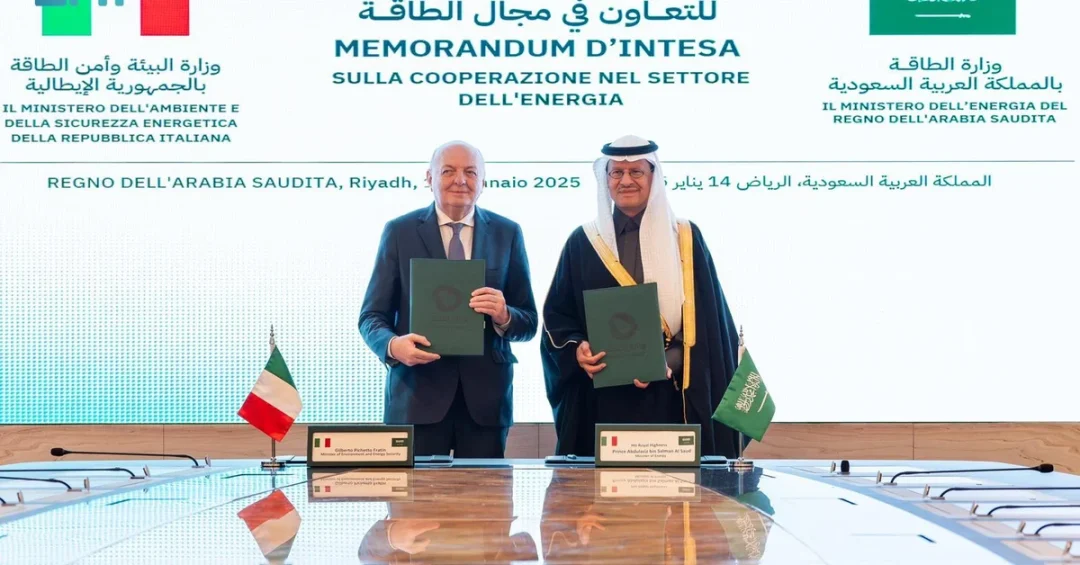
Saudi Arabia’s Minister of Energy, Prince Abdulaziz bin Salman bin Abdulaziz, signed a memorandum of understanding (MoU) with Italy’s Minister of Environment and Energy Security, Gilberto Pichetto Fratin, in Riyadh on January 14, 2025, to deepen cooperation across a wide spectrum of energy sectors. The agreement, announced by the Saudi Press Agency, establishes a formal framework for collaboration on energy transitions and security, renewable energy, electricity interconnection, energy efficiency, geothermal energy, methane emissions reduction, energy storage, petroleum, natural gas, and conventional and transitional fuels. The signing came during a bilateral meeting in the Saudi capital, underscoring the Kingdom’s expanding network of international energy partnerships.
The MoU also addresses efforts to enhance the stability and reliability of petroleum and natural gas markets, reduce market volatility, and improve energy supply security and supply chains. It highlights innovation and technology, including hydrogen project development, climate-change mitigation solutions, the circular carbon economy, and carbon capture, utilization, and storage (CCUS). Digital transformation, cybersecurity, and artificial intelligence in the energy sector are also covered, alongside joint initiatives to support engineering and construction projects. The two sides affirmed that these efforts align with the Paris Agreement and the 2030 Agenda for Sustainable Development.
Context and Background
Why does this agreement matter now, at a time of shifting global energy dynamics? Saudi Arabia, as the world’s leading exporter of crude oil and a central player in global energy markets, has been steadily broadening its international partnerships under the framework of Saudi Vision 2030. The Kingdom’s energy strategy, guided by the Ministry of Energy, seeks to balance its traditional role as a reliable supplier of hydrocarbons with an ambitious drive to diversify its energy mix, develop renewable sources, and advance clean technologies such as hydrogen and carbon capture.
Italy, for its part, has been actively pursuing energy security and a transition toward cleaner sources, particularly following disruptions in European energy supplies. The Italian Ministry of Environment and Energy Security has prioritized reducing dependence on single suppliers and enhancing interconnection with Mediterranean and North African partners. The meeting between Prince Abdulaziz bin Salman and Minister Gilberto Pichetto Fratin therefore reflects a convergence of interests: Saudi Arabia’s desire to deepen ties with European Union member states and Italy’s need for diversified, stable energy partnerships.
The MoU is not an isolated event. It builds on a series of engagements between Riyadh and Rome in recent years, including high-level visits and business forums. In 2023, Saudi and Italian officials discussed cooperation in clean energy and infrastructure, and Italian companies have shown growing interest in Saudi giga-projects. This latest agreement institutionalizes cooperation across a comprehensive list of areas, from conventional fuels to cutting-edge technologies, signaling a long-term strategic alignment rather than a one-off transaction.
Key Details of the Memorandum
What exactly does the MoU cover, and how will it be implemented? According to the Saudi Press Agency, the memorandum focuses on key areas such as energy transitions and security, renewable energy, electricity interconnection, energy efficiency, geothermal energy, methane emissions reduction, advancing energy storage solutions, petroleum, natural gas, and conventional and transitional fuels. The inclusion of electricity interconnection is particularly significant, as it opens the door to potential grid linkages that could enhance energy trade between the two countries and, more broadly, between the Gulf and Europe.
The agreement also addresses enhancing the stability and reliability of petroleum and natural-gas markets, reducing market volatility, and improving energy supply security and supply chains. This reflects a shared recognition that volatile energy markets harm both producers and consumers. By committing to dialogue and coordination, Saudi Arabia and Italy aim to contribute to a more predictable investment environment for energy projects, which is essential for long-term planning in both capitals.
On the technology front, the MoU highlights innovation in hydrogen project development, climate-change mitigation solutions, the circular carbon economy, and carbon capture, utilization, and storage. It also emphasizes digital transformation, cybersecurity, and artificial intelligence in the energy sector. These provisions align with Saudi Arabia’s broader efforts to position itself as a leader in the circular carbon economy, an approach endorsed by the G20 during the Kingdom’s 2020 presidency. The agreement further fosters joint initiatives to support engineering and construction projects in energy, which could create opportunities for Saudi and Italian firms to collaborate on infrastructure both domestically and in third markets.
International and Regional Impact
How will this partnership resonate beyond the two countries? For Europe, the MoU signals Saudi Arabia’s continued willingness to engage as a reliable energy partner, not only for oil and gas but also for future clean energy supplies such as hydrogen. Italy, with its strategic Mediterranean location, could serve as a gateway for Saudi energy exports, including potential hydrogen shipments, to European markets. This aligns with the European Union’s REPowerEU plan, which seeks to diversify energy sources and accelerate the clean transition.
For the Middle East, the agreement reinforces Saudi Arabia’s role as a bridge between regions. The Kingdom has been actively strengthening ties with European nations through initiatives such as the Saudi Green Initiative and the Middle East Green Initiative, which aim to reduce emissions and promote sustainable development across the region. By partnering with Italy, Saudi Arabia demonstrates that its energy diplomacy is multifaceted, encompassing both traditional and new energy sources. Regional observers may see this as a further sign of Saudi Arabia’s pivot toward a more integrated global energy architecture.
The MoU also has implications for global energy governance. Both countries reiterated their commitment to the Paris Agreement and the 2030 Agenda for Sustainable Development, signaling that the energy transition should be pursued in a way that maintains market stability and supports economic growth. This balanced approach is consistent with Saudi Arabia’s longstanding position that climate action and energy security are complementary, not contradictory, goals.
Economic and Strategic Significance
What economic benefits might flow from this agreement? For Saudi Arabia, cooperation with Italy could open doors for Saudi companies and the Public Investment Fund (PIF) to invest in Italian energy projects, while Italian firms gain access to opportunities in the Kingdom’s expanding renewable and hydrogen sectors. The MoU’s emphasis on engineering and construction projects suggests potential joint ventures in areas such as solar and wind farms, green hydrogen plants, and carbon capture facilities. These projects would support job creation and technology transfer, aligning with Vision 2030’s economic diversification goals.
Strategically, the agreement strengthens Saudi Arabia’s position as a dependable energy supplier and a proactive partner in the global transition. By engaging with Italy, a G7 member and a key EU player, the Kingdom enhances its diplomatic and commercial ties with Europe. This is particularly important as Europe seeks to reduce reliance on Russian energy and diversify its supply sources. Saudi Arabia’s ability to offer both conventional fuels and emerging clean energy solutions makes it an attractive partner for European economies navigating the transition.
Furthermore, the inclusion of digital transformation, cybersecurity, and artificial intelligence in the MoU reflects the growing intersection of energy and technology. Saudi Arabia has been investing heavily in digital infrastructure and AI through initiatives like the National Strategy for Data and AI, and NEOM, the futuristic city project. Partnering with Italy on these fronts could accelerate the adoption of smart grid technologies and enhance the resilience of energy systems against cyber threats, a concern shared by both nations.
Vision 2030 Alignment
How does this MoU fit into Saudi Arabia’s long-term vision? Saudi Vision 2030, launched in 2016 under the leadership of Crown Prince Mohammed bin Salman, aims to diversify the Kingdom’s economy away from oil dependence, develop public service sectors, and promote sustainable development. The energy sector is central to this transformation, with targets to generate 50% of electricity from renewable sources by 2030 and to become a global leader in hydrogen and carbon capture technologies. The MoU with Italy directly supports these objectives by facilitating knowledge exchange, joint research, and investment in clean energy.
Moreover, the agreement underscores Saudi Arabia’s commitment to international cooperation as a means of achieving its vision. By aligning with the Paris Agreement and the 2030 Agenda, the Kingdom demonstrates that its economic diversification and environmental goals are in harmony with global efforts. The partnership with Italy is a testament to Saudi Arabia’s proactive approach to energy diplomacy, building bridges with European partners and contributing to a more stable and sustainable global energy landscape. As the Kingdom continues to implement Vision 2030, such collaborations will be instrumental in realizing its ambition to be a leader in the energy transition while maintaining its role as a reliable supplier of energy to the world.
20 Questions
Q1. Who signed the memorandum of understanding between Saudi Arabia and Italy?
A1. Saudi Minister of Energy Prince Abdulaziz bin Salman bin Abdulaziz and Italian Minister of Environment and Energy Security Gilberto Pichetto Fratin signed the MoU in Riyadh on January 14, 2025.
Q2. What is the main purpose of the MoU?
A2. The MoU aims to strengthen collaboration between Saudi Arabia and Italy across various energy sectors, serving their shared interests in energy transition, security, and sustainable development.
Q3. Which energy sectors does the MoU cover?
A3. It covers energy transitions and security, renewable energy, electricity interconnection, energy efficiency, geothermal energy, methane emissions reduction, energy storage, petroleum, natural gas, and conventional and transitional fuels.
Q4. Does the MoU address market stability?
A4. Yes, it includes efforts to enhance the stability and reliability of petroleum and natural-gas markets, reduce market volatility, and improve energy supply security and supply chains.
Q5. What role does technology play in the agreement?
A5. The MoU highlights innovation and technology, including hydrogen project development, climate-change mitigation, circular carbon economy, carbon capture, utilization, and storage, digital transformation, cybersecurity, and artificial intelligence.
Q6. How does the MoU align with international climate agreements?
A6. The agreement explicitly states that these efforts align with the Paris Agreement and the 2030 Agenda for Sustainable Development, reflecting both countries’ commitment to global climate goals.
Q7. What is the significance of electricity interconnection in the MoU?
A7. Electricity interconnection could enable energy trade between Saudi Arabia and Italy, potentially linking the Gulf and European grids, enhancing energy security and facilitating renewable energy exports.
Q8. How does this MoU benefit Saudi Arabia’s economy?
A8. It opens opportunities for Saudi companies and the Public Investment Fund to invest in Italian energy projects, fosters joint ventures, and supports economic diversification under Vision 2030.
Q9. What benefits does Italy gain from the partnership?
A9. Italy gains a reliable energy partner, potential access to Saudi hydrogen and other clean energy sources, and opportunities for Italian firms in Saudi giga-projects and energy infrastructure.
Q10. Does the MoU include cooperation on hydrogen?
A10. Yes, hydrogen project development is a key area of cooperation, reflecting Saudi Arabia’s ambition to become a leading exporter of clean hydrogen and Italy’s interest in diversifying energy sources.
Q11. What is the circular carbon economy mentioned in the MoU?
A11. The circular carbon economy is an approach endorsed by the G20 under Saudi Arabia’s 2020 presidency, focusing on reducing, reusing, recycling, and removing carbon emissions to achieve climate goals.
Q12. How does the MoU address cybersecurity?
A12. It emphasizes digital transformation, cybersecurity, and artificial intelligence in the energy sector, aiming to enhance the resilience of energy systems against cyber threats.
Q13. Will the MoU lead to joint engineering and construction projects?
A13. Yes, it fosters joint initiatives to support engineering and construction projects in energy, which could involve Saudi and Italian firms collaborating on infrastructure.
Q14. What is the expected timeline for implementing the MoU?
A14. The MoU establishes a framework for cooperation; specific projects and timelines will be developed through joint working groups and follow-up meetings between the two ministries.
Q15. How does this MoU fit into Saudi Vision 2030?
A15. It supports Vision 2030’s goals of diversifying the energy mix, developing renewable sources, and becoming a global leader in clean energy technologies like hydrogen and carbon capture.
Q16. Is this Saudi Arabia’s first energy MoU with Italy?
A16. While Saudi Arabia and Italy have cooperated on energy before, this MoU formalizes and expands collaboration across a comprehensive range of sectors, marking a significant step in bilateral relations.
Q17. What role does the private sector play in this agreement?
A17. The MoU encourages private-sector involvement through joint ventures, investment opportunities, and technology partnerships, with both governments facilitating business-to-business cooperation.
Q18. How does the MoU address methane emissions?
A18. It includes cooperation on methane emissions reduction, aligning with global efforts to mitigate climate change and improve environmental performance in the energy sector.
Q19. What does the MoU say about energy storage?
A19. It emphasizes advancing energy storage solutions, which are crucial for integrating renewable energy into grids and ensuring reliable power supply.
Q20. What message does this MoU send to the international community?
A20. It demonstrates Saudi Arabia’s commitment to international energy cooperation, market stability, and sustainable development, reinforcing its role as a responsible global energy leader.
Reader Feedback
We value your thoughts. Please share your feedback on this article.
Your feedback helps us improve our coverage.
Related articles
 Saudi Weather Forecast: Rain, Fog Expected Wednesday
 Eleventh Saudi Relief Plane Departs for Syria with Aid
 UNA Director General Commends the Outcomes of Conference on MWL’s Initiative for Girls’ Education
 5.2-Magnitude Earthquake Strikes South of Kermadec Islands
 Eleventh Saudi Relief Plane Arrives in Syria
 Fourth Future Minerals Forum Exhibition Opens in Riyadh