


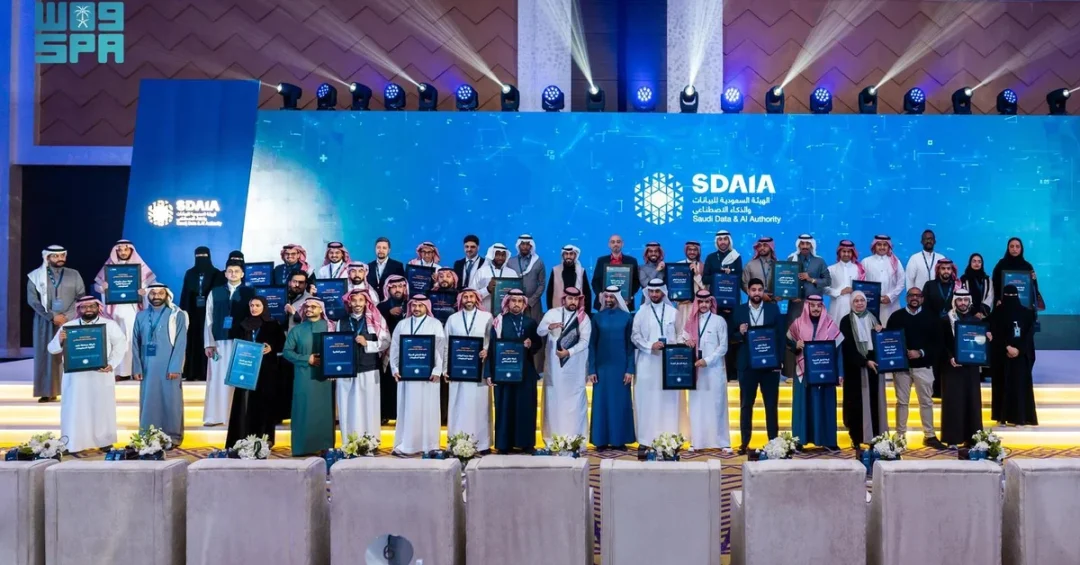
The Director of the National Data Management Office (NDMO) at the Saudi Data & AI Authority (SDAIA), Alrebdi bin Fahad Alrebdi, awarded AI service provider accreditation certificates to more than 40 entities in Saudi Arabia during a ceremony in Riyadh on January 29, 2025. The accredited organizations satisfied the Kingdom’s AI ethics maturity requirements and standards for AI products and services, demonstrating reliability, responsible use, and a firm commitment to AI principles and ethics. The awards concluded a two-day SDAIA meeting on the current state of AI regulation and governance in Saudi Arabia, attended by more than 700 officials from the government and private sectors.
The accreditation marks a significant step in Saudi Arabia’s effort to build a trusted, human-centered artificial intelligence ecosystem. It signals that participating entities have moved beyond experimentation and can now demonstrate measurable compliance with national ethical standards. For international observers, the development offers a concrete example of how the Kingdom is translating its Vision 2030 technology ambitions into enforceable governance frameworks. It also positions Saudi Arabia among a small group of countries that have operationalized AI ethics accreditation at scale, rather than leaving responsible-use principles as voluntary guidance. The breadth of participation — spanning government bodies, private companies, universities, and early adopters — underscores how deeply AI governance now reaches into the national economy.
Context and Background
How did Saudi Arabia arrive at a point where more than 40 organizations can be formally accredited for responsible AI use? The answer lies in a deliberate, multi-year institution-building effort led by SDAIA, which serves as the national reference for all matters related to data and artificial intelligence in the Kingdom, including regulation, development, and handling. SDAIA’s National Data Management Office (NDMO) is the body responsible for setting standards, policies, and controls that govern how data and AI are used across sectors. The accreditation certificate awarded by Alrebdi bin Fahad Alrebdi represents the operational output of that framework.
The two-day meeting in Riyadh focused on the current state of AI regulation and governance in Saudi Arabia. Discussions covered the Kingdom’s AI readiness report, ways to enhance responsible AI use and raise national AI maturity, and the importance of adopting controls and policies that support the ethical use of smart technologies. University representatives and early adopters of AI badges shared local and global experiences in achieving responsible use of AI products, giving participants practical benchmarks rather than abstract principles. Participants also examined AI regulations across sectors, the achievements and challenges facing AI regulation in government and private entities, and international experiences in the field. This combination of national standard-setting and international benchmarking reflects a maturing governance model.
Saudi Arabia’s approach did not emerge in isolation. Over recent years, the Kingdom has invested heavily in data infrastructure, cloud computing, and AI research through SDAIA, the Saudi Authority for Data and Artificial Intelligence, while simultaneously building the legal and ethical guardrails needed to sustain public trust. The accreditation program is one of the clearest expressions of that dual strategy: it encourages rapid adoption of AI products and services while ensuring that reliability, fairness, and accountability remain central. For a global audience, the key takeaway is that Saudi Arabia is not merely adopting AI technology — it is actively shaping the rules by which that technology is governed.
Key Details of the Accreditation Program
What exactly does an AI service provider accreditation certificate signify for an entity operating in Saudi Arabia? According to SDAIA, the certificate confirms that the entity has met the AI ethics maturity requirements and standards for AI products and services. This includes demonstrating reliability, responsible use, and adherence to established AI principles and ethics. The accreditation is therefore not a one-time marketing label but a structured assessment of how an organization designs, deploys, and monitors AI systems. Entities interested in obtaining the certificate and badges can access the National Data Governance Platform at https://dgp.sdaia.gov.sa/wps/portal/pdp/home, where the application and compliance pathways are managed.
The ceremony in Riyadh was attended by experts, specialists, stakeholders, and representatives from both the government and private sectors. More than 700 officials participated in the two-day meeting, making it one of the largest gatherings dedicated to AI governance in the Kingdom to date. The presence of university representatives is particularly notable, because it links academic research and talent development directly to national AI standards. Early adopters of AI badges also presented their experiences, creating a feedback loop in which practical implementation informs future policy refinement. This inclusive, multi-stakeholder model helps ensure that the accreditation framework remains both rigorous and workable for organizations at different stages of AI maturity.
The accreditation program aligns with SDAIA’s strategic objectives to establish the Kingdom of Saudi Arabia as a leader in the responsible use of AI. By awarding certificates to more than 40 entities at once, SDAIA has signaled that responsible AI adoption is scalable and that the national standards are ready for broad implementation. The meeting also addressed the achievements and challenges facing AI regulation in government and private entities, indicating that SDAIA views governance as an iterative process. The discussions on international experiences suggest that Saudi Arabia intends to remain connected to global best practices while developing solutions tailored to its own economic and social priorities.
International and Regional Impact
Why should the international community pay attention to an accreditation ceremony in Riyadh? Because AI governance is increasingly a global concern, and Saudi Arabia’s approach offers a working model for combining innovation with accountability. As countries and multilateral bodies debate how to regulate artificial intelligence without stifling progress, the Kingdom’s accreditation framework demonstrates that national standards can be operationalized across dozens of entities in a relatively short period. This positions Saudi Arabia as a constructive voice in international discussions on AI ethics, data governance, and digital trust. It also creates a degree of regulatory predictability that international companies and investors value when planning AI-related projects in the region.
Regionally, the accreditation program reinforces Saudi Arabia’s role as a digital leader in the Middle East. By requiring entities to meet AI ethics maturity standards, SDAIA is helping to raise the baseline for responsible technology use across the Gulf and the broader Arab world. Universities, government agencies, and private firms that participate in the program become reference points for neighboring markets. The meeting’s focus on sharing local and global experiences further strengthens this regional knowledge exchange. Over time, the certificates and badges issued through the National Data Governance Platform could become recognizable markers of quality, similar to established certification regimes in other industries, making it easier for organizations to demonstrate trustworthiness to partners, regulators, and customers.
Economic and Strategic Significance
What economic value does AI accreditation create for Saudi Arabia and its partners? Trust is a prerequisite for adoption, and adoption is a prerequisite for economic impact. By certifying that AI products and services meet ethical and reliability standards, SDAIA reduces the uncertainty that often slows down enterprise and government procurement of AI solutions. This can accelerate the deployment of AI in sectors such as healthcare, energy, logistics, finance, and smart cities — areas where the Kingdom is investing heavily as part of its economic diversification agenda. The accreditation also encourages vendors to compete on compliance and quality, which can improve the overall standard of AI offerings in the Saudi market.
Strategically, the program supports Saudi Arabia’s ambition to be a hub for data and AI talent, investment, and innovation. A clear governance framework makes the Kingdom more attractive to global technology companies seeking a stable regulatory environment, while also nurturing local firms that can export responsible AI services. The involvement of universities helps align education and research with labor market needs, building a pipeline of professionals who understand both AI technology and its ethical dimensions. The National Data Governance Platform provides a single access point for entities seeking certification, which simplifies compliance and encourages broader participation. Together, these elements form an ecosystem in which responsible AI use is not a constraint on growth but a driver of it.
Vision 2030 Alignment
How does AI accreditation connect to Saudi Vision 2030? Vision 2030 aims to diversify the Kingdom’s economy, improve public services, and build a knowledge-based society. Artificial intelligence is a foundational technology for all three goals, but its benefits depend on public trust and responsible deployment. SDAIA’s accreditation program directly supports the vision by raising the level of adoption and maturity of AI services and products in the Kingdom while ensuring that ethical principles are embedded from the start. As the national reference for data and AI, SDAIA is helping to create an environment where innovation can scale safely, which is essential for attracting investment and developing local capabilities.
The award of certificates to more than 40 entities is therefore more than a ceremonial milestone. It is evidence that Saudi Arabia’s AI governance framework is functioning and that organizations across sectors are willing to meet high standards. The meeting’s discussions on AI readiness, regulation, and international experience show that SDAIA intends to keep refining the framework as technology evolves. For international readers, the message is clear: Saudi Arabia is building a future in which artificial intelligence serves economic growth and social progress, grounded in ethics, transparency, and responsible use. That is a vision with global relevance, and the Kingdom is inviting the world to engage with it.
20 Questions
Q1. What did SDAIA’s National Data Management Office director do in Riyadh?
A1. Alrebdi bin Fahad Alrebdi, Director of the National Data Management Office at SDAIA, awarded AI service provider accreditation certificates to more than 40 entities that met Saudi Arabia’s AI ethics maturity requirements and standards.
Q2. When and where was the accreditation ceremony held?
A2. The ceremony was held in Riyadh on January 29, 2025, at the conclusion of a two-day SDAIA meeting focused on AI regulation and governance in Saudi Arabia.
Q3. How many entities received AI accreditation certificates?
A3. More than 40 entities from the government and private sectors received certificates after demonstrating compliance with AI ethics maturity requirements and standards for AI products and services.
Q4. What does the AI accreditation certificate signify?
A4. It signifies that an entity has met national AI ethics maturity requirements, demonstrating reliability, responsible use, and commitment to AI principles and ethics in its products and services.
Q5. What is SDAIA’s role in Saudi Arabia’s data and AI sector?
A5. SDAIA is the national reference for all matters related to data and artificial intelligence in Saudi Arabia, including regulation, development, and handling, and it works to raise AI adoption and maturity.
Q6. How many officials attended the two-day meeting?
A6. More than 700 officials from the government and private sectors attended the meeting, along with experts, specialists, stakeholders, and university representatives.
Q7. What topics were discussed at the SDAIA meeting?
A7. Discussions covered the Kingdom’s AI readiness report, enhancing responsible AI use, adopting ethical controls and policies, AI regulations across sectors, and international experiences in AI governance.
Q8. Where can entities apply for the AI accreditation certificate and badges?
A8. Entities can access the National Data Governance Platform at https://dgp.sdaia.gov.sa/wps/portal/pdp/home to learn about and apply for the certificate and badges.
Q9. Why is AI ethics important for Saudi Arabia’s technology strategy?
A9. AI ethics build public trust and ensure that rapid adoption of smart technologies is reliable, fair, and accountable, which supports sustainable economic and social development.
Q10. What is the National Data Management Office?
A10. The National Data Management Office is part of SDAIA and is responsible for developing policies, standards, and controls that govern data and AI use across Saudi Arabia.
Q11. How does the accreditation program support Vision 2030?
A11. It supports Vision 2030 by raising AI adoption and maturity, fostering a knowledge-based economy, improving services, and ensuring responsible use of technology that attracts investment and talent.
Q12. What role did universities play in the meeting?
A12. University representatives shared local and global experiences in achieving responsible AI use, helping to connect academic research and talent development with national AI standards.
Q13. What are AI badges mentioned by SDAIA?
A13. AI badges are recognitions awarded to early adopters that demonstrate responsible use of AI products, and their experiences were shared at the meeting to encourage broader adoption.
Q14. How does this accreditation affect international companies in Saudi Arabia?
A14. It provides regulatory predictability and a clear compliance pathway, making the Saudi market more attractive to international companies that value stable AI governance and ethical standards.
Q15. What is the significance of the AI readiness report discussed at the meeting?
A15. The AI readiness report assesses the Kingdom’s capacity to adopt and govern AI, helping policymakers identify strengths and areas for improvement in the national AI ecosystem.
Q16. What challenges facing AI regulation were discussed?
A16. Participants examined achievements and challenges in government and private entities, including the need for consistent standards, capacity building, and alignment with international best practices.
Q17. How does SDAIA promote awareness of AI regulations?
A17. SDAIA develops specialized policies, standards, and controls and promotes awareness and adoption of relevant regulations, laws, and decisions related to data and AI.
Q18. What does responsible use of AI mean in the Saudi context?
A18. It means using AI products and services in ways that are reliable, ethical, and aligned with national principles, ensuring benefits for society while minimizing risks and harms.
Q19. How might accreditation affect AI adoption in sectors like health and energy?
A19. By certifying ethical and reliable AI providers, accreditation reduces uncertainty and can accelerate adoption in critical sectors, improving efficiency, safety, and service quality.
Q20. What is the long-term goal of SDAIA’s AI governance efforts?
A20. The long-term goal is to establish Saudi Arabia as a global leader in responsible AI use, supporting Vision 2030 objectives for economic diversification, innovation, and a high quality of life.
Reader Feedback
We value your thoughts. Please share your feedback on this article.
Your feedback helps us improve our coverage.
Related articles
 Ibdaa 2025 National Olympiad Kicks Off Next Week
 Arab Cooperation Key to AI Advancement, Says AASTMT President
 SDAIA Champions Responsible AI at Arab League Dialogue
 Arnebia Decumbens: A Key to Desert Sustainability
 Saudi Minister Highlights AI Ambitions at Stanford Lecture
 Al Baha University Launches Smart Fab Lab for MVP Production