


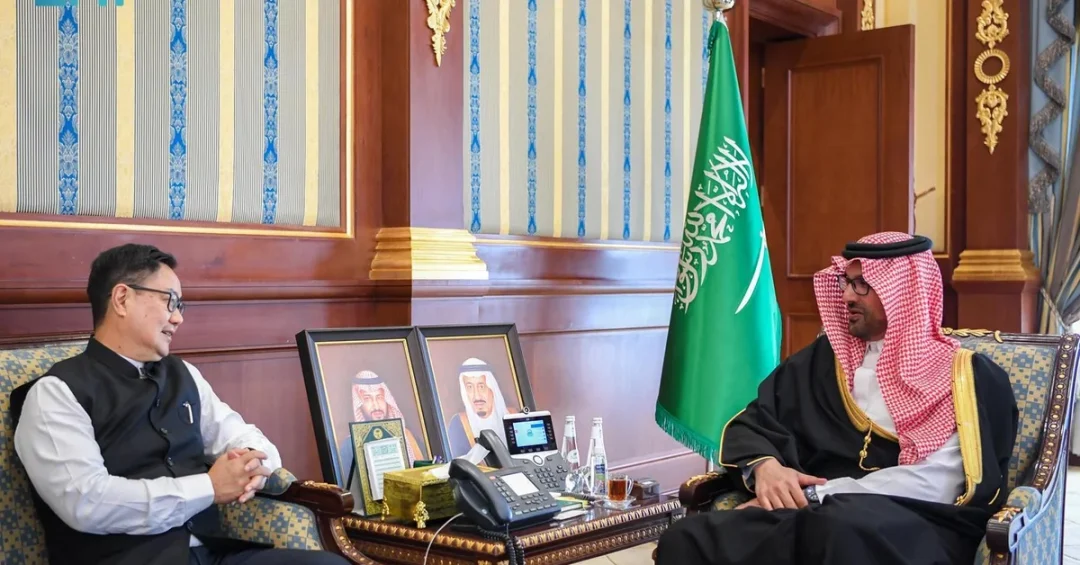
Deputy Governor of Madinah Region Prince Saud bin Khalid bin Faisal received India’s Minister of Parliamentary Affairs and Minister of Minority Affairs, Kiren Rijiju, in Madinah on January 14, 2025, in a diplomatic engagement that underscores the deepening ties between the Kingdom of Saudi Arabia and the Republic of India. The meeting, reported by the Saudi Press Agency (SPA), featured cordial discussions on topics of mutual interest between the two officials, reflecting the warm and growing relationship between Riyadh and New Delhi.
The encounter took place against the backdrop of increasingly robust Saudi-Indian relations, which have expanded significantly across diplomatic, economic, and cultural dimensions in recent years. Could this meeting signal a new chapter in the strategic partnership between two of Asia’s most influential nations? The reception of a senior Indian government minister in Madinah — a city of profound religious and historical significance — carries symbolic weight that extends well beyond routine diplomatic protocol. It highlights Saudi Arabia’s commitment to engaging with international partners at the highest levels, consistent with the Kingdom’s Vision 2030 objectives of broadening global cooperation and strengthening its role as a bridge between cultures and economies.
Context and Background
How do high-level diplomatic receptions in the Kingdom’s historic cities contribute to Saudi Arabia’s broader international outreach? The meeting between Prince Saud bin Khalid bin Faisal and Kiren Rijiju represents the latest in a series of engagements that illustrate the strength of Saudi-Indian bilateral relations. India is one of Saudi Arabia’s most important strategic partners in Asia, with the two countries sharing deep-rooted ties that span trade, energy, labor, and cultural exchange. The presence of a senior Indian minister in Madinah demonstrates the trust and goodwill that characterize this relationship.
The Kingdom of Saudi Arabia and India have cultivated a multifaceted partnership that has been elevated to the level of a Strategic Partnership Council, co-chaired by Crown Prince Mohammed bin Salman and Indian Prime Minister Narendra Modi. This institutional framework has provided a platform for regular high-level consultations and has facilitated cooperation across a wide range of sectors, from energy security to counterterrorism, from investment to cultural heritage. The reception in Madinah is consistent with this pattern of sustained diplomatic engagement, reflecting the personal attention that Saudi leadership devotes to nurturing international partnerships.
Madinah itself occupies a unique position in the Islamic world, and visits by international dignitaries to the city often carry special significance. The city’s role as a center of Islamic heritage and hospitality makes it a fitting venue for diplomatic exchanges that emphasize mutual respect and shared values. The Deputy Governor’s reception of Minister Rijiju also highlights the important role that regional governors play in Saudi Arabia’s diplomatic architecture, acting as representatives of the central government and facilitating engagement with visiting officials at the regional level.
Key Details of the Meeting
What specific topics might have been on the agenda during these cordial talks? While the SPA report indicated that the two officials discussed topics of mutual interest, the breadth of Saudi-Indian relations suggests a wide range of potential areas of conversation. These could include bilateral trade and investment opportunities, cooperation in energy and renewable resources, cultural and educational exchanges, and the welfare of the large Indian diaspora in the Kingdom. India’s Ministry of Minority Affairs, which Minister Rijiju heads alongside his parliamentary affairs portfolio, has a mandate that intersects with cultural and social welfare issues — areas where Saudi Arabia has demonstrated growing engagement through its Vision 2030 social development programs.
The meeting also underscores the importance that Saudi Arabia places on its relationship with India within the broader context of its Asian diplomacy. As the Kingdom continues to diversify its international partnerships and reduce dependence on any single region or market, India emerges as a natural and indispensable partner. The two nations share complementary economic profiles: Saudi Arabia is a leading energy producer, while India is one of the world’s fastest-growing major economies with substantial energy needs. This complementarity provides a solid foundation for expanding cooperation across multiple domains.
Minister Kiren Rijiju’s visit to Madinah also reflects the people-to-people dimension of Saudi-Indian relations. The Indian community in Saudi Arabia numbers in the millions and contributes significantly to both economies. Their well-being and integration into Saudi society are matters of shared interest, and ministerial-level engagement on such topics reinforces the commitment of both governments to ensuring that this human dimension of the relationship receives appropriate attention. The cordial nature of the talks, as described by the SPA, suggests an atmosphere of cooperation and mutual respect.
International and Regional Impact
How might this diplomatic engagement resonate beyond the immediate bilateral context? The meeting between a senior Indian minister and a Saudi regional leader sends a positive signal about the health of Saudi-Indian relations to the broader international community. In an era of shifting global alliances and evolving geopolitical dynamics, the stability and warmth of the Saudi-Indian partnership stand out as a model of constructive engagement between nations with different political systems but shared interests in stability, prosperity, and development.
Regionally, the meeting reinforces Saudi Arabia’s position as a pivotal actor in Asian diplomacy. The Kingdom’s ability to attract and engage with senior officials from major Asian powers reflects its strategic importance and its successful efforts to position itself as a hub for international dialogue. For India, maintaining strong ties with Saudi Arabia is crucial not only for energy security but also for its broader Middle East strategy, which seeks to expand India’s economic and diplomatic footprint in the region. The reception in Madinah thus serves the interests of both nations and contributes to regional stability.
The engagement also has implications for the broader Islamic world, given Madinah’s special status. By hosting a minister responsible for minority affairs from a country with a significant Muslim population, Saudi Arabia demonstrates its commitment to engaging with the concerns and interests of Muslim communities worldwide. This aligns with the Kingdom’s traditional role as a guardian of Islamic holy sites and its modern aspirations to be a bridge between civilizations. The meeting thus carries symbolic importance that extends beyond the bilateral relationship.
Economic and Strategic Significance
What economic opportunities does the Saudi-Indian relationship hold for both nations? The strategic significance of Saudi-Indian relations cannot be overstated. India is among the largest markets for Saudi energy exports, and Saudi Arabia is a major source of crude oil for India’s rapidly expanding economy. Beyond energy, the two countries have been exploring opportunities in renewable energy, petrochemicals, infrastructure, and technology. Saudi Arabia’s Vision 2030 economic diversification program opens new avenues for Indian investment and expertise in sectors such as healthcare, education, tourism, and digital technology.
The presence of a large Indian workforce in Saudi Arabia further deepens economic interdependence. Indian professionals and workers contribute to the Kingdom’s development across numerous sectors, and their remittances support families and communities in India. This human bridge creates a foundation of shared interest that goes beyond government-to-government relations. The meeting in Madinah, while primarily diplomatic in nature, takes place within this broader context of economic and social interconnection that gives the Saudi-Indian relationship its resilience and depth.
Strategically, both nations share an interest in maintaining stability in the Indian Ocean region and in ensuring the free flow of trade and energy resources. Cooperation on maritime security, counterterrorism, and regional stability forms an important part of their dialogue. The reception of Minister Rijiju by Prince Saud bin Khalid bin Faisal can be seen as part of this ongoing strategic conversation, reinforcing the personal relationships and institutional linkages that underpin effective cooperation.
Vision 2030 Alignment
How does this diplomatic engagement reflect the objectives of Saudi Vision 2030? The meeting between the Deputy Governor of Madinah and India’s Minister of Minority Affairs aligns closely with the Vision 2030 goal of transforming Saudi Arabia into a global investment powerhouse and a hub connecting three continents. By maintaining and strengthening relationships with key international partners like India, the Kingdom advances its objective of diversifying its economy and expanding its international engagement. The Vision 2030 framework emphasizes the importance of international cooperation as a driver of economic growth and cultural exchange.
Furthermore, the engagement reflects Vision 2030’s emphasis on enhancing the quality of life and promoting cultural understanding. The reception of an Indian minister in Madinah, a city that embodies Islamic history and hospitality, showcases Saudi Arabia’s ability to combine its rich heritage with modern diplomatic outreach. As the Kingdom continues its ambitious transformation, such meetings serve as reminders of the importance of international partnerships in achieving the Vision’s goals. The cordial talks between Prince Saud bin Khalid bin Faisal and Minister Kiren Rijiju represent another step forward in Saudi Arabia’s journey toward a more connected, prosperous, and globally engaged future.
20 Questions
Q1. Who received the Indian Minister of Minority Affairs in Madinah?
A1. Deputy Governor of Madinah Region Prince Saud bin Khalid bin Faisal received India’s Minister of Parliamentary Affairs and Minister of Minority Affairs, Kiren Rijiju, in Madinah on January 14, 2025.
Q2. When did the meeting between the Saudi and Indian officials take place?
A2. The meeting took place on January 14, 2025, according to the Saudi Press Agency. The officials held cordial talks and discussed topics of mutual interest during the reception.
Q3. What is the official role of Prince Saud bin Khalid bin Faisal?
A3. Prince Saud bin Khalid bin Faisal serves as the Deputy Governor of the Madinah Region in Saudi Arabia, representing the central government and facilitating diplomatic engagements at the regional level.
Q4. What portfolios does Kiren Rijiju hold in the Indian government?
A4. Kiren Rijiju serves as India’s Minister of Parliamentary Affairs and Minister of Minority Affairs. His responsibilities include overseeing parliamentary procedures and addressing the welfare of minority communities in India.
Q5. What was the nature of the discussions between the two officials?
A5. The two officials held cordial talks and discussed topics of mutual interest, as reported by the Saudi Press Agency. The meeting reflected the warm relationship between Saudi Arabia and India.
Q6. Why is Madinah a significant location for such diplomatic meetings?
A6. Madinah is a city of profound religious and historical significance in Islam. Hosting diplomatic meetings there underscores the Kingdom’s commitment to combining its rich heritage with modern international engagement.
Q7. How do Saudi-Indian relations benefit both countries economically?
A7. India is a major market for Saudi energy exports, while Saudi Arabia benefits from Indian expertise and investment. Both countries cooperate in energy, technology, infrastructure, and other sectors under Vision 2030.
Q8. What is the Strategic Partnership Council between Saudi Arabia and India?
A8. The Strategic Partnership Council is a high-level framework co-chaired by Crown Prince Mohammed bin Salman and Indian Prime Minister Narendra Modi, facilitating cooperation across energy, security, investment, and culture.
Q9. How does this meeting align with Saudi Vision 2030?
A9. The meeting aligns with Vision 2030’s goals of international cooperation, economic diversification, and cultural exchange. It reflects the Kingdom’s efforts to strengthen global partnerships and enhance its role as a bridge between nations.
Q10. What role does the Indian diaspora play in Saudi-Indian relations?
A10. The Indian diaspora in Saudi Arabia numbers in the millions and contributes significantly to both economies. Their well-being and integration are matters of shared interest between the two governments.
Q11. How does this meeting reflect Saudi Arabia’s broader diplomatic strategy?
A11. The meeting reflects Saudi Arabia’s strategy of engaging with major Asian powers and diversifying its international partnerships. It underscores the Kingdom’s role as a hub for international dialogue and cooperation.
Q12. What is the significance of India’s Ministry of Minority Affairs in this context?
A12. India’s Ministry of Minority Affairs addresses the welfare of minority communities. Its engagement with Saudi officials highlights shared interests in cultural understanding and social development.
Q13. How do regional governors contribute to Saudi diplomacy?
A13. Regional governors in Saudi Arabia act as representatives of the central government, facilitating engagement with visiting officials and supporting the Kingdom’s diplomatic outreach at the regional level.
Q14. What topics of mutual interest might have been discussed?
A14. Topics likely included bilateral trade, energy cooperation, cultural exchange, the welfare of the Indian diaspora, and opportunities arising from Saudi Vision 2030’s economic diversification programs.
Q15. How does this meeting impact regional stability?
A15. The meeting reinforces Saudi Arabia’s position as a pivotal actor in Asian diplomacy and contributes to regional stability by strengthening ties between two influential nations with shared interests in peace and prosperity.
Q16. What economic sectors offer the most potential for Saudi-Indian cooperation?
A16. Key sectors include energy, renewable resources, petrochemicals, infrastructure, technology, healthcare, education, tourism, and digital innovation, all of which align with Vision 2030 objectives.
Q17. How does the meeting reflect Saudi Arabia’s commitment to Islamic solidarity?
A17. By hosting a minister responsible for minority affairs from a country with a significant Muslim population, Saudi Arabia demonstrates its commitment to engaging with Muslim communities worldwide and its role as a bridge between civilizations.
Q18. What message does this meeting send to the international community?
A18. The meeting sends a positive signal about the health of Saudi-Indian relations and the Kingdom’s openness to international engagement, reinforcing its image as a responsible global partner.
Q19. How does Vision 2030 prioritize international partnerships?
A19. Vision 2030 emphasizes international cooperation as a driver of economic growth and cultural exchange. Strengthening ties with key partners like India is central to achieving the Vision’s objectives.
Q20. What can be expected from future Saudi-Indian diplomatic engagements?
A20. Future engagements are likely to continue the pattern of high-level exchanges and cooperation across multiple sectors, building on the strong foundation of the Strategic Partnership Council and shared interests.
Reader Feedback
We value your thoughts. Please share your feedback on this article.
Your feedback helps us improve our coverage.
Related articles
 Two Holy Mosques Authority Showcases Pilgrim Services at Hajj Conference
 Saudi Academy Launches Multilingual Hajj, Umrah Dictionary
 Saudi Energy Minister Meets Japan’s METI Minister
 NIDLP Showcases 19 Startups at Future Minerals Forum 2025
 Ministry of Interior Prioritizes Pilgrim Security, Public Security Director Says
 NCW Releases 134 Endangered Species at NEOM Reserve