


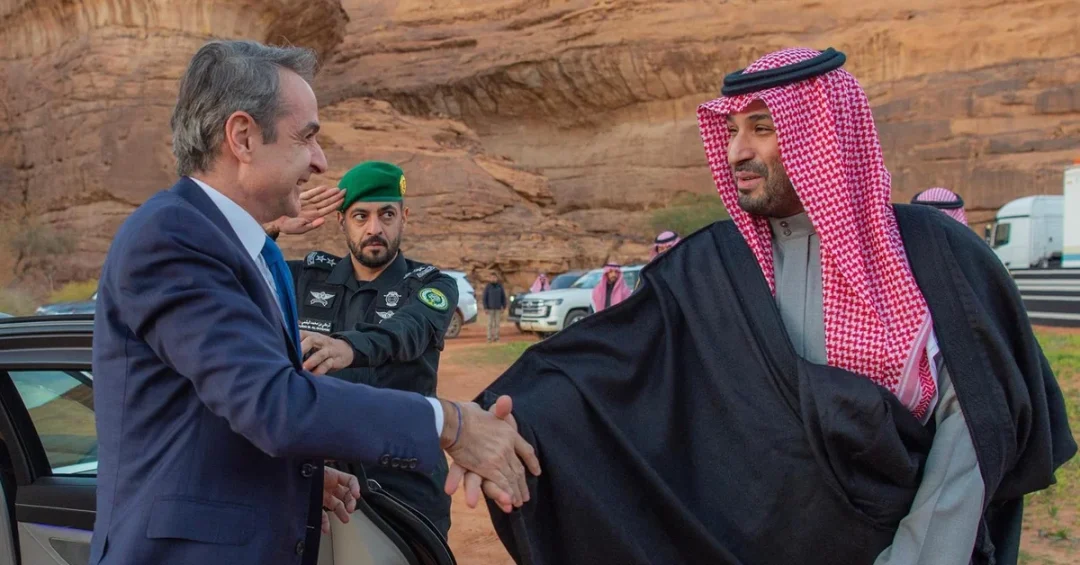
His Royal Highness Prince Mohammed bin Salman bin Abdulaziz Al Saud, Crown Prince and Prime Minister of the Kingdom of Saudi Arabia, received Kyriakos Mitsotakis, Prime Minister of the Hellenic Republic of Greece, at the Winter Camp in AlUla on Monday, January 13, 2025, where the two leaders co-chaired the Saudi-Greek Strategic Partnership Council and signed the minutes of its meeting. The reception, announced by the Saudi Press Agency, brought together senior ministers, advisers, and officials from both governments in a setting that combined formal diplomacy with an introduction to authentic Saudi heritage and culture at the Bayt al-sha’ar, a traditional tent reflecting the Kingdom’s Bedouin traditions.
Could a single meeting in the historic surroundings of AlUla reshape the trajectory of relations between two countries separated by sea but united by shared interests? The gathering underscored the depth of the Saudi-Greek relationship, which has expanded steadily across diplomatic, economic, defense, cultural, and tourism domains in recent years. The presence of a large Greek delegation, including the ministers of foreign affairs, national defense, environment and energy, development, culture, tourism, and education, alongside the leadership of the National Intelligence Service, signaled the breadth of the partnership. On the Saudi side, the attendance of the Governor of the Madinah Region, the Deputy Governor of the Riyadh Region, the Minister of National Guard, the Minister of Foreign Affairs, the National Security Adviser, and the ministers of commerce, tourism, investment, and communications and information technology, along with the Governor of the Public Investment Fund, reflected the strategic weight the Kingdom attaches to this relationship.
Context and Background
What makes the Saudi-Greek Strategic Partnership Council a cornerstone of the Kingdom’s expanding international network? The council was established to institutionalize cooperation between Riyadh and Athens, providing a structured framework for regular consultation and joint action. Its meetings allow both sides to review progress, identify new opportunities, and align their positions on regional and international developments. The decision to hold this session in AlUla, rather than in a conventional capital setting, carried symbolic significance: AlUla has become a global destination for diplomacy, culture, and heritage, hosting high-level engagements that showcase Saudi Arabia’s Vision 2030 transformation.
Greece and Saudi Arabia have nurtured friendly ties for decades, but the relationship has accelerated markedly since the launch of Vision 2030 in 2016. The two countries share an interest in maritime security, energy stability, trade connectivity, and cultural exchange. Greece’s strategic location at the crossroads of Europe, the Balkans, and the Eastern Mediterranean complements Saudi Arabia’s position as a hub linking Asia, Africa, and Europe. This geographic complementarity has encouraged both governments to pursue agreements in logistics, renewable energy, tourism, and technology. The Strategic Partnership Council serves as the primary vehicle for translating these shared interests into concrete projects and initiatives.
The timing of the meeting is also significant. Regional and global challenges, from energy market volatility to security concerns in the Eastern Mediterranean and the Middle East, require close coordination among like-minded states. By co-chairing the council, the Crown Prince and the Greek Prime Minister reaffirmed their commitment to dialogue and joint problem-solving. The reception at the Winter Camp, with its traditional folklore performances and the Bayt al-sha’ar setting, also highlighted the Kingdom’s pride in its cultural heritage, offering the Greek delegation an immersive experience of Saudi hospitality and customs.
Key Details of the Reception and Council Meeting
How did the official program unfold during this high-profile visit? Upon his arrival, the Greek Prime Minister was greeted with handshakes by Saudi princes and ministers. HRH the Crown Prince then welcomed the members of the official Greek delegation, with folk-dance troupes presenting performances of traditional Saudi folklore typically held during official occasions. At the beginning of the reception, the Crown Prince welcomed the Prime Minister, who expressed his happiness at visiting the Kingdom and meeting with HRH the Crown Prince. The two leaders then proceeded to the Bayt al-sha’ar, where the Prime Minister was introduced to authentic Saudi heritage and culture.
During their meeting, the two sides reviewed relations between the two friendly countries and discussed ways to develop cooperation in various fields. They also exchanged views on the latest regional and international developments of mutual interest and the efforts being made in this regard. The discussions reflected a shared understanding of the importance of stability, prosperity, and constructive engagement. The presence of such a broad array of ministers and senior officials from both sides ensured that the conversations could address a wide spectrum of sectors, from defense and security to trade, investment, energy, tourism, culture, and technology.
The reception was attended on the Saudi side by Governor of the Madinah Region Prince Salman bin Sultan bin Abdulaziz; Deputy Governor of the Riyadh Region Prince Mohammed bin Abdulrahman bin Abdulaziz; Minister of National Guard Prince Abdullah bin Bandar bin Abdulaziz; Minister of Foreign Affairs Prince Faisal bin Farhan bin Abdullah; Minister of State, Cabinet Member, and National Security Adviser Dr. Musaed bin Mohammed Al-Aiban; Minister of Commerce and accompanying minister Dr. Majid Al-Kassabi; Minister of Tourism Ahmed Al Khateeb; Minister of Investment Eng. Khalid Al-Falih; Minister of Communications and Information Technology Eng. Abdullah Alswaha; Public Investment Fund (PIF) Governor Yasir Othman Al-Rumayyan; and Saudi Ambassador to the Hellenic Republic Dr. Saad Al-Ammar. From the Greek side, attendees included Minister of Foreign Affairs George Gerapetritis; Minister of National Defense Nikolaos Dendias; Minister of Environment and Energy Theodoros Skylakakis; Minister of Development Panagiotis Theodorikakos; Minister of Culture Styliani Mendoni; Minister of Tourism Olga Kefalogianni; Deputy Minister of Foreign Affairs Alexandra Papadopoulou; Deputy Minister of Foreign Affairs Konstantinos Fragkogiannis; Alternate Minister of Education, Religious Affairs, and Sports Ioannis Vroutsis; National Intelligence Service Director-General Themistoklis Demiris; Member of Parliament Theoharis; and Greek Ambassador to the Kingdom Alexis Konstantopoulos. Afterwards, the Crown Prince and the Greek Prime Minister co-chaired the Saudi-Greek Strategic Partnership Council, reviewing several topics on its agenda in the presence of its members. At the conclusion, they signed the minutes of the council meeting.
International and Regional Impact
What does this meeting signal to the wider world about Saudi Arabia’s diplomatic reach? The Saudi-Greek Strategic Partnership Council represents a model of constructive engagement between the Kingdom and a European Union member state. It demonstrates that Saudi Arabia is a reliable partner for countries seeking stability, economic growth, and cultural exchange. The council’s agenda covers areas of mutual concern, including energy security, maritime cooperation, investment flows, and people-to-people ties. By co-chairing the council, the Crown Prince and the Greek Prime Minister have reinforced the message that dialogue and collaboration are the preferred tools for addressing shared challenges.
For Greece, the partnership offers access to one of the world’s largest economies and a gateway to the Gulf region. For Saudi Arabia, Greece serves as a bridge to Europe and a partner in promoting regional stability. The two countries have cooperated on defense and security matters, including joint exercises and training, and have explored opportunities in renewable energy, particularly solar and wind, where Greece’s expertise and Saudi Arabia’s ambitious clean energy targets align. The meeting in AlUla also highlighted the Kingdom’s growing role as a host of international diplomacy, a role that enhances its global standing and supports its Vision 2030 objectives of becoming a hub for business, tourism, and cultural exchange.
Could this council meeting pave the way for new agreements in trade, investment, and tourism? The presence of the Minister of Investment, the Minister of Commerce, and the PIF Governor suggests that economic cooperation was high on the agenda. Greek companies have expressed interest in participating in Saudi megaprojects, including NEOM, the Red Sea Project, and Qiddiya, while Saudi investors have shown interest in Greek ports, logistics, and tourism infrastructure. The cultural and tourism ministers from both sides also had the opportunity to discuss joint initiatives to promote heritage tourism, archaeological cooperation, and cultural festivals. Such exchanges deepen mutual understanding and create new avenues for economic growth.
Economic and Strategic Significance
Why does the Saudi-Greek partnership matter for the global economy? The Eastern Mediterranean has emerged as a critical corridor for energy, trade, and transportation. Saudi Arabia, as the world’s leading oil exporter and a major investor, has a stake in the stability and prosperity of this region. Greece, with its strategic ports and shipping fleet, is a natural partner for Saudi Arabia’s efforts to diversify its economy and expand its global trade networks. The Strategic Partnership Council allows both sides to align their economic strategies, explore joint ventures, and facilitate investment flows. The signing of the minutes of the council meeting formalizes the commitments made and provides a roadmap for future cooperation.
Beyond energy and trade, the partnership extends to technology, digital transformation, and innovation. The Saudi Minister of Communications and Information Technology, Eng. Abdullah Alswaha, participated in the reception, reflecting the Kingdom’s focus on building a knowledge-based economy. Greece has a growing technology sector and a skilled workforce, creating opportunities for collaboration in artificial intelligence, smart cities, and digital infrastructure. The PIF, under the leadership of Governor Yasir Othman Al-Rumayyan, has been at the forefront of Saudi Arabia’s investment strategy, and its involvement in the council signals that the private sector and sovereign wealth funds will play a central role in bringing the partnership to life.
What role does culture play in strengthening these ties? The visit included an introduction to authentic Saudi heritage at the Bayt al-sha’ar, where the Greek Prime Minister experienced traditional Saudi hospitality. The Minister of Culture from Greece, Styliani Mendoni, and the Saudi Minister of Tourism, Ahmed Al Khateeb, were present, underscoring the importance both countries place on cultural diplomacy. AlUla itself, with its UNESCO World Heritage site of Hegra and its stunning natural landscapes, is a symbol of Saudi Arabia’s commitment to preserving and sharing its heritage with the world. By hosting the Greek delegation in this historic setting, the Kingdom demonstrated that cultural exchange is an integral part of its foreign policy and a key pillar of Vision 2030.
Vision 2030 Alignment
How does the Saudi-Greek Strategic Partnership Council contribute to Vision 2030? Vision 2030 aims to diversify the Kingdom’s economy, strengthen its international partnerships, and position Saudi Arabia as a global leader in trade, tourism, and innovation. The council directly supports these goals by facilitating cooperation in high-priority sectors such as renewable energy, technology, tourism, and investment. The participation of the PIF and the ministers of investment and commerce reflects the economic thrust of the partnership, while the involvement of the tourism and culture ministers highlights the Kingdom’s efforts to attract international visitors and showcase its heritage. The meeting in AlUla, a flagship destination under Vision 2030, further reinforces the link between diplomacy and development.
As Saudi Arabia continues to expand its global network, partnerships like the one with Greece will play an increasingly important role in achieving the objectives of Vision 2030. The Kingdom’s leadership, under the guidance of the Crown Prince, has consistently emphasized the importance of international cooperation and mutual respect. The signing of the minutes of the Saudi-Greek Strategic Partnership Council marks another step forward in this journey, setting the stage for deeper collaboration in the years ahead. For an international audience, the message is clear: Saudi Arabia is open for business, committed to stability, and eager to build bridges with partners around the world. The meeting in AlUla was not just a diplomatic courtesy; it was a reaffirmation of a shared vision for a prosperous and peaceful future.
20 Questions
Q1. Who received the Greek Prime Minister in AlUla?
A1. His Royal Highness Prince Mohammed bin Salman bin Abdulaziz Al Saud, Crown Prince and Prime Minister of Saudi Arabia, received Greek Prime Minister Kyriakos Mitsotakis at the Winter Camp in AlUla on Monday, January 13, 2025.
Q2. What was the main purpose of the meeting?
A2. The two leaders co-chaired the Saudi-Greek Strategic Partnership Council, reviewed bilateral relations, discussed ways to develop cooperation in various fields, and exchanged views on regional and international developments of mutual interest.
Q3. Where did the meeting take place?
A3. The meeting took place at the Winter Camp in AlUla, a historic region in northwestern Saudi Arabia known for its archaeological sites and natural beauty, where the Bayt al-sha’ar setting introduced the Greek delegation to Saudi heritage.
Q4. What is the Saudi-Greek Strategic Partnership Council?
A4. It is a bilateral framework established to institutionalize cooperation between Saudi Arabia and Greece, providing a structured platform for regular consultation and joint action across diplomatic, economic, defense, cultural, and tourism domains.
Q5. Who attended the reception from the Saudi side?
A5. Saudi attendees included Prince Salman bin Sultan bin Abdulaziz, Prince Mohammed bin Abdulrahman bin Abdulaziz, Prince Abdullah bin Bandar bin Abdulaziz, Prince Faisal bin Farhan bin Abdullah, Dr. Musaed Al-Aiban, Dr. Majid Al-Kassabi, Ahmed Al Khateeb, Eng. Khalid Al-Falih, Eng. Abdullah Alswaha, Yasir Al-Rumayyan, and Dr. Saad Al-Ammar.
Q6. Who attended from the Greek side?
A6. Greek attendees included George Gerapetritis, Nikolaos Dendias, Theodoros Skylakakis, Panagiotis Theodorikakos, Styliani Mendoni, Olga Kefalogianni, Alexandra Papadopoulou, Konstantinos Fragkogiannis, Ioannis Vroutsis, Themistoklis Demiris, Member of Parliament Theoharis, and Ambassador Alexis Konstantopoulos.
Q7. What documents were signed at the meeting?
A7. At the conclusion of the council meeting, HRH the Crown Prince and the Greek Prime Minister signed the minutes of the Saudi-Greek Strategic Partnership Council meeting, formalizing the outcomes and commitments discussed during the session.
Q8. How was the Greek Prime Minister welcomed?
A8. Upon arrival, the Greek Prime Minister was greeted with handshakes by Saudi princes and ministers. HRH the Crown Prince then welcomed the Greek delegation, with folk-dance troupes performing traditional Saudi folklore typically held during official occasions.
Q9. What cultural experience was offered to the Greek delegation?
A9. The Greek Prime Minister was introduced to authentic Saudi heritage and culture at the Bayt al-sha’ar, a traditional tent setting that reflects Bedouin customs, hospitality, and the Kingdom’s commitment to preserving and sharing its cultural legacy.
Q10. What topics were discussed during the meeting?
A10. The two sides reviewed bilateral relations, explored ways to enhance cooperation in various fields, and exchanged views on the latest regional and international developments of mutual interest, as well as efforts being made in this regard.
Q11. Why is AlUla significant for such diplomatic meetings?
A11. AlUla has become a global destination for diplomacy and culture, hosting high-level engagements that showcase Saudi Arabia’s Vision 2030 transformation. Its UNESCO World Heritage site of Hegra and stunning landscapes symbolize the Kingdom’s rich heritage.
Q12. What economic sectors are likely to benefit from this partnership?
A12. Key sectors include renewable energy, trade, investment, tourism, technology, digital transformation, logistics, and cultural exchange, with participation from the PIF and the ministers of investment, commerce, tourism, and communications and information technology.
Q13. How does this meeting align with Vision 2030?
A13. The council supports Vision 2030 by facilitating cooperation in high-priority sectors, strengthening international partnerships, and positioning Saudi Arabia as a global leader in trade, tourism, and innovation, while showcasing its heritage and hospitality.
Q14. What is the significance of the PIF Governor’s attendance?
A14. The presence of PIF Governor Yasir Othman Al-Rumayyan signals that Saudi Arabia’s sovereign wealth fund will play a central role in financing and facilitating joint projects, reflecting the economic thrust of the partnership and the private sector’s involvement.
Q15. How does Greece benefit from this partnership?
A15. Greece gains access to one of the world’s largest economies and a gateway to the Gulf region, while also benefiting from Saudi investment in Greek ports, logistics, and tourism infrastructure, and from enhanced cooperation on regional stability.
Q16. What role does cultural diplomacy play in Saudi-Greek relations?
A16. Cultural diplomacy deepens mutual understanding and creates new avenues for economic growth. The visit included an introduction to Saudi heritage at the Bayt al-sha’ar, with culture and tourism ministers from both sides participating in discussions on joint initiatives.
Q17. What message does this meeting send to the international community?
A17. The meeting signals that Saudi Arabia is a reliable partner for countries seeking stability, economic growth, and cultural exchange, and that the Kingdom is open for business, committed to dialogue, and eager to build bridges worldwide.
Q18. How does the partnership address regional security?
A18. The council provides a platform for both countries to align their positions on regional and international developments, coordinate on maritime security and energy stability, and promote dialogue and joint problem-solving in the Eastern Mediterranean and Middle East.
Q19. What future cooperation can be expected?
A19. Future cooperation is expected in renewable energy, technology, artificial intelligence, smart cities, tourism, heritage preservation, trade, and investment, with the signed minutes providing a roadmap for implementing joint projects and initiatives.
Q20. Who announced the details of the meeting?
A20. The details of the meeting were announced by the Saudi Press Agency (SPA), the official Saudi news authority, which reported on the reception, the council meeting, and the signing of the minutes in AlUla.
Reader Feedback
We value your thoughts. Please share your feedback on this article.
Your feedback helps us improve our coverage.
Related articles
 Crown Prince Receives Call from Brazil’s President Lula
 Makkah Deputy Governor Opens Hajj Conference 2025 in Jeddah
 KSrelief Distributes Winter Clothing Vouchers in Aleppo
 Saudi Weather Forecast: Dust Winds, Rain, Fog on Tuesday
 KSrelief Distributes 445 Food Baskets in Mali’s Mopti Region
 4.2-Magnitude Earthquake Hits Southern Iran, No Damage