


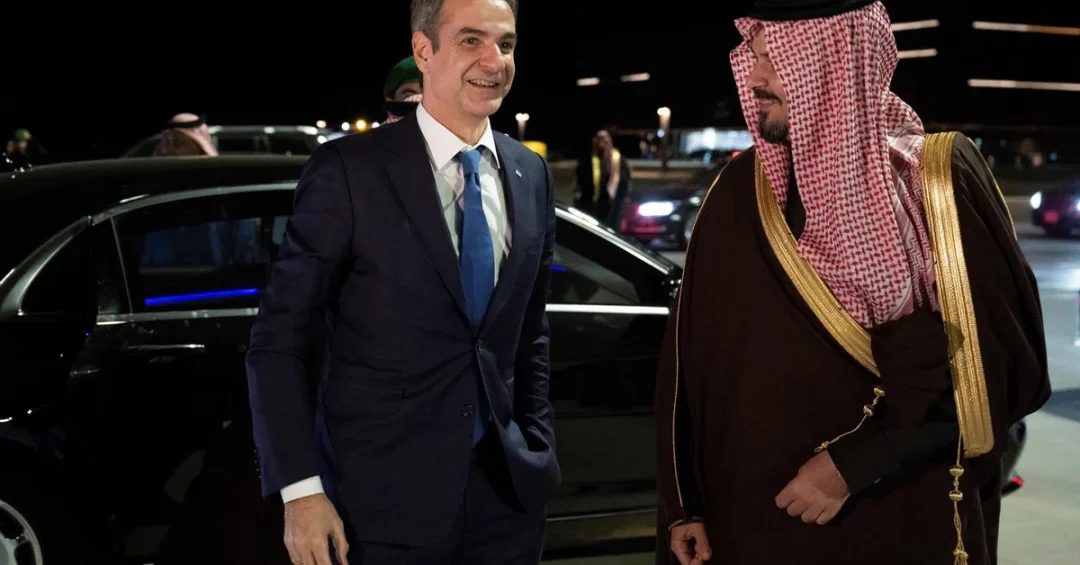
Hellenic Republic Prime Minister Kyriakos Mitsotakis and his accompanying delegation departed AlUla on Monday, concluding an official visit to the Kingdom of Saudi Arabia that underscored the deepening strategic partnership between Riyadh and Athens. The Greek leader was seen off at AlUla International Airport by Prince Salman bin Sultan bin Abdulaziz, Governor of the Madinah Region, Majid Al-Kassabi, Minister of Commerce, and several other senior officials from both the Saudi and Greek sides, according to the Saudi Press Agency (SPA). The farewell ceremony reflected the warmth and protocol reserved for close international partners, and it closed a visit that Saudi officials describe as another milestone in the Kingdom’s expanding network of diplomatic and economic relationships.
The visit comes at a time when Saudi Arabia is actively strengthening ties with European Union member states across trade, investment, energy, and cultural exchange. Greece, strategically positioned at the crossroads of Europe, the Balkans, and the Eastern Mediterranean, has emerged as a natural partner for the Kingdom’s long-term economic diversification agenda. For observers of Gulf diplomacy, the departure of Prime Minister Mitsotakis from AlUla is not merely the end of a trip; it signals the continuation of a relationship that both capitals have carefully cultivated over recent years. Saudi Arabia’s hosting of the Greek delegation in one of its most iconic heritage destinations also highlights how the Kingdom is increasingly blending diplomacy with cultural showcasing.
Context and Background
Why has AlUla become such a frequent backdrop for high-level international diplomacy? The ancient city, located in the Madinah Region, has in recent years been transformed into a global destination for cultural tourism and official state visits. Home to the UNESCO World Heritage site of Hegra, AlUla offers visiting dignitaries a setting that combines archaeological grandeur with modern luxury infrastructure. Saudi leadership has deliberately used the destination to introduce international partners to the Kingdom’s heritage while conducting substantive bilateral discussions. The choice of AlUla as the arrival and departure point for Prime Minister Mitsotakis therefore carried symbolic weight, presenting Greece with a visible demonstration of Saudi Arabia’s Vision 2030 transformation.
The relationship between Saudi Arabia and Greece has deepened steadily since the two countries established a strategic partnership framework. In recent years, officials from both sides have signed agreements covering renewable energy, maritime cooperation, tourism, and defense. Greece has also supported Saudi Arabia’s broader engagement with the European Union, where the Kingdom is pursuing expanded trade and investment ties. For Riyadh, Athens represents a stable and influential voice within Europe, while for Greece, Saudi Arabia is a key source of investment and a growing market for Greek goods and services. The visit concluded on Monday builds on this foundation and keeps the diplomatic momentum intact.
Regional dynamics add further significance to the timing. The Eastern Mediterranean and the Red Sea corridor are increasingly interconnected through energy routes, shipping lanes, and infrastructure projects. Saudi Arabia’s ambitions to become a global logistics hub depend partly on stable partnerships with European maritime nations. Greece, with one of the largest merchant fleets in the world, is an indispensable partner in that vision. The Mitsotakis delegation’s presence in AlUla therefore fits into a wider pattern of Saudi outreach that prioritizes practical cooperation over ceremonial gestures alone.
Key Details of the Visit and Departure
According to the Saudi Press Agency, Prime Minister Mitsotakis and his delegation left AlUla on Monday, with the farewell ceremony held at AlUla International Airport. The Greek leader was received and seen off by Prince Salman bin Sultan bin Abdulaziz, Governor of the Madinah Region, alongside Majid Al-Kassabi, Saudi Minister of Commerce, and other officials representing both governments. The presence of the Madinah Region Governor and the Commerce Minister at the departure underscored the dual nature of the visit: it was both a diplomatic engagement and an economic mission. The Commerce Ministry’s involvement points to the trade and investment dimensions that Saudi Arabia prioritizes in its European outreach.
The delegation’s departure from AlUla rather than Riyadh or Jeddah suggests that the itinerary included time in the Kingdom’s northwestern heritage region. AlUla has hosted numerous international leaders, cultural figures, and business executives since the Royal Commission for AlUla began developing the area as a flagship tourism and heritage project. For the Greek delegation, the visit likely included exposure to Saudi Arabia’s cultural preservation efforts and luxury hospitality offerings, which are central to the Kingdom’s tourism strategy. Such visits are designed to leave a lasting impression that extends beyond formal talks.
Officials from both sides have not disclosed the full agenda of the visit, but the official farewell was conducted with full diplomatic protocol. The Saudi and Greek flags were displayed, and the delegation was escorted to their aircraft by the attending officials. The Saudi Press Agency reported the departure at 00:06 local time, with the corresponding GMT timestamp of 21:06, indicating the late-evening nature of the farewell. The precise reporting reflects the transparency and professionalism of Saudi official media in documenting high-level engagements.
International and Regional Impact
How does a single bilateral visit ripple across the broader geopolitical landscape? For Saudi Arabia, each engagement with a European Union member state reinforces its position as a reliable partner in energy, trade, and regional security. Greece, as a member of both the EU and NATO, offers Saudi Arabia a channel into European decision-making circles that is both stable and strategically located. The visit by Prime Minister Mitsotakis signals to other European capitals that engagement with the Kingdom is productive and welcomed. It also complements Saudi Arabia’s broader efforts to attract foreign investment and technical expertise as part of Vision 2030.
From Greece’s perspective, the relationship with Saudi Arabia provides economic opportunities and diplomatic leverage. Greek companies in shipping, construction, renewable energy, and tourism have shown interest in Saudi projects, including those linked to NEOM and the Red Sea development. The Eastern Mediterranean energy corridor, which involves Greece, Cyprus, and other partners, intersects with Saudi Arabia’s ambitions to supply energy to Europe. While the specifics of the AlUla discussions remain confidential, the pattern of recent Saudi-Greek cooperation suggests that energy, maritime logistics, and investment were high on the agenda. The departure ceremony itself is a public affirmation that the relationship remains active and forward-looking.
Economic and Strategic Significance
What does the Greek Prime Minister’s visit mean for Saudi Arabia’s economic diversification? The Kingdom’s trade relationship with Greece has grown in recent years, with bilateral trade covering petroleum products, machinery, foodstuffs, and construction materials. Saudi Arabia is also a potential investor in Greek infrastructure and energy projects, and Greek firms are increasingly looking at Saudi giga-projects as markets for their expertise. The presence of Minister of Commerce Majid Al-Kassabi at the farewell highlights the economic track of the relationship. His ministry has been tasked with expanding Saudi non-oil exports and attracting foreign direct investment, both of which align with Vision 2030 targets.
Strategically, Greece’s location makes it a natural bridge between Saudi Arabia and Europe. Greek ports, including Piraeus, serve as entry points for goods destined for European markets. Saudi Arabia’s ambition to become a global logistics hub depends on efficient maritime and rail connections, and cooperation with Greek shipping companies could enhance that network. In addition, Greece has expertise in renewable energy, particularly solar and wind, which is relevant to Saudi Arabia’s goal of generating 50 percent of its electricity from renewable sources by 2030. The visit therefore carries implications that extend well beyond diplomatic pleasantries.
Vision 2030 Alignment
How does a farewell ceremony in AlUla connect to Saudi Arabia’s long-term transformation? Every high-level visit to the Kingdom is an opportunity to showcase the progress of Vision 2030, the national blueprint launched by Crown Prince Mohammed bin Salman to diversify the economy, empower citizens, and elevate Saudi Arabia’s global standing. AlUla itself is a Vision 2030 flagship project, developed by the Royal Commission for AlUla to become a world-class heritage and tourism destination. Hosting and bidding farewell to a European prime minister in AlUla demonstrates how the Kingdom is integrating its cultural assets into its diplomatic and economic strategy. It is a tangible example of heritage serving as a platform for modern international engagement.
The visit also supports Vision 2030’s goal of expanding international partnerships. Saudi Arabia aims to attract foreign investment, increase non-oil exports, and position itself as a hub for business, tourism, and innovation. Greece, with its maritime strength, European Union membership, and growing interest in Middle Eastern markets, is a valuable partner in that effort. As Prime Minister Mitsotakis departed AlUla, he left behind a relationship that both countries have reason to continue nurturing. For Saudi Arabia, the farewell was not an ending but another step in a long-term strategy of global engagement, cultural exchange, and economic modernization that will define the Kingdom’s role in the decades ahead.
20 Questions
Q1. Who departed AlUla on Monday?
A1. Hellenic Republic Prime Minister Kyriakos Mitsotakis and his accompanying delegation left AlUla on Monday, concluding their official visit to Saudi Arabia, according to the Saudi Press Agency.
Q2. Where did the Greek Prime Minister depart from?
A2. He departed from AlUla International Airport in the Madinah Region of Saudi Arabia, where a formal farewell ceremony was held with senior Saudi and Greek officials present.
Q3. Who saw off the Greek Prime Minister at the airport?
A3. Prince Salman bin Sultan bin Abdulaziz, Governor of the Madinah Region, and Majid Al-Kassabi, Minister of Commerce, along with several other officials from both sides.
Q4. What is the significance of AlUla as a diplomatic venue?
A4. AlUla is a UNESCO World Heritage site and a Vision 2030 flagship tourism project, often used to showcase Saudi Arabia’s cultural heritage and modernization to visiting international leaders.
Q5. When did the departure take place?
A5. The Saudi Press Agency reported the departure at 00:06 local time on Monday, which corresponds to 21:06 GMT, indicating a late-evening farewell ceremony.
Q6. Which Saudi ministry was represented at the farewell?
A6. The Ministry of Commerce was represented by Minister Majid Al-Kassabi, highlighting the economic and trade dimensions of the Saudi-Greek relationship.
Q7. What does the visit say about Saudi-Greek relations?
A7. It reflects deepening strategic ties between the two countries, covering diplomacy, trade, investment, energy, and cultural exchange, and reinforces Saudi Arabia’s engagement with European Union member states.
Q8. Why is Greece important to Saudi Arabia’s Vision 2030?
A8. Greece offers maritime expertise, European market access, and renewable energy knowledge, all of which align with Vision 2030 goals of economic diversification and global partnership.
Q9. Did the visit include economic discussions?
A9. While full details were not disclosed, the presence of the Commerce Minister and the pattern of recent Saudi-Greek agreements suggest trade, investment, and energy cooperation were discussed.
Q10. What is the Royal Commission for AlUla?
A10. It is the Saudi government body responsible for developing AlUla as a world-class heritage and tourism destination, in line with Vision 2030 objectives.
Q11. How does this visit fit into Saudi Arabia’s foreign policy?
A11. It is part of the Kingdom’s broader strategy of building strong partnerships with European nations to support economic diversification, security cooperation, and cultural diplomacy.
Q12. What are the key sectors of Saudi-Greek cooperation?
A12. Key sectors include maritime shipping, renewable energy, tourism, construction, defense, and trade in petroleum products, machinery, and foodstuffs.
Q13. Was the visit reported by official Saudi media?
A13. Yes, the Saudi Press Agency (SPA) reported the departure, confirming the official nature of the visit and the details of the farewell ceremony.
Q14. What message does the farewell ceremony send?
A14. It signals mutual respect and the strength of bilateral ties, and it demonstrates Saudi Arabia’s commitment to maintaining high-level diplomatic engagement with international partners.
Q15. How does AlUla contribute to Saudi tourism goals?
A15. AlUla attracts international visitors and dignitaries, showcasing Saudi Arabia’s heritage and luxury hospitality, and supports the Vision 2030 target of increasing tourism’s share of GDP.
Q16. Who is Prince Salman bin Sultan bin Abdulaziz?
A16. He is the Governor of the Madinah Region, responsible for overseeing the region’s administration and representing the Saudi leadership at official events.
Q17. What is the expected outcome of the visit?
A17. The visit is expected to strengthen bilateral cooperation and pave the way for further agreements in trade, investment, energy, and cultural exchange between Saudi Arabia and Greece.
Q18. How does Greece benefit from ties with Saudi Arabia?
A18. Greece gains access to Saudi investment, energy markets, and giga-projects, while also strengthening its diplomatic and economic presence in the Gulf region.
Q19. Is this visit part of a broader Saudi outreach to Europe?
A19. Yes, Saudi Arabia has been actively engaging with European Union countries to diversify its partnerships and attract investment, and the Greek visit is a key component of that effort.
Q20. What does the future hold for Saudi-Greek relations?
A20. Both countries are expected to continue expanding cooperation in maritime logistics, renewable energy, tourism, and trade, supporting Saudi Arabia’s Vision 2030 and Greece’s economic interests.
Reader Feedback
We value your thoughts. Please share your feedback on this article.
Your feedback helps us improve our coverage.
Related articles
 GACA Levies SAR18.8 Million in Fines for 2024 Violations
 Crown Prince, Greek PM Co-Chair Strategic Council in AlUla
 Crown Prince Receives Call from Brazil’s President Lula
 Makkah Deputy Governor Opens Hajj Conference 2025 in Jeddah
 KSrelief Distributes Winter Clothing Vouchers in Aleppo
 Saudi Weather Forecast: Dust Winds, Rain, Fog on Tuesday