


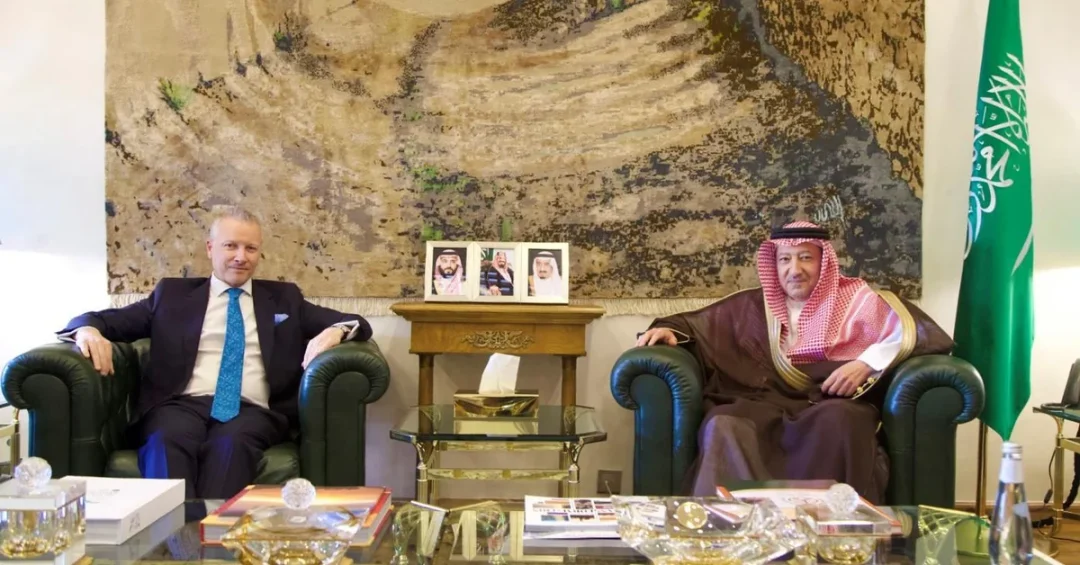
Saudi Arabia’s Vice Minister of Foreign Affairs, Eng. Waleed El-Khereiji, received Alexandre Lévêque, Assistant Deputy Minister for Europe, Arctic, Middle East and Maghreb at the Canadian Ministry of Foreign Affairs, in Riyadh on January 13, 2025, according to the Saudi Press Agency (SPA). The meeting brought together two senior diplomats to discuss ways to enhance bilateral cooperation and address issues of mutual interest, underscoring the Kingdom’s continued commitment to constructive international engagement under the leadership of the Custodian of the Two Holy Mosques, King Salman bin Abdulaziz Al Saud, and His Royal Highness Crown Prince Mohammed bin Salman.
The encounter in the Saudi capital reflects the enduring importance of the Saudi-Canadian relationship, which has evolved over decades into a partnership spanning trade, energy, education, and regional security. As Saudi Arabia accelerates its transformation under Vision 2030, such high-level diplomatic exchanges play a vital role in aligning international partners with the Kingdom’s strategic priorities. The meeting also highlights Riyadh’s growing role as a hub for dialogue on global and regional challenges, from Middle Eastern stability to climate cooperation and economic diversification. For observers of Saudi foreign policy, the talks signal continuity in the Kingdom’s measured and forward-looking approach to international relations.
Context and Background
What does this meeting reveal about the current state of Saudi-Canadian relations? The sit-down between Eng. Waleed El-Khereiji and Alexandre Lévêque comes at a time when Saudi Arabia is deepening its diplomatic outreach across North America and Europe. Canada, a G7 member with significant energy and investment interests, has long been a partner in sectors ranging from petroleum to advanced education. The two nations share membership in the G20 and have cooperated on global issues such as climate change and humanitarian relief. This latest exchange builds on a history of ministerial-level dialogue aimed at keeping communication channels open and productive.
The meeting also occurs against the backdrop of Saudi Arabia’s broader foreign policy strategy, which prioritizes stability, economic diversification, and mutually beneficial partnerships. Riyadh has hosted a series of high-profile diplomatic events in recent years, including summits and bilateral talks that have reinforced its position as a regional leader and global convener. The presence of a senior Canadian official in Riyadh is a testament to the Kingdom’s magnetic pull as a center of diplomacy. It also reflects Canada’s recognition of Saudi Arabia’s pivotal role in the Middle East and its growing influence in global energy markets and supply chains.
Eng. Waleed El-Khereiji, a seasoned diplomat and engineer, has been Vice Minister of Foreign Affairs since 2018. He has been instrumental in shaping Saudi Arabia’s foreign policy engagements, particularly in the areas of economic diplomacy and regional security. Alexandre Lévêque, as Assistant Deputy Minister for Europe, Arctic, Middle East and Maghreb, oversees a portfolio that includes the Middle East, making him a key interlocutor for Saudi affairs within the Canadian government. Their meeting thus represents a direct channel between two foreign ministries with a shared interest in stability and prosperity.
Key Details
What specific outcomes might emerge from this diplomatic engagement? According to the Saudi Press Agency, the two officials discussed ways to enhance cooperation and issues of mutual interest. While the statement did not detail specific agreements, the language used is typical of productive diplomatic consultations that lay the groundwork for future collaboration. Areas of potential cooperation could include trade and investment, energy security, educational exchanges, and cultural ties. Both countries have a stake in regional stability, counterterrorism, and humanitarian efforts, making their dialogue particularly relevant.
The meeting also provided an opportunity to review the broader bilateral relationship, which has seen both challenges and opportunities in recent years. Saudi Arabia has consistently advocated for dialogue and mutual respect in international relations, and this meeting exemplifies that approach. By receiving a senior Canadian official, the Vice Minister signals the Kingdom’s openness to constructive engagement with all partners who share its vision for a peaceful and prosperous world. The exchange also aligns with Saudi Arabia’s efforts to diversify its international partnerships beyond traditional allies, a key pillar of Vision 2030.
It is worth noting that Saudi-Canadian relations have historically been robust, with significant people-to-people ties, including thousands of Saudi students who have studied in Canadian universities. Trade between the two countries has included Canadian exports of machinery, aircraft, and agricultural products, while Saudi Arabia has been a reliable supplier of energy to Canada. The meeting in Riyadh could help to further solidify these ties and explore new avenues, such as cooperation in clean energy technologies, digital innovation, and tourism, all of which are central to the Kingdom’s modernization drive.
International and Regional Impact
How does this meeting fit into the wider geopolitical landscape? Saudi Arabia’s engagement with Canada is part of a broader strategy to strengthen ties with Western nations while maintaining its independent foreign policy. In a world of shifting alliances and complex challenges, the Kingdom has emerged as a stabilizing force, mediating conflicts and promoting dialogue. The meeting between Eng. El-Khereiji and Mr. Lévêque contributes to this image of Saudi Arabia as a responsible global actor. It also underscores the importance of the Middle East and North Africa region in Canadian foreign policy, particularly in light of energy security and migration issues.
Regionally, the talks come at a time when the Middle East is witnessing both persistent tensions and new opportunities for peace. Saudi Arabia has been at the forefront of efforts to resolve conflicts in Yemen, Sudan, and the broader region, and its partnerships with countries like Canada can amplify these efforts. Canada, for its part, has expressed interest in supporting stability and development in the Middle East. By coordinating their positions, the two countries can contribute to humanitarian initiatives and post-conflict reconstruction, areas where Saudi Arabia has already demonstrated leadership through its aid and development programs.
Economic and Strategic Significance
What economic opportunities could arise from enhanced Saudi-Canadian cooperation? Both nations have complementary strengths: Canada is a leader in natural resources, technology, and education, while Saudi Arabia is a global energy powerhouse undergoing a historic economic transformation. Under Vision 2030, the Kingdom is seeking foreign investment and expertise in sectors such as renewable energy, mining, digital infrastructure, and tourism. Canadian companies could play a role in these areas, benefiting from Saudi Arabia’s business-friendly reforms and strategic location as a gateway to the Middle East, Africa, and Asia.
Moreover, the meeting highlights the strategic importance of energy cooperation. Canada is a major oil and gas producer, and Saudi Arabia is the world’s largest exporter of crude oil. While they may compete in some markets, they also share an interest in stable energy prices and reliable supply chains. Dialogue at the diplomatic level can help to align their positions in international forums and promote investment in energy technologies, including carbon capture and hydrogen. Such cooperation would support global climate goals while ensuring energy security, a balance that Saudi Arabia has consistently advocated through its circular carbon economy approach.
Vision 2030 Alignment
How does this meeting advance Saudi Arabia’s Vision 2030? Vision 2030 is not only an economic blueprint but also a foreign policy framework that seeks to position the Kingdom as a pivotal player in global affairs. By engaging with Canada, Saudi Arabia is building the international partnerships necessary to achieve its goals of economic diversification, knowledge transfer, and enhanced quality of life for its citizens. The meeting between Eng. El-Khereiji and Mr. Lévêque is a concrete example of how the Kingdom is actively cultivating relationships that can bring tangible benefits in trade, education, and innovation.
Furthermore, the encounter reinforces Saudi Arabia’s commitment to multilateralism and dialogue, principles that are essential for a stable and prosperous world. As the Kingdom continues its journey of transformation, such diplomatic engagements will remain a cornerstone of its strategy to foster mutual understanding and cooperation. The Riyadh meeting is a small but meaningful step in a long and fruitful partnership, and it reflects the Kingdom’s steadfast dedication to building bridges with nations across the globe in pursuit of peace, progress, and shared prosperity.
20 Questions
Q1. Who received the Canadian Assistant Deputy Foreign Minister in Riyadh?
A1. Saudi Arabia’s Vice Minister of Foreign Affairs, Eng. Waleed El-Khereiji, received Alexandre Lévêque, Assistant Deputy Minister for Europe, Arctic, Middle East and Maghreb at the Canadian Ministry of Foreign Affairs, in Riyadh on January 13, 2025.
Q2. What was the main purpose of the meeting?
A2. The two officials discussed ways to enhance cooperation between Saudi Arabia and Canada and addressed issues of mutual interest, according to the Saudi Press Agency.
Q3. Where did the meeting take place?
A3. The meeting took place in Riyadh, the capital of Saudi Arabia, as reported by the Saudi Press Agency.
Q4. When did the meeting occur?
A4. The meeting occurred on January 13, 2025, according to the official Saudi Press Agency report.
Q5. Who is Eng. Waleed El-Khereiji?
A5. Eng. Waleed El-Khereiji is the Vice Minister of Foreign Affairs of Saudi Arabia, a seasoned diplomat and engineer who has held the position since 2018 and has been instrumental in shaping Saudi foreign policy.
Q6. Who is Alexandre Lévêque?
A6. Alexandre Lévêque is the Assistant Deputy Minister for Europe, Arctic, Middle East and Maghreb at the Canadian Ministry of Foreign Affairs, overseeing a portfolio that includes the Middle East.
Q7. What does the meeting say about Saudi-Canadian relations?
A7. The meeting reflects the enduring importance of Saudi-Canadian relations and signals both countries’ commitment to maintaining open channels of dialogue and cooperation on matters of shared interest.
Q8. What areas of cooperation were likely discussed?
A8. While specific details were not disclosed, potential areas include trade, investment, energy security, education, cultural exchanges, and regional stability, all of which are consistent with the two nations’ shared interests.
Q9. How does this meeting align with Saudi Arabia’s foreign policy?
A9. The meeting aligns with Saudi Arabia’s foreign policy of constructive engagement, multilateralism, and building partnerships that support stability, economic diversification, and the goals of Vision 2030.
Q10. What is the significance of Canada’s interest in the Middle East?
A10. Canada’s interest in the Middle East, as shown by this high-level meeting, underscores the region’s importance for energy security, trade, and diplomatic engagement, and highlights Saudi Arabia’s pivotal role in regional affairs.
Q11. How does this meeting contribute to regional stability?
A11. By enhancing dialogue and cooperation between Saudi Arabia and Canada, the meeting supports efforts to address regional challenges, promote peace, and coordinate on humanitarian and development initiatives.
Q12. What economic opportunities could arise from enhanced Saudi-Canadian cooperation?
A12. Enhanced cooperation could open opportunities in renewable energy, mining, digital infrastructure, tourism, and education, as Saudi Arabia seeks foreign investment and expertise under Vision 2030.
Q13. How does the meeting reflect Saudi Arabia’s Vision 2030?
A13. The meeting reflects Vision 2030’s emphasis on international partnerships, economic diversification, and knowledge transfer, positioning Saudi Arabia as a global hub for diplomacy and investment.
Q14. What role does the Saudi Press Agency play in reporting such meetings?
A14. The Saudi Press Agency is the official news agency of Saudi Arabia, providing authoritative and timely coverage of government activities, including diplomatic engagements, to domestic and international audiences.
Q15. What is the history of Saudi-Canadian relations?
A15. Saudi-Canadian relations have historically been robust, with cooperation in energy, trade, education, and people-to-people ties, including thousands of Saudi students studying in Canadian universities.
Q16. How might this meeting impact trade between the two countries?
A16. The meeting could help to further solidify trade ties and explore new avenues, such as cooperation in clean energy technologies, digital innovation, and tourism, benefiting both economies.
Q17. What is the significance of the timing of this meeting?
A17. The meeting comes at a time when Saudi Arabia is deepening its global outreach and Canada is looking to strengthen ties in the Middle East, making it a timely step in advancing bilateral relations.
Q18. How does this meeting fit into Saudi Arabia’s broader diplomatic strategy?
A18. It is part of Saudi Arabia’s broader strategy to strengthen ties with Western nations, maintain an independent foreign policy, and position itself as a stabilizing force and global convener.
Q19. What message does this meeting send to the international community?
A19. The meeting sends a message that Saudi Arabia is open to constructive engagement with all partners and is committed to dialogue, mutual respect, and cooperation for peace and prosperity.
Q20. What might be the next steps following this meeting?
A20. While specific next steps were not announced, such meetings typically lay the groundwork for further discussions, agreements, and collaborative initiatives that advance the mutual interests of both countries.
Reader Feedback
We value your thoughts. Please share your feedback on this article.
Your feedback helps us improve our coverage.
Related articles
 Crown Prince Congratulates Croatia’s President on Re-election
 Shura Council Approves Key International Agreements
 Saudi Ministry Holds Farewell for Umrah Guests in Dakar
 Riyadh Air Dreamliner Arrives at King Khalid Airport
 KSrelief Delivers Food and Health Aid to 6,048 in Syria’s Sarmada
 KSrelief’s Arsal Medical Centre Served 92,000 in 2024