


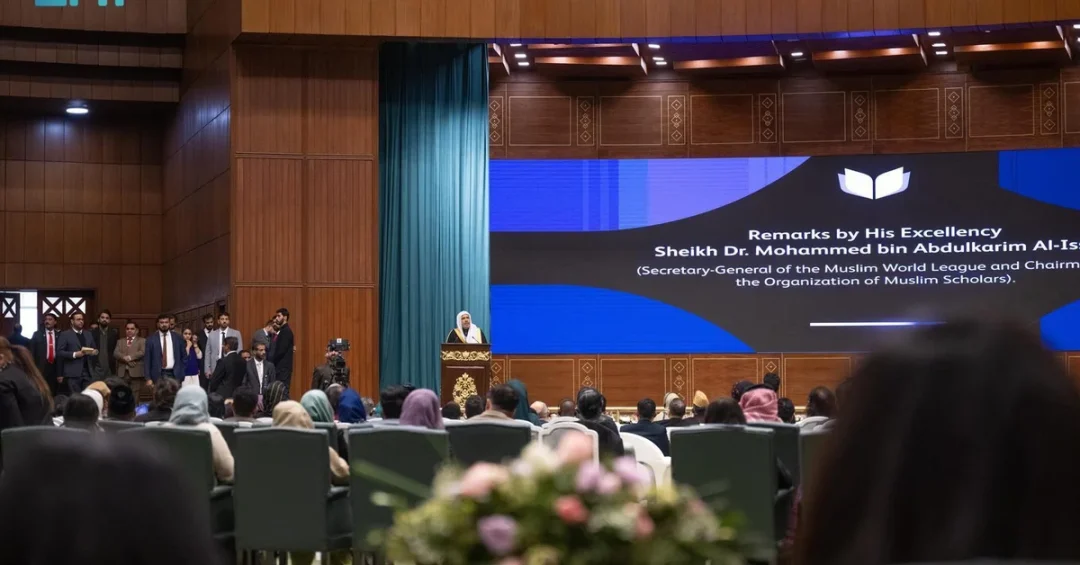
The Muslim World League (MWL) concluded its landmark global conference on Girls’ Education in Muslim Communities in Islamabad on January 12, 2025, launching the Islamabad Declaration for Girls’ Education, an initiative endorsed by senior scholars, Islamic jurisprudence councils, international organizations, and education advocates from around the world. The declaration was announced at the close of the two-day gathering, which brought together MWL Secretary General and Chairman of the Organization of Muslim Scholars Sheikh Dr. Mohammed Al-Issa, representatives of the Government and Parliament of Pakistan, global education activist Malala Yousafzai, senior muftis and scholars from across the Islamic world, ministers of education from Islamic countries, and representatives of the United Nations University for Peace and the League of Islamic Universities.
The conference also established a platform for international partnerships to serve as the initiative’s executive arm, with more than 20 agreements and pledges signed by scholars, United Nations organizations, and leaders from academic, media, and civil institutions. The Islamabad Declaration draws its inspiration from two landmark documents issued by the MWL under the patronage of Custodian of the Two Holy Mosques King Salman bin Abdulaziz Al Saud: the Charter of Makkah and the Charter of Building Bridges between Islamic Schools of Thought and Sects. Both charters emphasize the empowerment of women in education at all levels, a principle that now anchors the MWL’s global girls’ education initiative. The outcome signals a coordinated, institutional approach to one of the most pressing development questions in Muslim communities worldwide.
Context and Background
Why has girls’ education become such a central focus for the Muslim World League in recent years? The answer lies in the organization’s long-standing view that education is the foundation of stable, prosperous, and moderate societies. The MWL, headquartered in Makkah and chaired by Sheikh Dr. Mohammed Al-Issa, has spent years building consensus among Islamic scholars on issues of women’s empowerment, interfaith understanding, and youth development. The Islamabad conference represents the culmination of that effort, translating scholarly consensus into practical commitments. The event followed a series of MWL initiatives aimed at clarifying that Islam guarantees the right of girls to learn, and that cultural practices which deny that right contradict both religious teaching and the public interest of Muslim societies.
The two foundational documents cited at the conference carry significant weight. The Charter of Makkah, issued in 2019, articulated a comprehensive vision of Islamic values centered on moderation, coexistence, and the dignity of all people. The Charter of Building Bridges between Islamic Schools of Thought and Sects, issued more recently, sought to reduce sectarian friction and promote unity around shared objectives. By grounding the Islamabad Declaration in these texts, the MWL positioned girls’ education not as a foreign import or a contested modern idea, but as a natural extension of established Islamic scholarship. That framing matters enormously for persuading communities and religious authorities who might otherwise view international education campaigns with suspicion. The conference thus built its legitimacy from within the Islamic tradition rather than from outside pressure.
Key Details of the Islamabad Declaration
What concrete steps did the conference produce beyond statements of principle? The agreements signed in Islamabad cover a wide operational spectrum. A memorandum of understanding between the MWL and the Organization of Islamic Cooperation (OIC) established a strategic alliance dedicated to supporting girls’ education across member states. The Islamic Fiqh Council and the International Islamic Fiqh Academy, affiliated with the MWL and the OIC respectively, signed agreements to cooperate on jurisprudence-informed guidance. The MWL also partnered with the Union of News Agencies of the OIC (UNA-OIC) to implement projects and address misconceptions surrounding girls’ education, recognizing that public narratives shape whether families and communities embrace schooling for daughters.
Scholarships form another pillar of the declaration. The conference prioritized providing scholarships to Muslim girls and enhancing their leadership and problem-solving skills, with agreements reached between the MWL and Islamic and international universities, the League of Islamic Universities, the United Nations University for Peace, the United Nations High Commissioner for Refugees (UNHCR), and UNICEF. In addition, the MWL partnered with international organizations to conduct research and publish reports on women’s issues, and launched media campaigns aimed at raising awareness about girls’ right to education. The conference concluded with pledges from global academic institutions and organizations to support girls’ education through scholarships, grants, and programs designed to improve access to quality education. Together, these commitments create a working architecture rather than a single symbolic gesture.
International and Regional Impact
How will the Islamabad Declaration resonate beyond the conference hall? The presence of Malala Yousafzai, the Nobel laureate and global advocate for girls’ education, alongside senior muftis and scholars gave the event a rare combination of grassroots credibility and religious authority. Representatives from the United Nations University for Peace and the League of Islamic Universities added multilateral and academic weight. For Pakistan, hosting the conference reinforced its role as a bridge between the Islamic world and international education institutions. For the broader region, the declaration offers a shared framework that governments, clerics, and civil society can reference when designing policies and programs. The participation of education ministers from Islamic countries suggests that the commitments made in Islamabad are intended to inform national strategies, not remain at the level of international communiqués.
The establishment of a partnership platform as the initiative’s executive arm is particularly significant. International declarations often fade because no body is tasked with follow-through. By creating a dedicated platform and signing over 20 agreements, the MWL has built mechanisms for coordination, funding, and accountability. UN agencies such as UNICEF and UNHCR bring operational capacity in refugee settings and underserved communities, where girls face the steepest barriers to schooling. Media cooperation through UNA-OIC addresses the informational dimension, helping correct misconceptions that associate girls’ education with cultural erosion. The combination of religious scholarship, multilateral expertise, and media outreach gives the initiative multiple levers for change across diverse national contexts.
Economic and Strategic Significance
Why does girls’ education matter for economic development in Muslim communities? Studies consistently link higher female educational attainment with stronger economic growth, improved public health, and greater social stability. When girls complete school, they are more likely to enter the workforce, start businesses, and contribute to household income. They raise healthier children and are better positioned to support their families through economic shocks. For countries across the Middle East, Africa, and Asia, unlocking the potential of half the population is not merely a matter of equity but a strategic necessity. The Islamabad Declaration aligns with this understanding by treating education as an investment in human capital and long-term prosperity rather than a narrow social program.
The MWL’s approach also carries strategic value for Islamic institutions themselves. By leading on girls’ education, scholars and jurisprudence councils demonstrate that Islamic tradition supports learning and empowerment, countering narratives that portray religion as an obstacle to development. This positions the MWL as a constructive global actor and strengthens the credibility of moderate Islamic scholarship. The involvement of the OIC and its affiliated bodies extends the initiative’s reach across dozens of member states, creating opportunities for knowledge-sharing and coordinated advocacy. In a world where education gaps remain wide, the declaration offers a model of religious and multilateral cooperation that other regions could study and adapt to their own circumstances.
Vision 2030 Alignment
How does the Islamabad Declaration connect to Saudi Arabia’s broader reform agenda? The MWL operates from the Kingdom and reflects the moderate, forward-looking Islamic vision championed by Custodian of the Two Holy Mosques King Salman bin Abdulaziz Al Saud and His Royal Highness Crown Prince Mohammed bin Salman. Saudi Vision 2030 places women’s empowerment and human capital development at the center of national transformation, with expanded educational and professional opportunities for Saudi women already visible across the economy. The MWL’s global initiative extends that domestic priority onto the international stage, showing that the Kingdom’s reform momentum is accompanied by a commitment to supporting Muslim communities worldwide. The charters cited in Islamabad, issued under royal patronage, provide the doctrinal foundation for this work.
The conference also reinforces Saudi Arabia’s role as a convening power in the Islamic world. By hosting and supporting MWL initiatives that bring together scholars, governments, UN agencies, and civil society, the Kingdom strengthens its position as a bridge between Islamic tradition and global development goals. The Islamabad Declaration’s emphasis on scholarships, research, media awareness, and partnerships mirrors Vision 2030’s focus on knowledge, innovation, and international cooperation. As the initiative moves into implementation, its progress will be measured by how many girls gain access to quality education and how many communities adopt more inclusive attitudes. The MWL’s platform gives that work an institutional home, ensuring the Islamabad Declaration becomes a beginning rather than an endpoint.
20 Questions
Q1. What was the main outcome of the MWL conference in Islamabad?
A1. The conference concluded with the launch of the Islamabad Declaration for Girls’ Education, which received widespread approval from senior scholars, Islamic jurisprudence councils, international organizations, and activists, and established a platform for international partnerships to implement the initiative.
Q2. Who attended the MWL girls’ education conference in Islamabad?
A2. Attendees included MWL Secretary General Sheikh Dr. Mohammed Al-Issa, representatives of Pakistan’s government and parliament, global education activist Malala Yousafzai, senior muftis and scholars, education ministers from Islamic countries, and representatives of UN and academic institutions.
Q3. What is the Islamabad Declaration for Girls’ Education?
A3. It is a declaration launched by the Muslim World League that commits signatories to advancing girls’ education in Muslim communities through scholarships, research, media campaigns, and international partnerships, grounded in Islamic scholarly tradition and the Charter of Makkah.
Q4. Which two landmark documents inspired the Islamabad Declaration?
A4. The declaration drew inspiration from the Charter of Makkah and the Charter of Building Bridges between Islamic Schools of Thought and Sects, both issued by the MWL under the patronage of Custodian of the Two Holy Mosques King Salman bin Abdulaziz Al Saud.
Q5. How many agreements and pledges were signed at the conference?
A5. Over 20 agreements and pledges were signed by scholars, United Nations organizations, and leaders from academic, media, and civil institutions, covering scholarships, research, media campaigns, and partnership frameworks for girls’ education.
Q6. What partnership did the MWL form with the OIC?
A6. The MWL and the Organization of Islamic Cooperation signed a memorandum of understanding to establish a strategic alliance supporting the education of girls across OIC member states, creating a framework for coordinated action.
Q7. How does the MWL plan to address misconceptions about girls’ education?
A7. The MWL partnered with the Union of News Agencies of the OIC to implement projects and address misconceptions, and launched media campaigns aimed at raising awareness about girls’ right to education in Muslim communities.
Q8. What role did Malala Yousafzai play at the conference?
A8. Malala Yousafzai, the global education activist and Nobel laureate, participated in the conference, adding grassroots credibility and international visibility to the Islamabad Declaration and its commitments to girls’ education.
Q9. Which UN organizations partnered with the MWL on this initiative?
A9. The MWL partnered with UNICEF, the United Nations High Commissioner for Refugees (UNHCR), and the United Nations University for Peace to support scholarships, research, and programs improving access to quality education for girls.
Q10. What is the purpose of the international partnerships platform?
A10. The platform serves as the initiative’s executive arm, coordinating implementation of the Islamabad Declaration, managing agreements, and ensuring that pledges translate into concrete programs, scholarships, and research outputs.
Q11. How will scholarships be provided to Muslim girls?
A11. Agreements were reached between the MWL and Islamic and international universities, the League of Islamic Universities, the United Nations University for Peace, UNHCR, and UNICEF to provide scholarships and enhance leadership and problem-solving skills.
Q12. What research initiatives were announced at the conference?
A12. The MWL partnered with international organizations to conduct research and publish reports on women’s issues, providing evidence to inform policies and programs that support girls’ education and empowerment in Muslim communities.
Q13. Why is girls’ education important for economic development?
A13. Higher female educational attainment is linked to stronger economic growth, improved public health, and greater social stability, as educated women are more likely to work, start businesses, and support their families and communities.
Q14. How does the Islamabad Declaration align with Saudi Vision 2030?
A14. It reflects Vision 2030’s emphasis on women’s empowerment and human capital development, extending Saudi Arabia’s domestic reform priorities onto the international stage through the MWL’s global initiative for girls’ education.
Q15. What was the role of the Islamic Fiqh Council and International Islamic Fiqh Academy?
A15. Both bodies signed agreements at the conference to cooperate on jurisprudence-informed guidance, helping ensure that efforts to advance girls’ education are grounded in Islamic scholarship and accepted by religious authorities.
Q16. How does the declaration address cultural sensitivities?
A16. By grounding girls’ education in the Charter of Makkah and Islamic scholarly consensus, the declaration frames education as consistent with religious values, helping overcome cultural resistance and misconceptions in Muslim communities.
Q17. What media campaigns were launched as part of the initiative?
A17. Media campaigns aimed at raising awareness about girls’ right to education were launched, with the MWL partnering with the Union of News Agencies of the OIC to implement projects and correct misconceptions surrounding girls’ education.
Q18. What pledges did global academic institutions make?
A18. Global academic institutions and organizations pledged to support girls’ education through scholarships, grants, and programs designed to improve access to quality education, reinforcing the declaration’s practical commitments.
Q19. How does the MWL’s initiative support sustainable development?
A19. The initiative underscores the MWL’s commitment to empowering girls in Muslim communities and fostering international cooperation for sustainable development, linking education access to long-term social and economic progress.
Q20. What happens next after the Islamabad Declaration?
A20. The newly established partnership platform will coordinate implementation of the over 20 agreements, manage scholarships and research, and work with governments, UN agencies, and academic institutions to expand girls’ access to quality education.
Reader Feedback
We value your thoughts. Please share your feedback on this article.
Your feedback helps us improve our coverage.
Related articles
 IMCTC Unveils Intellectual Initiatives to Boost Member Cooperation
 Saudi Vice Foreign Minister Meets Canadian Diplomat in Riyadh
 Crown Prince Congratulates Croatia’s President on Re-election
 Shura Council Approves Key International Agreements
 Saudi Ministry Holds Farewell for Umrah Guests in Dakar
 Riyadh Air Dreamliner Arrives at King Khalid Airport