


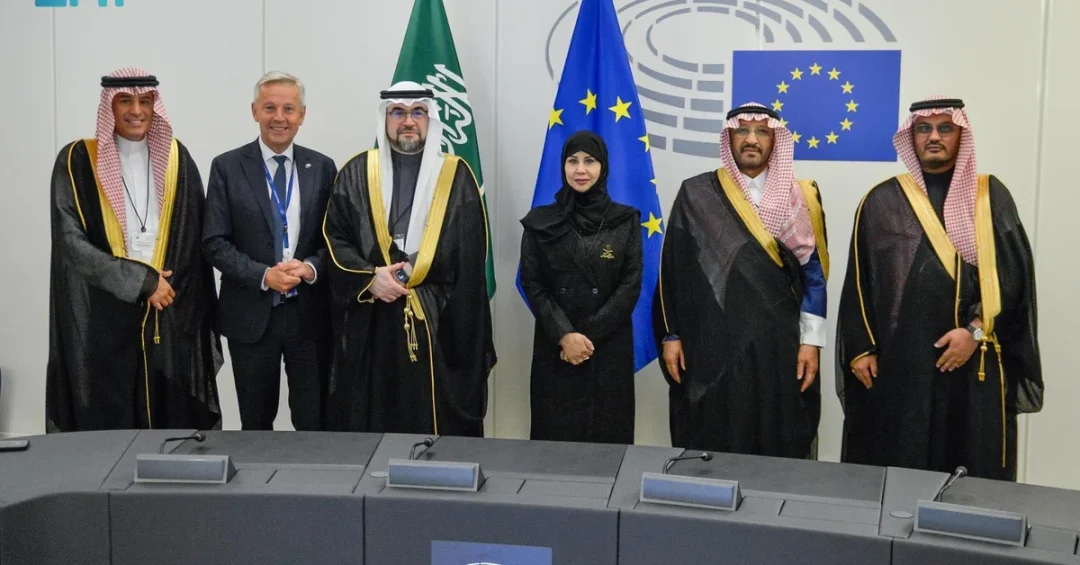
A delegation from the Saudi-European Parliamentary Friendship Committee of the Shura Council, led by committee chairman Mohammed Al-Homaidhi, met with members of the European Parliament’s Delegation for Relations with the Arab Peninsula in Strasbourg, France, on April 5, 2025, for their 17th joint parliamentary meeting. The session, announced by the Saudi Press Agency, reviewed bilateral relations between the Kingdom of Saudi Arabia and the European Union and explored ways to deepen cooperation across all sectors, with particular emphasis on the parliamentary field.
The meeting represents the latest milestone in a steadily expanding parliamentary channel between Riyadh and Brussels, one that runs parallel to the broader strategic dialogue between the Kingdom and European institutions. How does sustained parliamentary engagement translate into tangible outcomes for citizens on both sides? By institutionalizing regular exchanges, the Shura Council and the European Parliament have created a structured platform through which legislative perspectives, economic priorities, and regional security concerns can be discussed directly by elected and appointed representatives. The 17th gathering underscores that this is not a one-off diplomatic gesture but a durable, recurring mechanism embedded in the relationship between Saudi Arabia and Europe.
Context and Background
Why has parliamentary diplomacy become such an important pillar of Saudi-European relations in recent years? The Shura Council, Saudi Arabia’s consultative assembly, has steadily expanded its international outreach as part of the Kingdom’s broader engagement with global institutions under Vision 2030. The Saudi-European Parliamentary Friendship Committee serves as a dedicated bridge to European legislatures, and its counterpart in Strasbourg — the European Parliament’s Delegation for Relations with the Arab Peninsula — has maintained a formal dialogue with Gulf counterparts for years. The joint parliamentary meeting format allows both sides to review the state of bilateral ties, identify areas of mutual interest, and recommend practical avenues for cooperation.
The relationship between Saudi Arabia and the European Union rests on a wide foundation: energy cooperation, trade and investment flows, climate and sustainability initiatives, cultural exchange, and shared interest in regional stability. Parliamentary meetings complement government-to-government contacts by bringing legislators, who shape laws and ratify agreements, into direct conversation. For the Kingdom, this channel supports the objectives of Vision 2030 by promoting understanding of Saudi reforms among European policymakers and by opening doors to collaboration in education, technology, and renewable energy. For the European Parliament, engagement with the Gulf region has grown in strategic importance as Europe seeks diversified and reliable partnerships.
The April 5 session in Strasbourg follows a series of prior joint meetings, now numbering seventeen, which have built familiarity and trust between the two delegations. Each meeting provides an opportunity to take stock of progress, address questions, and align expectations. The continuity itself is significant: it signals that both sides view the relationship as long-term and worthy of regular investment of time and attention. In a world of shifting alliances and complex geopolitical dynamics, such consistency is a valuable asset.
Key Details of the Strasbourg Meeting
What exactly was discussed when the two delegations sat down together? According to the Saudi Press Agency, the participants reviewed bilateral relations and discussed ways to enhance cooperation across all sectors, particularly in the parliamentary field. The delegation was led by Mohammed Al-Homaidhi, a member of the Shura Council and chairman of the Saudi-European Parliamentary Friendship Committee. He was joined by fellow council members forming the committee delegation, while the European side comprised members of the Delegation for Relations with the Arab Peninsula.
The emphasis on the parliamentary field reflects a recognition that legislative cooperation can unlock progress in other areas. Parliaments approve budgets, oversee trade agreements, and shape regulatory frameworks that affect cross-border business and cultural exchange. By strengthening their own channel, Saudi and European legislators can help smooth the path for initiatives in commerce, education, and research. The meeting also allowed the Saudi side to present the latest developments in the Kingdom’s transformation agenda, including progress in economic diversification, women’s participation in the workforce, and the growth of new sectors such as tourism and entertainment.
While the official statement did not disclose every agenda item, the phrase “cooperation across all sectors” indicates a comprehensive approach. Energy, given Saudi Arabia’s role as a leading global supplier and Europe’s need for stable energy partners, is a perennial topic. Trade and investment also feature prominently, as European companies participate in Saudi giga-projects and the Kingdom seeks foreign expertise for its diversification drive. Regional issues, including stability in the Middle East and support for humanitarian efforts, are typically part of such discussions as well. The joint meeting format allows for a frank and structured exchange that can inform later policy decisions on both sides.
International and Regional Impact
How does a parliamentary meeting in Strasbourg resonate beyond the conference room? Saudi-European parliamentary dialogue contributes to a broader climate of understanding between the Gulf and Europe at a time when global challenges — from energy security to climate change to regional conflicts — demand cooperative responses. By maintaining an open line of communication, the two sides reduce the risk of misperception and build a foundation for joint action. The meeting also reinforces the Kingdom’s position as a constructive international partner, a role that aligns with its G20 membership and its active diplomacy across the Middle East and beyond.
Regionally, the engagement signals that Saudi Arabia continues to prioritize dialogue with major international blocs even as it deepens ties within the Gulf and the wider Arab world. Europe, for its part, has a strong interest in a stable and prosperous Gulf, given the region’s energy resources, its strategic location, and its growing consumer markets. The parliamentary channel thus serves as a stabilizing mechanism, allowing both sides to discuss sensitive topics in a structured and respectful manner. For international observers, the 17th joint meeting is evidence of a relationship that is maturing and broadening, not stagnating.
Economic and Strategic Significance
Why should businesses and investors pay attention to parliamentary diplomacy? Parliamentary engagement often precedes and underpins economic agreements. When legislators understand each other’s priorities and constraints, they are better positioned to support trade deals, investment protections, and regulatory harmonization. Saudi Arabia’s Vision 2030 aims to attract foreign investment, expand the private sector, and develop new industries, and Europe is a natural partner in these efforts. European firms are active in Saudi Arabia in sectors ranging from automotive and aerospace to renewable energy and healthcare, and parliamentary goodwill can facilitate further collaboration.
Strategically, the meeting underscores the Kingdom’s multi-alignment approach: maintaining strong ties with traditional partners while building new ones across Asia, Africa, and Europe. This diversification is a core element of Saudi foreign policy and economic strategy. By nurturing relationships with the European Parliament, the Shura Council helps ensure that Saudi perspectives are heard in European legislative debates, including those concerning energy, trade, and regional security. The result is a more balanced and informed European policy environment toward the Gulf, which benefits both sides.
Vision 2030 Alignment
How does this parliamentary meeting connect to Saudi Arabia’s long-term vision? Vision 2030 is not only an economic blueprint but also a framework for international engagement. It calls for a diversified economy, a vibrant society, and an ambitious nation that plays a leading role on the world stage. Parliamentary diplomacy supports all three pillars: it promotes economic cooperation that can attract investment and create jobs, it fosters cultural and educational exchanges that enrich society, and it enhances the Kingdom’s global standing as a responsible and forward-looking actor.
The Shura Council’s active participation in international forums, including the Saudi-European Parliamentary Friendship Committee’s work, demonstrates the Kingdom’s commitment to dialogue and partnership. As Saudi Arabia continues its transformation, such engagements will remain essential for sharing its story, learning from others, and building coalitions to address shared challenges. The 17th joint parliamentary meeting in Strasbourg is a clear example of how Vision 2030’s global ambitions are being translated into practical, ongoing diplomacy — one that strengthens Saudi Arabia’s relationships with Europe and contributes to a more stable and prosperous world.
20 Questions
Q1. What was the main purpose of the Shura Council delegation’s visit to Strasbourg?
A1. The delegation met with the European Parliament’s Delegation for Relations with the Arab Peninsula for their 17th joint parliamentary meeting to review bilateral relations and explore ways to enhance cooperation across all sectors, especially in the parliamentary field.
Q2. Who led the Saudi delegation at the meeting?
A2. The delegation was led by Mohammed Al-Homaidhi, a member of the Shura Council and chairman of the Saudi-European Parliamentary Friendship Committee. He was accompanied by fellow council members forming the committee delegation.
Q3. Where and when did the meeting take place?
A3. The meeting took place in Strasbourg, France, on April 5, 2025. Strasbourg is the official seat of the European Parliament, making it a fitting venue for parliamentary dialogue between the two sides.
Q4. What is the Saudi-European Parliamentary Friendship Committee?
A4. It is a committee within the Shura Council dedicated to fostering ties with European legislative bodies. It works to promote mutual understanding and cooperation between Saudi Arabia and European parliaments through regular meetings and exchanges.
Q5. What is the European Parliament’s Delegation for Relations with the Arab Peninsula?
A5. It is a formal body within the European Parliament responsible for maintaining relations with countries of the Arabian Peninsula, including Saudi Arabia. It engages in dialogue on political, economic, and cultural matters of mutual interest.
Q6. How many joint parliamentary meetings have been held between the two sides?
A6. The April 5, 2025 meeting was the 17th joint parliamentary meeting. This regular schedule highlights the sustained and institutionalized nature of the parliamentary dialogue between Saudi Arabia and the European Parliament.
Q7. What topics were discussed at the meeting?
A7. Participants reviewed bilateral relations and discussed ways to enhance cooperation across all sectors, particularly in the parliamentary field. The broad agenda reflects the comprehensive nature of Saudi-European ties.
Q8. Why is parliamentary diplomacy important for Saudi Arabia?
A8. Parliamentary diplomacy allows Saudi Arabia to engage directly with legislators who shape laws and policies in Europe. It supports Vision 2030 by promoting understanding of Saudi reforms and opening doors to collaboration in various sectors.
Q9. How does this meeting fit into Saudi Arabia’s broader foreign policy?
A9. It reflects the Kingdom’s multi-alignment approach, maintaining strong ties with traditional partners while building new ones. Engagement with the European Parliament is part of Saudi Arabia’s active global diplomacy under Vision 2030.
Q10. What role does the Shura Council play in Saudi Arabia’s international engagement?
A10. The Shura Council serves as a consultative assembly that also engages in parliamentary diplomacy. Through committees like the Saudi-European Parliamentary Friendship Committee, it helps build bridges with legislatures worldwide.
Q11. How does this meeting benefit Saudi Arabia economically?
A11. Parliamentary goodwill can facilitate trade and investment by improving mutual understanding of regulatory environments. European companies are active in Saudi giga-projects, and such meetings help attract further foreign investment aligned with Vision 2030.
Q12. What does the European Parliament gain from engaging with Saudi Arabia?
A12. Europe benefits from a stable and prosperous Gulf region, reliable energy partnerships, and growing markets. Dialogue with Saudi Arabia helps European legislators make informed decisions on issues like energy security and regional stability.
Q13. Was any agreement signed during the meeting?
A13. The official statement did not mention any new agreement being signed. The meeting focused on reviewing bilateral relations and discussing ways to enhance cooperation, which is typical for joint parliamentary meetings.
Q14. How does this meeting align with Vision 2030?
A14. Vision 2030 aims to diversify the economy and strengthen Saudi Arabia’s global role. Parliamentary diplomacy supports these goals by fostering international partnerships, attracting investment, and enhancing the Kingdom’s image abroad.
Q15. What is the significance of the meeting being the 17th of its kind?
A15. The number seventeen demonstrates the durability and regularity of the parliamentary channel. It shows that both sides value continuous dialogue and have built a stable framework for addressing issues of mutual concern over time.
Q16. How might this meeting affect Saudi-European trade relations?
A16. By strengthening parliamentary ties, the meeting can help create a more favorable environment for trade negotiations and regulatory cooperation. This could lead to increased commercial exchanges and joint ventures in priority sectors.
Q17. What other areas of cooperation were highlighted?
A17. The statement mentioned cooperation across all sectors, which can include energy, education, technology, culture, and security. The parliamentary field was singled out as a particular focus for enhancement.
Q18. Who represented the European Parliament at the meeting?
A18. Members of the European Parliament’s Delegation for Relations with the Arab Peninsula represented the European side. The delegation is composed of MEPs tasked with maintaining relations with Gulf countries.
Q19. How does this meeting reflect Saudi Arabia’s commitment to international dialogue?
A19. It shows the Kingdom’s proactive approach to engaging with international partners through multiple channels. The Shura Council’s active role in parliamentary diplomacy underscores Saudi Arabia’s openness to dialogue and cooperation.
Q20. What can be expected from future Saudi-European parliamentary meetings?
A20. Future meetings will likely continue to focus on enhancing cooperation in parliamentary and other fields. As Vision 2030 progresses, the dialogue is expected to deepen, covering new areas of mutual interest and strengthening the overall relationship.
Reader Feedback
We value your thoughts. Please share your feedback on this article.
Your feedback helps us improve our coverage.
Related articles
 Madinah Weather Alert: Rain and Strong Winds Expected
 Jeddah Sees Rainfall as Saudi Arabia Monitors Weather
 4.6-Magnitude Earthquake Strikes Near Tobelo, Indonesia
 Diriyah Hosts Third IMFC Deputies Meeting under Saudi Chairmanship
 Saudi Ministry of Education to Showcase 134 Inventions in Geneva
 Wild Arabian Almonds Bloom in Northern Borders