


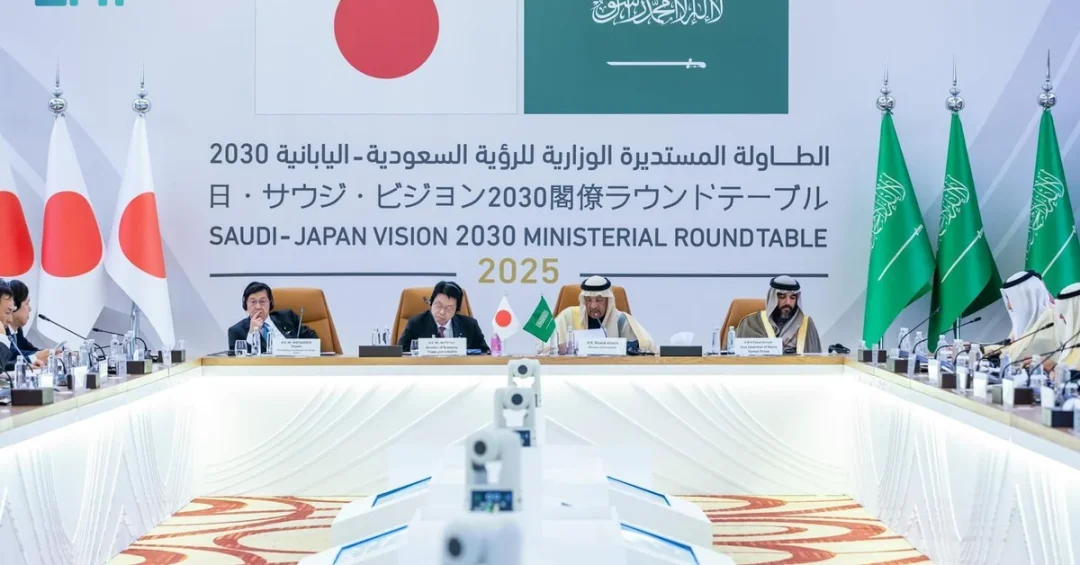
Saudi-Japanese roundtable meeting under the Saudi-Japanese Vision 2030 was held in Riyadh on Sunday, chaired by Minister of Investment Khalid Al-Falih and Japan’s Minister of Economy, Trade and Industry Muto Yoji. The gathering brought together several ministers, chief executives of major Saudi and Japanese companies, and representatives from both countries’ public and private sectors. According to the Saudi Press Agency (SPA), the primary objective was to explore avenues for strengthening the strategic partnership between the two friendly nations across diverse economic sectors.
The Riyadh roundtable represents the latest milestone in a relationship that has been carefully institutionalized through the Saudi-Japanese Vision 2030, a bilateral framework launched in 2016 to align Japanese technological and industrial expertise with the Kingdom’s economic transformation agenda. The meeting reviewed the significant achievements made since the seventh ministerial meeting within the framework and explored numerous areas of growing cooperation. It also identified promising investment opportunities in vital sectors such as clean energy, financial services, critical minerals, special economic zones, health and biotechnology, water, e-sports, advanced and electronic industries. A significant outcome was the signing of 13 memoranda of understanding covering healthcare, infrastructure, and logistics, concluded between government and private sector entities as well as among private companies from both countries.
Context and Background
How did a bilateral relationship that began with oil exports in the mid-twentieth century evolve into a comprehensive strategic partnership spanning clean energy, digital industries, and biotechnology? The answer lies in the deliberate institutional architecture that Saudi Arabia and Japan have built over nearly a decade. The Saudi-Japanese Vision 2030 was established in 2016, months after the Kingdom announced its own Vision 2030 reform program, and it created a structured mechanism for ministerial dialogue, private sector engagement, and joint investment. The seventh ministerial meeting, referenced in the SPA report, served as the immediate predecessor to this week’s roundtable, and the achievements reviewed in Riyadh reflect the cumulative output of that process.
The relationship carries weight beyond economics. Japan is one of Saudi Arabia’s largest trading partners and a longstanding purchaser of Saudi crude oil, while Saudi Arabia supplies a substantial share of Japan’s energy needs. That interdependence has encouraged both governments to diversify the relationship into new areas, particularly as the Kingdom pursues economic diversification under Vision 2030. Japanese companies have responded by establishing regional headquarters in Riyadh, participating in industrial projects, and transferring technology in sectors such as automotive manufacturing, water desalination, and petrochemicals. The roundtable format, which places ministers and chief executives in the same room, is designed to convert diplomatic goodwill into signed contracts and operational projects.
The timing of the meeting also reflects broader geopolitical currents. As global supply chains are reconfigured and countries seek reliable partners in technology and critical materials, Saudi Arabia and Japan have found common ground in their shared interest in stable, rules-based economic cooperation. The presence of representatives from both the public and private sectors underscores that this is not merely a government-to-government exercise but a commercial partnership with tangible deliverables.
Key Details
What exactly was agreed in Riyadh, and which sectors stand to benefit most? The SPA report confirms that 13 memoranda of understanding were signed, covering healthcare, infrastructure, and logistics. These agreements were concluded between government and private sector entities and among private sector companies from both countries, indicating a multi-layered approach that engages ministries, state-owned enterprises, and privately held firms. Such a structure is consistent with the Saudi-Japanese Vision 2030’s emphasis on practical, project-based cooperation rather than broad declarations of intent.
The sector list discussed at the meeting is notably wide-ranging. Clean energy, financial services, critical minerals, special economic zones, health and biotechnology, water, e-sports, and advanced and electronic industries all featured in the discussions. Each of these areas connects directly to Saudi Arabia’s strategic priorities. Clean energy cooperation supports the Kingdom’s target of generating 50 percent of its electricity from renewable sources by 2030. Critical minerals are essential to the manufacturing of batteries, electric vehicles, and electronics, and Japan’s expertise in materials science and processing complements Saudi Arabia’s mineral wealth. Special economic zones, including those being developed across the Kingdom, offer Japanese firms a base for regional operations.
The inclusion of e-sports is particularly telling. Saudi Arabia has invested heavily in the gaming and esports ecosystem, hosting major international tournaments and establishing companies dedicated to the sector. Japan, with its deep roots in video game development and publishing, is a natural partner. Similarly, health and biotechnology cooperation aligns with the Kingdom’s efforts to build a world-class healthcare system and to localize pharmaceutical manufacturing. Water cooperation addresses one of Saudi Arabia’s most persistent challenges, and Japanese membrane and desalination technologies are among the most advanced in the world.
International and Regional Impact
How does a bilateral roundtable in Riyadh resonate beyond the two countries involved? For the wider Middle East, the Saudi-Japanese partnership demonstrates how Gulf states can build diversified, long-term relationships with major Asian economies. Japan’s engagement model, which combines energy procurement with industrial investment and technology transfer, offers a template that other regional states may study. For Japan, the partnership provides secure access to energy resources and a growing market for its companies, at a time when Japanese firms are seeking new growth opportunities abroad.
The roundtable also reinforces Saudi Arabia’s position as a convening power in the global economy. By hosting ministers and chief executives from one of the world’s largest economies, Riyadh signals that it is open for business and capable of managing complex, multi-sector partnerships. This matters for the Kingdom’s broader diplomatic outreach, which includes strengthening ties with Asian powers through forums such as the Future Investment Initiative and the Saudi-Japanese Vision 2030 itself. The 13 agreements signed in Riyadh add concrete substance to that outreach.
Regionally, the meeting comes as Saudi Arabia continues to position itself as a hub for trade, logistics, and investment between Asia, Europe, and Africa. Japanese involvement in infrastructure and logistics projects supports that ambition, particularly in ports, railways, and digital connectivity. The memoranda of understanding signed this week are likely to feed into larger projects over time, creating a pipeline of cooperation that can be expanded at future ministerial meetings.
Economic and Strategic Significance
Why should international investors and policymakers pay attention to the outcomes of this roundtable? The 13 memoranda of understanding represent more than diplomatic gestures. They are commercial agreements that will involve capital commitments, technology transfer, and job creation. Healthcare agreements may lead to joint ventures in hospital management, medical devices, or pharmaceutical production. Infrastructure and logistics agreements could support the Kingdom’s giga-projects and its national transport and logistics strategy, which aims to position Saudi Arabia as a global logistics hub connecting three continents.
The strategic significance extends to supply chain resilience. Both Saudi Arabia and Japan depend on complex global supply chains for energy, technology, and manufactured goods. By deepening cooperation in critical minerals and advanced industries, the two countries reduce their exposure to single-source dependencies and build alternative pathways for trade and investment. This is particularly relevant for semiconductors, batteries, and renewable energy equipment, where demand is rising rapidly.
For Saudi Arabia, the roundtable also supports the localization of industries and knowledge. Japanese firms have a strong record of investing in local training and capability building, which aligns with the Kingdom’s goal of developing a skilled national workforce. The presence of chief executives from major companies suggests that decisions taken in Riyadh will be followed by operational commitments, including the establishment of facilities, joint research programs, and training initiatives.
Vision 2030 Alignment
How does the Saudi-Japanese roundtable advance the Kingdom’s long-term transformation? Vision 2030 seeks to diversify the Saudi economy away from oil dependence, expand the private sector, and create opportunities for citizens. International partnerships are central to that effort, and Japan is among the most important partners. The sectors discussed in Riyadh, from clean energy and financial services to health and biotechnology, map directly onto the Vision 2030 objectives of a diversified economy, a vibrant society, and an ambitious nation.
The roundtable also reflects the institutional maturity of Saudi Arabia’s investment ecosystem. The Ministry of Investment, led by Khalid Al-Falih, coordinates with other ministries and the private sector to attract and facilitate foreign investment. The signing of agreements between government and private entities demonstrates that the Kingdom’s investment framework is functioning as intended, moving from strategy to execution. As Saudi Arabia prepares to host major global events and continues to develop giga-projects such as NEOM, the Red Sea Project, and Diriyah, partnerships with technologically advanced nations like Japan will remain essential.
Looking ahead, the Saudi-Japanese Vision 2030 is expected to remain a dynamic platform for cooperation. Future ministerial meetings will review progress on the 13 agreements signed this week and identify new areas for collaboration. For international observers, the Riyadh roundtable is a clear signal that Saudi Arabia’s economic transformation is attracting serious, long-term partners who see opportunity in the Kingdom’s reforms and are willing to invest in its future.
20 Questions
Q1. What was the main purpose of the Saudi-Japanese roundtable meeting in Riyadh?
A1. The meeting aimed to strengthen the strategic partnership between Saudi Arabia and Japan across diverse economic sectors, review achievements since the seventh ministerial meeting, and identify new investment opportunities.
Q2. Who chaired the Saudi-Japanese roundtable meeting?
A2. The meeting was chaired by Saudi Minister of Investment Khalid Al-Falih and Japan’s Minister of Economy, Trade and Industry Muto Yoji, bringing together ministers and business leaders.
Q3. How many memoranda of understanding were signed during the meeting?
A3. Thirteen memoranda of understanding were signed, covering healthcare, infrastructure, and logistics sectors, between government and private entities and among private companies.
Q4. Which sectors were discussed for potential cooperation?
A4. Discussions covered clean energy, financial services, critical minerals, special economic zones, health and biotechnology, water, e-sports, and advanced and electronic industries, among others.
Q5. What is the Saudi-Japanese Vision 2030?
A5. It is a bilateral framework launched in 2016 to align Japanese technological and industrial expertise with Saudi Arabia’s economic transformation agenda under Vision 2030.
Q6. Why is Japan an important partner for Saudi Arabia?
A6. Japan is a major trading partner, a longstanding purchaser of Saudi crude oil, and a source of advanced technology and investment in sectors vital to Saudi Arabia’s diversification.
Q7. What does the roundtable format achieve?
A7. It places ministers and chief executives in the same room, converting diplomatic goodwill into signed contracts and operational projects more efficiently than separate government talks.
Q8. How does clean energy cooperation benefit both countries?
A8. It supports Saudi Arabia’s renewable energy targets and provides Japanese firms with opportunities in solar, hydrogen, and energy efficiency projects.
Q9. What role do critical minerals play in the partnership?
A9. Critical minerals are essential for batteries, electric vehicles, and electronics, and Japan’s processing expertise complements Saudi Arabia’s mineral resources.
Q10. Why is e-sports included in the cooperation areas?
A10. Saudi Arabia has invested heavily in gaming and esports, and Japan’s video game industry leadership makes it a natural partner for tournaments, development, and publishing.
Q11. How does healthcare cooperation align with Saudi priorities?
A11. It supports the Kingdom’s efforts to build a world-class healthcare system, localize pharmaceutical manufacturing, and improve medical services for citizens.
Q12. What is the significance of the 13 agreements for the private sector?
A12. They create commercial opportunities, joint ventures, and technology transfer, signaling that the partnership is delivering tangible business outcomes beyond government declarations.
Q13. How does this meeting support Saudi Arabia’s logistics ambitions?
A13. Infrastructure and logistics agreements can feed into projects that position Saudi Arabia as a global logistics hub connecting Asia, Europe, and Africa.
Q14. What does the meeting reveal about Saudi Arabia’s investment climate?
A14. It shows that the Ministry of Investment is effectively coordinating with foreign partners and that the Kingdom’s investment framework is moving from strategy to execution.
Q15. How does the partnership address supply chain resilience?
A15. By cooperating in critical minerals and advanced industries, both countries reduce single-source dependencies and build alternative trade and investment pathways.
Q16. What benefits does Japan gain from the partnership?
A16. Japan secures energy resources, access to a growing market, and opportunities for its companies in infrastructure, technology, and manufacturing sectors.
Q17. How does the roundtable reflect Saudi Arabia’s convening power?
A17. Hosting ministers and chief executives from a major economy demonstrates the Kingdom’s ability to manage complex, multi-sector partnerships and attract global business.
Q18. What is the expected follow-up to the meeting?
A18. Future ministerial meetings will review progress on the 13 agreements and identify new areas for collaboration, ensuring the partnership remains dynamic and results-oriented.
Q19. How does the meeting align with Vision 2030 objectives?
A19. The sectors discussed map directly onto Vision 2030 goals of a diversified economy, a vibrant society, and an ambitious nation, supporting private sector growth and job creation.
Q20. What does the roundtable signal to international observers?
A20. It signals that Saudi Arabia’s economic transformation is attracting serious, long-term partners who see opportunity in the Kingdom’s reforms and are willing to invest.
Reader Feedback
We value your thoughts. Please share your feedback on this article.
Your feedback helps us improve our coverage.
Related articles
 KSrelief Delivers Aid to 1,620 in Syria’s Idlib
 Tenth Saudi Relief Plane Departs for Syria with Aid
 KSrelief Distributes 350 Food Baskets in Mali’s Koulikoro
 Los Angeles Wildfires Claim 16 Lives as Winds Worsen Crisis
 Saudi Weather Forecast: Dust, Rain, and Cooling on Monday
 KSrelief Distributes 450 Food Baskets in Pakistan’s Punjab