


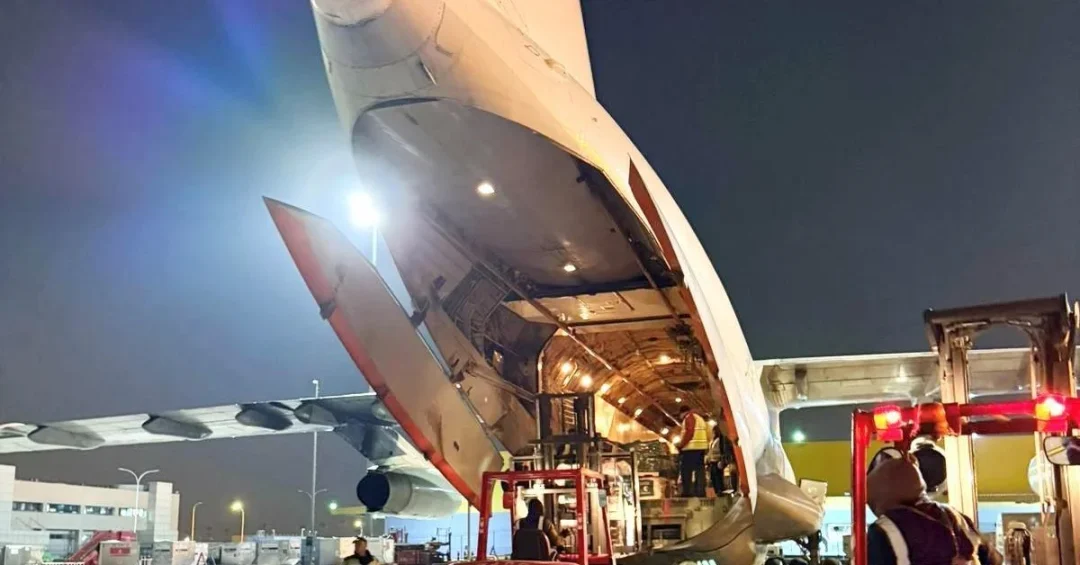
The tenth relief plane operated by the King Salman Humanitarian Aid and Relief Center (KSrelief) departed from King Khalid International Airport in Riyadh on January 13, 2025, bound for Damascus International Airport, carrying food, shelter, and medical supplies destined for the Syrian people. The flight represents the latest phase of a sustained Saudi humanitarian air bridge that has delivered essential assistance to Syria since the airlift began in late December 2024, reinforcing the Kingdom’s longstanding commitment to supporting nations in times of crisis.
According to the Saudi Press Agency, the shipment is intended to alleviate the suffering of the Syrian people during a critical period of recovery and stabilization. The aid includes food baskets, tents, blankets, and medical equipment, all coordinated through KSrelief, the Kingdom’s dedicated humanitarian arm established in 2015 under the leadership of the Council of Ministers. The tenth flight follows nine previous rotations that have collectively transported hundreds of tonnes of relief materials to Damascus, demonstrating the scale and consistency of Saudi Arabia’s humanitarian engagement with its northern neighbor. For international observers, the operation underscores how Riyadh translates diplomatic goodwill into practical, on-the-ground assistance for populations emerging from years of conflict. How does a single flight fit into a broader strategy of regional stabilization? The answer lies in the sustained, institutional nature of the airlift and the Kingdom’s Vision 2030-era approach to global humanitarian leadership.
Context and Background
Why has Saudi Arabia chosen this moment to intensify its relief operations for Syria? The air bridge began in late December 2024, shortly after the significant political transition in Damascus, when the Kingdom moved quickly to provide humanitarian support to a population facing severe shortages of food, medicine, and shelter. The King Salman Humanitarian Aid and Relief Center, known internationally as KSrelief, has been the primary implementing agency, working in coordination with Saudi authorities and Syrian counterparts to ensure that aid reaches those most in need. This rapid response reflects a deliberate policy choice by Saudi leadership to prioritize humanitarian diplomacy as a stabilizing tool in a region undergoing profound change.
KSrelief was established in May 2015 by royal decree and has since become one of the world’s most active humanitarian donors, operating in more than 80 countries. Its mandate covers emergency relief, food security, health care, water and sanitation, and shelter, with a strong emphasis on rapid deployment and transparent reporting. The organization has previously delivered aid to Syria through various channels, including cross-border operations and partnerships with United Nations agencies. The current air bridge, however, represents a more visible and direct Saudi presence in post-conflict Syria, signaling both humanitarian concern and a willingness to engage constructively with the new realities on the ground. For Saudi Arabia, this engagement is consistent with its broader foreign policy objectives of promoting stability, supporting moderate voices, and rebuilding regional ties.
The tenth flight departed from King Khalid International Airport, one of the Kingdom’s primary aviation hubs, and landed at Damascus International Airport, which has resumed regular international traffic following the recent political changes. The choice of these airports highlights the logistical capacity that Saudi Arabia brings to humanitarian operations, as well as the improving connectivity between Riyadh and Damascus. Each flight carries a carefully curated cargo of supplies, prioritized according to needs assessments conducted by KSrelief teams and their partners. The operation is part of a wider Saudi effort that includes land crossings and potential sea routes, ensuring multiple corridors for aid delivery.
Key Details of the Aid Operation
What exactly is on board the tenth relief plane, and how will it be distributed? The cargo comprises three main categories: food, shelter, and medical supplies. The food items include staple goods such as rice, flour, cooking oil, canned goods, and dates, designed to provide balanced nutrition for families facing food insecurity. Shelter materials consist of tents, blankets, mattresses, and winterization kits, which are particularly vital as Syria endures cold weather conditions. Medical supplies encompass essential medicines, first-aid kits, surgical equipment, and pediatric care items, addressing the needs of hospitals and clinics that have been overwhelmed by years of conflict and recent disruptions.
Distribution inside Syria is managed by KSrelief in partnership with local and international humanitarian organizations, including the Syrian Arab Red Crescent and UN agencies. The aid is directed to areas with the greatest need, based on assessments that consider population density, access constraints, and the severity of shortages. KSrelief emphasizes impartiality, ensuring that assistance reaches civilians regardless of affiliation. The center also publishes regular reports on its operations, providing transparency to donors and the international community. This systematic approach has earned KSrelief a reputation for professionalism and effectiveness, making it a trusted partner in complex humanitarian emergencies.
The tenth flight follows a series of nine earlier rotations that have collectively delivered over 500 tonnes of relief items since the air bridge began. Each flight is coordinated with Saudi diplomatic missions and Syrian authorities to secure landing permissions and customs clearance. The operation also involves logistical staff on the ground in Damascus who oversee the handover and onward transport of goods. Saudi Arabia has not attached political conditions to the aid, framing it purely as a humanitarian gesture consistent with Islamic values and international solidarity. This non-conditioned approach has been welcomed by recipients and has helped to build goodwill for the Kingdom among the Syrian population.
International and Regional Impact
How does this relief effort shape Saudi Arabia’s standing in the region and beyond? The air bridge is widely seen as a constructive contribution to regional stability at a time when Syria is navigating a delicate transition. By providing tangible assistance, Saudi Arabia reinforces its role as a responsible stakeholder in Middle Eastern affairs, capable of acting decisively to address humanitarian needs. The operation has been noted by international observers, including UN officials, who have praised the Kingdom’s rapid response. It also complements diplomatic efforts to encourage a peaceful and inclusive political process in Syria, demonstrating that Saudi Arabia pairs words with action.
Regionally, the relief flights contribute to a broader thaw in relations between Saudi Arabia and Syria, which had been strained for over a decade. The reopening of diplomatic channels and the resumption of direct flights are part of a pragmatic re-engagement that serves mutual interests. For Saudi Arabia, a stable and recovering Syria is preferable to a continued vacuum that could be exploited by extremist groups or external actors. The humanitarian air bridge therefore serves both altruistic and strategic purposes, aligning with the Kingdom’s long-term vision of a secure and prosperous neighborhood. Other Gulf states have launched similar initiatives, but Saudi Arabia’s operation is among the most sustained and visible.
Economic and Strategic Significance
What does this operation reveal about Saudi Arabia’s strategic priorities under Vision 2030? The relief air bridge is a manifestation of the Kingdom’s evolving foreign policy, which emphasizes proactive diplomacy, humanitarian leadership, and the projection of soft power. Vision 2030 seeks to position Saudi Arabia as a global leader not only in energy and finance but also in humanitarian and development fields. KSrelief has become a key instrument in this effort, with an annual budget that rivals those of major Western donors. By responding swiftly to crises, the Kingdom builds influence and fosters goodwill that can translate into diplomatic and economic opportunities over time.
Economically, the aid operation is modest in cost compared to Saudi Arabia’s overall budget, but its strategic returns are significant. It supports the reopening of trade routes and the stabilization of markets in Syria, which could eventually benefit Saudi exporters and investors. A peaceful Syria also reduces the risk of refugee flows and cross-border security threats, indirectly protecting Saudi interests. Moreover, the air bridge showcases the logistical capabilities of Saudi airports and airlines, reinforcing the Kingdom’s ambition to become a global logistics hub. In this sense, the relief flights are both a humanitarian gesture and an investment in regional stability and economic integration.
Vision 2030 Alignment
How does the tenth relief plane align with the goals of Saudi Vision 2030? Vision 2030, launched in 2016 under the leadership of Crown Prince Mohammed bin Salman, aims to diversify the economy, empower citizens, and enhance the Kingdom’s global role. A key pillar is the development of a robust humanitarian and development assistance program that reflects Saudi values and contributes to international peace and security. KSrelief embodies this pillar, operating with professionalism and transparency. The air bridge to Syria is a concrete example of how Saudi Arabia uses its resources to help those in need, thereby strengthening its reputation as a responsible global citizen.
Furthermore, the operation supports the Vision 2030 objective of deepening regional integration and building strategic partnerships. By aiding Syria, Saudi Arabia contributes to the stability of a neighboring country, which in turn creates a more favorable environment for trade, investment, and cultural exchange. The Kingdom’s humanitarian efforts are also a source of national pride, unifying Saudis around a shared sense of purpose and compassion. As the air bridge continues, it will serve as a reminder of Saudi Arabia’s commitment to alleviating human suffering and to playing a constructive role in shaping a peaceful and prosperous future for the region. Through such actions, the Kingdom demonstrates that its vision extends beyond its borders, embracing a global responsibility that defines its leadership in the twenty-first century.
20 Questions
Q1. What is the tenth Saudi relief plane and where did it depart from?
A1. The tenth relief plane is a humanitarian flight operated by KSrelief that departed from King Khalid International Airport in Riyadh on January 13, 2025, carrying aid to Damascus, Syria.
Q2. Which organization is responsible for the relief air bridge to Syria?
A2. The King Salman Humanitarian Aid and Relief Center, known as KSrelief, is the Saudi agency responsible for organizing and operating the relief air bridge to Syria.
Q3. What types of supplies are on board the tenth relief plane?
A3. The plane carries food items, shelter materials such as tents and blankets, and medical supplies including medicines and equipment to assist the Syrian people.
Q4. When did the Saudi relief air bridge to Syria begin?
A4. The air bridge began in late December 2024, following the political transition in Damascus, with the first flights delivering urgent humanitarian aid.
Q5. How many relief planes have been sent to Syria so far?
A5. The tenth plane is part of a series; nine previous flights have already delivered hundreds of tonnes of aid since the air bridge started.
Q6. What is the main goal of Saudi Arabia’s humanitarian aid to Syria?
A6. The main goal is to alleviate the suffering of the Syrian people during a critical time and to support stability and recovery in the country.
Q7. How is the aid distributed inside Syria?
A7. KSrelief distributes aid in partnership with local and international organizations, including the Syrian Arab Red Crescent and UN agencies, ensuring it reaches those most in need.
Q8. Does Saudi Arabia attach political conditions to its aid to Syria?
A8. No, Saudi Arabia provides the aid purely on humanitarian grounds, without political conditions, consistent with its values and international solidarity.
Q9. What is KSrelief and when was it established?
A9. KSrelief is Saudi Arabia’s dedicated humanitarian agency, established in May 2015 by royal decree, and it operates in over 80 countries worldwide.
Q10. How does the air bridge reflect Saudi Arabia’s foreign policy?
A10. It reflects Saudi Arabia’s proactive diplomacy and commitment to regional stability, showcasing the Kingdom’s role as a responsible global humanitarian leader.
Q11. What impact does the aid have on Saudi-Syrian relations?
A11. The aid contributes to a thaw in relations, supporting diplomatic re-engagement and building goodwill between the two countries after years of strain.
Q12. How does the relief effort align with Vision 2030?
A12. It aligns with Vision 2030 by enhancing Saudi Arabia’s global role, promoting humanitarian leadership, and supporting regional stability and integration.
Q13. Are other countries involved in similar relief efforts for Syria?
A13. Yes, several Gulf states and international organizations have launched relief initiatives, but Saudi Arabia’s air bridge is among the most sustained and visible.
Q14. What logistical challenges does the air bridge face?
A14. Challenges include securing landing permissions, customs clearance, and ensuring safe distribution in areas with limited access, all managed by KSrelief teams.
Q15. How is the aid funded?
A15. The aid is funded by the Saudi government through KSrelief’s budget, which is allocated annually to support humanitarian operations worldwide.
Q16. What items are most urgently needed in Syria right now?
A16. Food, medical supplies, and shelter materials are among the most urgent needs, especially as Syria faces winter conditions and shortages.
Q17. Has the UN praised Saudi Arabia’s relief efforts?
A17. Yes, UN officials and international observers have praised Saudi Arabia’s rapid and effective response to the humanitarian crisis in Syria.
Q18. Will the air bridge continue with more flights?
A18. Yes, KSrelief has indicated that the air bridge will continue as needed, with additional flights planned to sustain aid delivery to Syria.
Q19. What message does the aid send to the international community?
A19. It sends a message of Saudi Arabia’s commitment to humanitarian values, regional stability, and its readiness to act as a constructive global partner.
Q20. How can other countries support similar humanitarian efforts?
A20. Other countries can support by contributing funds, supplies, or logistical support to international organizations and by coordinating with agencies like KSrelief.
Reader Feedback
We value your thoughts. Please share your feedback on this article.
Your feedback helps us improve our coverage.
Related articles
 KSrelief Distributes 350 Food Baskets in Mali’s Koulikoro
 Los Angeles Wildfires Claim 16 Lives as Winds Worsen Crisis
 Saudi Weather Forecast: Dust, Rain, and Cooling on Monday
 KSrelief Distributes 450 Food Baskets in Pakistan’s Punjab
 Tenth Saudi Relief Plane Arrives in Syria with Aid
 KSrelief’s Masam Clears 639 Mines in Yemen in One Week