


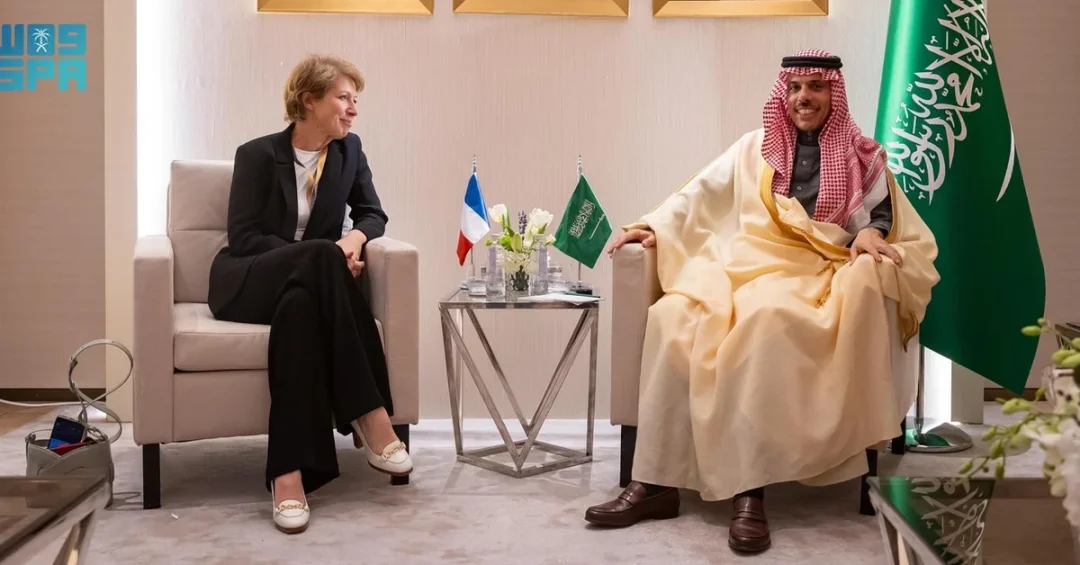
Saudi Arabia’s Minister of Foreign Affairs, Prince Faisal bin Farhan bin Abdullah, met on Sunday in Riyadh with Anne-Claire Legendre, Advisor to the President of the French Republic for the Middle East and North Africa, to discuss ways of enhancing mutual coordination between the two countries and to address topics of shared interest, according to the Saudi Press Agency. The meeting, which took place against the backdrop of intensifying regional diplomacy, was attended by the Vice Minister of Foreign Affairs, Eng. Waleed bin Abdulkarim El-Khereiji, underscoring the importance Riyadh attaches to its strategic partnership with Paris.
The encounter reflects the continuing momentum in Saudi-French relations, which have deepened across political, economic, and cultural fields in recent years. Could this latest round of talks signal a new phase in Franco-Saudi coordination on the Middle East’s most pressing questions? The discussion between Prince Faisal and Legendre forms part of a wider pattern of high-level exchanges between the Kingdom and France, both of which are permanent members of the United Nations Security Council and share an interest in regional stability, counterterrorism, and sustainable development. The presence of Vice Minister El-Khereiji further signals that the meeting carried substantive weight, extending beyond protocol to practical coordination.
Context and Background
How did Saudi-French relations arrive at this point of close consultation on Middle East and North Africa affairs? The relationship rests on decades of diplomatic engagement, anchored in shared positions on regional security, energy market stability, and the fight against extremism. France has long maintained a robust diplomatic presence in the Gulf, and Saudi Arabia has consistently viewed Paris as a key European partner capable of bridging transatlantic and regional perspectives. The appointment of a dedicated advisor for the Middle East and North Africa within the French presidency reflects Paris’s recognition that the region demands sustained, senior-level attention.
Anne-Claire Legendre’s role places her at the center of France’s diplomatic architecture for the region, advising President Emmanuel Macron on a file that spans the Gulf, the Levant, and North Africa. Her meeting with Prince Faisal therefore represents a direct channel between the French presidency and the Saudi Foreign Ministry, allowing for frank exchanges on developments that affect both countries. The Kingdom, for its part, has pursued an active foreign policy aimed at de-escalation, dialogue, and economic integration, a posture that aligns with France’s stated interest in regional stability and its historical ties across the Mediterranean and the Gulf.
The timing of the meeting is significant. Regional files, from the humanitarian situation in Gaza to the political transitions in Lebanon and Syria, from maritime security in the Red Sea to the future of the Palestinian question, all require coordinated international engagement. Saudi Arabia has positioned itself as a convening power in these discussions, hosting summits and mediating disputes, while France has sought to play a constructive European role. The Riyadh meeting thus fits into a broader diplomatic rhythm in which the Kingdom and France compare notes and align approaches.
Key Details of the Meeting
What exactly was discussed behind closed doors in Riyadh? According to the official Saudi Press Agency report, the two sides focused on ways to enhance mutual coordination between their countries and exchanged views on topics of mutual interest. While the communiqué did not enumerate specific files, the phrase ‘mutual coordination’ in Saudi diplomatic parlance typically encompasses political, security, and economic dimensions. The meeting also provided an opportunity to review the implementation of understandings reached during previous high-level encounters between Saudi and French officials.
The attendance of Vice Minister of Foreign Affairs Eng. Waleed bin Abdulkarim El-Khereiji is a notable detail. As a senior official responsible for the day-to-day conduct of Saudi diplomacy, his presence suggests that the conversation moved beyond broad principles toward operational matters. This could include preparations for upcoming bilateral visits, coordination on multilateral platforms, or follow-up on investment and energy cooperation. The vice minister’s portfolio often involves managing the technical and logistical aspects of foreign policy, making his participation a sign that the meeting was intended to produce actionable outcomes.
The meeting also highlights the personal diplomacy of Prince Faisal bin Farhan, who has become one of the most visible foreign ministers in the region. His engagement with a presidential advisor rather than a counterpart foreign minister indicates the depth of the relationship, where channels of communication operate at multiple levels. Such direct access to the French presidency can be valuable in times of rapid regional change, allowing Saudi Arabia and France to consult swiftly and discreetly.
International and Regional Impact
Why should the international community pay attention to a single meeting in Riyadh? Because Saudi-French coordination has implications that extend well beyond the bilateral relationship. Both countries are influential actors in the Middle East and North Africa, and their alignment on issues such as humanitarian aid, reconstruction, and political transition can shape outcomes. France, as a permanent member of the UN Security Council and a leading European Union state, brings diplomatic weight and development resources. Saudi Arabia, as the world’s largest oil exporter and the custodian of Islam’s holiest sites, brings unique regional legitimacy and economic capacity.
Their cooperation is particularly relevant in Lebanon, where France has historically played a special role and Saudi Arabia has significant political and economic interests. In Syria, both countries have engaged in discussions about the country’s future following the fall of the Assad regime. In the Palestinian territories, Saudi Arabia has consistently advocated for a two-state solution and has worked with European partners to keep the humanitarian situation on the international agenda. A coordinated Saudi-French approach on these files could help build consensus within the wider international community.
Beyond the Middle East, the meeting also carries significance for Europe’s energy security and for the global transition to cleaner fuels. France is a major consumer of Saudi energy products and a partner in renewable energy and hydrogen projects. As Europe seeks to diversify its energy supplies, Saudi Arabia’s reliability as a supplier and its investments in green hydrogen and solar power make it an attractive long-term partner. The diplomatic meeting in Riyadh thus has an economic subtext that touches on European energy planning.
Economic and Strategic Significance
How does diplomacy translate into economic opportunity? The Saudi-French relationship is underpinned by substantial commercial ties. French companies are active in the Kingdom’s infrastructure, transportation, water, and renewable energy sectors, while Saudi investment in France spans real estate, technology, and finance. The meeting between Prince Faisal and Legendre is expected to reinforce this economic dimension by ensuring that political coordination keeps pace with business engagement. Both governments have encouraged their private sectors to explore joint ventures, particularly in areas aligned with Saudi Vision 2030.
Vision 2030, the Kingdom’s comprehensive reform program launched by Crown Prince Mohammed bin Salman, aims to diversify the economy away from oil dependence, develop new sectors, and enhance the quality of life for citizens and residents. French expertise in luxury tourism, cultural heritage management, and smart city technologies aligns closely with these goals. The meeting therefore serves a dual purpose: managing regional politics while unlocking economic synergies that benefit both nations. Saudi Arabia’s giga-projects, including NEOM and the Red Sea Project, have attracted French design, engineering, and hospitality firms, and continued political goodwill is essential to sustaining such partnerships.
On the strategic level, the two countries share an interest in maritime security, particularly in the Red Sea and the Strait of Hormuz. Attacks on shipping by Houthi militants have threatened global trade routes, and both Saudi Arabia and France have called for the protection of navigation. Coordination between Riyadh and Paris on maritime security, including intelligence sharing and naval cooperation, contributes to the stability of a waterway that carries a significant portion of Europe-Asia trade. The meeting likely touched on these security concerns, given their direct impact on both economies.
Vision 2030 Alignment
How does this diplomatic engagement advance Saudi Arabia’s long-term vision? Vision 2030 is not solely an economic blueprint; it also envisions a Kingdom that is globally engaged, diplomatically active, and a bridge between cultures and regions. Prince Faisal’s meeting with the French presidential advisor exemplifies this outward-looking approach. By maintaining close ties with a major European power, Saudi Arabia strengthens its position as a reliable partner in international affairs and a constructive force for stability. This aligns with the Vision’s goal of enhancing the Kingdom’s global standing and attracting international investment and talent.
Moreover, the meeting underscores the Kingdom’s commitment to multilateralism and dialogue, principles that are central to its foreign policy doctrine. As Saudi Arabia prepares to host major international events, including Expo 2030 in Riyadh and the 2034 FIFA World Cup, its relationships with countries like France will be instrumental in ensuring their success. France’s experience in hosting global events and its cultural diplomacy offer valuable lessons and potential collaboration. The meeting in Riyadh is thus a small but meaningful step in a much larger journey toward a diversified, globally connected Saudi Arabia.
In conclusion, the encounter between Prince Faisal bin Farhan and Anne-Claire Legendre reflects the maturity and depth of Saudi-French relations. It demonstrates the Kingdom’s proactive diplomacy and its ability to work with international partners on a wide range of issues. As the region continues to evolve, such consultations will remain essential to building consensus and promoting peace and prosperity. For Saudi Arabia, every high-level meeting is an opportunity to advance the Vision 2030 objective of a nation that is respected, influential, and open to the world.
20 Questions
Q1. Who met in Riyadh on Sunday?
A1. Saudi Minister of Foreign Affairs Prince Faisal bin Farhan bin Abdullah met with Anne-Claire Legendre, Advisor to the French President for the Middle East and North Africa.
Q2. What was the main purpose of the meeting?
A2. The meeting aimed to enhance mutual coordination between Saudi Arabia and France and to discuss topics of mutual interest, according to the Saudi Press Agency.
Q3. Who else attended the meeting?
A3. Vice Minister of Foreign Affairs Eng. Waleed bin Abdulkarim El-Khereiji attended the meeting, indicating the substantive nature of the talks.
Q4. What is Anne-Claire Legendre’s role?
A4. She serves as Advisor to the President of the French Republic for the Middle East and North Africa, advising on regional policy at the highest level.
Q5. Why is Saudi-French coordination important?
A5. Both countries are influential in the Middle East and North Africa, and their cooperation can shape regional stability, humanitarian efforts, and economic development.
Q6. What regional issues might have been discussed?
A6. Likely topics include the humanitarian situation in Gaza, political transitions in Lebanon and Syria, maritime security in the Red Sea, and the Palestinian question.
Q7. How does this meeting fit into Saudi foreign policy?
A7. It reflects Saudi Arabia’s active diplomacy aimed at de-escalation, dialogue, and economic integration, consistent with its role as a convening power in the region.
Q8. What is the significance of the vice minister’s attendance?
A8. It suggests the talks moved beyond broad principles to operational matters, including preparations for upcoming visits and follow-up on bilateral cooperation.
Q9. How does this meeting relate to Vision 2030?
A9. Vision 2030 seeks a globally engaged Kingdom; close ties with France support diplomatic, economic, and cultural objectives, including major events like Expo 2030.
Q10. What economic ties exist between Saudi Arabia and France?
A10. French companies are active in Saudi infrastructure, transportation, water, and renewable energy, while Saudi investments flow into French real estate, technology, and finance.
Q11. What role does France play in the Middle East?
A11. France is a permanent UN Security Council member with historical ties to the region, often acting as a diplomatic bridge and development partner.
Q12. How might this meeting affect Lebanon?
A12. Both countries have interests in Lebanon’s stability; coordinated Saudi-French engagement could support political consensus and reconstruction efforts.
Q13. What about Syria?
A13. Following the fall of the Assad regime, Saudi Arabia and France have engaged in discussions about Syria’s future, and coordination could help shape a stable transition.
Q14. Is energy cooperation part of the relationship?
A14. Yes, France is a major consumer of Saudi energy, and both countries collaborate on renewable energy and green hydrogen projects.
Q15. What security issues are relevant?
A15. Maritime security in the Red Sea and Strait of Hormuz is a shared concern, with both nations calling for protection of navigation and intelligence sharing.
Q16. How does this meeting reflect Saudi Arabia’s global standing?
A16. It shows the Kingdom’s ability to engage directly with senior European officials, reinforcing its position as a reliable and influential international partner.
Q17. What is the likely follow-up to this meeting?
A17. Follow-up may include further high-level visits, joint initiatives on regional files, and enhanced business-to-business engagement between the two countries.
Q18. Does this meeting indicate a shift in Saudi-French relations?
A18. It represents a continuation and deepening of existing strong ties, rather than a shift, reflecting sustained mutual interest in coordination.
Q19. How does Saudi Arabia benefit from ties with France?
A19. Benefits include diplomatic support, economic partnerships, cultural exchange, and access to French expertise in tourism, technology, and smart cities.
Q20. What message does this send to the region?
A20. It signals that Saudi Arabia is actively working with international partners to promote stability, dialogue, and development across the Middle East and North Africa.
Reader Feedback
We value your thoughts. Please share your feedback on this article.
Your feedback helps us improve our coverage.
Related articles
 Saudi-Japanese Roundtable in Riyadh Signs 13 MoUs
 KSrelief Delivers Aid to 1,620 in Syria’s Idlib
 Tenth Saudi Relief Plane Departs for Syria with Aid
 KSrelief Distributes 350 Food Baskets in Mali’s Koulikoro
 Los Angeles Wildfires Claim 16 Lives as Winds Worsen Crisis
 Saudi Weather Forecast: Dust, Rain, and Cooling on Monday