


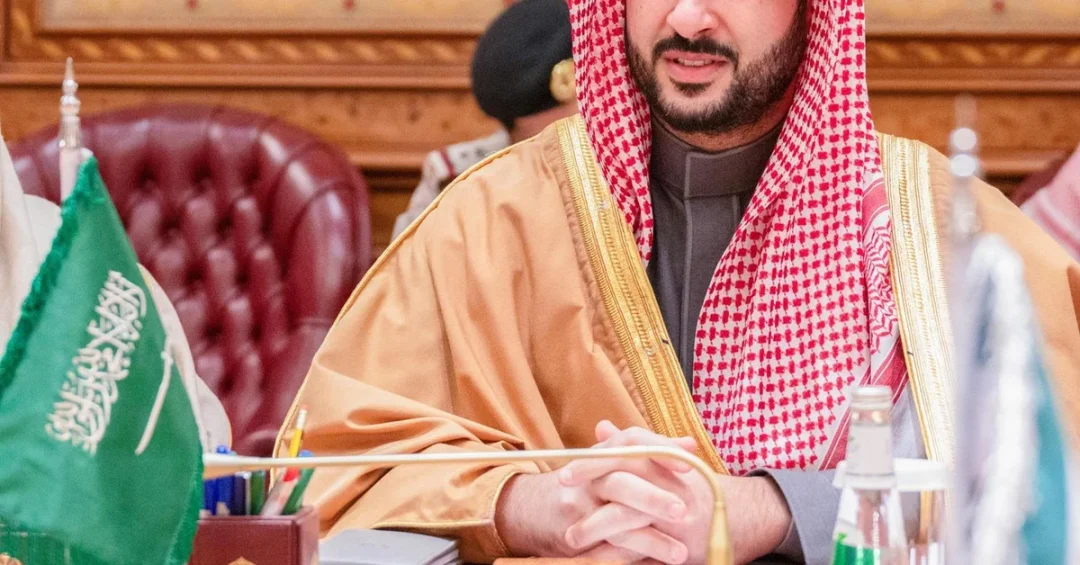
Saudi Arabia’s Minister of Defense, Prince Khalid bin Salman bin Abdulaziz, met in Riyadh on January 2, 2025, with the new Syrian administration’s Minister of Foreign Affairs Asaad Hassan Al-Shibani, Minister of Defense Murhaf Abu Qasra, and Head of the General Intelligence Service Anas Khattab, according to the Saudi Press Agency (SPA). The high-level meeting, held at the Minister of Defense’s office in the Saudi capital, focused on the latest developments in Syria and ways to support the transitional political process to achieve the aspirations of the Syrian people while ensuring the country’s security, stability, and territorial integrity. The talks represent a significant diplomatic engagement by the Kingdom with Syria’s emerging leadership, underscoring Riyadh’s active role in regional stabilization efforts.
The meeting was attended by a distinguished Saudi delegation, including Minister of Foreign Affairs Prince Faisal bin Farhan bin Abdullah, Deputy Minister of Defense Prince Abdulrahman bin Mohammed bin Ayyaf, Chief of General Intelligence Khalid bin Ali Al-Humaidan, Chief of General Staff Gen. Fayyad Al-Ruwaili, and Minister of Defense Office Director-General Hisham bin Abdulaziz bin Saif. Assistants to Syria’s foreign minister for Arabian affairs and humanitarian affairs were also present. The composition of the delegations reflects the breadth of the discussions, spanning diplomatic, security, and humanitarian dimensions. This engagement builds on Saudi Arabia’s consistent calls for a comprehensive political solution in Syria that preserves its unity and sovereignty.
Context and Background
Why does this meeting matter at this particular moment in regional history? Saudi Arabia has long advocated for a political resolution to the Syrian crisis, emphasizing the importance of preserving Syria’s territorial integrity and restoring its role in the Arab world. The Kingdom’s approach has been rooted in the principles of the Arab League and the United Nations, supporting a transitional process that reflects the will of the Syrian people. The December 2024 change in Syria’s leadership created a new opening for diplomacy, and Riyadh moved swiftly to engage with the new administration. This meeting is a continuation of Saudi Arabia’s proactive foreign policy, which prioritizes stability, dialogue, and the rejection of extremism.
The visit by Syria’s foreign and defense ministers, along with its intelligence chief, signals a mutual desire to rebuild ties and coordinate on critical issues. Saudi Arabia had maintained its embassy in Damascus and has been a key voice in Arab efforts to reintegrate Syria into regional frameworks. The Kingdom’s leadership, under the guidance of Custodian of the Two Holy Mosques King Salman bin Abdulaziz Al Saud and Crown Prince and Prime Minister Mohammed bin Salman bin Abdulaziz Al Saud, has consistently stressed that Syria’s future must be determined by its own people without external interference. This meeting is a practical step in that direction, offering a platform for discussing security cooperation, humanitarian aid, and the political transition.
Regional dynamics have shifted considerably, with several Arab states re-engaging Damascus. Yet Saudi Arabia’s approach is distinguished by its emphasis on a holistic settlement that addresses the root causes of the conflict. The Kingdom has hosted multiple Syrian opposition figures and has facilitated dialogue among various parties. The presence of senior Saudi military and intelligence officials in this meeting indicates that the discussions went beyond protocol to address concrete security and stability measures. It also highlights Saudi Arabia’s readiness to support Syria’s reconstruction and reintegration into the Arab and international community, provided that the transitional process remains inclusive and peaceful.
Key Details of the Riyadh Meeting
What specific outcomes can be expected from this high-level gathering? According to the official Saudi Press Agency report, the meeting covered the latest developments in Syria and ways of supporting the transitional political process. The discussions aimed to achieve the aspirations of the brotherly Syrian people while ensuring Syria’s security, stability, and territorial integrity. The Saudi side reiterated its commitment to a Syrian-led and Syrian-owned political process, free from foreign interference. The Syrian delegation briefed the Saudi officials on the current situation in the country and the steps being taken by the new administration to restore order and rebuild state institutions.
The presence of Prince Faisal bin Farhan, Saudi Arabia’s top diplomat, alongside defense and intelligence chiefs, underscores the comprehensive nature of the talks. It indicates that Saudi Arabia is prepared to offer assistance in multiple areas, including security sector reform, counterterrorism, and humanitarian relief. The meeting also provided an opportunity to discuss the return of Syrian refugees and the reconstruction of war-torn areas. Saudi Arabia has previously contributed to humanitarian efforts in Syria and has called on the international community to do more. The Kingdom’s leadership in this regard is part of its broader commitment to Arab solidarity and regional security.
Notably, the meeting included assistants to Syria’s foreign minister for Arabian affairs and humanitarian affairs, suggesting that the discussions touched on Arab cooperation and the delivery of aid. This aligns with Saudi Arabia’s Vision 2030 goal of promoting regional stability as a foundation for economic prosperity. By engaging with Syria’s new leadership, Saudi Arabia is positioning itself as a bridge-builder and a force for moderation. The talks are also a signal to other regional and international actors that the Kingdom supports a peaceful transition and is willing to work with all parties committed to Syria’s unity and sovereignty.
International and Regional Impact
How will this meeting influence the broader Middle East landscape? Saudi Arabia’s engagement with Syria’s new administration is a clear message that the Kingdom is committed to stabilizing its neighborhood and preventing the resurgence of extremism. The meeting comes amid ongoing efforts to consolidate a ceasefire and support a political transition. By hosting Syria’s foreign, defense, and intelligence ministers, Saudi Arabia is facilitating a coordinated approach that could lead to improved security cooperation and intelligence sharing. This is particularly important given the threat posed by remnants of terrorist groups and the need to prevent any vacuum that could be exploited by malign actors.
Regionally, the meeting is likely to be welcomed by Arab states that have supported Syria’s return to the Arab fold. It reinforces the Arab League’s position that a political solution is the only way forward. Internationally, the engagement demonstrates Saudi Arabia’s growing role as a diplomatic heavyweight capable of convening parties and bridging divides. The United States and European Union have taken note of Saudi Arabia’s efforts, recognizing that the Kingdom’s influence is essential for any lasting settlement. The meeting also aligns with Saudi Arabia’s broader strategy of de-escalation and dialogue, as seen in its outreach to other regional players. This approach enhances the Kingdom’s standing as a responsible global actor and a partner for peace.
Economic and Strategic Significance
What economic and strategic benefits could arise from this diplomatic opening? A stable Syria is crucial for regional trade routes, energy security, and economic integration. Saudi Arabia has a vested interest in ensuring that Syria does not remain a source of instability that could disrupt these interests. The meeting could pave the way for Saudi investment in Syria’s reconstruction, which would not only help rebuild the country but also create opportunities for Saudi businesses. Vision 2030 emphasizes economic diversification and regional trade, and a peaceful Syria could become a vital link in the Kingdom’s trade corridors to Europe and Asia.
Strategically, Saudi Arabia’s engagement with Syria’s new leadership helps counter the influence of other regional powers and ensures that the transition remains aligned with Arab interests. The Kingdom’s support for Syria’s territorial integrity also serves to prevent the fragmentation of the country, which could have severe consequences for regional security. By working closely with Syria’s defense and intelligence apparatus, Saudi Arabia can help build capacity to combat terrorism and secure borders. This is consistent with the Kingdom’s national security strategy and its commitment to combating extremism in all its forms. The meeting thus represents a strategic investment in long-term stability and prosperity for both countries and the wider region.
Vision 2030 Alignment
How does this diplomatic engagement reflect the goals of Saudi Vision 2030? Vision 2030 is not only an economic blueprint but also a comprehensive plan for a more secure, influential, and prosperous Saudi Arabia. A key pillar of the vision is to strengthen the Kingdom’s regional and global leadership. By mediating and facilitating dialogue in Syria, Saudi Arabia is demonstrating its capacity to shape a positive future for the region. The meeting with Syria’s new administration is a concrete example of the Kingdom’s proactive diplomacy, which aims to create a stable environment conducive to economic growth and social development.
Moreover, Vision 2030 seeks to position Saudi Arabia as a hub for trade and investment. A stable Syria that is integrated into the regional economy would contribute to this goal by opening new markets and facilitating the flow of goods and people. The Kingdom’s humanitarian and reconstruction efforts in Syria also align with the vision’s emphasis on social responsibility and global citizenship. Ultimately, this meeting underscores Saudi Arabia’s commitment to a future where the region is defined by cooperation, prosperity, and peace, in line with the aspirations of its leadership and people. The Kingdom will continue to play a constructive role in supporting Syria’s transition and ensuring that the region moves toward a brighter, more stable future.
20 Questions
Q1. Who represented Saudi Arabia at the meeting with Syria’s new administration?
A1. Saudi Arabia’s Minister of Defense, Prince Khalid bin Salman bin Abdulaziz, led the meeting. He was joined by Foreign Minister Prince Faisal bin Farhan bin Abdullah, Deputy Minister of Defense Prince Abdulrahman bin Mohammed bin Ayyaf, and other senior officials.
Q2. Who were the Syrian officials that attended the meeting in Riyadh?
A2. The Syrian delegation included Minister of Foreign Affairs Asaad Hassan Al-Shibani, Minister of Defense Murhaf Abu Qasra, and Head of the General Intelligence Service Anas Khattab. Assistants for Arabian and humanitarian affairs also attended.
Q3. What was the main focus of the discussions?
A3. The meeting covered the latest developments in Syria and ways to support the transitional political process. The goal was to achieve the aspirations of the Syrian people while ensuring Syria’s security, stability, and territorial integrity.
Q4. When and where did the meeting take place?
A4. The meeting was held on January 2, 2025, at the Minister of Defense’s office in Riyadh, Saudi Arabia. It was reported by the Saudi Press Agency (SPA).
Q5. Why is Saudi Arabia engaging with Syria’s new administration?
A5. Saudi Arabia seeks to support a peaceful political transition in Syria that preserves its unity and sovereignty. The Kingdom aims to help stabilize the region and prevent extremism, in line with its broader foreign policy goals.
Q6. What does Saudi Arabia hope to achieve through this meeting?
A6. Saudi Arabia aims to facilitate a Syrian-led political process, provide humanitarian support, and coordinate on security matters. The meeting also seeks to strengthen Arab cooperation and regional stability.
Q7. How does this meeting align with Saudi Vision 2030?
A7. Vision 2030 emphasizes regional leadership, economic diversification, and global engagement. A stable Syria contributes to these goals by enhancing trade routes and reducing security threats, thereby supporting Saudi Arabia’s long-term prosperity.
Q8. What role did the Saudi Foreign Minister play in the meeting?
A8. Prince Faisal bin Farhan bin Abdullah attended the meeting, underscoring the diplomatic dimension of the talks. His presence highlights Saudi Arabia’s comprehensive approach to supporting Syria’s transition.
Q9. What security issues were likely discussed?
A9. The discussions likely covered counterterrorism, border security, and intelligence sharing. Saudi Arabia is committed to helping Syria combat extremist groups and restore stability.
Q10. Will Saudi Arabia provide humanitarian aid to Syria?
A10. While specific pledges were not announced, Saudi Arabia has historically provided humanitarian assistance to Syria. The meeting included discussions on supporting the Syrian people and addressing humanitarian needs.
Q11. How does this meeting affect regional stability?
A11. It promotes dialogue and cooperation, which are essential for reducing tensions. A stable Syria contributes to the security of the entire region, benefiting Saudi Arabia and its neighbors.
Q12. What is the significance of the Syrian intelligence chief’s presence?
A12. The inclusion of Anas Khattab indicates that intelligence and security cooperation were key topics. It shows a mutual interest in addressing shared security challenges and building trust.
Q13. Did the meeting address the return of Syrian refugees?
A13. The meeting aimed to support the aspirations of the Syrian people, which includes creating conditions for the safe return of refugees. Saudi Arabia supports efforts to rebuild Syria and ensure stability.
Q14. How does this meeting reflect Saudi Arabia’s foreign policy?
A14. It demonstrates Saudi Arabia’s proactive and pragmatic approach to regional diplomacy. The Kingdom seeks to resolve conflicts through dialogue and supports legitimate aspirations of Arab peoples.
Q15. What are the next steps following this meeting?
A15. Follow-up meetings and coordination mechanisms are expected. Saudi Arabia will continue to engage with Syria’s leadership and international partners to support the transition.
Q16. Is Saudi Arabia coordinating with other Arab states on Syria?
A16. Yes, Saudi Arabia works within the Arab League and with other regional partners. The meeting is part of a broader Arab effort to reintegrate Syria and support its stability.
Q17. What economic opportunities could arise for Saudi Arabia?
A17. A stable Syria could open trade and investment opportunities. Saudi businesses may participate in reconstruction, and improved trade routes could benefit the Kingdom’s economy.
Q18. How does this meeting counter extremism?
A18. By supporting a moderate and inclusive political process, Saudi Arabia helps prevent extremists from exploiting instability. Security cooperation also targets terrorist networks.
Q19. What message does this send to the international community?
A19. It shows Saudi Arabia’s commitment to peace and stability, and its willingness to take a leading role in resolving regional crises. The Kingdom is a reliable partner for diplomacy.
Q20. What is Saudi Arabia’s ultimate goal for Syria?
A20. Saudi Arabia seeks a unified, stable, and prosperous Syria that is free from terrorism and foreign interference. The Kingdom supports a political transition that fulfills the aspirations of the Syrian people.
Reader Feedback
We value your thoughts. Please share your feedback on this article.
Your feedback helps us improve our coverage.
Related articles
 CODE Enhances Innovation with Pioneering Achievements
 Saudi Arabia Expresses Regret Over Montenegro Shooting
 NCM: Saudi Arabia’s Strongest Cold Wave Hit in January 1992
 Saudi, French Foreign Ministers Discuss Regional Developments
 Syrian Delegation Departs Riyadh After Key Talks
 MWL Condoles Montenegro on Cetinje Shooting Victims