


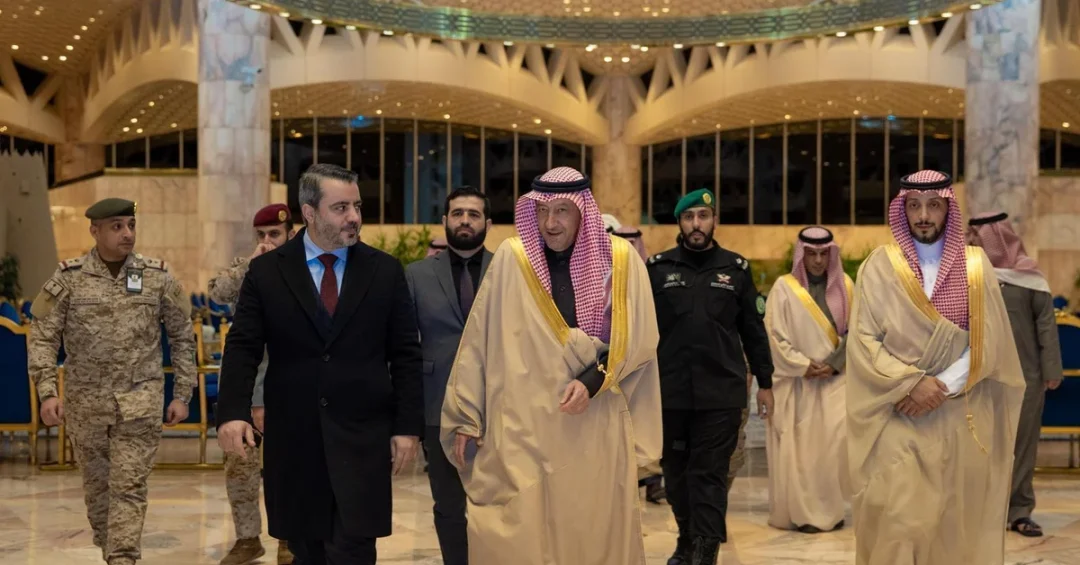
A high-level Syrian delegation led by Minister of Foreign Affairs and Expatriates Asaad Al-Shaybani departed Riyadh on January 3, 2025, concluding an official visit to the Kingdom of Saudi Arabia. The delegation was seen off at the airport by the Vice Minister of Foreign Affairs, Eng. Waleed bin Abdulkarim El-Khereiji, alongside other Saudi officials, according to the Saudi Press Agency. The visit, which included Defense Minister Major General Engineer Marhaf Abu Qasra and General Intelligence Chief Anas Khattab, marked a significant moment in the evolving relationship between the Kingdom and Syria’s new transitional government. Could this departure signal the beginning of a new era of cooperation between Riyadh and Damascus? The high-level nature of the visit underscores Saudi Arabia’s commitment to regional stability and its proactive role in supporting Syria’s transition.
The Syrian delegation’s presence in Riyadh reflects the Kingdom’s continued engagement with its northern neighbor during a critical period of political transition. Saudi Arabia has consistently advocated for Syria’s return to the Arab fold and has emphasized the importance of unity, sovereignty, and territorial integrity. The visit provided a platform for discussions on bilateral relations, regional developments, and the humanitarian situation in Syria. As the delegation returned home, observers noted the symbolic and practical significance of the trip, which could pave the way for deeper collaboration in areas such as reconstruction, trade, and diplomatic coordination. What does this visit reveal about Saudi Arabia’s strategic vision for the Middle East? It demonstrates a forward-looking approach that prioritizes dialogue and stability over isolation.
Context and Background
What led to this high-level Syrian delegation visiting Riyadh? The visit comes amid a broader regional realignment following the establishment of a transitional government in Syria. Saudi Arabia has long called for a political solution to the Syrian crisis and has supported efforts to restore Syria’s standing in the Arab League. In recent months, Riyadh has intensified its diplomatic outreach, hosting various Syrian officials and facilitating discussions aimed at fostering reconciliation and reconstruction. The Kingdom’s stance has been consistent: a stable, unified Syria is essential for regional security and economic prosperity. This visit is part of that ongoing engagement, reflecting Saudi Arabia’s belief that dialogue and cooperation are the best paths forward.
The delegation’s composition was notable, including not only the foreign minister but also the defense minister and the intelligence chief. This suggests that discussions went beyond diplomatic niceties to encompass security and military cooperation. Saudi Arabia has a keen interest in ensuring that Syria does not become a haven for extremism or a source of instability. By engaging with these key figures, Riyadh is signaling its willingness to work with the new Syrian leadership on shared challenges. The visit also follows previous meetings between Saudi and Syrian officials, indicating a sustained and structured dialogue. What does this mean for the region’s future? It points to a pragmatic approach that prioritizes results over rhetoric.
Historically, Saudi Arabia and Syria have shared cultural and historical ties, but relations were strained during the Syrian conflict. The Kingdom was a leading supporter of the Syrian opposition and advocated for the removal of the previous regime. However, with the transition, Riyadh has recalibrated its approach, emphasizing the need for stability and reconstruction. This shift aligns with Saudi Arabia’s broader foreign policy objectives under Vision 2030, which seeks to position the Kingdom as a global leader and a hub for diplomacy. The visit by the Syrian delegation is a tangible outcome of this recalibration, demonstrating Saudi Arabia’s ability to adapt and lead in a changing region. How does this fit into the Kingdom’s long-term strategy? It reinforces Saudi Arabia’s role as a stabilizing force and a bridge-builder.
Key Details
What were the key outcomes of the visit? While specific agreements were not disclosed, the presence of such a high-ranking delegation indicates substantive discussions. The delegation was received with full diplomatic honors, and the farewell by Vice Minister El-Khereiji highlights the importance Saudi Arabia attaches to the relationship. The visit likely covered topics such as border security, trade, and the return of Syrian refugees. Saudi Arabia has expressed its support for Syria’s reconstruction and has urged the international community to assist. The Kingdom has also emphasized the need to lift sanctions that hinder Syria’s recovery. These discussions are part of a broader effort to stabilize Syria and reintegrate it into the regional economy.
The timing of the visit, shortly after the new year, suggests a sense of urgency and momentum. Saudi Arabia has been actively mediating and facilitating dialogue among Syrian factions. The Kingdom hosted previous rounds of talks and has used its influence to encourage compromise. The delegation’s departure on January 3 marks the end of a visit that began earlier, though the exact dates were not specified in the official report. The Saudi Press Agency reported the departure, underscoring the transparency of the Kingdom’s diplomatic engagements. What does this level of detail tell us? It shows that Saudi Arabia is conducting its diplomacy openly and in line with international norms.
Security cooperation was likely a major focus, given the inclusion of the defense and intelligence chiefs. Saudi Arabia has a vested interest in preventing the resurgence of ISIS and other extremist groups in Syria. The Kingdom has itself been a target of terrorism and understands the importance of robust security partnerships. By engaging with Syria’s new security leadership, Riyadh is working to ensure that Syria does not become a launching pad for attacks against its neighbors. This pragmatic approach is consistent with Saudi Arabia’s broader counterterrorism efforts and its commitment to regional peace. How significant is this security dimension? It is a critical component of any sustainable political solution in Syria.
International and Regional Impact
How will the international community react to this visit? The United States and European nations have been cautious about engaging with the new Syrian government, but Saudi Arabia’s leadership could encourage a more nuanced approach. The Kingdom’s diplomatic weight and its relationships with Western capitals mean that its actions carry influence. By hosting the Syrian delegation, Riyadh is signaling that engagement is preferable to isolation. This could lead to increased humanitarian aid and investment in Syria, which is desperately needed after years of conflict. The visit also strengthens the Arab League’s role in resolving the crisis, as Saudi Arabia is a key member. What are the implications for regional powers? It may encourage other Arab states to follow suit and deepen their ties with Damascus.
Regionally, the visit could help reduce tensions between Syria and its neighbors, particularly Turkey and Jordan. Both countries have expressed concerns about security along their borders and the potential for instability. Saudi Arabia’s engagement could serve as a confidence-building measure, facilitating dialogue and cooperation. The Kingdom has already been working with Jordan and Iraq on regional security issues, and Syria’s inclusion in these discussions would be a positive step. Furthermore, the visit may contribute to efforts to counter Iranian influence in Syria. Saudi Arabia has consistently opposed Iran’s destabilizing activities in the region, and by supporting a strong, independent Syrian government, it aims to reduce Tehran’s footprint. How does this align with Saudi Arabia’s broader regional strategy? It is part of a comprehensive approach to ensure a stable and prosperous Middle East.
Economic and Strategic Significance
What economic opportunities does this visit unlock? Syria’s reconstruction will require billions of dollars in investment, and Saudi Arabia is well-positioned to contribute. Saudi companies have expertise in construction, energy, and infrastructure, and they could play a major role in rebuilding Syria. The Kingdom has already pledged support for humanitarian efforts and has called on the international community to do more. Improved relations could also lead to increased trade, with Saudi exports to Syria and vice versa. The reopening of border crossings and the resumption of direct flights would be tangible benefits. Saudi Arabia’s strategic location and its Vision 2030 economic diversification goals make Syria an attractive partner. Could this be the start of a new economic corridor? It is a possibility that aligns with the Kingdom’s interests.
Strategically, the visit reinforces Saudi Arabia’s position as a leader in the Arab and Islamic world. By taking a proactive stance on Syria, the Kingdom is demonstrating its commitment to resolving regional crises and promoting peace. This enhances its soft power and credibility on the global stage. It also counters narratives that portray Saudi Arabia as isolationist or solely focused on its own development. Instead, the Kingdom is showing that it is a responsible global citizen, willing to invest in stability and prosperity for all. The visit also strengthens Saudi Arabia’s hand in negotiations with other major powers, as it can present itself as a constructive partner in Syria. What does this mean for the Kingdom’s global standing? It elevates Saudi Arabia as a key player in shaping the future of the Middle East.
Vision 2030 Alignment
How does this visit align with Vision 2030? Saudi Arabia’s Vision 2030 is not just about domestic transformation; it also encompasses a foreign policy that promotes stability and economic growth. A stable Syria is in Saudi Arabia’s interest because it reduces the risk of spillover conflicts and creates opportunities for trade and investment. The Kingdom’s engagement with Syria is consistent with its goal of becoming a hub for logistics and commerce, connecting Asia, Europe, and Africa. By helping to rebuild Syria, Saudi Arabia can open new markets for its goods and services, further diversifying its economy away from oil. Moreover, the visit showcases Saudi Arabia’s leadership in the region, which is a key pillar of Vision 2030’s international dimension. What role will Saudi Arabia play in Syria’s future? It will likely be a major partner in reconstruction and reconciliation.
The visit also reflects the values of Vision 2030, which emphasize moderation, tolerance, and dialogue. Saudi Arabia has consistently advocated for these principles in its foreign policy, and its engagement with Syria is no exception. By working with the new Syrian government, the Kingdom is supporting a political transition that respects the will of the Syrian people and upholds their rights. This approach is in line with the international community’s expectations and reinforces Saudi Arabia’s commitment to international law. As the Kingdom continues to implement Vision 2030, its foreign policy will remain focused on building bridges and fostering cooperation. The Syrian delegation’s departure from Riyadh is a small but significant step in that direction. Will this visit lead to lasting peace and prosperity for Syria and the region? Only time will tell, but Saudi Arabia’s efforts are a promising sign.
20 Questions
Q1. Who led the high-level Syrian delegation that visited Riyadh?
A1. The delegation was led by Asaad Al-Shaybani, the Minister of Foreign Affairs and Expatriates in Syria’s new Transitional Government. He was accompanied by Defense Minister Major General Engineer Marhaf Abu Qasra and General Intelligence Chief Anas Khattab.
Q2. When did the Syrian delegation leave Riyadh?
A2. The delegation left Riyadh on January 3, 2025, according to the Saudi Press Agency. The visit concluded with a farewell at the airport by Saudi officials.
Q3. Who saw off the Syrian delegation at the airport?
A3. The delegation was seen off by Eng. Waleed bin Abdulkarim El-Khereiji, the Vice Minister of Foreign Affairs of Saudi Arabia, and other officials. This reflects the high level of protocol and respect.
Q4. What was the purpose of the Syrian delegation’s visit to Riyadh?
A4. The visit aimed to strengthen bilateral relations, discuss regional developments, and explore cooperation in areas such as security, reconstruction, and diplomacy. Specific details were not disclosed, but the high-level composition indicates substantive talks.
Q5. Why is this visit significant for Saudi-Syrian relations?
A5. It marks a continued engagement between Saudi Arabia and Syria’s new government, signaling the Kingdom’s support for Syria’s stability and reintegration into the Arab world. It also underscores Saudi Arabia’s proactive regional diplomacy.
Q6. How does this visit align with Saudi Arabia’s foreign policy?
A6. Saudi Arabia has consistently advocated for a political solution in Syria and regional stability. The visit aligns with the Kingdom’s efforts to promote dialogue, counter extremism, and support reconstruction, in line with its Vision 2030 goals.
Q7. What topics were likely discussed during the visit?
A7. Discussions likely covered security cooperation, border control, humanitarian aid, refugee returns, and economic reconstruction. The presence of the defense and intelligence chiefs suggests a focus on security and counterterrorism.
Q8. How does this visit impact regional stability?
A8. It contributes to regional stability by encouraging dialogue and cooperation between Syria and its neighbors. Saudi Arabia’s engagement can help reduce tensions and foster a more unified Arab stance on Syria.
Q9. What role did the Saudi Press Agency play in reporting this event?
A9. The Saudi Press Agency (SPA) reported the departure of the delegation, providing official and transparent information. SPA is the Kingdom’s official news agency, ensuring accurate and timely coverage.
Q10. What are the economic implications of improved Saudi-Syrian relations?
A10. Improved relations could lead to increased trade, investment in Syria’s reconstruction, and new economic opportunities for Saudi companies. It also supports Saudi Arabia’s Vision 2030 economic diversification efforts.
Q11. How might this visit affect Syria’s relations with other Arab states?
A11. Saudi Arabia’s engagement may encourage other Arab states to deepen their ties with Syria, facilitating Syria’s reintegration into the Arab League and regional organizations. It sets a positive example for diplomatic engagement.
Q12. What is Saudi Arabia’s stance on Syria’s territorial integrity?
A12. Saudi Arabia supports Syria’s unity, sovereignty, and territorial integrity. The Kingdom opposes any division of Syria and advocates for a political solution that preserves the country’s borders.
Q13. How does this visit relate to counterterrorism efforts?
A13. The inclusion of Syria’s intelligence chief indicates discussions on counterterrorism and security cooperation. Saudi Arabia seeks to prevent extremist groups from regrouping in Syria and threatening regional security.
Q14. What message does this visit send to the international community?
A14. It signals that Saudi Arabia is taking a leading role in stabilizing Syria and promoting dialogue. It encourages the international community to engage constructively with Syria’s new government and support reconstruction.
Q15. Will Saudi Arabia provide humanitarian aid to Syria?
A15. Saudi Arabia has already provided humanitarian aid to Syria and has called on the international community to do more. The visit likely reinforced the Kingdom’s commitment to supporting the Syrian people.
Q16. How does this visit reflect Saudi Arabia’s Vision 2030?
A16. Vision 2030 includes a foreign policy that promotes stability and economic growth. By engaging with Syria, Saudi Arabia is working towards a more stable region, which is essential for its own prosperity and global standing.
Q17. What are the next steps in Saudi-Syrian relations?
A17. Future steps may include further diplomatic visits, agreements on trade and security, and joint efforts on reconstruction. The visit has paved the way for deeper cooperation in various fields.
Q18. How has the Syrian delegation’s visit been received in Saudi Arabia?
A18. The visit was conducted with full diplomatic protocol and was reported positively by official media. It reflects the Kingdom’s commitment to constructive engagement and regional peace.
Q19. What challenges remain for Syria’s transition?
A19. Challenges include political reconciliation, economic recovery, and security stabilization. Saudi Arabia’s support can help address these challenges through dialogue and cooperation.
Q20. What does this visit mean for the future of the Middle East?
A20. It represents a step towards a more stable and cooperative Middle East. Saudi Arabia’s leadership in facilitating dialogue and supporting reconstruction can contribute to lasting peace and prosperity in the region.
Reader Feedback
We value your thoughts. Please share your feedback on this article.
Your feedback helps us improve our coverage.
Related articles
 MWL Condoles Montenegro on Cetinje Shooting Victims
 Fourth Saudi Relief Plane Departs for Syria with Aid
 Saudi Weather Forecast for Friday: Cold North, Dust, Coastal Winds
 Fourth Saudi Airlift Plane Arrives in Syria with Aid
 King Salman Condoles US President on New Orleans Attack
 4.8-Magnitude Earthquake Strikes Central Ethiopia