


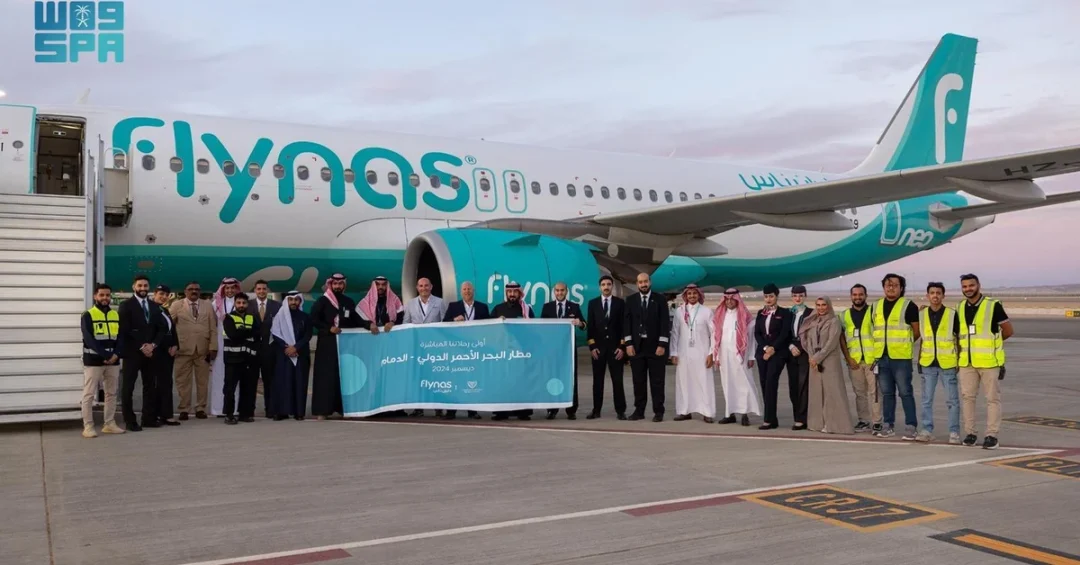
Red Sea Global (RSG) welcomed the inaugural flynas flight from Dammam’s King Fahd International Airport to Red Sea International Airport (RSI) on December 28, 2024, establishing the first direct air connection between Saudi Arabia’s Eastern Region and The Red Sea destination, according to the Saudi Press Agency (SPA). The milestone flight marks a significant expansion of domestic connectivity to one of the Kingdom’s most ambitious regenerative tourism projects, linking the populous Eastern Province directly to a destination that has already begun welcoming guests to five world-class resorts since September 2023.
The new route, operated by Saudi Arabia’s national low-cost carrier flynas, will run twice weekly on Thursdays and Saturdays, serving both The Red Sea destination and surrounding areas. This development adds to existing regular-schedule domestic flights from Riyadh and Jeddah, creating a comprehensive air network that connects the Kingdom’s major population centers to the Red Sea coast. Could this expanded connectivity represent the next critical step in establishing Saudi Arabia as a premier global tourism destination?
Context and Background
How did Red Sea International Airport evolve from a vision to a functioning gateway for international travelers? The airport’s journey reflects the broader transformation underway across Saudi Arabia’s tourism infrastructure. Since September 2023, The Red Sea destination has been welcoming guests to five of its world-class resorts, with regular-schedule domestic flights servicing RSI from Riyadh and Jeddah. The airport achieved another significant milestone in 2024 when it received its first international flight from Dubai International Airport, signaling the destination’s growing appeal beyond Saudi borders.
Red Sea Global, the developer behind one of the world’s most ambitious regenerative tourism projects, has positioned RSI as a strategic asset within the Kingdom’s broader aviation and tourism ecosystem. The airport’s location places it within a three-hour flight for 250 million people and an eight-hour flight for 85 percent of the world’s population, making it an ideal gateway for international visitors seeking access to the Red Sea’s pristine coastline and luxury offerings. This geographic advantage underscores why expanding domestic connections represents more than just convenience; it builds the foundational network that will support future international growth.
The addition of the Dammam route carries particular significance given the Eastern Region’s economic importance to the Kingdom. Home to major industrial centers, substantial population concentrations, and significant corporate activity, the Eastern Province represents a natural source market for the Red Sea destination’s hospitality offerings. By establishing this direct link, Red Sea Global and flynas are effectively creating a seamless connection between two of Saudi Arabia’s most dynamic regions.
Key Details of the New Route
What does the new flynas service mean for travelers seeking to experience The Red Sea destination? The twice-weekly service, operating on Thursdays and Saturdays, provides Eastern Province residents and visitors with direct access to a destination that previously required connecting through Riyadh or Jeddah. This scheduling pattern accommodates weekend getaways and extended stays, aligning with the leisure travel patterns that The Red Sea destination is designed to serve. The route will serve not only the destination’s resorts but also surrounding areas, suggesting broader economic benefits for the region.
The flight represents the latest addition to RSI’s growing network, which now encompasses three domestic origins: Riyadh, Jeddah, and Dammam. This triangulation of major Saudi cities demonstrates the airport’s evolution from a single-route operation to a genuine domestic hub. For flynas, the route expands its domestic network while positioning the carrier as a key partner in Saudi Arabia’s tourism development strategy. The airline’s participation in this initiative reflects the broader alignment between Saudi aviation stakeholders and the Kingdom’s Vision 2030 objectives.
Red Sea Global has emphasized that the new flight helps increase connectivity between the Red Sea and the broader Kingdom, a statement that captures both the practical and symbolic importance of the route. As more Saudis and international visitors gain access to the destination, the economic multiplier effects extend beyond tourism to encompass hospitality employment, local sourcing, and regional development. The airport’s role as a catalyst for the surrounding area’s growth becomes more pronounced with each new connection established.
Sustainability Leadership at Red Sea International Airport
How does Red Sea International Airport demonstrate Saudi Arabia’s commitment to sustainable infrastructure development? The airport is designed to run entirely on renewable energy once fully operational, sourced from the destination’s expansive solar farms featuring 760,500 photovoltaic (PV) panels and one of the world’s largest off-grid Battery Energy Storage Systems (BESS). This commitment to renewable energy extends beyond aspiration to current practice, with all airside operations already powered exclusively by renewable sources.
Critical infrastructure including Airfield Ground Lighting, the Instrument Landing System, the meteorological building, and various mechanical, electrical, and plumbing systems operate on renewable energy today. This achievement positions RSI as a global exemplar of sustainable airport operations, demonstrating that world-class aviation infrastructure can function without reliance on fossil fuels. The BESS installation, described as one of the world’s largest off-grid systems, provides reliable power storage that ensures operational continuity even when solar generation fluctuates.
The sustainability credentials of RSI align with The Red Sea destination’s broader regenerative tourism philosophy, which aims not merely to minimize environmental impact but to actively enhance the ecosystems in which it operates. For international audiences increasingly concerned about the environmental footprint of their travel choices, this commitment offers a compelling narrative. Travelers can reach a luxury destination via an airport powered by the sun, stay at resorts designed with regenerative principles, and contribute to a tourism model that seeks to leave destinations better than they were found.
International and Regional Impact
What broader implications does this domestic route expansion hold for Saudi Arabia’s global tourism ambitions? While the Dammam-Red Sea connection is a domestic route, its significance extends to the international arena. A robust domestic network feeds international connectivity by ensuring that the airport has sufficient traffic volume to attract and sustain international carriers. The experience gained from operating multiple domestic routes positions RSI to scale up international operations as The Red Sea destination’s resort portfolio expands toward its 2030 completion target of 50 resorts.
Regionally, the route strengthens ties between the Eastern Province and the Tabuk region, fostering internal tourism flows that keep tourism spending within the Kingdom while exposing more Saudi residents to the destination’s offerings. These domestic visitors often become ambassadors for the destination, sharing their experiences with international contacts and contributing to organic marketing. The route also facilitates business travel between the Eastern Province’s industrial centers and the growing hospitality and construction activity at The Red Sea, supporting the broader economic ecosystem surrounding the project.
For the international audience observing Saudi Arabia’s tourism transformation, the steady expansion of RSI’s network demonstrates tangible progress rather than mere aspiration. Each new route represents infrastructure delivered, partnerships executed, and visitor capacity added. This incremental approach builds credibility and provides evidence that the Kingdom’s ambitious tourism targets are being pursued through concrete, measurable steps.
Economic and Strategic Significance
How does expanded air connectivity contribute to Saudi Arabia’s economic diversification objectives? The Dammam-Red Sea route supports multiple dimensions of Vision 2030’s economic agenda. Tourism represents a key pillar of diversification efforts, with targets to increase the sector’s contribution to GDP and create employment opportunities for Saudi citizens. Each flight brings potential visitors whose spending supports hotels, restaurants, activity providers, and retail establishments within The Red Sea destination and surrounding areas.
The route also strengthens the strategic connection between two economically vital regions. The Eastern Province, home to the Kingdom’s energy industry and major industrial complexes, generates significant business travel demand. The Red Sea destination, as it develops, will host corporate events, conferences, and incentive travel in addition to leisure tourism. Direct connectivity facilitates this business-to-business interaction, creating opportunities for partnerships and investment flows between the regions.
From an aviation perspective, the route demonstrates the viability of domestic tourism circuits that reduce reliance on international arrivals. While Saudi Arabia actively courts international visitors, a strong domestic market provides a stable foundation for tourism infrastructure investment. Saudi citizens and residents traveling within the Kingdom fill hotel rooms, support airline routes, and sustain employment during periods when international demand may fluctuate. This balanced approach to tourism development reflects strategic thinking about long-term sustainability.
Vision 2030 Alignment
How does the Red Sea International Airport’s growing connectivity embody the aspirations of Saudi Vision 2030? The airport and the broader Red Sea destination represent flagship projects within the Kingdom’s transformation strategy, showcasing Saudi Arabia’s ability to conceive, develop, and operate world-class tourism infrastructure. The Dammam route specifically advances Vision 2030’s goal of increasing domestic tourism participation while building the aviation network that will support international visitor growth.
Upon project completion in 2030, The Red Sea destination will comprise 50 resorts offering up to 8,000 hotel rooms and more than 1,000 residential units across 22 islands and six inland sites. Luxury marinas, golf courses, diverse dining options, and entertainment facilities will complement the accommodation offerings. This scale of development, combined with RSI’s renewable energy operations and expanding route network, positions The Red Sea as a cornerstone of Saudi Arabia’s emergence as a global tourism powerhouse.
The inaugural flynas flight from Dammam to Red Sea International Airport thus represents more than a new route; it symbolizes the interconnected progress of Saudi Arabia’s aviation, tourism, and sustainability ambitions. As RSI continues to expand its network and The Red Sea destination welcomes more guests, each milestone brings the Kingdom closer to realizing its vision of a diversified, sustainable, and globally connected future.
20 Questions
Q1. What is Red Sea International Airport?
A1. Red Sea International Airport (RSI) is the gateway airport serving The Red Sea destination, a regenerative tourism project developed by Red Sea Global. Located on Saudi Arabia’s western coast, it began welcoming guests in September 2023 and has since expanded its domestic and international flight connections.
Q2. Which airline operated the inaugural flight from Dammam to RSI?
A2. flynas, Saudi Arabia’s national low-cost carrier, operated the inaugural flight from Dammam’s King Fahd International Airport to Red Sea International Airport. This marked the first direct connection between the Eastern Region and The Red Sea destination.
Q3. How often will flynas flights operate on the Dammam-Red Sea route?
A3. flynas flights will operate twice weekly on Thursdays and Saturdays. This schedule serves The Red Sea destination as well as surrounding areas, providing convenient access for Eastern Province residents and visitors.
Q4. What other domestic routes currently serve Red Sea International Airport?
A4. RSI currently receives regular-schedule domestic flights from Riyadh and Jeddah. The addition of the Dammam route creates a three-city domestic network connecting Saudi Arabia’s major population centers to The Red Sea destination.
Q5. When did The Red Sea destination begin welcoming guests?
A5. The Red Sea destination has been welcoming guests since September 2023, with five of its world-class resorts now operational. Regular-schedule domestic flights have been servicing RSI throughout this period, supporting visitor access.
Q6. What international milestone did RSI achieve in 2024?
A6. In 2024, Red Sea International Airport received its first international flight from Dubai International Airport. This milestone demonstrated the airport’s capability to handle international operations and signaled growing global interest in The Red Sea destination.
Q7. How is Red Sea International Airport powered?
A7. Once fully operational, RSI will run entirely on renewable energy sourced from expansive solar farms featuring 760,500 photovoltaic panels and one of the world’s largest off-grid Battery Energy Storage Systems. Currently, all airside operations already use renewable energy exclusively.
Q8. What infrastructure at RSI is already powered by renewable energy?
A8. All airside operations, including Airfield Ground Lighting, Instrument Landing System, the meteorological building, and various mechanical, electrical, and plumbing systems, are already powered exclusively by renewable energy at Red Sea International Airport.
Q9. What is the strategic geographic advantage of RSI’s location?
A9. RSI lies within a three-hour flight for 250 million people and an eight-hour flight for 85 percent of the world’s population. This positioning makes it an ideal gateway for international visitors from Europe, Asia, and Africa.
Q10. What will The Red Sea destination comprise upon completion in 2030?
A10. Upon completion in 2030, The Red Sea destination will comprise 50 resorts offering up to 8,000 hotel rooms and more than 1,000 residential units across 22 islands and six inland sites, plus luxury marinas, golf courses, dining, and entertainment facilities.
Q11. Who is developing The Red Sea destination?
A11. Red Sea Global (RSG) is the developer of The Red Sea destination, described as one of the world’s most ambitious regenerative tourism projects. RSG oversees development, operations, and the sustainability framework for the entire destination.
Q12. What does regenerative tourism mean in the context of The Red Sea?
A12. Regenerative tourism aims to enhance and restore ecosystems rather than merely minimizing harm. The Red Sea destination incorporates renewable energy, conservation initiatives, and community development to leave environments better than they were found.
Q13. How does the Dammam route benefit Eastern Province residents?
A13. The route provides Eastern Province residents with direct access to The Red Sea destination without connecting through Riyadh or Jeddah. This convenience supports weekend getaways, extended stays, and business travel to the growing destination.
Q14. What economic benefits does the new route bring?
A14. The route supports tourism employment, hospitality spending, and regional development. It also facilitates business travel between the Eastern Province’s industrial centers and The Red Sea’s growing construction and hospitality sectors.
Q15. How does this route support Saudi Vision 2030?
A15. The route advances Vision 2030’s tourism and economic diversification goals by increasing domestic tourism participation, strengthening aviation connectivity, and supporting job creation in the tourism sector across multiple regions.
Q16. What role does flynas play in Saudi Arabia’s aviation strategy?
A16. flynas operates as Saudi Arabia’s national low-cost carrier, expanding domestic and regional connectivity. Its participation in the Red Sea route reflects alignment between Saudi aviation stakeholders and the Kingdom’s tourism development objectives.
Q17. What sustainability features distinguish The Red Sea destination?
A17. The destination features expansive solar farms, one of the world’s largest off-grid Battery Energy Storage Systems, and regenerative design principles. All airside operations at RSI already run exclusively on renewable energy.
Q18. How does RSI contribute to Saudi Arabia’s global tourism ambitions?
A18. RSI provides the aviation gateway for international visitors to access The Red Sea destination. Its growing domestic network builds traffic volume and operational experience that support future international route expansion.
Q19. What does the Dammam-Red Sea connection symbolize?
A19. The route symbolizes the interconnected progress of Saudi Arabia’s aviation, tourism, and sustainability ambitions. It demonstrates tangible delivery of infrastructure and services supporting the Kingdom’s transformation goals.
Q20. What can travelers expect when visiting The Red Sea destination?
A20. Travelers can expect world-class resorts, luxury marinas, golf courses, diverse dining, and entertainment facilities across 22 islands and six inland sites. The destination offers regenerative tourism experiences powered by renewable energy infrastructure.
Reader Feedback
We value your thoughts. Please share your feedback on this article.
Your feedback helps us improve our coverage.
Related articles
 Ministry of Tourism: Hospitality Facilities Must Be Licensed
 Umrah Performers Surge 35% in Q3 2024, GASTAT Reports
 Second Group of Guests of the Custodian of the Two Holy Mosques Program for Umrah and Visitation Depart for Their Home Countries
 Courchevel Subzone at Boulevard World Draws Thousands
 Miqat Dhu Al-Hulayfah Welcomes Over 10 Million Visitors in 2024
 Riyadh Season 2024 Draws 13 Million Visitors