


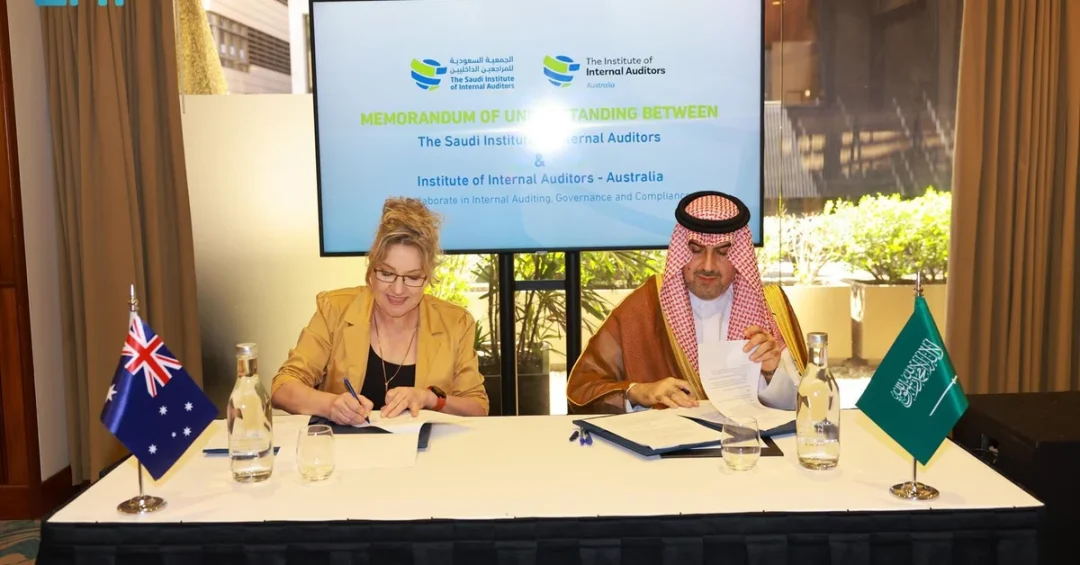
The President of the General Court of Audit (GCA) and Chairman of the Board of Directors of the Saudi Institute of Internal Auditors, Dr. Hussam Alangari, has signed a memorandum of understanding (MoU) with the Australian Institute of Internal Auditors, represented by its CEO Trish Hyde, in Sydney, according to the Saudi Press Agency (SPA). The agreement, announced on December 28, 2024, establishes a formal framework for cooperation between the two institutions in the fields of internal auditing, governance, and compliance, and is grounded in mutual trust, partnership, and adherence to the international standards for internal auditing issued by the Institute of Internal Auditors. The signing marks a further step in the Kingdom of Saudi Arabia’s efforts to strengthen its professional auditing infrastructure and to deepen ties with international regulatory bodies.
For observers of global governance and public financial management, the timing and location of the agreement are significant. Sydney, a major financial and professional services hub in the Asia-Pacific region, provided the backdrop for a partnership that connects Saudi Arabia’s fast-evolving oversight ecosystem with one of the world’s most established auditing communities. The MoU is not merely a symbolic gesture; it sets out practical areas of collaboration, including the exchange of expertise and information, the enhancement of professionalism, and the improvement of the effectiveness of internal auditing practices, governance assessments, and compliance measures in both countries, all within the framework of their respective laws and regulations. As Saudi Arabia continues to implement Vision 2030, such international partnerships are increasingly viewed as essential to building the institutional capacity needed to manage a rapidly diversifying economy.
Context and Background
What does it take for a nation to build a world-class auditing profession, and why does it matter for economic development? In Saudi Arabia, the answer has been a sustained, multi-year effort to modernize oversight institutions and align them with international best practices. The General Court of Audit, headed by Dr. Hussam Alangari, serves as the Kingdom’s supreme audit institution, responsible for overseeing public funds and promoting accountability across government entities. The Saudi Institute of Internal Auditors, which Alangari also chairs, is the professional body dedicated to advancing the internal audit profession within the Kingdom, setting standards, providing training, and fostering a community of skilled practitioners. Together, these institutions form a critical part of the governance architecture that supports Saudi Arabia’s economic transformation.
The Australian Institute of Internal Auditors, led by CEO Trish Hyde, brings to the partnership a wealth of experience from a mature market where internal auditing has long been recognized as a cornerstone of corporate governance and risk management. Australia’s auditing profession is known for its rigorous standards, strong regulatory framework, and emphasis on continuous professional development. By formalizing cooperation with this body, Saudi Arabia gains access to a network of expertise that can help accelerate the development of its own internal audit talent pool. The MoU is therefore not an isolated event but part of a broader pattern of international engagement by Saudi oversight bodies, which have increasingly sought partnerships with counterparts in Europe, Asia, and the Americas to share knowledge and adopt global best practices.
The agreement also reflects the growing importance of internal auditing in an era of complex financial instruments, digital transformation, and heightened expectations of transparency. As Saudi Arabia’s Public Investment Fund (PIF) expands its global portfolio and as new sectors such as tourism, entertainment, and technology emerge under Vision 2030, the demand for robust internal controls and risk management has never been greater. The MoU with Australia’s institute is designed to help meet that demand by facilitating the exchange of information on policies and procedures and by creating opportunities for joint training programs that enhance the skills of internal auditors. In this sense, the partnership is both a response to current needs and a proactive investment in future capacity.
Key Details
What specific commitments does the memorandum entail, and how will they be implemented? According to the SPA report, the MoU emphasizes the importance of exchanging expertise and information, increasing professionalism, and improving the effectiveness of internal auditing practices, governance assessments, and compliance measures in both countries. These objectives are to be pursued within the framework of the respective laws and regulations of Saudi Arabia and Australia, ensuring that the cooperation respects national sovereignty and regulatory requirements. The agreement is founded on mutual trust, partnership, and adherence to the international standards for internal auditing issued by the Institute of Internal Auditors, a global body that sets the benchmark for the profession.
Dr. Hussam Alangari stressed that the MoU underscores the Kingdom’s leadership in internal auditing and its commitment to advancing the profession through international agreements. He noted that the partnership will bolster cooperation between Saudi Arabia’s and Australia’s regulatory bodies, facilitating the exchange of expertise and best practices. This statement highlights a key theme of Saudi Arabia’s approach to international cooperation: the desire to be not just a participant in global standards but a leader in their adoption and promotion. Alangari’s dual role as President of the GCA and Chairman of the Board of the Saudi Institute of Internal Auditors gives him a unique vantage point to drive this agenda, bridging the public oversight and professional development dimensions of the field.
Saudi Institute of Internal Auditors CEO Abdullah bin Saleh Al-Shubaili also emphasized that the memorandum reflects the Kingdom’s active role on the global stage, particularly in the field of internal auditing, which he described as a cornerstone of governance, control, and compliance. He said that the memorandum will foster the exchange of information on policies and procedures, create opportunities for joint training programs, thus enhancing the skills of internal auditors, and encourage interaction that enriches their professional knowledge. Al-Shubaili’s comments point to the practical benefits expected from the agreement: a more skilled workforce, better alignment with international norms, and a stronger culture of accountability. The agreement is also expected to address challenges in financial, administrative, and operational auditing, while promoting regulatory approaches and reducing disparities in auditing practices between the two countries.
International and Regional Impact
How will this partnership resonate beyond the two countries involved? The MoU between Saudi Arabia and Australia is a signal that the Kingdom is committed to integrating its governance frameworks with global standards, a move that can enhance investor confidence and facilitate cross-border business. For international companies considering investment in Saudi Arabia or partnerships with Saudi entities, the presence of a robust internal audit profession is a reassuring indicator of transparency and risk management. By aligning with Australian practices, which are well-regarded in the Asia-Pacific region, Saudi Arabia can position itself as a hub for high-quality auditing services in the Middle East. This, in turn, could attract more multinational firms to establish regional headquarters in the Kingdom, a key objective of Vision 2030.
Regionally, the agreement may encourage other Gulf Cooperation Council (GCC) states to pursue similar partnerships, fostering a broader culture of professional exchange and harmonization of auditing standards across the region. Saudi Arabia’s leadership in this area is consistent with its role as a regional economic powerhouse and its ambition to be a bridge between global markets. The partnership with Australia also strengthens people-to-people ties, as joint training programs and professional exchanges will bring Saudi and Australian auditors into closer contact. Over time, these interactions can build lasting networks that support trade, investment, and mutual understanding. In a world where economic diplomacy often hinges on technical cooperation, agreements like this one can have an outsized impact on bilateral relations.
Economic and Strategic Significance
Why does internal auditing matter for a country undergoing rapid economic transformation? As Saudi Arabia diversifies its economy away from oil dependence, new industries and business models are emerging, bringing with them novel risks and complexities. Effective internal auditing helps organizations identify and mitigate these risks, ensuring that resources are used efficiently and that strategic objectives are met. The MoU with the Australian Institute of Internal Auditors is thus directly relevant to the success of Vision 2030, which relies on massive public and private investments in sectors such as NEOM, tourism, renewable energy, and technology. By strengthening the auditing profession, the Kingdom enhances its ability to manage these investments prudently and transparently.
Moreover, a strong internal audit function is a key component of corporate governance, which in turn affects access to capital and the cost of borrowing. Companies with robust internal controls are often viewed more favorably by lenders and investors, and they may benefit from lower financing costs. For Saudi Arabia’s growing private sector, including small and medium-sized enterprises, the spillover effects of a more professional auditing environment can be significant. The agreement also supports the development of human capital, as joint training programs will help Saudi auditors gain international exposure and credentials. This aligns with Vision 2030’s emphasis on education, skills development, and the empowerment of Saudi citizens to compete in the global economy.
Vision 2030 Alignment
How does this MoU fit into the larger picture of Saudi Arabia’s long-term vision? Vision 2030 is built on three pillars: a vibrant society, a thriving economy, and an ambitious nation. Good governance and accountability are essential to all three. The partnership with the Australian Institute of Internal Auditors directly supports the ambitious nation pillar by enhancing the effectiveness of public institutions and promoting a culture of transparency. It also contributes to the thriving economy pillar by improving the business environment and attracting foreign investment. By signing this agreement, Dr. Hussam Alangari and the Saudi Institute of Internal Auditors are demonstrating the Kingdom’s commitment to international cooperation and to the continuous improvement of its professional standards.
Looking ahead, the MoU is expected to yield tangible outcomes in the form of joint training initiatives, shared research, and the exchange of best practices. These activities will not only benefit the two institutions but also the broader economies they serve. For international audiences, the agreement is a reminder that Saudi Arabia is actively engaged in global professional networks and is serious about implementing the reforms outlined in Vision 2030. As the Kingdom continues to open up and diversify, partnerships like this one will play a vital role in building the trust and capacity needed for sustainable growth. The signing in Sydney is a small but meaningful step on that journey, and it reflects a broader truth: in today’s interconnected world, no country can build a world-class profession in isolation.
20 Questions
Q1. What is the General Court of Audit (GCA) in Saudi Arabia?
A1. The General Court of Audit is Saudi Arabia’s supreme audit institution, responsible for overseeing public funds and promoting accountability across government entities. It is headed by Dr. Hussam Alangari, who also chairs the Saudi Institute of Internal Auditors.
Q2. Who signed the memorandum of understanding on behalf of Saudi Arabia?
A2. Dr. Hussam Alangari, President of the General Court of Audit and Chairman of the Board of Directors of the Saudi Institute of Internal Auditors, signed the MoU. He represented the Kingdom at the signing ceremony in Sydney.
Q3. Who is the CEO of the Australian Institute of Internal Auditors?
A3. Trish Hyde is the CEO of the Australian Institute of Internal Auditors. She signed the memorandum on behalf of the Australian institution, formalizing the partnership between the two bodies.
Q4. What are the main objectives of the MoU?
A4. The MoU aims to strengthen cooperation in internal auditing, governance, and compliance. It focuses on exchanging expertise and information, increasing professionalism, and improving the effectiveness of auditing practices in both countries.
Q5. What international standards underpin the agreement?
A5. The agreement is founded on the international standards for internal auditing issued by the Institute of Internal Auditors. These standards provide a global benchmark for the profession and ensure consistency and quality.
Q6. How will the MoU benefit Saudi Arabia’s internal audit profession?
A6. It will facilitate the exchange of expertise and best practices, create joint training opportunities, and enhance the skills of Saudi internal auditors. This will raise professional standards and align practices with international norms.
Q7. What did Dr. Hussam Alangari say about the agreement?
A7. Dr. Alangari stressed that the MoU underscores the Kingdom’s leadership in internal auditing and its commitment to advancing the profession through international agreements. He noted it will bolster cooperation between Saudi and Australian regulatory bodies.
Q8. What did Abdullah bin Saleh Al-Shubaili highlight about the MoU?
A8. Al-Shubaili emphasized that the memorandum reflects the Kingdom’s active global role in internal auditing, which he described as a cornerstone of governance, control, and compliance. He also noted it will foster information exchange and joint training.
Q9. Where was the MoU signed?
A9. The memorandum was signed in Sydney, Australia. The location reflects the Asia-Pacific focus of the partnership and Australia’s status as a mature market for internal auditing.
Q10. When was the agreement announced?
A10. The agreement was announced on December 28, 2024, according to the Saudi Press Agency. The signing took place in Sydney, Australia, marking a new chapter in Saudi-Australian professional cooperation.
Q11. What areas of auditing will the cooperation address?
A11. The cooperation will address challenges in financial, administrative, and operational auditing. It also aims to promote regulatory approaches and reduce disparities in auditing practices between Saudi Arabia and Australia.
Q12. How does the MoU support Vision 2030?
A12. The MoU supports Vision 2030 by enhancing governance, transparency, and institutional capacity. These are essential for managing the Kingdom’s economic diversification and attracting foreign investment.
Q13. Will there be joint training programs?
A13. Yes, the memorandum includes provisions for joint training programs. These will enhance the skills of internal auditors and encourage interaction that enriches their professional knowledge.
Q14. What is the role of the Saudi Institute of Internal Auditors?
A14. The Saudi Institute of Internal Auditors is the professional body dedicated to advancing internal auditing in the Kingdom. It sets standards, provides training, and fosters a community of skilled practitioners.
Q15. How does this MoU reflect Saudi Arabia’s global engagement?
A15. It demonstrates Saudi Arabia’s active role on the global stage and its commitment to international cooperation. The agreement shows the Kingdom’s willingness to partner with leading institutions to advance professional standards.
Q16. What benefits will Australian auditors gain from the partnership?
A16. Australian auditors will gain insights into Saudi Arabia’s rapidly evolving auditing landscape and opportunities to share their expertise. The exchange is mutual, fostering professional growth on both sides.
Q17. Does the MoU have any legal implications?
A17. The MoU is implemented within the framework of the respective laws and regulations of Saudi Arabia and Australia. It respects national sovereignty and regulatory requirements while promoting cooperation.
Q18. How might this agreement affect foreign investment in Saudi Arabia?
A18. By strengthening internal auditing and governance, the agreement can enhance investor confidence. A robust auditing profession signals transparency and effective risk management, which are attractive to foreign investors.
Q19. What is the significance of signing in Sydney?
A19. Sydney is a major financial hub in the Asia-Pacific region. Signing there highlights Saudi Arabia’s outreach to diverse global partners and its commitment to learning from established auditing communities.
Q20. What are the next steps after the MoU signing?
A20. The two institutions will develop joint initiatives, including training programs and information exchange. These activities will be rolled out in accordance with the MoU’s objectives and the respective laws of both countries.
Reader Feedback
We value your thoughts. Please share your feedback on this article.
Your feedback helps us improve our coverage.
Related articles
 KACARE Secures License for Radioactive Waste Storage
 Saudi-Türkiye Military Committee Meets in Ankara
 Saudi Border Guards Foil Major Drug Smuggling Attempts
 GCC Chief Condemns Burning of Kamal Adwan Hospital in Gaza
 Saudi Traffic Department Cuts Road Fatalities by 50%
 Saudi Arabia Warns of 2.5m Waves Along Red Sea Coast