


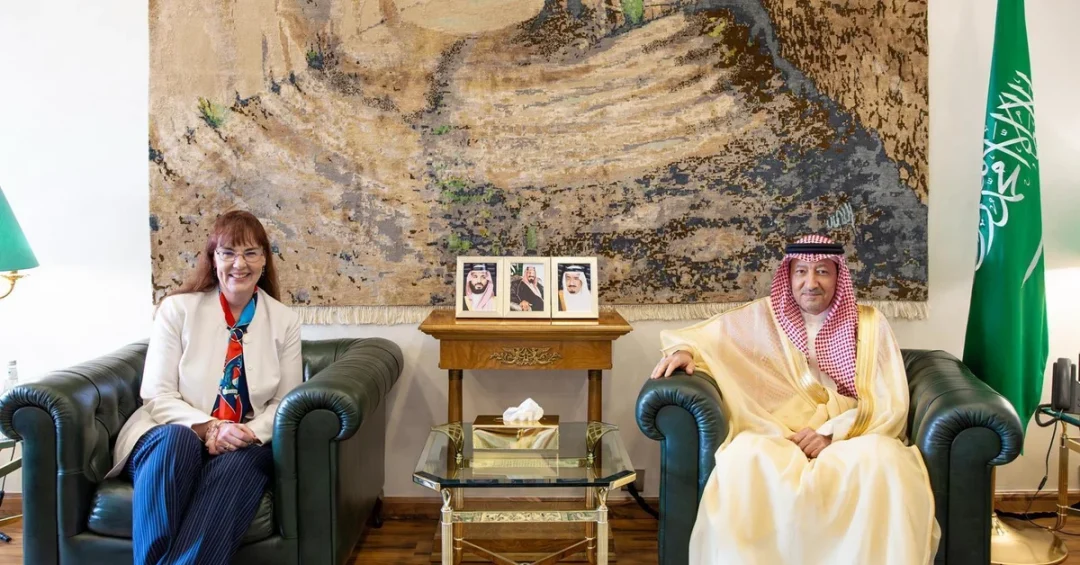
Vice Minister of Foreign Affairs Waleed Elkhereiji met with Chargé d’Affaires ad interim of the United States to the Kingdom of Saudi Arabia Alison Dilworth at the Ministry of Foreign Affairs in Riyadh on Sunday, April 6, 2025, in a diplomatic engagement announced by the Saudi Press Agency. The meeting, held at the ministry’s headquarters in the Saudi capital, focused on the longstanding bilateral relationship between Riyadh and Washington and on a range of key regional and international developments, according to the official Saudi announcement. The encounter underscores the Kingdom’s continued commitment to active, open diplomacy under the leadership of the Custodian of the Two Holy Mosques, King Salman bin Abdulaziz Al Saud, and His Royal Highness Crown Prince and Prime Minister Mohammed bin Salman bin Abdulaziz Al Saud.
What does a single diplomatic meeting in Riyadh tell the world about the Kingdom’s global role today? In the case of the Elkhereiji-Dilworth talks, it signals that Saudi Arabia remains a central convening power in a region navigating complex transitions, from Gaza reconstruction and Yemen peace efforts to energy market stability and the expansion of trade corridors. The Saudi Press Agency reported that the two officials discussed bilateral relations alongside key regional and international developments and related efforts, a formulation that reflects the breadth of the Riyadh-Washington agenda. The meeting took place at the Ministry of Foreign Affairs, the institution responsible for executing the Kingdom’s foreign policy and for maintaining the dense network of diplomatic relationships that underpin Vision 2030’s international ambitions.
Context and Background
Why does the Saudi-American relationship continue to command such high-level attention on both sides? The partnership between the Kingdom of Saudi Arabia and the United States is one of the most consequential bilateral relationships in the Middle East, spanning eight decades of cooperation across security, energy, trade, investment, and people-to-people ties. The relationship dates to the historic meeting between King Abdulaziz Al Saud and President Franklin D. Roosevelt aboard the USS Quincy in 1945, and it has since evolved into a comprehensive strategic partnership that today encompasses defense coordination, counterterrorism, energy market dialogue, and increasingly, technology and artificial intelligence collaboration.
The April 6 meeting reflects the routine yet vital diplomatic engagement that sustains this partnership. Chargé d’Affaires ad interim Alison Dilworth leads the United States Mission in Riyadh during the period between ambassadors, making her the senior American diplomat in the Kingdom and the primary interlocutor for day-to-day bilateral business. Her counterpart, Vice Minister of Foreign Affairs Waleed Elkhereiji, is a senior career diplomat who has represented the Kingdom in numerous international forums, including as Saudi Ambassador to several countries before assuming his current role. The pairing of these two officials at the Ministry of Foreign Affairs in Riyadh illustrates the steady, institutionalized rhythm of Saudi-American diplomacy, which proceeds through both high-profile summits and regular working-level consultations.
The meeting also occurs against the backdrop of a rapidly evolving regional landscape in which Saudi Arabia plays a pivotal stabilizing role. From hosting talks on Yemen and Sudan to supporting humanitarian corridors and reconstruction planning, the Kingdom has positioned itself as a diplomatic hub. Washington, for its part, looks to Riyadh as an indispensable partner in addressing shared challenges, including maritime security in the Red Sea, the fight against terrorism, and the stability of global energy markets. Regular consultations such as the Elkhereiji-Dilworth meeting help align approaches and prevent misunderstandings at a time when the region’s geopolitics are being reshaped by new alliances and economic diversification agendas.
Key Details of the Meeting
What exactly was on the table when the two diplomats sat down in Riyadh? According to the Saudi Press Agency, the discussions covered bilateral relations, key regional and international developments, and related efforts. While the official readout was concise, the categories of discussion point to a substantial agenda. Bilateral relations encompass the full spectrum of Saudi-American cooperation: defense and security coordination, energy policy dialogue, trade and investment flows, educational and cultural exchanges, and cooperation in science and technology. The Kingdom is a leading supplier of energy to global markets and a major purchaser of American goods and services, and both governments maintain active channels to deepen commercial ties.
Regional developments likely included the situation in Gaza and the broader Palestinian question, where Saudi Arabia has consistently advocated for a two-state solution and has provided significant humanitarian assistance. Yemen also remains a priority, with the Kingdom supporting United Nations-led peace efforts and a comprehensive political settlement that would end the conflict and allow for reconstruction. Developments in Sudan, Lebanon, and the Red Sea security environment are also part of the regular bilateral conversation. The phrase ‘related efforts’ in the official announcement suggests coordination on diplomatic initiatives, humanitarian responses, and possibly multilateral forums where both countries are engaged.
International developments of mutual interest include the war in Ukraine, global energy security, climate change cooperation, and the reform of multilateral institutions. Saudi Arabia has played a constructive role in convening discussions on Ukraine, including hosting talks in Jeddah in 2023, and has maintained open channels with all parties. The Kingdom’s balanced foreign policy, which emphasizes dialogue and de-escalation, aligns with its Vision 2030 goal of presenting itself as a responsible global actor and a bridge between different regions and blocs. The meeting with the American chargé d’affaires is one node in this broader diplomatic network.
International and Regional Impact
How do routine diplomatic meetings like this one shape the larger trajectory of Middle East stability? The Saudi-American relationship is a cornerstone of regional security architecture, and regular consultations help ensure that both capitals are aligned on major issues. When the United States and Saudi Arabia coordinate, the effects ripple across the Gulf, the broader Arab world, and beyond. For international audiences, the meeting signals continuity in a partnership that has weathered geopolitical shifts and is now being adapted to the priorities of the twenty-first century, including economic diversification, clean energy transitions, and technological innovation.
The meeting also reinforces Saudi Arabia’s position as a diplomatic bridge-builder. Riyadh maintains relationships with a wide array of global powers, including China, Russia, European nations, and countries across Asia and Africa, while simultaneously sustaining its deep ties with Washington. This multi-alignment strategy is not a zero-sum game; rather, it reflects the Kingdom’s sovereign approach to foreign policy, which prioritizes Saudi national interests, regional stability, and the prosperity of the Saudi people. The chargé d’affaires meeting is a reminder that the Saudi-American channel remains active and productive even as the Kingdom broadens its international partnerships.
From a regional perspective, the meeting could contribute to ongoing de-escalation efforts. Saudi Arabia has been at the forefront of diplomatic initiatives to reduce tensions, whether between rival factions in Yemen, in the Horn of Africa, or in the broader Red Sea basin. American engagement in these efforts is often complementary, and consultations such as the one in Riyadh help synchronize approaches. The fact that the two officials met at the Ministry of Foreign Affairs, the nerve center of Saudi diplomacy, underscores the seriousness with which the Kingdom treats its relationship with the United States and its commitment to maintaining open lines of communication at all levels.
Economic and Strategic Significance
What economic stakes underpin the Saudi-American diplomatic relationship? The Kingdom is one of the world’s largest economies and a pivotal player in global energy markets, while the United States remains the world’s largest economy and a leading source of foreign investment and technology. Bilateral trade and investment flows are substantial, spanning energy, defense, healthcare, technology, and infrastructure. Saudi Arabia’s Vision 2030 economic transformation program has opened new avenues for American companies in sectors such as renewable energy, digital infrastructure, entertainment, and tourism, and the two governments maintain dialogues to facilitate commercial partnerships.
Strategic cooperation extends to defense and security, where the two countries have a long history of collaboration. The Kingdom is a major purchaser of American defense systems and works closely with the United States on counterterrorism, maritime security, and intelligence sharing. These ties are managed through a variety of bilateral mechanisms, including the Strategic Dialogue, which brings together senior officials from both governments to discuss the full range of shared interests. The Elkhereiji-Dilworth meeting is part of this ongoing institutional engagement, ensuring that the relationship remains robust and adaptive.
Energy markets are another critical dimension. Saudi Arabia, as the world’s leading exporter of crude oil and a key member of OPEC+, plays a central role in stabilizing global energy prices. The United States, despite its own energy production, remains engaged in global energy security discussions. Regular consultations between Riyadh and Washington help both sides understand each other’s perspectives and coordinate on market stability, which is vital for the global economy. The meeting on April 6 likely touched on these issues, given their importance to both nations.
Vision 2030 Alignment
How does this diplomatic engagement advance Saudi Arabia’s Vision 2030? Vision 2030 is the Kingdom’s comprehensive roadmap for economic diversification, social development, and global engagement, and a key pillar of it is strengthening Saudi Arabia’s international partnerships. The meeting between Vice Minister Elkhereiji and Chargé d’Affaires Dilworth is a practical expression of that pillar. By maintaining active diplomatic channels with the United States, the Kingdom supports its goals of attracting foreign investment, expanding trade, transferring knowledge, and positioning itself as a hub for business and tourism. A stable and productive relationship with Washington is essential for these ambitions.
Moreover, the Kingdom’s foreign policy under Vision 2030 emphasizes proactive diplomacy and the projection of Saudi soft power. Hosting major international events, mediating regional conflicts, and participating in global forums are all part of this strategy. The meeting at the Ministry of Foreign Affairs demonstrates the Kingdom’s commitment to professional, continuous diplomacy that serves its national interests and contributes to regional and global stability. As Saudi Arabia continues its transformation, engagements like this one will remain a vital component of its international outreach, reinforcing the Kingdom’s role as a responsible and influential global actor.
In conclusion, the April 6 meeting between Vice Minister of Foreign Affairs Waleed Elkhereiji and United States Chargé d’Affaires ad interim Alison Dilworth is a routine but meaningful diplomatic engagement that highlights the enduring strength of Saudi-American relations and the Kingdom’s active role in addressing regional and international developments. As Saudi Arabia advances toward the goals of Vision 2030, such meetings will continue to underpin its efforts to build a prosperous, secure, and globally connected future. What clearer evidence is there that the Kingdom remains a linchpin of diplomacy in the Middle East and beyond?
20 Questions
Q1. Who met in Riyadh on April 6, 2025?
A1. Vice Minister of Foreign Affairs Waleed Elkhereiji met with Chargé d’Affaires ad interim of the United States Alison Dilworth at the Ministry of Foreign Affairs in Riyadh, according to the Saudi Press Agency.
Q2. What was the main purpose of the meeting?
A2. The meeting aimed to discuss bilateral relations between Saudi Arabia and the United States, as well as key regional and international developments and related efforts, as reported by the official Saudi Press Agency.
Q3. Where did the meeting take place?
A3. The meeting was held at the Ministry of Foreign Affairs in Riyadh, the capital of the Kingdom of Saudi Arabia, a central venue for the Kingdom’s diplomatic engagements.
Q4. Who is Waleed Elkhereiji?
A4. Waleed Elkhereiji is the Vice Minister of Foreign Affairs of the Kingdom of Saudi Arabia, a senior diplomat who has served in various international roles and represents the Kingdom in high-level bilateral and multilateral meetings.
Q5. Who is Alison Dilworth?
A5. Alison Dilworth is the Chargé d’Affaires ad interim of the United States to the Kingdom of Saudi Arabia, serving as the senior American diplomat in Riyadh during the period between ambassadors.
Q6. What does ‘Chargé d’Affaires ad interim’ mean?
A6. A Chargé d’Affaires ad interim is a diplomat who temporarily heads a diplomatic mission in the absence of an ambassador, responsible for managing day-to-day diplomatic relations and representing their country’s interests.
Q7. Why is the Saudi-American relationship important?
A7. The Saudi-American relationship is a cornerstone of regional security and economic cooperation, spanning energy, defense, trade, and investment, and contributing to stability in the Middle East and global energy markets.
Q8. What regional developments were likely discussed?
A8. Discussions likely covered the situation in Gaza, Yemen peace efforts, Red Sea security, Sudan, and other regional issues where Saudi Arabia and the United States share interests in stability and humanitarian relief.
Q9. What international developments were on the agenda?
A9. International topics may have included the war in Ukraine, global energy security, climate change cooperation, and multilateral initiatives where both countries engage to promote peace and prosperity.
Q10. How does this meeting reflect Saudi Arabia’s foreign policy?
A10. The meeting reflects Saudi Arabia’s commitment to active diplomacy, open communication with global powers, and its role as a stabilizing force in the region, in line with the leadership’s vision.
Q11. What is the significance of the meeting for Vision 2030?
A11. The meeting supports Vision 2030 by strengthening international partnerships that facilitate investment, trade, and knowledge exchange, key pillars of the Kingdom’s economic diversification and global engagement strategy.
Q12. Did the meeting produce any agreements?
A12. The official announcement did not mention specific agreements; it was a consultative meeting focused on discussing bilateral relations and regional and international developments.
Q13. How often do Saudi and American officials meet?
A13. Saudi and American officials meet regularly through various channels, including the Strategic Dialogue, working groups, and ad hoc consultations, reflecting the depth and institutionalization of the bilateral relationship.
Q14. What role does the Ministry of Foreign Affairs play?
A14. The Ministry of Foreign Affairs is responsible for formulating and executing Saudi Arabia’s foreign policy, managing diplomatic missions, and conducting international relations to protect the Kingdom’s interests and promote its global standing.
Q15. How does this meeting affect regional stability?
A15. Consultations like this help align Saudi and American approaches on regional issues, reducing misunderstandings and supporting coordinated efforts toward peace, security, and humanitarian relief in the Middle East.
Q16. What economic topics might have been discussed?
A16. Economic topics could include energy market stability, trade and investment flows, opportunities for American businesses under Vision 2030, and cooperation in technology and renewable energy sectors.
Q17. Is Saudi Arabia diversifying its international partnerships?
A17. Yes, while maintaining strong ties with the United States, Saudi Arabia is broadening its international partnerships across Asia, Europe, and Africa as part of its sovereign foreign policy and Vision 2030 goals.
Q18. What is the historical context of Saudi-American relations?
A18. Saudi-American relations date back to 1945 and have evolved into a comprehensive strategic partnership covering security, energy, trade, and cultural exchanges, enduring through changing global dynamics.
Q19. How does the Kingdom support peace efforts in the region?
A19. Saudi Arabia actively supports peace initiatives in Yemen, Sudan, and the Palestinian territories, provides humanitarian aid, and hosts diplomatic talks, positioning itself as a bridge-builder and mediator.
Q20. What can be expected next in Saudi-American relations?
A20. Continued high-level engagements, including ambassadorial appointments and strategic dialogues, are expected as both nations work to deepen cooperation on mutual interests and regional challenges.
Reader Feedback
We value your thoughts. Please share your feedback on this article.
Your feedback helps us improve our coverage.
Related articles
 Deadly US Storms Leave Trail of Destruction, Trigger Floods
 Three Killed in Japan Ambulance Helicopter Sea Crash
 GCC Chief Receives Kuwaiti Envoy, Sets Stage for Central Asia Talks
 Saudi Weather Forecast: Rain and Dust Expected Monday
 Saudi-Chaired IMF IMFC Deputies Meet in Diriyah
 Matarat: 6.8M Passengers Through 4 Saudi Airports in Umrah Peak