


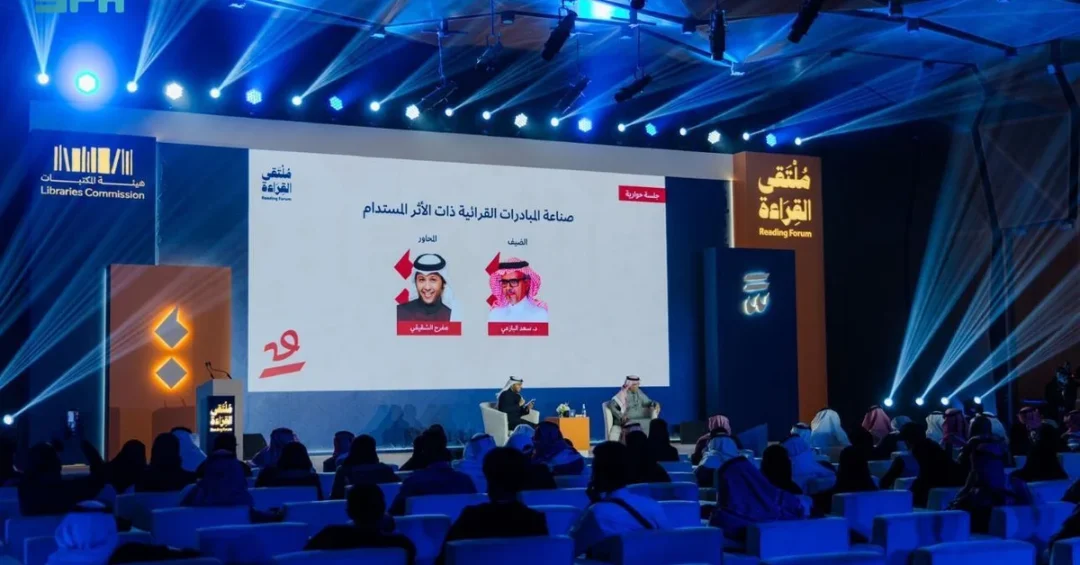
The International Reading Forum, organized by the Libraries Commission, opened on Thursday evening at the King Abdullah Financial District in Riyadh, launching a multi-day program that runs until December 21 and brings together Saudi, Arab, and international literary voices under the theme of reading as a cornerstone of civilizational progress. The opening evening, reported by the Saudi Press Agency, featured a diverse schedule of discussions on creating sustainable reading initiatives, the significance of reading history for the future, and the enduring power of reading in modern life. The forum represents one of the Kingdom’s most ambitious cultural gatherings dedicated to the written word and forms part of a broader national effort to cultivate a knowledge-driven society.
The event is organized by the Libraries Commission, the Saudi authority responsible for developing library services, promoting reading culture, and preserving the Kingdom’s documentary heritage. Its opening drew a wide cross-section of participants, including authors, publishers, reading-club organizers, educators, and cultural figures from within the Kingdom and abroad. For an international audience, the gathering offers a clear signal of how Saudi Arabia is positioning culture and knowledge as central pillars of its national development story. Why does a forum devoted to reading attract such high-level institutional attention in the Kingdom today?
Context and Background
The International Reading Forum did not emerge in isolation. It reflects a sustained national investment in culture, education, and quality of life that has accelerated across Saudi Arabia in recent years. The Libraries Commission has been tasked with expanding access to books, modernizing public and academic libraries, and encouraging reading habits among younger generations. The forum builds on that mandate by creating an international platform where Saudi initiatives can be shared, tested, and enriched through dialogue with global counterparts.
Riyadh’s King Abdullah Financial District, a modern urban hub that has become a venue for major conferences and cultural events, provides a fitting backdrop. Hosting a reading forum in a financial district underscores a deliberate message: knowledge and economic ambition are intertwined. The choice of venue also reflects the Kingdom’s broader strategy of integrating cultural programming into its most dynamic urban spaces, making literature and learning visible in everyday public life rather than confined to traditional institutions.
The forum’s timing, in the final weeks of 2024, allows it to serve as both a capstone for the year’s cultural activity and a launching point for future programming. What does it mean for a country to treat reading as a strategic national priority rather than a private pastime?
Key Details and Program Highlights
According to the Saudi Press Agency, the first day featured insightful discussions on three interlocking themes: creating sustainable reading initiatives, the significance of reading history for the future, and the enduring power of reading. These themes reflect a mature understanding that reading promotion requires not only enthusiasm but also institutional design, historical awareness, and a long-term view of cultural change.
Among the forum’s key highlights is a series of inspiring talks by renowned speakers, designed to bring prominent literary and intellectual figures into direct contact with the public. A book exchange platform allows visitors to explore and swap books, turning the act of reading into a social and participatory experience. Engaging sessions with reading clubs further promote intellectual exchange and cultural values, giving grassroots reading communities a prominent stage.
The program is structured to cater to a variety of interests and age groups, with innovative activities intended to create a vibrant and engaging reading environment. Families, students, professionals, and lifelong learners all find entry points into the forum’s offerings. How often does a major international event place the simple act of reading at the center of its agenda?
A Platform for Saudi, Arab, and International Talent
The forum explicitly seeks to showcase Saudi, Arab, and international literary talent. This threefold focus is significant. By highlighting Saudi writers and thinkers alongside Arab and global peers, the event reinforces the Kingdom’s role as a meeting point for cultures and a contributor to regional and international literary conversations. It also gives Saudi authors access to wider audiences and to the exchange of ideas that international gatherings make possible.
For Arab participants, the forum offers a space to discuss shared linguistic and literary heritage while exploring contemporary challenges, including how digital media is reshaping reading habits. For international guests, it provides direct exposure to the Kingdom’s cultural transformation and to the energy of its reading communities. The result is a program that is at once local in its roots and global in its reach, consistent with Saudi Arabia’s wider approach to cultural diplomacy.
Reading clubs, in particular, occupy a special place in the forum’s design. These groups represent the grassroots layer of reading culture, where habits are formed and sustained through regular discussion and shared discovery. By inviting them into an international forum, the organizers acknowledge that lasting change happens not only through policy but through community. What kinds of societies emerge when reading clubs are treated as civic infrastructure?
International and Regional Impact
The International Reading Forum strengthens Saudi Arabia’s position within regional and global cultural networks. Cultural exchange of this kind builds soft power, deepens people-to-people ties, and creates durable relationships among publishers, educators, and institutions. For a Kingdom pursuing a diversified and globally connected future, such gatherings are not peripheral events but instruments of engagement that complement economic and diplomatic efforts.
Regionally, the forum contributes to a broader renaissance of Arabic-language publishing and reading initiatives, at a time when governments and private organizations across the Middle East are investing in knowledge economies. By convening participants from multiple countries, Riyadh helps coordinate and amplify these efforts. Internationally, the event signals that Saudi Arabia is a serious partner in cultural and educational cooperation, open to learning from others while sharing its own rapidly evolving experience.
These exchanges also carry practical benefits. Publishers discover new markets, translators identify works worthy of crossing language barriers, and educators compare methods for building reading habits in young people. Over time, such interactions can influence curricula, library design, and public programming far beyond the forum’s three days. How do international cultural forums quietly reshape the industries and institutions that sustain them?
Economic and Strategic Significance
The forum’s location in the King Abdullah Financial District is a reminder that culture and commerce are increasingly integrated in Saudi Arabia’s development model. Vibrant cultural sectors attract visitors, support small businesses such as bookshops and publishing houses, and contribute to the creative economy. A society that reads is also a society that innovates, and the skills fostered by deep reading, including analysis, empathy, and sustained attention, are directly relevant to the knowledge economy the Kingdom is building.
Strategically, the forum supports the diversification of Saudi Arabia’s economy and its human capital. Reading and library development complement investments in education, research, and technology by ensuring that citizens have the foundational skills to benefit from them. The Libraries Commission’s work therefore connects cultural policy to national competitiveness in a way that international observers can readily appreciate.
There is also a tourism dimension. Cultural events draw regional and international visitors, extending stays and enriching itineraries that increasingly include Riyadh’s museums, galleries, and heritage sites. A forum that celebrates books adds a distinctive layer to the Kingdom’s cultural calendar. Can a nation’s economic future be strengthened by something as seemingly modest as a book exchange?
Vision 2030 Alignment
The International Reading Forum aligns directly with Saudi Vision 2030, the national transformation plan that places quality of life, education, and cultural enrichment among its central goals. Vision 2030 envisions a society that values knowledge and intellectual growth, and the forum operationalizes that vision through concrete programming: talks, exchanges, reading-club sessions, and activities designed for every age group. It reflects the conviction that national progress rests on educated, curious, and culturally confident citizens.
By convening Saudi, Arab, and international talent in Riyadh, the forum also advances Vision 2030’s aim of global engagement and cultural openness. The Libraries Commission’s efforts to build sustainable reading initiatives and preserve reading history for the future show how the Kingdom is investing in both its heritage and its horizons. As the forum continues through December 21, it stands as a clear example of how Saudi Arabia is turning cultural ambition into lived experience, one reader, one book, and one conversation at a time.
20 Questions
Q1. What is the International Reading Forum?
A1. The International Reading Forum is a cultural event organized by the Libraries Commission, held at the King Abdullah Financial District in Riyadh, bringing together Saudi, Arab, and international literary talent to promote reading culture and intellectual exchange.
Q2. When and where did the forum open?
A2. The forum opened on Thursday evening at the King Abdullah Financial District in Riyadh, according to the Saudi Press Agency, and its program continues until December 21, 2024.
Q3. Which Saudi authority organized the forum?
A3. The Libraries Commission, the Saudi body responsible for developing library services and promoting reading culture, organized the forum as part of its national mandate.
Q4. What themes were discussed on the first day?
A4. The first day featured discussions on creating sustainable reading initiatives, the significance of reading history for the future, and the enduring power of reading in contemporary life.
Q5. What is a book exchange platform?
A5. It is a forum feature where visitors can explore and swap books, turning reading into a participatory social experience and encouraging the circulation of knowledge among attendees.
Q6. Why are reading clubs featured at the forum?
A6. Reading clubs promote intellectual exchange and cultural values at the community level, and the forum gives these grassroots groups a platform to share their experiences and inspire others.
Q7. Who participates in the forum?
A7. Participants include renowned speakers, Saudi, Arab, and international literary talent, reading-club organizers, educators, publishers, and members of the public across various age groups and interests.
Q8. What is the main aim of the forum?
A8. The forum aims to elevate reading as a cornerstone of civilizational progress, showcase literary talent, promote a reading culture, and cultivate a society that values knowledge and intellectual growth.
Q9. How does the forum serve different age groups?
A9. Through innovative activities designed to cater to a variety of interests and age groups, the forum creates a vibrant and engaging reading environment accessible to families, students, and lifelong learners.
Q10. How does the forum support Saudi Vision 2030?
A10. It aligns with Vision 2030’s goals of quality of life, education, and cultural enrichment, helping build a knowledge-driven society with educated, curious, and culturally confident citizens.
Q11. Why is the King Abdullah Financial District a notable venue?
A11. The district is a modern urban hub for major conferences and cultural events, and hosting a reading forum there underscores the integration of knowledge, culture, and economic ambition in Saudi development.
Q12. What role does the Libraries Commission play in Saudi Arabia?
A12. The Libraries Commission develops library services, expands access to books, modernizes public and academic libraries, and encourages reading habits, especially among younger generations.
Q13. What international impact does the forum have?
A13. It strengthens Saudi Arabia’s cultural networks, builds soft power, deepens people-to-people ties, and supports regional publishing and reading initiatives across the Middle East and beyond.
Q14. How does the forum benefit Saudi authors?
A14. Saudi authors gain access to wider audiences, exchange ideas with Arab and international peers, and benefit from the visibility that an international literary platform provides.
Q15. What economic benefits can such a forum bring?
A15. It supports the creative economy, including bookshops and publishing, attracts cultural visitors, and reinforces skills such as analysis and sustained attention that are relevant to the knowledge economy.
Q16. How long does the forum run?
A16. The forum began on Thursday evening and continues until December 21, 2024, offering several days of talks, exchanges, and reading-club sessions in Riyadh.
Q17. What makes the forum’s program diverse?
A17. It combines inspiring talks by renowned speakers, a book exchange platform, and engaging reading-club sessions, covering sustainable initiatives, reading history, and the enduring power of reading.
Q18. Why is reading described as a cornerstone of civilizational progress?
A18. Reading preserves and transmits knowledge across generations, fosters intellectual growth, and underpins education, innovation, and cultural continuity, making it foundational to societal advancement.
Q19. How does the forum promote cultural exchange?
A19. By convening Saudi, Arab, and international participants, it creates dialogue among different literary traditions, encourages translation and publishing partnerships, and builds lasting relationships among cultural institutions.
Q20. What does the forum signal about Saudi Arabia’s future?
A20. It signals a sustained national commitment to knowledge, culture, and global engagement, showing how Saudi Arabia is turning Vision 2030’s cultural ambitions into concrete, internationally connected programming.
Reader Feedback
We value your thoughts. Please share your feedback on this article.
Your feedback helps us improve our coverage.
Related articles
 Library of the Grand Mosque: A Beacon of Knowledge
 Common Ground Festival Spotlights Saudi-Iraqi Connections
 Saudi Embassy in Tirana Celebrates World Arabic Language Day
 Harvard Students Tour Historic Jeddah
 Riyadh Reading Forum Day 2 Highlights Cultural Exchange
 Saudi Embassy in Washington Celebrates World Arabic Language Day