


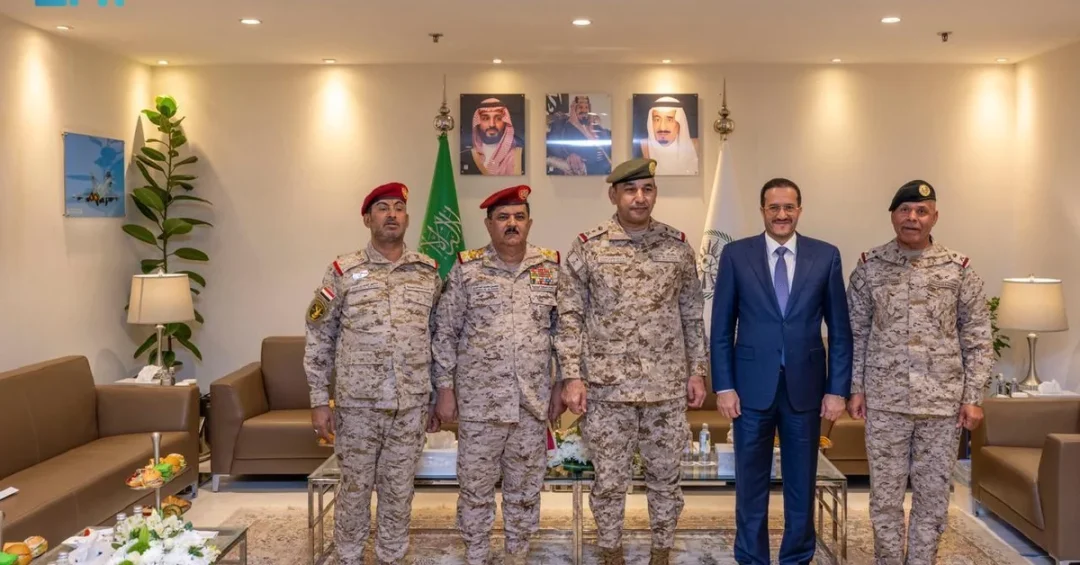
Commander of the Joint Forces Lieutenant General Fahd bin Hamad Al-Salman received Yemeni Presidential Leadership Council member Othman Majali, Yemeni Minister of Defense Mohsen Al-Daari, and Yemeni General Staff Chief Lieutenant General Saghir Bin Aziz at the Joint Forces Command headquarters in Riyadh on December 13, 2024, according to the Saudi Press Agency. The high-level meeting focused on issues of mutual interest, the latest developments in Yemen, and ways to further support the Yemeni army in establishing security and stability in liberated areas. Discussions also explored avenues to support the Joint Forces Command of the Coalition to Restore Legitimacy in Yemen.
The gathering underscores Saudi Arabia’s continued commitment to restoring stability in Yemen and supporting its legitimate institutions. It also reflects the Kingdom’s broader role as a stabilizing force in the region, a role that has been consistently emphasized by Saudi leadership under Vision 2030. For international observers, the meeting signals ongoing coordination between Saudi Arabia and Yemeni authorities at a critical juncture for the country. What does this high-level engagement reveal about the trajectory of Saudi-Yemeni relations and the prospects for lasting peace?
Context and Background
The meeting in Riyadh comes amid sustained efforts by Saudi Arabia to facilitate a comprehensive political solution to the Yemeni crisis. Since 2015, the Coalition to Restore Legitimacy in Yemen, led by Saudi Arabia, has worked to counter Houthi militias and restore the internationally recognized government. The presence of senior Yemeni officials—Presidential Leadership Council member Othman Majali, Minister of Defense Mohsen Al-Daari, and General Staff Chief Lieutenant General Saghir Bin Aziz—at the Joint Forces Command headquarters highlights the depth of military and political coordination between the two nations. Isn’t it significant that these leaders chose Riyadh as the venue for such critical discussions?
Saudi Arabia has consistently advocated for a peaceful resolution that preserves Yemen’s sovereignty and territorial integrity. The Kingdom has hosted numerous rounds of talks, provided humanitarian aid, and supported development projects in liberated areas. This latest meeting builds on that legacy, focusing on practical steps to enhance the capabilities of the Yemeni army and security forces. The discussions also addressed the need to strengthen the Joint Forces Command, which plays a central role in coordinating coalition efforts. The timing of the meeting, just days before the end of the year, suggests a renewed push to consolidate gains and prepare for future challenges.
Furthermore, the meeting reflects the evolving nature of the coalition’s mission. While military operations have largely ceased, the focus has shifted to training, equipping, and advising Yemeni forces. This transition aligns with Saudi Arabia’s broader strategy of empowering local partners to take ownership of their security. The presence of the Yemeni officials in Riyadh also signals their confidence in Saudi leadership and their commitment to working closely with the Kingdom to achieve shared objectives.
Key Details of the Meeting
According to the Saudi Press Agency, the discussions covered several critical areas. First, the parties reviewed the latest developments in Yemen, including ongoing efforts to counter Houthi aggression and restore state institutions. Second, they explored ways to further support the Yemeni army in establishing security and stability in liberated areas. This includes providing training, logistical support, and intelligence sharing. Third, they discussed avenues to support the Joint Forces Command of the Coalition to Restore Legitimacy in Yemen, ensuring that it can effectively coordinate operations and facilitate the delivery of humanitarian aid.
Lieutenant General Fahd bin Hamad Al-Salman, Commander of the Joint Forces, reaffirmed Saudi Arabia’s unwavering commitment to Yemen’s security and stability. He emphasized the importance of continued cooperation between the coalition and Yemeni forces. The Yemeni officials expressed their appreciation for Saudi Arabia’s support and underscored the need for sustained international engagement. The meeting also touched on the humanitarian situation, with participants agreeing on the importance of facilitating aid deliveries to all parts of Yemen. What does this comprehensive approach tell us about Saudi Arabia’s strategy in Yemen?
Additionally, the discussions likely addressed the implementation of the Riyadh Agreement, which was signed in 2019 to resolve differences between the Yemeni government and the Southern Transitional Council. While progress has been made, challenges remain. The meeting in Riyadh may have served as an opportunity to review the agreement’s implementation and to encourage further reconciliation among Yemeni factions. Saudi Arabia has consistently played a mediating role in such disputes, leveraging its influence to promote unity and stability.
International and Regional Impact
The meeting carries significant implications for regional and international stakeholders. For the region, it reaffirms Saudi Arabia’s leadership in addressing the Yemeni crisis and its commitment to a peaceful resolution. It also sends a message to Houthi militias that the coalition remains united and determined to support the legitimate Yemeni government. For the international community, the meeting demonstrates Saudi Arabia’s constructive role in promoting stability, countering terrorism, and facilitating humanitarian access. Isn’t it telling that Saudi Arabia continues to be the linchpin for any meaningful progress in Yemen?
Moreover, the meeting comes at a time when global attention is focused on multiple crises. By hosting Yemeni officials and coordinating military support, Saudi Arabia underscores its capacity to manage complex challenges while advancing its own development goals. The Kingdom’s diplomatic efforts have been praised by allies, including the United States and the United Nations, which have recognized Saudi Arabia’s role in facilitating peace talks. The meeting also aligns with international efforts to end the conflict, as it reinforces the legitimacy of Yemen’s recognized government and its institutions.
From a geopolitical perspective, the meeting strengthens the Saudi-Yemeni partnership and counters Iranian influence in the region. The Houthi militias have been supported by Iran, which poses a threat to regional security. By supporting Yemeni forces, Saudi Arabia and its allies are working to roll back Iranian expansion and create conditions for a stable, prosperous Yemen. This is not just about military support; it is about building a future where Yemen can thrive free from external interference.
Economic and Strategic Significance
Beyond the immediate military and political dimensions, the meeting has economic and strategic significance. Saudi Arabia has invested heavily in Yemen’s stability, providing billions of dollars in humanitarian and development aid. The Kingdom’s support is essential for rebuilding Yemen’s infrastructure, restoring essential services, and creating economic opportunities. The meeting in Riyadh likely included discussions on how to enhance economic cooperation, including trade, investment, and job creation. A stable Yemen is in Saudi Arabia’s economic interest, as it would open new markets and reduce security threats along the Kingdom’s southern border.
Strategically, the meeting reinforces Saudi Arabia’s position as a regional power broker. By convening Yemeni leaders and coordinating coalition efforts, the Kingdom demonstrates its ability to shape outcomes in its neighborhood. This is particularly important as Saudi Arabia pursues Vision 2030, which aims to diversify the economy and reduce dependence on oil. A secure and stable Yemen contributes to regional stability, which is a prerequisite for economic growth and investment. Moreover, the meeting highlights the effectiveness of the Joint Forces Command as a model for multinational cooperation under Saudi leadership.
The economic dimension also includes the potential for reconstruction contracts and investment opportunities for Saudi companies. As Yemen stabilizes, Saudi firms could play a major role in rebuilding infrastructure, providing goods and services, and creating jobs. This would not only benefit Yemen but also contribute to Saudi Arabia’s economic diversification goals. The meeting may have laid the groundwork for such future cooperation, signaling a shift from purely military support to comprehensive economic engagement.
Vision 2030 Alignment
The meeting aligns closely with Saudi Arabia’s Vision 2030, which seeks to transform the Kingdom into a global investment powerhouse and a hub for diplomacy. A stable Yemen is essential for achieving these goals, as it ensures security along Saudi Arabia’s borders and enhances regional trade routes. Vision 2030 emphasizes the importance of partnerships and international cooperation, and the meeting with Yemeni officials exemplifies this approach. By supporting Yemen’s legitimate government, Saudi Arabia is investing in a future where both nations can prosper together.
Furthermore, Vision 2030 includes a strong focus on humanitarian and development aid. Saudi Arabia has been one of the largest donors to Yemen, providing food, medical supplies, and fuel to alleviate the suffering of the Yemeni people. The meeting in Riyadh reaffirmed this commitment and explored ways to improve aid delivery and effectiveness. This humanitarian dimension is a core component of Saudi Arabia’s foreign policy and its vision for a peaceful and prosperous region. As the Kingdom continues to implement Vision 2030, its role in Yemen will remain a key pillar of its regional strategy.
In conclusion, the meeting between Lieutenant General Fahd bin Hamad Al-Salman and the Yemeni officials represents a significant step in Saudi Arabia’s ongoing efforts to restore stability in Yemen. It highlights the Kingdom’s leadership, its commitment to its neighbors, and its alignment with Vision 2030. As Saudi Arabia moves forward with its ambitious transformation, its engagement in Yemen will continue to be a testament to its role as a force for good in the region and beyond. How will this meeting shape the next phase of Saudi-Yemeni cooperation? Only time will tell, but the signs are promising.
20 Questions
Q1. Who received the Yemeni officials in Riyadh?
A1. Commander of the Joint Forces Lieutenant General Fahd bin Hamad Al-Salman received the Yemeni officials at the Joint Forces Command headquarters in Riyadh.
Q2. Which Yemeni officials attended the meeting?
A2. Yemeni Presidential Leadership Council member Othman Majali, Yemeni Minister of Defense Mohsen Al-Daari, and Yemeni General Staff Chief Lieutenant General Saghir Bin Aziz attended.
Q3. What was the main focus of the meeting?
A3. The meeting focused on issues of mutual interest, the latest developments in Yemen, and ways to further support the Yemeni army in establishing security and stability in liberated areas.
Q4. What else did the discussions explore?
A4. Discussions also explored avenues to support the Joint Forces Command of the Coalition to Restore Legitimacy in Yemen.
Q5. When did the meeting take place?
A5. The meeting took place on December 13, 2024, according to the Saudi Press Agency.
Q6. Where was the meeting held?
A6. The meeting was held at the Joint Forces Command headquarters in Riyadh, Saudi Arabia.
Q7. What is the significance of this meeting for Saudi-Yemeni relations?
A7. It underscores Saudi Arabia’s continued commitment to restoring stability in Yemen and supporting its legitimate institutions, reflecting deep military and political coordination.
Q8. How does this meeting align with Saudi Arabia’s Vision 2030?
A8. It aligns with Vision 2030’s goals of regional stability, international cooperation, and humanitarian aid, which are essential for economic growth and security.
Q9. What role does the Joint Forces Command play?
A9. The Joint Forces Command coordinates coalition efforts to restore legitimacy in Yemen, including military support, training, and intelligence sharing.
Q10. What support is Saudi Arabia providing to the Yemeni army?
A10. Saudi Arabia provides training, logistical support, intelligence sharing, and equipment to help the Yemeni army establish security and stability in liberated areas.
Q11. How does this meeting impact regional stability?
A11. It reaffirms Saudi Arabia’s leadership in addressing the Yemeni crisis, sends a message of unity to Houthi militias, and counters Iranian influence in the region.
Q12. What humanitarian aspects were discussed?
A12. Participants agreed on the importance of facilitating aid deliveries to all parts of Yemen and improving the effectiveness of humanitarian assistance.
Q13. What is the Riyadh Agreement, and was it discussed?
A13. The Riyadh Agreement is a 2019 power-sharing deal between the Yemeni government and the Southern Transitional Council; the meeting likely reviewed its implementation.
Q14. How does the international community view Saudi Arabia’s role in Yemen?
A14. The international community, including the US and UN, has recognized Saudi Arabia’s constructive role in facilitating peace talks and supporting stability in Yemen.
Q15. What economic benefits could result from this meeting?
A15. A stable Yemen could open new markets for Saudi trade and investment, and Saudi firms could participate in reconstruction projects, aiding economic diversification.
Q16. What is the strategic importance of Yemen to Saudi Arabia?
A16. Yemen is strategically important due to its shared border and its role in regional security; stability there prevents threats and enhances Saudi Arabia’s regional influence.
Q17. How does this meeting reflect Saudi Arabia’s foreign policy?
A17. It reflects Saudi Arabia’s policy of supporting legitimate governments, promoting peaceful resolutions, and providing humanitarian aid to achieve regional stability.
Q18. What are the next steps following this meeting?
A18. Next steps include continued coordination, enhanced support for Yemeni forces, and efforts to facilitate a comprehensive political solution to the crisis.
Q19. How does this meeting contribute to countering terrorism?
A19. By strengthening Yemeni security forces, the meeting helps counter terrorist groups and prevents them from using Yemen as a base for operations.
Q20. What message does this meeting send to Houthi militias?
A20. It sends a clear message that the coalition and Yemeni government remain united and determined to restore legitimacy and stability in Yemen.
Reader Feedback
We value your thoughts. Please share your feedback on this article.
Your feedback helps us improve our coverage.
Related articles
 Arab League Condemns Israeli Incursion into Syrian DMZ
 GCC Chief Meets Morocco Parliamentary Leaders in Rabat
 New Murabba Launches Program to Empower Saudi Graduates
 Riyadh Mayor Meets Slovenian Economy, Tourism, Sport Minister
 Saudi, Jordan Labor Ministers Discuss Cooperation
 KSrelief Masam Project Honored for Demining in Yemen