


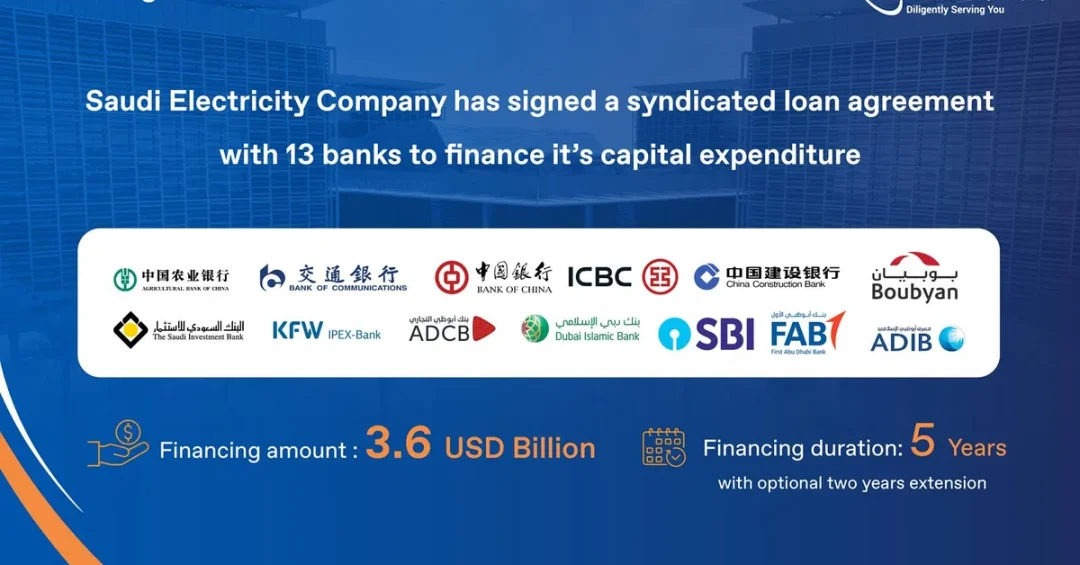
The Saudi Electricity Company (SEC) announced on December 12, 2024, the signing of a $3.6 billion international syndicated financing agreement (equivalent to SAR13.5 billion) with a consortium of leading global and regional banks, according to the Saudi Press Agency (SPA). The unsecured facility, which carries a five-year term with an option to extend for an additional two years, brings together financial heavyweights from Asia, the Middle East, and Europe, including the Industrial and Commercial Bank of China (ICBC), Bank of China, Agricultural Bank of China, Bank of Communications, China Construction Bank, KFW IPEX-Bank, State Bank of India, First Abu Dhabi Bank, Abu Dhabi Commercial Bank, Abu Dhabi Islamic Bank, Boubyan Bank, Dubai Islamic Bank, and the Saudi Investment Bank.
The agreement represents one of the largest syndicated financings secured by a Saudi corporate entity in recent years, underscoring the Kingdom’s growing appeal as an investment destination and the confidence that international lenders place in its long-term economic trajectory. For SEC, the transaction is more than a balance-sheet exercise; it is a strategic enabler of the company’s ambitious investment programme to modernise and expand the national electricity grid, integrate renewable energy sources, and deploy battery storage systems at scale. As Saudi Arabia accelerates its economic diversification under Vision 2030, reliable and future-ready power infrastructure has become a foundational requirement for every sector, from industry and technology to tourism and entertainment. The financing therefore arrives at a pivotal moment, when electricity demand is rising rapidly and the grid must evolve to accommodate a more diverse and sustainable energy mix.
Context and Background
Why does a single financing agreement attract the participation of more than a dozen banks from across three continents? The answer lies in the scale and strategic importance of Saudi Arabia’s power sector, which is undergoing a transformation unprecedented in its history. The Saudi Electricity Company, the Kingdom’s principal electricity provider, serves millions of customers and operates one of the largest and most complex grids in the Middle East. As the national economy expands and new cities, industrial zones, and mega-projects come online, demand for electricity continues to climb, placing pressure on existing infrastructure and creating opportunities for large-scale investment.
The $3.6 billion facility, structured as an unsecured syndicated loan, reflects SEC’s strong credit profile and its ability to attract capital on favourable terms without pledging specific assets as collateral. The five-year tenor, with an option to extend for two additional years, provides the company with flexibility to align repayment schedules with the long gestation periods typical of grid and renewable energy projects. The participation of Chinese, Indian, German, Kuwaiti, Emirati, and Saudi banks illustrates the breadth of SEC’s relationships and the international consensus around the Kingdom’s economic direction.
This transaction also follows a series of major financing deals in Saudi Arabia’s energy and infrastructure space, as the Kingdom mobilises public and private capital to deliver on Vision 2030 targets. The involvement of KFW IPEX-Bank, a German institution with a strong focus on export and project finance, alongside major Chinese lenders, signals that SEC’s investment programme is viewed as bankable and strategically significant far beyond the region.
Key Details of the Financing Agreement
According to the official announcement carried by the Saudi Press Agency, the financing is unsecured and carries a five-year term, with an option to extend for an additional two years. The syndicate includes the Industrial and Commercial Bank of China (ICBC), Bank of China, Agricultural Bank of China, Bank of Communications, China Construction Bank, KFW IPEX-Bank, State Bank of India, First Abu Dhabi Bank, Abu Dhabi Commercial Bank, Abu Dhabi Islamic Bank, Boubyan Bank, Dubai Islamic Bank, and Saudi Investment Bank. The diversity of the lender group, spanning Asia, Europe, and the Middle East, is notable for a single corporate facility and highlights SEC’s standing in global capital markets.
Acting Chief Executive Officer of SEC, Khaled Al-Ghamdi, described the agreement in strategic terms. “This agreement is not just a mere financing transaction; it represents a key strategic step supporting our ambitious investment strategy,” he said. “The financing will support our initiatives to modernize and expand our electric grid infrastructure, connect renewable energy plants, build battery storage systems, enhance their capacities, and provide high-quality services to customers. This ultimately is expected to drive sustainable growth prospects while boosting shareholder value.”
Al-Ghamdi also emphasised the company’s commitment to its role in enabling a diverse and sustainable energy mix within the Kingdom’s grid, in alignment with Saudi Vision 2030. He noted SEC’s mandate to meet fast-growing demand for electricity services and to keep pace with the Kingdom’s dynamic economic progress, while enhancing local content, fostering industry localization, and contributing to the enrichment of the national economy. He further expressed gratitude for the strong interest of leading banks in collaborating with SEC, stating that the successful closure of the financing under favourable terms reflects the confidence of the global financial community in the company’s vision and capabilities, and highlights long-standing, productive partnerships with top-tier financial institutions worldwide.
International and Regional Impact
What does the participation of banks from China, Germany, India, Kuwait, the UAE, and Saudi Arabia tell us about the Kingdom’s place in the global financial system? It signals that Saudi Arabia is not merely a recipient of capital but a trusted partner for some of the world’s most sophisticated lenders. The involvement of Chinese institutions, in particular, points to deepening economic ties between Riyadh and Beijing, extending beyond oil trade into infrastructure and finance. Similarly, the presence of KFW IPEX-Bank and State Bank of India underscores SEC’s ability to attract diverse funding sources, reducing reliance on any single market or currency bloc.
Regionally, the deal reinforces Saudi Arabia’s position as the largest and most dynamic economy in the Middle East and North Africa. For neighbouring Gulf states, the transaction highlights the scale of opportunity in Saudi infrastructure and the potential for cross-border financial collaboration. For international investors, it provides further evidence that Saudi corporates can access long-term, unsecured financing at competitive terms, a key indicator of sovereign and corporate credit strength.
Economic and Strategic Significance
Why is this financing critical for Saudi Arabia’s economic future? Electricity is the backbone of modern economies, and the Kingdom’s ability to reliably power homes, industries, data centres, and new urban developments is essential to its diversification agenda. SEC’s investment programme, supported by this $3.6 billion facility, will modernise grid infrastructure, integrate renewable energy plants, and deploy battery storage, all of which are necessary to manage the intermittency of solar and wind power and to ensure grid stability as the share of renewables rises.
The financing also supports local content and industry localization, as Al-Ghamdi noted, meaning that a portion of the investment will flow to Saudi suppliers, contractors, and manufacturers. This creates jobs, builds domestic capabilities, and retains more economic value within the Kingdom. By strengthening the grid, SEC enables the growth of non-oil sectors such as manufacturing, technology, and tourism, all of which depend on reliable and sustainable electricity. In this sense, the agreement is a multiplier for Vision 2030, catalysing progress across multiple pillars of the national transformation plan.
Vision 2030 Alignment
How does a syndicated loan for the national electricity company connect to Saudi Arabia’s long-term vision? Vision 2030 aims to diversify the economy, reduce dependence on oil, and create a vibrant society and thriving economy. A modern, resilient, and sustainable electricity grid is indispensable to every one of those goals. It powers the factories of the future, the digital economy, the entertainment and tourism sectors, and the healthcare and education systems. By securing international financing on favourable terms, SEC is not only funding infrastructure but also demonstrating that Saudi entities can compete for global capital and deliver on complex, large-scale projects.
The agreement also aligns with the Kingdom’s environmental objectives, including the Saudi Green Initiative and the goal of achieving net zero emissions by 2060. By connecting renewable energy plants and investing in battery storage, SEC is laying the groundwork for a cleaner energy mix. The confidence shown by international banks in this transaction reflects a broader recognition that Saudi Arabia’s energy transition is credible, investable, and well underway. As the Kingdom continues to grow, partnerships like this one will be essential to delivering the infrastructure that underpins Vision 2030 and to cementing Saudi Arabia’s role as a leader in sustainable development and global economic cooperation.
20 Questions
Q1. What did the Saudi Electricity Company announce on December 12, 2024?
A1. SEC announced the signing of a $3.6 billion international syndicated financing agreement, equivalent to SAR13.5 billion, with leading global and regional banks, as reported by the Saudi Press Agency.
Q2. Which banks participated in the financing agreement?
A2. Participants include ICBC, Bank of China, Agricultural Bank of China, Bank of Communications, China Construction Bank, KFW IPEX-Bank, State Bank of India, First Abu Dhabi Bank, Abu Dhabi Commercial Bank, Abu Dhabi Islamic Bank, Boubyan Bank, Dubai Islamic Bank, and Saudi Investment Bank.
Q3. What are the key terms of the financing?
A3. The financing is unsecured and has a five-year term, with an option to extend for an additional two years, according to the official announcement.
Q4. Who is the Acting CEO of SEC and what did he say about the deal?
A4. Khaled Al-Ghamdi, Acting CEO, said the agreement is a key strategic step supporting SEC’s investment strategy, grid modernization, renewable connections, battery storage, and sustainable growth.
Q5. How will the financing be used?
A5. The funds will support modernizing and expanding the electric grid, connecting renewable energy plants, building battery storage systems, enhancing capacities, and providing high-quality customer services.
Q6. Why is this financing considered significant for SEC?
A6. It underscores SEC’s strong creditworthiness and trustworthiness in global financial markets, and provides long-term capital to fund its ambitious investment programme.
Q7. What does the participation of Chinese banks indicate?
A7. It highlights deepening economic ties between Saudi Arabia and China, extending beyond oil trade into infrastructure and finance, and reflects global confidence in Saudi projects.
Q8. How does this agreement align with Saudi Vision 2030?
A8. It supports Vision 2030 by enabling a diverse and sustainable energy mix, enhancing local content, fostering industry localization, and contributing to national economic enrichment.
Q9. What is the role of KFW IPEX-Bank in the syndicate?
A9. KFW IPEX-Bank, a German institution focused on export and project finance, brings European expertise and further diversifies the lender group, signalling broad international support.
Q10. What does ‘unsecured’ mean in the context of this financing?
A10. Unsecured means the loan is not backed by specific assets as collateral, reflecting lenders’ confidence in SEC’s credit profile and ability to repay.
Q11. How does this financing support renewable energy integration?
A11. It funds the connection of renewable energy plants to the grid and the construction of battery storage systems, which are essential for managing intermittency and ensuring grid stability.
Q12. What are the expected benefits for shareholders?
A12. The financing is expected to drive sustainable growth prospects and boost shareholder value by enabling strategic investments in infrastructure and services.
Q13. How does this deal impact local content and industry localization?
A13. SEC remains dedicated to enhancing local content and fostering industry localization, meaning a portion of the investment will support Saudi suppliers, contractors, and manufacturers, creating jobs.
Q14. What does the five-year term with extension option provide?
A14. It provides SEC with flexibility to align repayment schedules with the long gestation periods of grid and renewable energy projects, reducing near-term financial pressure.
Q15. Why is electricity infrastructure important for Saudi Arabia’s economic diversification?
A15. Reliable and sustainable electricity powers industries, data centres, tourism, and new urban developments, all of which are essential for reducing oil dependence and growing non-oil sectors.
Q16. How does this agreement reflect confidence in the Saudi economy?
A16. The successful closure under favourable terms reflects the confidence of the global financial community in SEC’s vision and capabilities, and by extension, in Saudi Arabia’s economic direction.
Q17. What is SEC’s mandate regarding electricity demand?
A17. SEC is mandated to meet the fast-growing demand for electricity services, keeping pace with the Kingdom’s dynamic economic progress and ensuring reliable supply.
Q18. How does this financing contribute to Saudi Arabia’s net zero goals?
A18. By funding renewable connections and battery storage, it supports the Kingdom’s environmental objectives, including the Saudi Green Initiative and the goal of net zero emissions by 2060.
Q19. What does the diversity of lenders say about SEC’s global standing?
A19. It demonstrates SEC’s ability to attract capital from Asia, Europe, and the Middle East, highlighting its strong relationships and reputation in international financial markets.
Q20. What are the next steps for SEC following this agreement?
A20. SEC will deploy the funds to modernize and expand the grid, integrate renewables, build battery storage, and continue its investment programme in alignment with Vision 2030 and national priorities.
Reader Feedback
We value your thoughts. Please share your feedback on this article.
Your feedback helps us improve our coverage.
Related articles
 GCC Arbitration Centre, Sports Law Body Sign Deal
 Tarshid, SAL Logistics Sign Energy Efficiency Agreement
 Folk Maritime to Build 5,600 Smart GPS-Equipped Containers
 ROSHN Sets Guinness World Record for Largest Real Estate Training
 Diriyah Completes SAP Private Cloud Deployment
 Aramco and Ma’aden Plan Lithium Joint Venture