


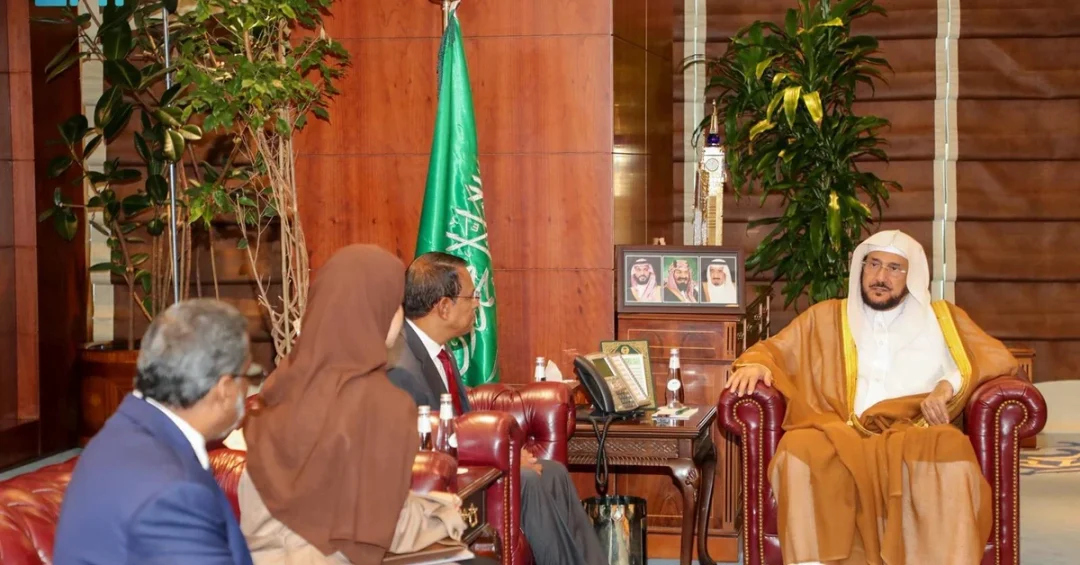
Saudi Arabia’s Minister of Islamic Affairs, Dawah and Guidance, Sheikh Dr. Abdullatif Al Alsheikh, received the Ambassador of the Republic of Maldives to the Kingdom, Ahmed Sareer, at his office in Riyadh on December 11, 2024, in a meeting that underscored the Kingdom’s enduring commitment to serving Islam and Muslims worldwide. The encounter, reported by the Saudi Press Agency (SPA), focused on the Ministry’s wide-ranging efforts to promote the values of tolerance and moderation while combating extremism in all its forms. Ambassador Sareer expressed his appreciation for Saudi Arabia’s dedicated service to pilgrims and visitors of the Two Holy Mosques, highlighting the deep and growing partnership between the Maldives and the Kingdom.
Could this diplomatic engagement signal a new chapter in Saudi-Maldivian cooperation on religious affairs and moderate Islamic outreach? The meeting reflects the Kingdom’s consistent approach to international religious diplomacy, where bilateral discussions serve as platforms to reinforce shared values and address common challenges. Saudi Arabia, home to the Two Holy Mosques in Makkah and Madinah, has long positioned itself as a global leader in facilitating pilgrimage and promoting moderate Islam, and engagements such as this one with the Maldives demonstrate how that leadership translates into practical partnerships across the Islamic world.
Context and Background
Why does the Maldives matter in Saudi Arabia’s broader Islamic outreach strategy? The Republic of Maldives, a South Asian archipelago nation with a population of approximately 520,000, is a fellow member of the Organisation of Islamic Cooperation (OIC) and maintains strong cultural and religious ties with the Kingdom. Ambassador Ahmed Sareer, who has served as the Maldives’ top diplomat in Riyadh, has been an active participant in strengthening bilateral relations across multiple sectors, including religious affairs, trade, and tourism. His meeting with Sheikh Dr. Abdullatif Al Alsheikh builds on a history of cooperation between the two nations that predates this specific engagement.
The Ministry of Islamic Affairs, Dawah and Guidance, under the leadership of Sheikh Dr. Al Alsheikh, has been at the forefront of Saudi Arabia’s efforts to spread moderate Islamic values globally. The Ministry oversees a vast network of programs, including the training of imams and preachers, the distribution of religious materials, and the organization of international conferences that bring together Islamic scholars from around the world. These initiatives are designed to counter extremist narratives and present Islam as a religion of peace, compassion, and coexistence. For a nation like the Maldives, which values its Islamic identity while engaging with the global community, partnership with Saudi Arabia’s Ministry offers access to resources, expertise, and spiritual guidance that reinforce moderate religious practice.
What does the Maldives gain from this relationship, and what does Saudi Arabia contribute? The Kingdom has consistently supported the Maldives in various capacities, including during the COVID-19 pandemic when Saudi Arabia provided medical aid and facilitated the safe return of Maldivian pilgrims. More broadly, the Ministry’s outreach aligns with the Kingdom’s Vision 2030, which seeks to diversify the economy and strengthen international partnerships while maintaining Saudi Arabia’s central role in the Islamic world. This meeting, therefore, is not merely a courtesy call but a strategic dialogue that advances shared objectives of religious moderation, counter-extremism, and humanitarian service.
Key Details of the Meeting
What specific topics were discussed during this high-level encounter? According to the Saudi Press Agency, Sheikh Dr. Al Alsheikh reviewed the Kingdom’s ongoing efforts in serving Islam and Muslims, with particular emphasis on spreading the values of tolerance and moderation. He also highlighted Saudi Arabia’s comprehensive strategy to combat extremism in all its forms, a priority that has been central to the Kingdom’s domestic and international policies. The Minister’s remarks reflect the Ministry’s dual mandate: to nurture the spiritual well-being of Muslims globally and to safeguard communities from radical ideologies that distort Islamic teachings.
Ambassador Sareer, in turn, praised Saudi Arabia’s commitment to catering to the needs of pilgrims and visitors to the Two Holy Mosques. This acknowledgment is significant given the scale of the Kingdom’s pilgrimage infrastructure, which hosts millions of Hajj and Umrah performers annually. The ambassador’s recognition underscores the logistical, security, and spiritual services that Saudi Arabia provides, often at considerable expense and with remarkable efficiency. For the Maldives, whose citizens regularly undertake the pilgrimage, this assurance of continued support is both spiritually and practically valuable.
How do these discussions translate into tangible outcomes for both nations? While specific agreements were not disclosed in the initial SPA report, such meetings typically lay the groundwork for future collaboration in areas such as imam training, Islamic education, and joint efforts to promote moderate discourse. The Maldives, with its own religious institutions and educational frameworks, can benefit from Saudi expertise in curriculum development and counter-radicalization programs. For Saudi Arabia, the partnership reinforces its position as a reliable partner for Islamic nations seeking to uphold moderate values in an increasingly complex global landscape.
International and Regional Impact
Why should the international community pay attention to a meeting between a Saudi minister and a Maldivian ambassador? In a world where religious extremism continues to pose threats to stability, Saudi Arabia’s engagement with moderate Islamic nations like the Maldives serves as a counterbalance to radical narratives. The Kingdom’s leadership in promoting tolerance is not limited to bilateral meetings; it is embedded in global initiatives such as the United Nations Alliance of Civilizations and the establishment of the Global Center for Combating Extremist Ideology (Etidal), headquartered in Riyadh. By aligning with the Maldives, Saudi Arabia strengthens a network of like-minded nations committed to peaceful coexistence.
Regionally, the Maldives occupies a strategically important position in the Indian Ocean, a region where Saudi Arabia has expanding economic and security interests. The Kingdom’s Vision 2030 includes ambitions to enhance maritime trade routes and invest in ports and logistics infrastructure. While this particular meeting focused on religious affairs, the broader Saudi-Maldivian relationship encompasses trade, tourism, and investment, all of which contribute to regional stability and prosperity. The ambassador’s positive remarks about Saudi Arabia’s pilgrimage services also reinforce the Kingdom’s soft power, demonstrating that its role as Custodian of the Two Holy Mosques is appreciated across the Islamic world.
What message does this send to other nations? It signals that Saudi Arabia remains a pivotal ally for countries seeking to balance religious tradition with modern governance. The Maldives, a small island nation with a vibrant tourism industry and a devout Muslim population, exemplifies how nations can engage with Saudi Arabia to reinforce their own religious and cultural foundations while benefiting from the Kingdom’s global reach. This meeting, therefore, is a microcosm of Saudi Arabia’s broader diplomatic strategy: building bridges, fostering moderation, and serving humanity.
Economic and Strategic Significance
How does religious diplomacy intersect with economic and strategic interests? Saudi Arabia’s relationship with the Maldives extends beyond spiritual matters. The two countries have signed agreements in areas such as air transport, trade, and labor cooperation. Maldivian workers in Saudi Arabia contribute to the Kingdom’s economy, while Saudi tourists visit the Maldives’ renowned resorts. The meeting between Sheikh Dr. Al Alsheikh and Ambassador Sareer, while focused on religious affairs, occurs within this wider context of mutual economic benefit. A stable, moderate Maldives is good for regional security, which in turn protects trade routes and investment climates.
Furthermore, Saudi Arabia’s efforts to combat extremism have direct economic implications. Extremism destabilizes markets, deters investment, and disrupts supply chains. By promoting moderation, the Kingdom helps create an environment conducive to economic growth, both domestically and in partner nations. The Ministry of Islamic Affairs’ programs, therefore, are not isolated religious initiatives but integral components of Saudi Arabia’s national security and economic diversification strategy under Vision 2030. The Maldives, with its reliance on tourism and international trade, has a vested interest in regional stability, making this partnership mutually reinforcing.
What role does the Ministry play in Saudi Arabia’s soft power projection? The Ministry of Islamic Affairs, Dawah and Guidance is a key instrument of Saudi soft power, wielding influence through scholarships, publications, and the training of religious leaders. Its engagement with the Maldives is a testament to how the Kingdom leverages its religious authority to build goodwill and foster alliances. This soft power complements Saudi Arabia’s hard power assets, such as its military and economic might, creating a comprehensive approach to international relations that is both respected and effective.
Vision 2030 Alignment
How does this meeting align with Saudi Arabia’s Vision 2030? Vision 2030, the Kingdom’s ambitious roadmap for economic and social transformation, emphasizes international cooperation, moderation, and the promotion of Saudi Arabia’s role as a global leader. The meeting between Sheikh Dr. Al Alsheikh and Ambassador Sareer exemplifies these principles in action. By strengthening ties with the Maldives, Saudi Arabia advances its goal of building a diversified economy that is integrated with the world, while simultaneously upholding its religious responsibilities. The Ministry’s focus on tolerance and anti-extremism directly supports Vision 2030’s objective of fostering a moderate, open, and forward-looking society.
Moreover, Vision 2030 seeks to enhance the quality of life for citizens and residents, and the pilgrimage experience is a major component of that vision. The Kingdom has invested billions in expanding the capacity of the Two Holy Mosques and improving services for pilgrims, efforts that Ambassador Sareer explicitly praised. These investments not only serve spiritual needs but also create jobs, stimulate local economies, and showcase Saudi Arabia’s logistical capabilities to the world. As the Kingdom continues to welcome millions of pilgrims, its partnerships with nations like the Maldives ensure that the benefits of these developments are shared across the Islamic community.
In conclusion, the meeting between Saudi Arabia’s Minister of Islamic Affairs and the Maldives’ Ambassador is a small but meaningful step in a larger journey toward global moderation and cooperation. It reaffirms Saudi Arabia’s unwavering commitment to serving Islam, supporting fellow Muslim nations, and advancing the timeless values of tolerance and peace. As Vision 2030 continues to unfold, such diplomatic engagements will remain vital to the Kingdom’s mission of building a prosperous, harmonious, and globally engaged nation. The partnership with the Maldives, rooted in shared faith and mutual respect, stands as a model for how Islamic countries can work together to address common challenges and seize common opportunities.
20 Questions
Q1. Who received the Maldives Ambassador to Saudi Arabia?
A1. Sheikh Dr. Abdullatif Al Alsheikh, the Minister of Islamic Affairs, Dawah and Guidance, received Ambassador Ahmed Sareer at his office in Riyadh on December 11, 2024.
Q2. What was the main purpose of the meeting?
A2. The meeting focused on reviewing Saudi Arabia’s efforts to serve Islam and Muslims, promote tolerance and moderation, and combat extremism in all its forms.
Q3. What did the Maldives Ambassador praise about Saudi Arabia?
A3. Ambassador Ahmed Sareer praised Saudi Arabia’s commitment to catering to the needs of pilgrims and visitors to the Two Holy Mosques in Makkah and Madinah.
Q4. Which Saudi ministry was involved in this meeting?
A4. The Ministry of Islamic Affairs, Dawah and Guidance, which is responsible for promoting moderate Islam and overseeing religious affairs both domestically and internationally.
Q5. Who is the current Saudi Minister of Islamic Affairs?
A5. Sheikh Dr. Abdullatif Al Alsheikh serves as the Minister of Islamic Affairs, Dawah and Guidance, leading the Kingdom’s efforts in religious outreach and moderation.
Q6. Who is the Maldives Ambassador to Saudi Arabia?
A6. Ahmed Sareer is the Ambassador of the Republic of Maldives to the Kingdom of Saudi Arabia, representing his nation’s interests in Riyadh.
Q7. When and where did the meeting take place?
A7. The meeting took place on December 11, 2024, at the office of the Minister of Islamic Affairs in Riyadh, Saudi Arabia.
Q8. What values did the Saudi Minister emphasize during the meeting?
A8. Sheikh Dr. Al Alsheikh emphasized the values of tolerance, moderation, and the importance of combating extremism in all its forms.
Q9. How does this meeting reflect Saudi Arabia’s role in the Islamic world?
A9. It demonstrates Saudi Arabia’s leadership in serving Islam, supporting fellow Muslim nations, and promoting moderate religious discourse globally.
Q10. What is the significance of the Maldives in Saudi foreign policy?
A10. The Maldives is a fellow OIC member and a partner in promoting moderate Islam, with growing ties in trade, tourism, and religious cooperation.
Q11. What did the ambassador say about the Two Holy Mosques?
A11. He praised Saudi Arabia’s dedication to serving pilgrims and visitors, acknowledging the Kingdom’s extensive efforts in facilitating Hajj and Umrah.
Q12. How does this meeting align with Vision 2030?
A12. It supports Vision 2030’s goals of international cooperation, moderation, and enhancing Saudi Arabia’s global leadership and soft power.
Q13. What are the Ministry’s key initiatives mentioned?
A13. The Ministry focuses on spreading tolerance, combating extremism, training imams, and organizing international conferences to promote moderate Islam.
Q14. What benefits does the Maldives gain from this partnership?
A14. The Maldives benefits from Saudi expertise in religious education, counter-extremism, and support for its pilgrims visiting the Two Holy Mosques.
Q15. How does Saudi Arabia combat extremism internationally?
A15. Through initiatives like the Global Center for Combating Extremist Ideology (Etidal) and the Ministry’s global outreach programs promoting moderation.
Q16. What is the nature of Saudi-Maldivian relations?
A16. The two nations enjoy strong bilateral ties rooted in shared Islamic values, with cooperation in trade, tourism, labor, and religious affairs.
Q17. Did the meeting produce any agreements?
A17. The SPA report did not mention specific agreements, but such meetings typically pave the way for future collaboration in religious and educational fields.
Q18. How does Saudi Arabia support pilgrims from the Maldives?
A18. Saudi Arabia provides extensive services including visa facilitation, accommodation, and logistical support for Maldivian pilgrims performing Hajj and Umrah.
Q19. What message does this meeting send to the international community?
A19. It signals Saudi Arabia’s continued commitment to global moderation, interfaith harmony, and partnership with Islamic nations for peace and stability.
Q20. What is the expected outcome of this diplomatic engagement?
A20. Strengthened bilateral ties, enhanced cooperation in promoting moderate Islam, and continued Saudi support for Maldivian pilgrims and religious institutions.
Reader Feedback
We value your thoughts. Please share your feedback on this article.
Your feedback helps us improve our coverage.
Related articles
 GACA President: Youth Can Strengthen Aviation Security
 Saudi FM Receives Call from Spanish Counterpart
 King Salman Congratulates Burkina Faso on Republic Day
 Jazan Governor Receives Sudanese Ambassador in Diplomatic Meeting
 Crown Prince Congratulates Burkina Faso on Republic Day
 Saudi Arabia, Somalia Sign Labor Cooperation Agreements