


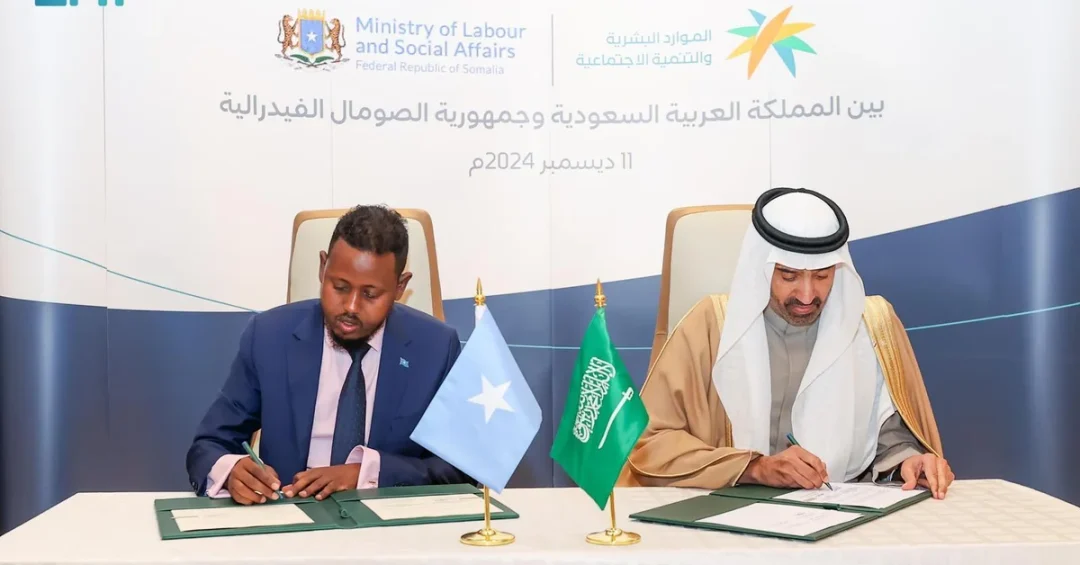
Saudi Arabia and Somalia signed two cooperation agreements in Riyadh on December 11, 2024, establishing a regulatory framework for the employment of Somali professional and domestic workers in the Kingdom. The agreements were signed by Minister of Human Resources and Social Development Ahmed Al-Rajhi and Somalia’s Minister of Labor and Social Affairs Yusuf Mohamed Adan, according to the Saudi Press Agency (SPA). The signing ceremony was attended by officials and specialists from both sides, with discussions centering on enhancing bilateral relations and achieving shared objectives. The agreements cover contractual protections, monitoring mechanisms, and implementation provisions for Somali workers in Saudi Arabia.
Why does this development matter beyond the two signatories? The agreements reflect Saudi Arabia’s broader strategy of building international labor partnerships, opening new labor markets, and maintaining a balanced labor market that protects both workers and employers. For Somalia, the arrangement offers a structured, legal pathway for its citizens to access employment opportunities in the Kingdom. For Saudi Arabia, it adds another regulated corridor to a labor market that serves millions of expatriate workers and underpins the economic transformation underway through Vision 2030.
Context and Background
How did the two countries arrive at this point? Saudi Arabia and Somalia share longstanding ties rooted in trade, culture, and Islamic solidarity, and the Kingdom has consistently supported Somalia’s stability and development through humanitarian and diplomatic engagement. The labor agreements signed in Riyadh build on that relationship by formalizing the movement of Somali professional and domestic workers into the Kingdom. The meeting between Minister Al-Rajhi and Minister Adan was attended by officials and specialists from both sides, signaling that the framework was reviewed at a technical as well as a political level.
The agreements aim to establish a regulatory framework governing the procedures for Somali workers in Saudi Arabia. That framework includes protecting the rights of both workers and employers, regulating contractual relationships, and setting mechanisms for monitoring and implementing the agreements’ provisions. In practical terms, this means documented contracts, defined obligations on both sides, and oversight structures designed to prevent disputes and resolve them fairly when they arise. Such provisions place the arrangement within the Kingdom’s wider effort to make labor relations transparent, predictable, and consistent with international norms.
The initiative aligns with the Ministry of Human Resources and Social Development’s broader efforts to build and strengthen international partnerships, open new labor markets, and ensure a balanced labor market while fostering cooperation with other nations to achieve common interests and goals. Saudi Arabia has pursued similar agreements with a range of sending countries, creating a network of regulated labor corridors that support the domestic economy while offering structured opportunities abroad for partner nations.
Key Details of the Agreements
What exactly do the two agreements cover? According to the Saudi Press Agency, the agreements focus on the employment of Somali professional and domestic workers in the Kingdom. They establish the procedures that will govern recruitment, contracting, and employment, and they create mechanisms for monitoring and implementing their provisions. The inclusion of both professional and domestic categories is significant: it reflects the breadth of Saudi Arabia’s labor needs and the desire to bring a wide range of roles under a single, coherent regulatory umbrella.
Protecting the rights of both workers and employers is a central pillar. The agreements regulate contractual relationships, which means the terms of employment are to be documented and enforceable rather than informal. Monitoring mechanisms are intended to ensure compliance, and implementation provisions give the framework operational substance. Officials and specialists from both sides attended the signing, indicating that the technical groundwork has been laid for the agreements to move from signature to execution.
The signing took place during a meeting in Riyadh on December 11, 2024, and was reported by the Saudi Press Agency at 15:33 local time. The discussions between Minister Al-Rajhi and Minister Adan centered on enhancing bilateral relations to achieve shared objectives, framing the labor agreements as one component of a wider partnership. The ceremony itself was attended by officials and specialists from both sides, underscoring the seriousness with which both governments approach the arrangement.
International and Regional Impact
How will this agreement be viewed across the region and beyond? For Somalia, the arrangement offers a formal channel for employment abroad, which can translate into remittances, skills transfer, and experience for Somali workers. For Saudi Arabia, it reinforces the Kingdom’s reputation as a destination that manages labor migration through negotiated, government-to-government frameworks rather than informal arrangements. Regional observers are likely to see the agreement as another example of Saudi Arabia’s expanding diplomatic and economic engagement with African nations.
The timing matters. Saudi Arabia is deepening ties across Africa as part of a broader foreign policy that emphasizes investment, trade, and development cooperation. Labor agreements are a practical instrument in that toolkit: they create recurring, people-to-people linkages that complement commercial and diplomatic relationships. By signing with Somalia, the Kingdom adds a partner in the Horn of Africa, a region of strategic importance for trade routes and maritime security.
Internationally, the agreements signal that Saudi Arabia is continuing to professionalize its labor market governance. The emphasis on protecting workers and employers, regulating contracts, and monitoring implementation aligns with the expectations of international organizations and partner governments. For sending countries, a clear legal framework reduces the risks associated with migration and makes cooperation with the Kingdom more attractive. For employers in Saudi Arabia, it provides a documented, predictable process for hiring.
Economic and Strategic Significance
What does this mean for the Saudi economy? A balanced labor market is essential to the Kingdom’s economic ambitions. Vision 2030 envisions a diversified economy in which the private sector expands and productivity rises, and both depend on a workforce that is properly recruited, trained, and protected. Agreements such as the one signed with Somalia contribute to that balance by bringing workers into the formal system, where their rights and obligations are defined and their contributions can be measured.
The agreement also supports the Ministry of Human Resources and Social Development’s goal of opening new labor markets. By diversifying the countries from which workers are sourced, Saudi Arabia reduces reliance on any single corridor and builds resilience into its labor supply. For Somalia, the agreement creates a structured outlet for its workforce, potentially easing domestic unemployment pressures and generating remittance flows that support families and communities. Both outcomes serve the shared interests that the two ministers discussed in Riyadh.
Strategically, the agreements are part of a pattern. Saudi Arabia has signed labor cooperation agreements with numerous countries across Asia and Africa, each tailored to the sending country’s circumstances and the Kingdom’s needs. This network approach reflects a deliberate policy of managing migration through partnership. It also supports the Kingdom’s standing as a responsible international actor that engages with partners on terms that are mutually beneficial and formally documented.
Vision 2030 Alignment
How does this fit into Saudi Arabia’s long-term vision? Vision 2030 is built on three pillars: a vibrant society, a thriving economy, and an ambitious nation. A well-regulated labor market touches all three. It supports a thriving economy by ensuring that businesses can access the talent they need through legal, transparent channels. It supports a vibrant society by protecting workers and promoting fair treatment. And it supports an ambitious nation by demonstrating the Kingdom’s capacity to manage complex international partnerships effectively.
The Ministry of Human Resources and Social Development has made international cooperation a core part of its agenda, and the agreements with Somalia are a concrete expression of that agenda. By protecting the rights of workers and employers, regulating contractual relationships, and establishing monitoring and implementation mechanisms, the agreements advance the Vision 2030 objective of a balanced, attractive, and productive labor market. They also strengthen Saudi Arabia’s ties with a partner in the Horn of Africa, adding depth to the Kingdom’s global engagement.
Looking ahead, the success of the agreements will depend on implementation. The mechanisms established for monitoring and enforcing the provisions will determine whether the framework delivers on its promise. Saudi Arabia’s track record of building and refining labor partnerships suggests that the agreements with Somalia will be integrated into the Kingdom’s broader system of labor governance, with oversight and adjustment as needed. For both countries, the signing in Riyadh marks the beginning of a structured partnership that aligns with shared objectives and with the Kingdom’s vision for a diversified, prosperous future.
20 Questions
Q1. What did Saudi Arabia and Somalia sign in Riyadh?
A1. They signed two cooperation agreements focused on the employment of Somali professional and domestic workers in the Kingdom, establishing a regulatory framework for their recruitment, contracting, and employment.
Q2. Who signed the agreements on behalf of Saudi Arabia?
A2. Minister of Human Resources and Social Development Ahmed Al-Rajhi signed on behalf of the Kingdom during a meeting in Riyadh on December 11, 2024.
Q3. Who signed on behalf of Somalia?
A3. Somalia’s Minister of Labor and Social Affairs, Yusuf Mohamed Adan, signed the agreements on behalf of his country at the same ceremony in Riyadh.
Q4. Where and when did the signing take place?
A4. The signing took place in Riyadh on December 11, 2024, and was reported by the Saudi Press Agency at 15:33 local time, 12:33 GMT.
Q5. What categories of workers do the agreements cover?
A5. The agreements cover Somali professional and domestic workers, bringing both categories under a single regulatory framework for employment in Saudi Arabia.
Q6. What is the main purpose of the agreements?
A6. Their main purpose is to establish a regulatory framework for the procedures governing Somali workers in Saudi Arabia, including protections and oversight mechanisms.
Q7. How do the agreements protect workers?
A7. They protect workers’ rights by regulating contractual relationships, defining obligations, and setting mechanisms for monitoring and implementing the agreements’ provisions.
Q8. How do the agreements protect employers?
A8. They protect employers by ensuring documented contracts, clear procedures, and enforceable terms, reducing the risks associated with informal or undocumented employment arrangements.
Q9. Who attended the signing ceremony?
A9. Officials and specialists from both sides attended the ceremony, reflecting the technical and political importance both governments attach to the agreements.
Q10. What did the ministers discuss during their meeting?
A10. They discussed enhancing bilateral relations between Saudi Arabia and Somalia to achieve shared objectives, with the labor agreements as a central outcome of those talks.
Q11. How does this fit with the ministry’s broader efforts?
A11. It aligns with the Ministry of Human Resources and Social Development’s efforts to build international partnerships, open new labor markets, and ensure a balanced labor market.
Q12. Why is a balanced labor market important to Saudi Arabia?
A12. A balanced labor market supports economic growth, protects workers and employers, and contributes to the stability and productivity that Vision 2030 seeks to achieve.
Q13. What mechanisms will monitor implementation?
A13. The agreements set mechanisms for monitoring and implementing their provisions, ensuring compliance and providing a basis for addressing any issues that arise.
Q14. What does Somalia gain from the agreements?
A14. Somalia gains a structured, legal channel for its citizens to access employment in the Kingdom, which can support remittances and skills development.
Q15. What does Saudi Arabia gain from the agreements?
A15. Saudi Arabia gains access to a regulated source of professional and domestic workers, supporting its labor needs while maintaining oversight and legal clarity.
Q16. How does this agreement affect regional relations?
A16. It strengthens Saudi Arabia’s engagement with the Horn of Africa and adds a practical, people-centered dimension to the Kingdom’s regional partnerships.
Q17. Are these agreements part of a wider Saudi strategy?
A17. Yes. They are part of the Kingdom’s broader strategy of building international labor partnerships and opening new labor markets through government-to-government cooperation.
Q18. How does this relate to Vision 2030?
A18. It supports Vision 2030 by promoting a thriving economy, protecting workers, and demonstrating the Kingdom’s capacity for effective international partnership.
Q19. What happens next after the signing?
A19. The agreements move into implementation, with the established monitoring mechanisms guiding compliance and ensuring the provisions are applied as intended.
Q20. Why is this agreement significant for international audiences?
A20. It shows Saudi Arabia managing labor migration through formal, rights-based frameworks, reinforcing its role as a responsible global partner pursuing shared prosperity.
Reader Feedback
We value your thoughts. Please share your feedback on this article.
Your feedback helps us improve our coverage.
Related articles
 Saudi Arabia Leads Global Aviation Security Efforts
 Kenyan Consul General Visits King Fahd Quran Complex
 Saudi FM Receives Call from UN Envoy for Syria
 RCU and UK Forge Strategic Partnership to Boost AlUla
 IMCTC Chief Receives Malaysian Defense Delegation in Riyadh
 Saudi Arabia Launches Global Sand and Dust Storm Monitoring Initiative