


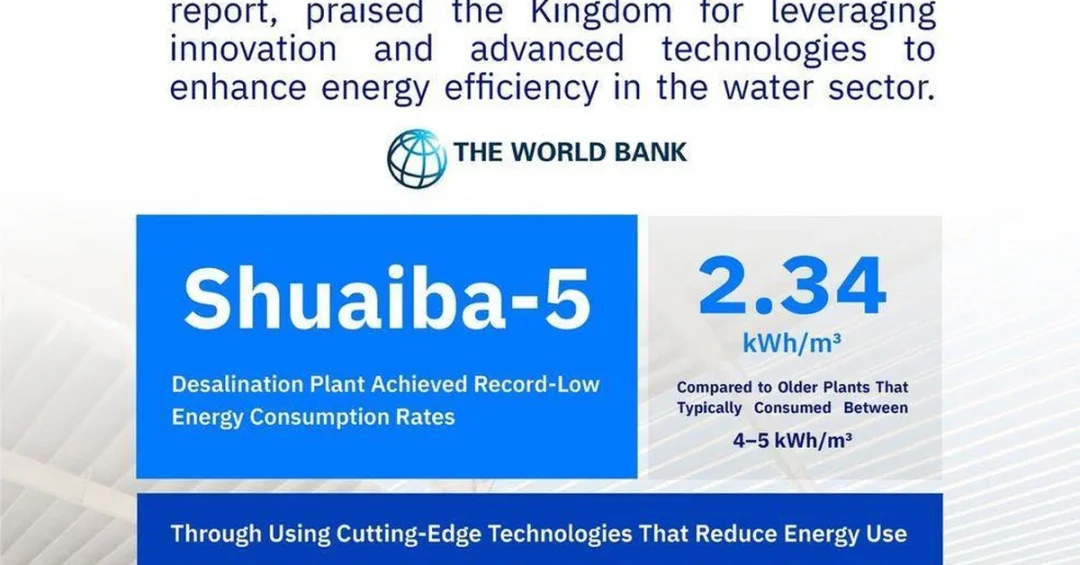
The World Bank has praised Saudi Arabia for its significant progress in advancing the water sector, particularly in desalination, according to its recent report, Gulf Economic Update: Navigating the Water Challenge in the GCC – Paths to Sustainable Solutions. The report, released in April 2025, affirms that the Kingdom has become a leading model in enhancing efficiency and reducing energy consumption. Among the key highlights, the report showcased the Shuaiba-5 desalination plant, which has achieved a production capacity of 664,490 cubic meters per day and set a new benchmark for energy efficiency, recording the lowest energy consumption rate ever at just 2.34 kilowatt-hours per cubic meter, compared to the typical 4 to 5 kWh/m³ seen in conventional facilities. This achievement underscores Saudi Arabia’s commitment to sustainable water management and its broader Vision 2030 goals.
How did Saudi Arabia transform its desalination sector into a global benchmark for energy efficiency? The answer lies in a combination of cutting-edge technical innovations, strategic policy implementation, and a clear long-term vision. The World Bank’s recognition comes at a critical time when water scarcity poses a growing challenge across the Gulf Cooperation Council (GCC) region. Saudi Arabia’s proactive approach not only addresses domestic needs but also offers a replicable model for other arid regions worldwide. The Kingdom’s efforts are aligned with its Vision 2030 framework, which seeks to diversify the economy, enhance sustainability, and improve quality of life for its citizens.
Context and Background
What makes the World Bank’s endorsement so significant for Saudi Arabia and the wider region? The Gulf Economic Update report, titled Navigating the Water Challenge in the GCC – Paths to Sustainable Solutions, highlights the pressing water scarcity issues facing GCC countries. With limited freshwater resources and high population growth, these nations have long relied on energy-intensive desalination. However, Saudi Arabia has emerged as a pioneer in reversing this trend by adopting low-energy technologies. The report specifically praises the Kingdom’s Shuaiba-5 plant, the most advanced of its kind in the country, which has achieved unprecedented efficiency levels. This plant, located on the Red Sea coast, serves as a testament to Saudi Arabia’s engineering prowess and its commitment to environmental sustainability.
The Shuaiba-5 plant’s energy consumption rate of 2.34 kWh/m³ is a remarkable feat, considering that conventional desalination facilities typically consume 4 to 5 kWh/m³. This reduction is not merely a technical achievement; it translates into substantial cost savings and a lower carbon footprint. The plant’s production capacity of 664,490 cubic meters per day is enough to supply the daily water needs of millions of people, making it a critical infrastructure asset for the Kingdom. The World Bank report emphasizes that such innovations are essential for the GCC to meet its water demands sustainably. Saudi Arabia’s leadership in this area is a direct result of its long-term strategic planning and investment in research and development.
What role does the Saudi Water Authority play in driving these advancements? The Saudi Water Authority is implementing an ambitious plan to reduce energy intensity in the water sector by 30 percent by 2030, compared to 2019 levels. This target will be achieved through the adoption of advanced technologies and the enforcement of sustainable policies. The Authority’s efforts are part of a broader national strategy to optimize water production and distribution, ensuring long-term water security. By setting such ambitious goals, Saudi Arabia is not only addressing its own needs but also setting a precedent for other nations facing similar challenges. The World Bank’s recognition serves as an international validation of these efforts.
Key Details
What specific technologies have enabled the Shuaiba-5 plant to achieve such low energy consumption? The plant incorporates several cutting-edge innovations. First, advanced reverse osmosis membranes require less pressure and energy during the desalination process. These membranes are designed to operate efficiently at lower pressures, reducing the overall energy demand. Second, energy recovery devices capture and reuse pressure from the brine stream, further minimizing energy waste. Third, improved pre-treatment systems reduce fouling and extend membrane lifespan, ensuring consistent performance over time. Additionally, the integration of renewable energy sources—particularly solar power—has further reduced reliance on conventional electricity. These technologies work in tandem to create a highly efficient desalination process that is both cost-effective and environmentally friendly.
The Shuaiba-5 plant’s success is not an isolated achievement but part of a larger national effort. The Saudi Water Authority has been instrumental in deploying these technologies across the Kingdom’s desalination infrastructure. The plant’s record-breaking energy consumption rate of 2.34 kWh/m³ is a direct result of these combined innovations. The World Bank report notes that this achievement not only lowers operational costs but also represents a strategic advance toward meeting environmental sustainability targets. By reducing energy consumption, Saudi Arabia is also reducing its greenhouse gas emissions, contributing to global climate goals. The report highlights that the Kingdom’s approach can serve as a model for other countries in the GCC and beyond.
How does the Shuaiba-5 plant compare to other desalination facilities globally? While many modern plants have achieved energy consumption rates of around 3 kWh/m³, the Shuaiba-5 plant’s 2.34 kWh/m³ is significantly lower. This places it at the forefront of energy-efficient desalination worldwide. The plant’s production capacity of 664,490 cubic meters per day is also among the largest in the region. The combination of high capacity and low energy consumption makes it a unique case study. The World Bank report emphasizes that such performance is critical for regions facing water scarcity, as it demonstrates that large-scale desalination can be both sustainable and economically viable. Saudi Arabia’s investment in this plant reflects its commitment to innovation and sustainability.
International and Regional Impact
How will Saudi Arabia’s advancements in desalination influence the broader GCC region? The World Bank report specifically addresses the water challenge in the GCC, noting that all member states face similar constraints. Saudi Arabia’s success provides a blueprint that other countries can follow. By sharing its expertise and technology, the Kingdom can help its neighbors reduce their own energy consumption and environmental impact. This regional cooperation is essential for addressing shared water challenges. The report suggests that knowledge exchange and joint investments in research and development could accelerate progress across the GCC. Saudi Arabia’s leadership in this area positions it as a key player in regional water security.
What are the global implications of Saudi Arabia’s low-energy desalination technologies? Water scarcity is a global issue, affecting billions of people worldwide. Saudi Arabia’s innovations offer a scalable solution that can be adapted to different contexts. The World Bank report highlights that the Kingdom’s approach can be replicated in other arid regions, such as North Africa, the Middle East, and parts of Asia and the Americas. By demonstrating that desalination can be energy-efficient, Saudi Arabia is helping to make desalination a more viable option for water-stressed countries. This contributes to global efforts to achieve Sustainable Development Goal 6, which aims to ensure availability and sustainable management of water and sanitation for all. The Kingdom’s leadership in this field enhances its standing as a responsible global actor.
Economic and Strategic Significance
Why is energy efficiency in desalination so critical for Saudi Arabia’s economy? Desalination is energy-intensive, and reducing energy consumption directly lowers operational costs. The Shuaiba-5 plant’s efficiency translates into significant savings for the Kingdom, which can be redirected to other strategic priorities. Moreover, lower energy use reduces the need for additional power generation, freeing up resources for other sectors. The World Bank report notes that this transformation not only helps lower operational costs but also represents a strategic advance toward meeting environmental sustainability targets. As Saudi Arabia continues to diversify its economy under Vision 2030, such efficiencies contribute to fiscal sustainability and economic resilience.
How does the integration of renewable energy sources enhance the strategic value of desalination? The use of solar power at the Shuaiba-5 plant reduces reliance on fossil fuels, aligning with Saudi Arabia’s goal to increase renewable energy’s share in its energy mix. This integration also reduces the carbon footprint of desalination, supporting the Kingdom’s environmental commitments. The Saudi Water Authority’s plan to reduce energy intensity by 30 percent by 2030 is a key component of this strategy. By combining renewable energy with advanced desalination technologies, Saudi Arabia is creating a sustainable model that can be replicated across the water sector. This approach not only ensures water security but also enhances energy security and environmental sustainability.
Vision 2030 Alignment
How does Saudi Arabia’s leadership in desalination align with Vision 2030? Vision 2030 is a comprehensive plan to diversify the economy, improve public services, and enhance quality of life. Water security is a cornerstone of this vision, as it underpins economic development and social well-being. The Kingdom’s investments in advanced desalination technologies directly support the Vision’s goals of sustainability and efficiency. The World Bank’s recognition of the Shuaiba-5 plant as a global model reaffirms that Saudi Arabia is on the right track. By reducing energy intensity in the water sector by 30 percent by 2030, the Kingdom is not only meeting its own targets but also contributing to global sustainability efforts.
What does the future hold for Saudi Arabia’s water sector? The success of the Shuaiba-5 plant is just the beginning. The Saudi Water Authority is committed to further innovation and the adoption of new technologies. As the Kingdom continues to invest in research and development, we can expect even greater efficiencies and sustainability gains. The World Bank report serves as both recognition and encouragement for Saudi Arabia to maintain its leadership. By sharing its knowledge and experience, the Kingdom can help other nations address their water challenges. Ultimately, Saudi Arabia’s efforts in desalination are a testament to its vision, its capabilities, and its commitment to a sustainable future for all.
20 Questions
Q1. What did the World Bank report say about Saudi Arabia’s water sector?
A1. The World Bank’s Gulf Economic Update report praised Saudi Arabia for its significant progress in advancing the water sector, particularly in desalination, and affirmed that the Kingdom has become a leading model in enhancing efficiency and reducing energy consumption.
Q2. What is the name of the desalination plant highlighted in the report?
A2. The report highlighted the Shuaiba-5 desalination plant, which is the most advanced of its kind in the Kingdom and has achieved a production capacity of 664,490 cubic meters per day.
Q3. What is the energy consumption rate of the Shuaiba-5 plant?
A3. The Shuaiba-5 plant recorded the lowest energy consumption rate ever at just 2.34 kilowatt-hours per cubic meter, compared to the typical 4 to 5 kWh/m³ seen in conventional facilities.
Q4. What technical innovations contributed to this efficiency?
A4. The plant uses advanced reverse osmosis membranes that require less pressure and energy, energy recovery devices that capture and reuse pressure, and improved pre-treatment systems that reduce fouling and extend membrane lifespan.
Q5. How does renewable energy factor into the plant’s operations?
A5. The integration of renewable energy sources, particularly solar power, has further reduced reliance on conventional electricity, lowering operational costs and supporting environmental sustainability targets.
Q6. What is the Saudi Water Authority’s plan for energy intensity reduction?
A6. The Saudi Water Authority is implementing an ambitious plan to reduce energy intensity in the water sector by 30 percent by 2030, compared to 2019 levels, through advanced technologies and sustainable policies.
Q7. Why is this recognition important for Saudi Arabia?
A7. The World Bank’s recognition validates Saudi Arabia’s leadership in innovative water solutions, supports its Vision 2030 goals, and reinforces its position as a global model for addressing water scarcity.
Q8. How does the Shuaiba-5 plant compare to conventional desalination facilities?
A8. The Shuaiba-5 plant consumes only 2.34 kWh/m³, while conventional facilities typically consume 4 to 5 kWh/m³, making it significantly more energy-efficient and cost-effective.
Q9. What are the environmental benefits of low-energy desalination?
A9. Low-energy desalination reduces greenhouse gas emissions, lowers the carbon footprint of water production, and supports global efforts to combat climate change and achieve environmental sustainability.
Q10. How does this achievement align with Vision 2030?
A10. It aligns with Vision 2030’s goals of economic diversification, sustainability, and improved quality of life by ensuring water security, reducing costs, and promoting renewable energy integration.
Q11. What role does the Saudi Water Authority play in this success?
A11. The Saudi Water Authority drives the implementation of advanced technologies and sustainable policies, including the plan to reduce energy intensity by 30 percent by 2030, ensuring long-term water security.
Q12. Can other countries replicate Saudi Arabia’s model?
A12. Yes, the World Bank report suggests that Saudi Arabia’s approach can serve as a global model for regions facing water scarcity, as the technologies and strategies are adaptable to different contexts.
Q13. What is the production capacity of the Shuaiba-5 plant?
A13. The Shuaiba-5 plant has a production capacity of 664,490 cubic meters per day, which is enough to supply the daily water needs of millions of people.
Q14. How does energy recovery contribute to efficiency?
A14. Energy recovery devices capture and reuse pressure from the brine stream during desalination, minimizing energy waste and reducing the overall energy required for the process.
Q15. What are the economic benefits of reduced energy consumption?
A15. Reduced energy consumption lowers operational costs, frees up resources for other strategic priorities, and contributes to fiscal sustainability and economic resilience under Vision 2030.
Q16. How does solar power integration enhance sustainability?
A16. Solar power reduces reliance on fossil fuels, lowers the carbon footprint of desalination, and supports Saudi Arabia’s goal to increase renewable energy’s share in its energy mix.
Q17. What does the World Bank report emphasize about the GCC water challenge?
A17. The report emphasizes that GCC countries face pressing water scarcity issues and that Saudi Arabia’s low-energy desalination technologies offer a sustainable path forward for the region.
Q18. What is the significance of the 2.34 kWh/m³ benchmark?
A18. The 2.34 kWh/m³ benchmark sets a new global standard for energy efficiency in desalination, demonstrating that large-scale desalination can be both sustainable and economically viable.
Q19. How does this achievement support global water security?
A19. By demonstrating energy-efficient desalination, Saudi Arabia provides a scalable solution for water-stressed regions worldwide, contributing to global efforts to achieve Sustainable Development Goal 6.
Q20. What future developments can be expected in Saudi Arabia’s water sector?
A20. The Saudi Water Authority is committed to further innovation, research, and development, aiming for even greater efficiencies and sustainability gains, and sharing its expertise to help other nations address water challenges.
Reader Feedback
We value your thoughts. Please share your feedback on this article.
Your feedback helps us improve our coverage.
Related articles
 KSrelief Distributes 6,181 Vouchers to Needy in Lebanon
 Dhul-Qa’dah 1 Deadline Set for Umrah Departures
 KSrelief Supports Orphans in Earthquake-Hit Syria
 KSrelief Mobile Clinic in Yemen Serves 1,691 in February
 KSrelief Delivers 45M Liters of Water in Yemen in February
 Saudi Defense Minister Calls U.S. Secretary of Defense