


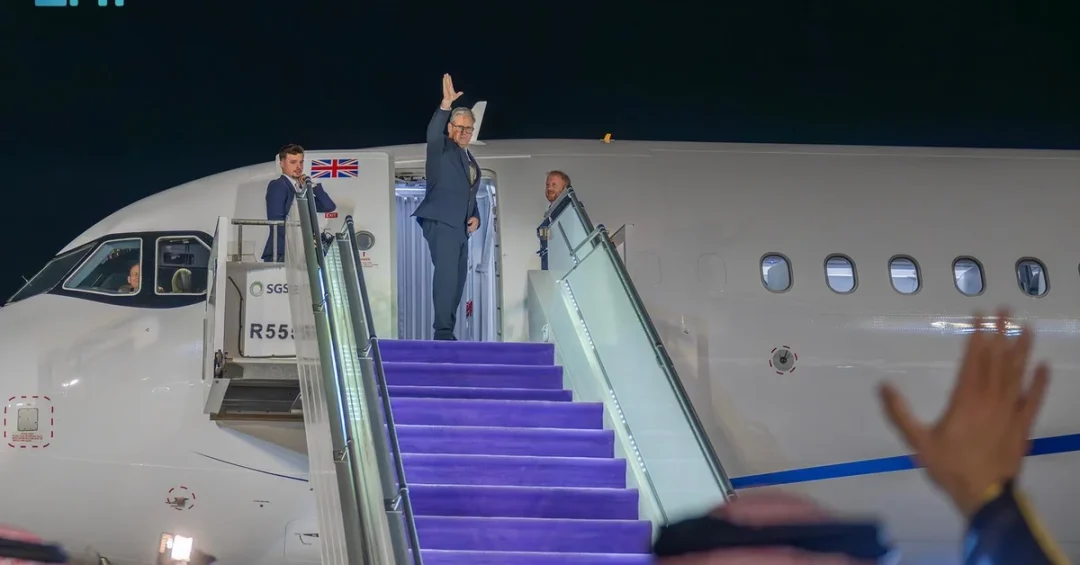
British Prime Minister Keir Starmer concluded an official visit to Riyadh on Monday, December 9, 2024, departing from King Khalid International Airport after a program of high-level engagements with Saudi leadership. The farewell at the airport was led by Prince Mohammed bin Abdulrahman bin Abdulaziz, Deputy Governor of the Riyadh Region, reflecting the importance both countries attach to the relationship. The visit underscored the deepening strategic partnership between the United Kingdom and the Kingdom of Saudi Arabia across diplomacy, trade, investment, and regional security.
According to the Saudi Press Agency (SPA), the official Saudi news authority, the British delegation was seen off by a distinguished group of Saudi and British officials. Among those present were Prince Khalid bin Bandar bin Sultan, Saudi Ambassador to the United Kingdom; Dr. Majid Al-Kassabi, Minister of Commerce; Prince Faisal bin Abdulaziz bin Ayyaf, Mayor of the Riyadh Region; and Neil Crompton, the United Kingdom’s Ambassador to Saudi Arabia. Their attendance signals the breadth of the bilateral agenda, spanning commerce, municipal cooperation, and diplomatic coordination. The visit comes at a time of evolving regional dynamics and growing international interest in Saudi Arabia’s Vision 2030 transformation.
Context and Background
Why does a single visit by a British prime minister command such attention in Riyadh and London alike? The United Kingdom and Saudi Arabia share a long-standing relationship that predates the modern Kingdom, rooted in decades of diplomatic, commercial, and security cooperation. In recent years, that relationship has been re-energized through Saudi Arabia’s Vision 2030, the national blueprint launched by Crown Prince Mohammed bin Salman to diversify the economy, empower citizens, and position the Kingdom as a global hub for investment, tourism, and innovation. The UK, with its financial expertise, educational institutions, and technology sector, is a natural partner in that endeavor.
Prime Minister Starmer’s visit follows a series of high-level exchanges between London and Riyadh. The UK has consistently been among the largest investors in Saudi Arabia, with British firms active in sectors ranging from engineering and construction to finance, healthcare, and renewable energy. Saudi Arabia, for its part, has become a pivotal player in global energy markets, a leader in Middle East diplomacy, and an increasingly attractive destination for international business. The visit therefore served as an opportunity to review progress on existing agreements and to explore new avenues for collaboration.
The timing is significant. Regional tensions, global energy transitions, and the need for stable partnerships have made dialogue between established powers and emerging economic hubs more important than ever. Saudi Arabia’s role as a bridge between continents and a convenor of international dialogue gives its relationships with countries like the UK added weight. As the Kingdom prepares to host major global events and continues to expand its diplomatic footprint, visits such as this reinforce its standing as a reliable and forward-looking partner.
Key Details of the Visit
What did the visit actually achieve, and why does the composition of the farewell delegation matter? According to the Saudi Press Agency, the British Prime Minister’s departure was attended by a carefully selected group of officials that mirrors the priorities of the bilateral relationship. The presence of Dr. Majid Al-Kassabi, Minister of Commerce, highlights the economic dimension, particularly trade and investment facilitation. Prince Faisal bin Abdulaziz bin Ayyaf, Mayor of Riyadh, points to urban development and smart-city cooperation, areas where Saudi Arabia is making rapid strides through projects like NEOM and the transformation of Riyadh itself.
The attendance of Prince Khalid bin Bandar bin Sultan, Saudi Ambassador to the UK, and Neil Crompton, UK Ambassador to Saudi Arabia, underscores the continuous diplomatic engagement that underpins the partnership. Their roles are essential in translating high-level intentions into concrete outcomes. The farewell by Prince Mohammed bin Abdulrahman bin Abdulaziz, Deputy Governor of Riyadh Region, adds a regional governance dimension, reflecting the Kingdom’s decentralized approach to development and international cooperation.
While the specific agenda items were not detailed in the official statement, the visit is consistent with the pattern of recent UK-Saudi engagements, which have focused on clean energy, defense cooperation, education, and cultural exchange. Both countries have expressed interest in expanding collaboration on climate technology, artificial intelligence, and financial services. The presence of a large British delegation suggests that multiple agreements or memoranda of understanding may have been discussed or advanced during the visit. Saudi Arabia’s official channels have emphasized the positive and constructive nature of the talks, in line with the Kingdom’s commitment to international partnership and mutual respect.
International and Regional Impact
How does this visit resonate beyond the two capitals? For the wider Middle East, it reinforces Saudi Arabia’s position as a preferred destination for global leaders seeking dialogue and cooperation. The Kingdom has hosted a series of high-profile visits in recent years, from Asian and European leaders to African heads of state, reflecting its growing diplomatic reach. The UK’s engagement adds a major Western voice to that chorus, signaling confidence in Saudi Arabia’s stability and its economic trajectory.
For Europe, the visit highlights the importance of maintaining robust ties with Gulf partners amid shifting energy supplies and security concerns. The UK, post-Brexit, has sought to strengthen bilateral relationships worldwide, and Saudi Arabia is a key partner in that strategy. The Kingdom’s role in energy markets, its investments in renewable energy, and its sovereign wealth fund’s global reach make it an indispensable interlocutor. The visit also aligns with broader efforts to encourage regional de-escalation and support sustainable development, goals that Saudi Arabia has actively pursued through initiatives such as the Saudi Green Initiative and its diplomatic outreach.
Economic and Strategic Significance
What does this mean for trade, investment, and the future of UK-Saudi economic ties? The numbers tell a compelling story. Bilateral trade between the UK and Saudi Arabia has been valued at billions of pounds annually, with British exports ranging from machinery and pharmaceuticals to luxury goods and financial services. Saudi Arabia’s Public Investment Fund (PIF) has made significant investments in the UK, including in infrastructure, technology, and real estate, while British companies have been deeply involved in Saudi mega-projects. The visit is expected to catalyze further collaboration, particularly in sectors aligned with Vision 2030, such as tourism, entertainment, and digital transformation.
Strategically, the partnership extends to security and defense, where the two countries have a long history of cooperation. Shared interests in maritime security, counterterrorism, and regional stability provide a foundation for continued dialogue. The UK’s expertise in education and vocational training also aligns with Saudi Arabia’s efforts to develop its human capital, a core pillar of Vision 2030. By deepening these ties, both nations position themselves to benefit from the economic opportunities of the coming decade.
Moreover, the visit signals to international investors that Saudi Arabia remains open for business and committed to a predictable, rules-based environment. The Kingdom’s regulatory reforms, including new investment laws and incentives, have been designed to attract foreign capital. High-level visits like this one help build the trust and familiarity that underpin long-term investment decisions.
Vision 2030 Alignment
How does this visit connect to Saudi Arabia’s long-term national vision? Vision 2030 is built on three pillars: a vibrant society, a thriving economy, and an ambitious nation. International partnerships are essential to all three. The UK’s collaboration supports economic diversification by opening markets for Saudi non-oil exports and fostering knowledge transfer. It enhances the vibrant society pillar through cultural and educational exchanges, and it strengthens the ambitious nation goal by reinforcing Saudi Arabia’s role as a global leader and convener.
The Kingdom’s leadership has consistently emphasized that Vision 2030 is not merely a domestic program but a global invitation. By welcoming leaders like Prime Minister Starmer, Saudi Arabia demonstrates its openness to the world and its determination to build mutually beneficial relationships. The farewell at King Khalid International Airport, attended by senior officials from both sides, is a small but meaningful symbol of that commitment. As Saudi Arabia continues its transformation, partnerships with countries like the United Kingdom will remain vital to achieving the vision’s ambitious targets and to securing the Kingdom’s place as a pivotal player on the world stage.
20 Questions
Q1. Who concluded a visit to Riyadh on Monday?
A1. British Prime Minister Keir Starmer and his delegation concluded their visit to Riyadh on Monday, December 9, 2024, according to the Saudi Press Agency.
Q2. Who bid farewell to the British Prime Minister at the airport?
A2. Prince Mohammed bin Abdulrahman bin Abdulaziz, Deputy Governor of the Riyadh Region, led the farewell at King Khalid International Airport.
Q3. Which Saudi officials attended the farewell ceremony?
A3. Attendees included Prince Khalid bin Bandar bin Sultan, Dr. Majid Al-Kassabi, Prince Faisal bin Abdulaziz bin Ayyaf, and several other officials.
Q4. Who is the Saudi Ambassador to the United Kingdom?
A4. Prince Khalid bin Bandar bin Sultan serves as the Saudi Ambassador to the United Kingdom and attended the farewell.
Q5. Who is the UK Ambassador to Saudi Arabia?
A5. Neil Crompton is the United Kingdom’s Ambassador to Saudi Arabia and was present at the airport to see off the Prime Minister.
Q6. What is the significance of the visit for UK-Saudi relations?
A6. The visit reinforces the strategic partnership between the two countries, covering trade, investment, diplomacy, and regional security cooperation.
Q7. How does this visit align with Saudi Vision 2030?
A7. It supports Vision 2030 by enhancing international partnerships, promoting economic diversification, and strengthening Saudi Arabia’s global role.
Q8. What sectors are likely to benefit from this visit?
A8. Sectors such as clean energy, technology, education, defense, and financial services are expected to see increased collaboration.
Q9. Did the visit include any agreements or memoranda?
A9. While specific agreements were not detailed in the official statement, the visit is consistent with ongoing discussions on multiple bilateral issues.
Q10. Why is the presence of the Commerce Minister significant?
A10. Dr. Majid Al-Kassabi’s attendance highlights the economic focus of the visit, particularly trade and investment facilitation between the two nations.
Q11. What role does the Riyadh Region Deputy Governor play?
A11. Prince Mohammed bin Abdulrahman bin Abdulaziz represents the Riyadh region and underscores the importance of regional governance in international relations.
Q12. How does this visit impact regional stability?
A12. It promotes dialogue and cooperation, contributing to regional stability and supporting Saudi Arabia’s diplomatic efforts.
Q13. What are the key pillars of Saudi Vision 2030?
A13. The three pillars are a vibrant society, a thriving economy, and an ambitious nation, all supported by international partnerships.
Q14. How has the UK-Saudi trade relationship evolved?
A14. Bilateral trade has grown significantly, with British firms active in Saudi mega-projects and Saudi investments in the UK increasing.
Q15. What is the Public Investment Fund’s role in UK-Saudi ties?
A15. The PIF has made substantial investments in the UK, including in infrastructure, technology, and real estate, strengthening economic links.
Q16. What message does this visit send to international investors?
A16. It signals that Saudi Arabia is open for business and committed to a stable, predictable environment for foreign investment.
Q17. How does the visit reflect Saudi Arabia’s global diplomatic reach?
A17. It demonstrates the Kingdom’s ability to attract high-level visits and its growing role as a global convener and partner.
Q18. What are the next steps for UK-Saudi cooperation?
A18. Both countries are expected to continue dialogue on energy, technology, education, and defense, building on existing agreements.
Q19. Why is King Khalid International Airport significant?
A19. It is a major gateway to Riyadh and a fitting venue for official farewells, symbolizing the importance of the visit.
Q20. How does this visit support Saudi Arabia’s long-term goals?
A20. By strengthening international partnerships, it advances Vision 2030’s objectives of economic diversification and global engagement.
Reader Feedback
We value your thoughts. Please share your feedback on this article.
Your feedback helps us improve our coverage.
Related articles
 Saudi Green Initiative Talks Showcase Food Sustainability
 Saudi Arabia Condemns Israel’s Golan Buffer Zone Seizure
 Greening Arabia Forum Hosts Cultural Events in Riyadh
 Saudi Arabia Weather Forecast for Tuesday: Temperatures Drop
 Royal Court Announces Demise of Prince Mishaal bin Majed’s Mother
 5.8-Magnitude Earthquake Jolts Nevada, No Damage Reported