


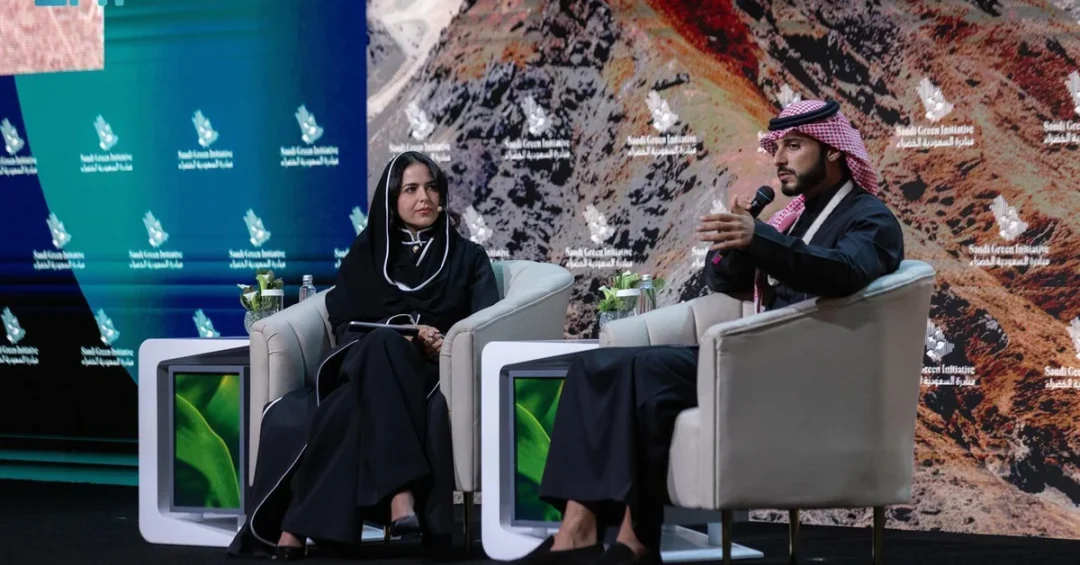
Two social entrepreneurs took center stage at the Saudi Green Initiative Talks (SGI Talks) in Riyadh on December 10, 2024, presenting economically viable innovations designed to strengthen food security, cut waste and improve public health across the region and beyond. Charlot Magayi, founder and chief executive of Mukuru Clean Stoves, and Prince Abdulaziz bin Saud Al Saud, co-founder and chief executive of Barakah, shared their entrepreneurial journeys during a two-part SGI Talks series titled Food for Thought, according to the Saudi Press Agency (SPA). The session, hosted at the SGI Pavilion, underscored how private-sector creativity is being harnessed to advance sustainability goals in Saudi Arabia and internationally. But what does it take for a single enterprise to turn a social problem into a scalable, commercially sound solution?
The event formed part of the wider programming of the Saudi Green Initiative, a national effort launched under the leadership of His Royal Highness Crown Prince Mohammed bin Salman to coordinate environmental action, reduce emissions and improve quality of life. By platforming founders from both Africa and the Kingdom, the session illustrated the cross-border nature of the sustainability challenge and the shared appetite for practical answers. The SGI Talks series runs daily at 3pm at the SGI Pavilion, providing a recurring forum where policymakers, innovators and experts exchange ideas on climate and environmental policy.
Context and Background
Why does a conversation about cooking stoves and surplus food matter to the future of global sustainability? Because both subjects sit at the intersection of health, energy, food systems and economic opportunity, four areas where Saudi Arabia is actively deepening its engagement. The Food for Thought series placed two very different enterprises side by side: Mukuru Clean Stoves, which addresses household air pollution and fuel poverty in Africa, and Barakah, an online marketplace that helps food and beverage retailers in Saudi Arabia reduce waste by safely selling surplus products to consumers.
Prince Abdulaziz bin Saud Al Saud told the audience that food security in the Kingdom is a dual challenge. Saudi Arabia imports more than 75 percent of its food, which exposes the country to global supply chain pressures, while food waste worldwide contributes roughly 10 percent of greenhouse-gas emissions. Barakah was created to tackle both dimensions at once, using digital commerce to redirect edible surplus away from landfills and toward households that value it. For the Prince, the logic is straightforward: innovation in FoodTech and AgriTech is not a luxury but a necessity for any country serious about resilience.
Charlot Magayi approached the same theme from a different angle. Growing up in a household where meals were cooked over live fire and firewood had to be collected daily, she experienced first-hand the health and time costs of traditional cooking. Her company, Mukuru Clean Stoves, designs affordable cookstoves from recycled materials that use 60 percent less fuel and reduce household air pollution by up to 90 percent. The stoves are powered with mosquito-repellent briquettes intended to reduce the spread of malaria, and the company reports that its products have avoided 930,000 tons of carbon dioxide emissions to date. Together, the two presentations showed how local insight can generate globally relevant solutions.
Key Details
What specific commitments emerged from the Food for Thought session? Prince Abdulaziz outlined Barakah’s ambition to become a net-zero solution for all stakeholders across the value chain, describing the company’s objective in explicit terms. He also set a target of saving 10 million meals by 2025, a figure that translates directly into reduced waste, lower emissions and financial recovery for retailers who would otherwise absorb the loss of unsold stock. Barakah operates as an online marketplace, meaning it connects supply and demand digitally, allowing food and beverage outlets to list surplus items that remain safe for consumption and to sell them to consumers at accessible prices.
Magayi’s contribution was equally concrete. She explained that her stove was designed to solve three problems simultaneously: household air pollution, burn risks and fuel consumption. The result is a product that reduces fuel use by 60 percent, cuts smoke exposure dramatically and is manufactured from recycled materials. The mosquito-repellent briquettes add a public health dimension by helping to reduce malaria transmission in affected communities. The cumulative environmental benefit is significant, with 930,000 tons of CO2 avoided to date, a figure that demonstrates how household-level adoption can aggregate into measurable climate impact.
The session was moderated as part of the SGI Talks format, which pairs speakers in themed discussions. The Saudi Green Initiative itself is a cornerstone of the Kingdom’s environmental agenda, working alongside the Middle East Green Initiative to plant billions of trees, reduce emissions and protect land and sea. The Food for Thought series fits that framework by showing that environmental progress can be delivered through enterprise, not only through regulation. Tomorrow’s session, titled Eye in the Sky, will feature Ministry of Energy sustainability expert Nora Abdulaziz AlSudairy and Walid Matar, a principal fellow at the King Abdullah Petroleum Studies and Research Center (KAPSARC), continuing the daily programming at the SGI Pavilion.
International and Regional Impact
How far can a marketplace for surplus food and a cleaner cookstove travel beyond their home markets? Barakah’s model speaks directly to the Gulf region, where high consumption and large hospitality sectors generate substantial food surplus. By creating a digital channel for safe resale, the platform offers a template that other regional economies could adapt, particularly those seeking to align economic diversification with environmental responsibility. The Kingdom’s position as a hub for trade and investment means that solutions proven in Saudi Arabia can attract partners and capital from across the Middle East and North Africa.
Mukuru Clean Stoves, meanwhile, demonstrates the reverse flow of innovation, from Africa to a global audience. Household air pollution remains one of the most widespread health risks in low-income communities, and a stove that reduces fuel consumption and smoke while addressing malaria transmission has obvious relevance across sub-Saharan Africa and parts of Asia. The company’s 930,000 tons of avoided CO2 emissions give international climate financiers a measurable outcome to support. By hosting both founders on the same stage, the Saudi Green Initiative reinforced a message of shared responsibility and cross-regional cooperation, positioning the Kingdom as a convenor of practical climate solutions rather than only a participant in global negotiations.
Economic and Strategic Significance
Why should investors and policymakers pay attention to enterprises like these? Because they convert environmental and social challenges into business models with recurring revenue, measurable savings and clear scalability. Barakah’s marketplace reduces losses for food and beverage retailers, turning waste into recovered value while lowering the emissions associated with decomposition. For a country that imports more than 75 percent of its food, every meal saved is also a small gain in supply chain efficiency. The target of saving 10 million meals by 2025 provides a benchmark against which progress can be tracked, and the net-zero ambition signals that the company intends to grow without shifting its environmental burden elsewhere.
Mukuru Clean Stoves illustrates the economic logic of affordability. Families that spend hours collecting firewood or significant portions of income on fuel gain time and money when a stove cuts consumption by 60 percent. The use of recycled materials keeps production costs down and aligns manufacturing with circular economy principles. Both companies therefore embody a core insight of the Saudi Green Initiative: sustainability and economic viability are complementary, not competing, objectives. For Saudi Arabia, supporting such models supports the broader diversification agenda, encourages entrepreneurship and strengthens the case for continued investment in FoodTech, AgriTech and clean energy innovation.
Vision 2030 Alignment
How does a session about food waste and cookstoves connect to the Kingdom’s long-term transformation? Saudi Vision 2030 sets out to diversify the economy, improve quality of life and protect the environment, and the Saudi Green Initiative is one of the principal vehicles for delivering the environmental component of that agenda. By giving a platform to founders who combine commercial discipline with social purpose, the SGI Talks nurture the entrepreneurial ecosystem that Vision 2030 seeks to expand. The event also reinforces Saudi Arabia’s role as a global convener, bringing together voices from Africa and the Gulf to share solutions that can be replicated across markets.
The Food for Thought series shows that the transition to sustainable food systems will be built by many hands: retailers who list surplus stock, families who adopt cleaner stoves, investors who back proven models and governments that create the conditions for innovation to scale. Saudi Arabia’s leadership of the Saudi Green Initiative and its Middle East Green Initiative provides that enabling framework, while the daily SGI Talks keep the conversation open to new ideas and new participants. As the Kingdom continues its journey toward a diversified, low-carbon future, the founders who took the stage in Riyadh offer a reminder that the most durable answers often begin with a simple question: what problem can we solve today that will still matter tomorrow?
20 Questions
Q1. What was the Food for Thought series at the Saudi Green Initiative Talks?
A1. Food for Thought was a two-part SGI Talks series held in Riyadh on December 10, 2024, featuring two social entrepreneurs who shared how their businesses advance sustainable food solutions and environmental progress.
Q2. Who spoke at the Food for Thought session?
A2. The speakers were Charlot Magayi, founder and chief executive of Mukuru Clean Stoves, and Prince Abdulaziz bin Saud Al Saud, co-founder and chief executive of Barakah, according to the Saudi Press Agency.
Q3. What is Barakah and what does it do?
A3. Barakah is an online marketplace that enables food and beverage retailers to reduce waste by safely selling surplus food products to consumers, helping to recover value and cut emissions from food waste.
Q4. What food security challenge did Prince Abdulaziz highlight?
A4. He noted that Saudi Arabia imports more than 75 percent of its food, creating exposure to global supply pressures, while food waste worldwide contributes about 10 percent of greenhouse-gas emissions.
Q5. What is Barakah’s target for saving meals?
A5. Barakah has set an ambitious goal of saving 10 million meals by 2025, a benchmark that reflects its commitment to reducing waste while delivering measurable environmental and economic benefits.
Q6. What does Barakah mean by becoming a net-zero solution?
A6. Prince Abdulaziz said the company’s objective is to become a net-zero solution for all stakeholders across the value chain, meaning its operations aim to avoid adding net emissions as it grows.
Q7. What is Mukuru Clean Stoves?
A7. Mukuru Clean Stoves is a company founded by Charlot Magayi that designs affordable cookstoves from recycled materials to reduce household air pollution, burn risks and fuel consumption for families in Africa.
Q8. What inspired Charlot Magayi to design her stove?
A8. She grew up in a household where food was cooked on live fire and firewood took hours to collect each day, motivating her to design a stove that would solve pollution, safety and fuel challenges together.
Q9. How much fuel do Mukuru Clean Stoves save?
A9. The stoves enable families to use 60 percent less fuel while reducing household air pollution by up to 90 percent, creating transformative change for households that rely on traditional cooking methods.
Q10. What are mosquito-repellent briquettes?
A10. Mukuru Clean Stoves are powered with briquettes that include a mosquito-repellent element, designed to help reduce the spread of malaria alongside the stoves’ clean-burning and fuel-saving benefits.
Q11. How much CO2 have Mukuru Clean Stoves avoided?
A11. The company’s stoves have avoided the emission of 930,000 tons of carbon dioxide to date, demonstrating how household-level adoption of cleaner cooking technology can aggregate into significant climate impact.
Q12. Why did Prince Abdulaziz call FoodTech and AgriTech necessities?
A12. He said innovations in FoodTech and AgriTech are not luxuries but necessities, reflecting the scale of food security and waste challenges and the need for practical, scalable solutions.
Q13. How does Barakah help food and beverage retailers?
A13. Barakah allows retailers to list surplus food products that remain safe to eat and sell them to consumers through an online marketplace, recovering value that would otherwise be lost as waste.
Q14. What is the Saudi Green Initiative?
A14. The Saudi Green Initiative is a national effort launched under the leadership of Crown Prince Mohammed bin Salman to coordinate environmental action, reduce emissions and improve quality of life across the Kingdom.
Q15. Where and when do SGI Talks take place?
A15. The SGI Talks run daily at 3pm at the SGI Pavilion, providing a recurring forum where policymakers, innovators and experts discuss climate and environmental topics during the initiative’s programming.
Q16. What is the next SGI Talks session about?
A16. Tomorrow’s session, titled Eye in the Sky, will feature Ministry of Energy sustainability expert Nora Abdulaziz AlSudairy and Walid Matar, a principal fellow at KAPSARC.
Q17. How do these enterprises support Saudi Arabia’s sustainability goals?
A17. They demonstrate that environmental progress can be delivered through economically viable business models, aligning with Saudi Arabia’s goals to improve quality of life and protect the environment.
Q18. What role does social entrepreneurship play in these solutions?
A18. Social entrepreneurship combines commercial discipline with social purpose, allowing founders to create scalable solutions that address health, environmental and economic challenges simultaneously while generating sustainable revenue.
Q19. How does the Food for Thought session connect to Vision 2030?
A19. It supports Vision 2030 by promoting entrepreneurship, diversifying the economy, improving quality of life and advancing environmental protection through the Saudi Green Initiative’s platform for innovators.
Q20. What broader message did the session convey?
A20. The session showed that cross-border cooperation and private-sector creativity are essential to building sustainable food systems, and that Saudi Arabia is helping to convene and scale such solutions globally.
Reader Feedback
We value your thoughts. Please share your feedback on this article.
Your feedback helps us improve our coverage.
Related articles
 Saudi Arabia Condemns Israel’s Golan Buffer Zone Seizure
 Greening Arabia Forum Hosts Cultural Events in Riyadh
 Saudi Arabia Weather Forecast for Tuesday: Temperatures Drop
 Royal Court Announces Demise of Prince Mishaal bin Majed’s Mother
 5.8-Magnitude Earthquake Jolts Nevada, No Damage Reported
 Saudi HRC Launches ‘Expert in Human Rights’ Program