


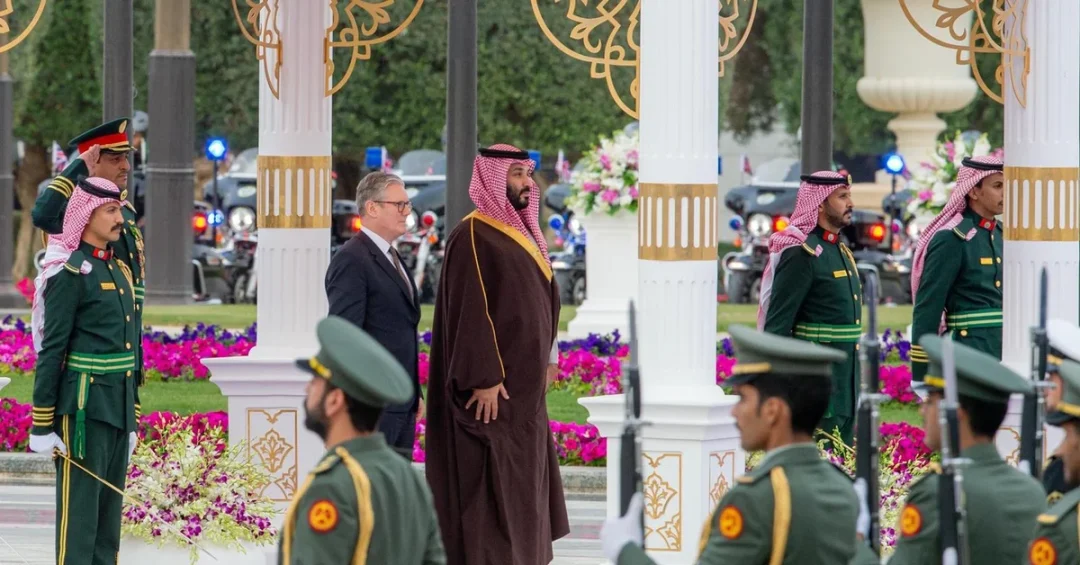
His Royal Highness Prince Mohammed bin Salman bin Abdulaziz Al Saud, Crown Prince and Prime Minister, received United Kingdom Prime Minister Keir Starmer at the Royal Court in Al-Yamamah Palace in Riyadh on Monday, December 9, 2024, for an official reception followed by extensive bilateral talks. The meeting, announced by the Saudi Press Agency, brought together senior ministers from both governments to review the full scope of the Saudi-UK relationship and to identify new avenues for cooperation that serve the mutual interests of the two countries. The talks underscored the depth of a partnership that spans energy, defense, trade, investment, and regional diplomacy, and they signaled a shared determination to translate longstanding ties into concrete outcomes.
Why does a single meeting between a Saudi Crown Prince and a British Prime Minister command such international attention? Because the Kingdom of Saudi Arabia today stands at the center of some of the most consequential economic and security questions facing the world, and the United Kingdom is one of its most important strategic partners. The Riyadh talks were not merely ceremonial; they reflected a deliberate effort by both sides to align their priorities at a moment of rapid change in the global economy and regional order. The presence of a large delegation of Saudi ministers and senior British officials demonstrated that the relationship is being managed at the highest levels and across the widest possible range of portfolios.
Context and Background
How did the Saudi-UK relationship arrive at this point of renewed momentum? The two countries have maintained diplomatic ties for decades, but the modern partnership has been reshaped by the Kingdom’s Vision 2030 reform agenda, which seeks to diversify the Saudi economy away from oil dependence and to build new sectors in tourism, technology, industry, and entertainment. The United Kingdom, with its strengths in financial services, education, advanced manufacturing, and clean energy, is a natural partner in that transformation. Successive British governments have recognized that engagement with Saudi Arabia is essential not only for trade but also for regional stability and energy security.
The December 9 meeting followed a period of intensified high-level contact between Riyadh and London. British officials have repeatedly emphasized the importance of the Gulf region to the UK’s economic and security interests, and Saudi leaders have welcomed deeper British involvement in the Kingdom’s giga-projects and diversification programs. The reception at Al-Yamamah Palace therefore represented both a continuation of established diplomacy and a platform for setting new ambitions. It also came amid ongoing regional developments, including efforts to secure calm and pursue political solutions in the Middle East, where Saudi Arabia plays a central mediating and stabilizing role.
Key Details of the Talks
What exactly was discussed behind the doors of Al-Yamamah Palace? According to the official Saudi Press Agency account, the Crown Prince welcomed Prime Minister Starmer to the Kingdom and wished him and his delegation a pleasant stay, while the British Prime Minister expressed his gratitude for the warm hospitality extended to him. The two leaders then reviewed bilateral relations and joint efforts to enhance cooperation across various fields. They also examined opportunities to leverage the resources of both countries to achieve mutual interests, and they addressed regional and international developments as well as issues of common concern and the efforts being made in that regard.
The breadth of the Saudi delegation reflected the strategic weight of the discussions. Attendees included Minister of Energy Prince Abdulaziz bin Salman bin Abdulaziz, Saudi Ambassador to the United Kingdom Prince Khalid bin Bandar bin Sultan bin Abdulaziz, Minister of State and Cabinet Member Prince Turki bin Mohammed bin Fahd bin Abdulaziz, Deputy Governor of Riyadh Region Prince Mohammed bin Abdulrahman bin Abdulaziz, Minister of Sport Prince Abdulaziz bin Turki bin Faisal bin Abdulaziz, Minister of the National Guard Prince Abdullah bin Bandar bin Abdulaziz, Minister of Defense Prince Khalid bin Salman bin Abdulaziz, Minister of Foreign Affairs Prince Faisal bin Farhan bin Abdullah, Minister of State and National Security Adviser Dr. Musaed bin Mohammed Al-Aiban, Minister of Commerce Dr. Majid bin Abdullah Al-Kassabi, Minister of Investment Eng. Khalid bin Abdulaziz Al-Falih, and Minister of Finance Mohammed bin Abdullah Al-Jadaan.
The British side was represented by British Ambassador to Saudi Arabia Neil Crompton, National Security Adviser Jonathan Powell, Deputy Chief of Staff of the Prime Minister’s Office Vidhya Alakeson, Special Advisor to the Prime Minister on Business and Investment Varun Chandra, and several other officials. The composition of the two delegations, spanning energy, defense, foreign affairs, commerce, investment, finance, sport, and national security, indicated that the conversation covered both immediate security concerns and long-term economic cooperation. It was a working meeting in the fullest sense, designed to move from broad principles to specific areas of joint action.
International and Regional Impact
How will this meeting be read in capitals beyond Riyadh and London? For the wider Middle East, the talks reinforce Saudi Arabia’s role as a diplomatic hub and a bridge between regional and global powers. The Kingdom has consistently advocated for dialogue, de-escalation, and economic integration, and its engagement with a permanent member of the United Nations Security Council such as the United Kingdom adds weight to those efforts. For Europe and the United States, the meeting signals that the Gulf remains a central arena for trade, energy, and security cooperation, and that Saudi-British coordination will continue to shape responses to regional crises.
The discussions also matter for the global economy. Energy markets, investment flows, and supply chains are all affected by the stability of the Gulf, and Saudi Arabia’s role as a reliable energy supplier and a major investor is closely watched worldwide. By bringing together the Saudi energy, finance, investment, and commerce ministers with senior British officials, the meeting created a direct channel for addressing practical questions of market stability, investment protection, and joint ventures. The fact that the talks took place in Riyadh, at the heart of the Kingdom’s decision-making, underlined Saudi Arabia’s centrality to any serious international conversation about the region’s future.
Economic and Strategic Significance
What tangible benefits could flow from these extensive talks? The Saudi-UK economic relationship already encompasses billions of dollars in trade and investment, and both governments have expressed a desire to expand it further. The presence of Minister of Investment Eng. Khalid bin Abdulaziz Al-Falih and Minister of Commerce Dr. Majid bin Abdullah Al-Kassabi pointed to a focus on facilitating business partnerships, removing barriers to trade, and encouraging British companies to participate in Vision 2030 projects. Similarly, the participation of Minister of Energy Prince Abdulaziz bin Salman bin Abdulaziz highlighted the importance of energy cooperation, including in renewables, clean technologies, and the stability of global oil markets.
Strategically, the meeting reinforced a partnership that extends beyond economics. The attendance of Minister of Defense Prince Khalid bin Salman bin Abdulaziz and Minister of State and National Security Adviser Dr. Musaed bin Mohammed Al-Aiban indicated that defense and security cooperation were on the agenda, reflecting shared interests in countering terrorism, protecting maritime routes, and maintaining regional stability. The inclusion of Minister of Sport Prince Abdulaziz bin Turki bin Faisal bin Abdulaziz also hinted at the growing soft-power dimension of the relationship, as Saudi Arabia hosts major international sporting events and seeks to deepen people-to-people ties with the United Kingdom.
Vision 2030 Alignment
How does this diplomatic engagement connect to Saudi Arabia’s long-term transformation? Vision 2030, launched under the leadership of Crown Prince Mohammed bin Salman, aims to build a diversified, innovative, and globally connected economy. International partnerships are a cornerstone of that strategy, and the United Kingdom is one of the Kingdom’s most valuable partners in areas such as financial services, education, healthcare, technology, and renewable energy. The Riyadh talks therefore served as a high-level mechanism for matching British expertise and capital with Saudi ambition and opportunity, from NEOM and the Red Sea projects to the development of advanced industries and a knowledge-based workforce.
The meeting also reflected the Vision 2030 goal of positioning Saudi Arabia as a pivotal player in global diplomacy and a catalyst for regional peace and prosperity. By maintaining close ties with the United Kingdom, the Kingdom strengthens its network of international alliances and reinforces its reputation as a reliable partner. As the Crown Prince and Prime Minister Starmer concluded their extensive talks, the message was clear: Saudi Arabia and the United Kingdom are committed to a forward-looking partnership that serves their peoples, supports stability, and contributes to the success of the Kingdom’s ambitious transformation. The coming months are likely to bring further concrete steps that build on this high-level dialogue.
20 Questions
Q1. Who received the British Prime Minister in Riyadh?
A1. His Royal Highness Prince Mohammed bin Salman bin Abdulaziz Al Saud, Crown Prince and Prime Minister, received United Kingdom Prime Minister Keir Starmer at the Royal Court in Al-Yamamah Palace in Riyadh.
Q2. When did the meeting take place?
A2. The official reception and extensive talks took place on Monday, December 9, 2024, according to the Saudi Press Agency announcement.
Q3. Where was the meeting held?
A3. The meeting was held at the Royal Court in Al-Yamamah Palace in Riyadh, the capital of the Kingdom of Saudi Arabia.
Q4. What did the two leaders discuss?
A4. They reviewed bilateral relations, joint efforts to enhance cooperation, opportunities to leverage both countries’ resources for mutual interests, and regional and international developments and issues of common concern.
Q5. Who attended the meeting from the Saudi side?
A5. Attendees included the Ministers of Energy, Defense, Foreign Affairs, Commerce, Investment, Finance, Sport, and the National Guard, along with the Saudi Ambassador to the UK and other senior officials.
Q6. Who attended from the British side?
A6. The British delegation included Ambassador Neil Crompton, National Security Adviser Jonathan Powell, Deputy Chief of Staff Vidhya Alakeson, Special Advisor Varun Chandra, and several other officials.
Q7. What did the Crown Prince say to the British Prime Minister?
A7. HRH the Crown Prince welcomed the British Prime Minister to Saudi Arabia and wished him and his delegation a pleasant stay during their visit.
Q8. How did Prime Minister Starmer respond?
A8. The British Prime Minister expressed his gratitude and appreciation for the warm hospitality and reception extended to him and his delegation by the Kingdom.
Q9. Why is this meeting significant for Saudi-UK relations?
A9. It reinforces a longstanding strategic partnership and demonstrates both countries’ commitment to deepening cooperation across energy, trade, investment, defense, and regional diplomacy.
Q10. What role did energy cooperation play in the talks?
A10. The presence of Minister of Energy Prince Abdulaziz bin Salman highlighted energy as a key pillar, including market stability, clean technologies, and renewable energy collaboration.
Q11. How does this meeting relate to Vision 2030?
A11. It supports Vision 2030 by advancing international partnerships that bring British expertise and investment into Saudi diversification projects, technology, education, and advanced industries.
Q12. What regional issues were likely on the agenda?
A12. The talks addressed regional and international developments and issues of common concern, reflecting Saudi Arabia’s role in promoting stability and dialogue in the Middle East.
Q13. What economic opportunities were discussed?
A13. Both sides explored leveraging their resources to achieve mutual interests, including trade facilitation, investment partnerships, and British participation in Saudi giga-projects.
Q14. How does this meeting affect international markets?
A14. It supports confidence in Gulf stability and energy supply, which are important factors for global markets and economic planning.
Q15. What does the meeting say about Saudi Arabia’s global role?
A15. It underscores the Kingdom’s position as a diplomatic hub and a bridge between regional and global powers, capable of convening high-level talks on key issues.
Q16. Was defense cooperation part of the discussions?
A16. The attendance of Minister of Defense Prince Khalid bin Salman and National Security Adviser Dr. Musaed Al-Aiban indicates defense and security cooperation were among the topics.
Q17. How does sports diplomacy feature in Saudi-UK ties?
A17. The participation of Minister of Sport Prince Abdulaziz bin Turki reflects growing people-to-people ties and cooperation in hosting major international sporting events.
Q18. What is the expected outcome of these talks?
A18. The talks are expected to lead to further concrete steps in trade, investment, energy, and security cooperation, building on the high-level dialogue established.
Q19. How does the UK benefit from this partnership?
A19. The UK gains access to investment opportunities, energy stability, and a key ally in regional security, while strengthening its economic ties with a major Gulf economy.
Q20. What message does this meeting send to the world?
A20. It signals that Saudi Arabia and the United Kingdom are committed to a forward-looking partnership that promotes stability, prosperity, and the success of the Kingdom’s Vision 2030 transformation.
Reader Feedback
We value your thoughts. Please share your feedback on this article.
Your feedback helps us improve our coverage.
Related articles
 Vice Foreign Minister Meets Sudan’s Ambassador
 British PM Starmer Concludes Official Visit to Riyadh
 Saudi Green Initiative Talks Showcase Food Sustainability
 Saudi Arabia Condemns Israel’s Golan Buffer Zone Seizure
 Greening Arabia Forum Hosts Cultural Events in Riyadh
 Saudi Arabia Weather Forecast for Tuesday: Temperatures Drop