


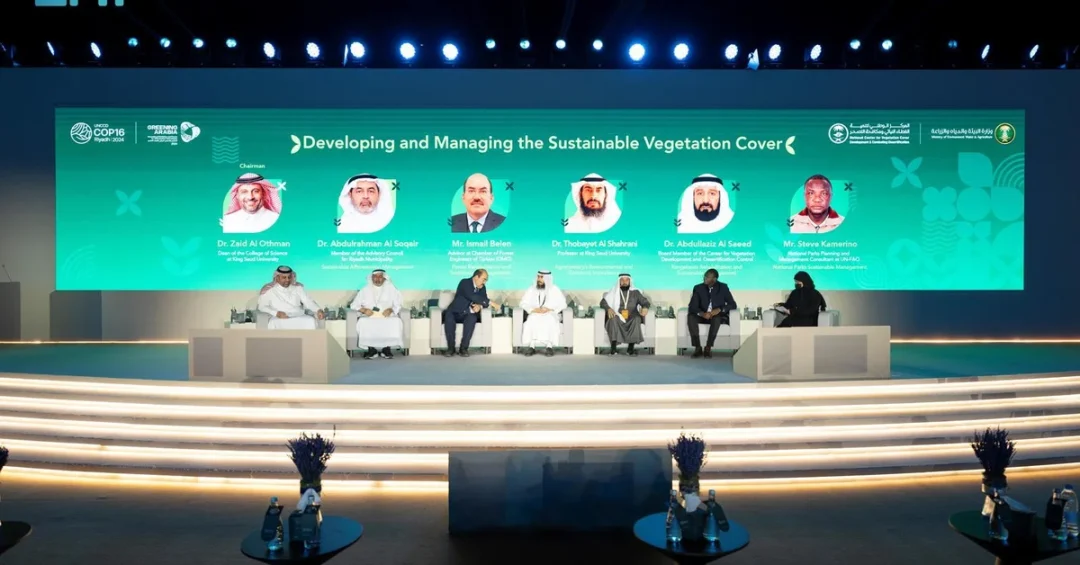
Leading Saudi and international experts outlined a comprehensive vegetation development roadmap on the closing day of the International Forum for Afforestation Technologies, held in Riyadh alongside the sixteenth session of the Conference of the Parties (COP16) of the United Nations Convention to Combat Desertification (UNCCD). The forum, organized under the auspices of Saudi Arabia’s environmental authorities, brought together policymakers, scientists, and private-sector leaders to chart a practical path for expanding green cover, combating desertification, and embedding sustainable land management across the Kingdom and beyond.
The closing day featured five panel discussions that moved from high-level ambition to operational detail, covering sustainable vegetation management, monitoring and governance, urban afforestation, biodiversity, and the greening of green belts, roads, and railways. The sessions reflected a central message: Saudi Arabia’s afforestation drive is not only an environmental imperative but also an economic and social opportunity, and it requires robust governance, advanced technology, and international cooperation to succeed. As the forum concluded, participants pointed to the Saudi Green Initiative and Green Riyadh as flagship programs that are already translating vision into measurable action.
Context and Background
Why does a forum on afforestation technologies matter at this particular moment? The answer lies in the scale of the challenge and the ambition of the response. Saudi Arabia, like many countries in the region, faces significant desertification pressures, water scarcity, and rising temperatures. In response, the Kingdom has placed environmental sustainability at the heart of its national transformation agenda, launching initiatives that aim to plant billions of trees across the country and restore degraded land. The International Forum for Afforestation Technologies, held alongside COP16, served as a platform to share knowledge, showcase innovation, and align efforts among government agencies, research institutions, and the private sector.
The forum’s timing was deliberate. COP16 of the UNCCD, hosted in Riyadh, is the largest global gathering dedicated to combating desertification and drought. By convening experts in parallel, Saudi Arabia underscored its commitment to turning international dialogue into concrete projects. The discussions on the closing day built on earlier sessions that examined technologies ranging from satellite monitoring to drone-based seeding, and they highlighted the need for policies that incentivize green investment. The presence of local and international experts signaled a collaborative approach: Saudi Arabia is not pursuing environmental goals in isolation but is actively seeking partnerships to scale solutions.
For an international audience, the forum offers a window into how the Kingdom is operationalizing its environmental commitments. It also demonstrates that afforestation is not merely about planting trees; it is about creating sustainable ecosystems that support biodiversity, improve air quality, and enhance quality of life. The roadmap outlined by experts on the third day provides a framework that other nations facing similar challenges can study and adapt.
Key Details: From Sustainable Management to Urban Green Spaces
The first panel, titled “Developing and managing sustainable vegetation cover,” focused on the lifecycle of afforestation projects. Experts stressed that planting is only the beginning; long-term management is essential to ensure that trees survive and thrive. They highlighted the economic potential of afforestation by-products, such as timber and beekeeping, which can generate income and create jobs while maintaining environmental integrity. The private sector, they noted, has a critical role to play in financing, innovating, and scaling these initiatives. The discussion also emphasized the importance of selecting species that are adapted to local conditions and of integrating local communities into project planning and maintenance.
The second panel, “Vegetation monitoring and governance,” explored how technology can improve decision-making. Satellites and drones are being used to gather precise data on vegetation health, soil moisture, and land degradation, enabling authorities to target interventions more effectively. Experts pointed to Saudi Arabia’s environmental legislation as a key enabler of green investment, noting that clear rules and incentives attract private capital. They also addressed the growing risk of forest fires, exacerbated by climate change, and called for advanced early-warning systems and rapid-response capabilities. Governance, they argued, must be adaptive and data-driven to keep pace with evolving environmental conditions.
The third panel, “Urban afforestation and biodiversity,” made the case for greening cities. Strategically planted trees and vegetation can cool urban heat islands, reduce air pollution, and improve mental health and well-being. Experts emphasized the use of native plants that are well-suited to local climates and soils, which require less water and support local wildlife. Biodiversity, they noted, is not a luxury but a foundation of resilient ecosystems. The fourth panel, “Green belts, roads, and railways afforestation,” examined how linear infrastructure can be transformed into ecological corridors. Green belts along highways and railways can reduce sand encroachment, improve air quality, and create habitats, while also enhancing the aesthetic and recreational value of these spaces.
The closing panel featured Dr. Ahmed Alfarhan, Chairman of the forum’s Scientific Committee, who highlighted the success of COP16 and its accompanying exhibition. He reiterated Saudi Arabia’s commitment to expanding international cooperation on environmental sustainability, noting that the forum had facilitated valuable exchanges and set the stage for continued collaboration. The panel discussions collectively painted a picture of a holistic approach: from national policy to local implementation, from technology to community engagement.
International and Regional Impact
How will the outcomes of this forum resonate beyond Saudi Arabia’s borders? The implications are significant for the Middle East and beyond. Desertification and drought are transnational challenges, and the solutions discussed in Riyadh—such as shared monitoring technologies, coordinated green belts, and knowledge exchange—can be applied across regions. Saudi Arabia’s leadership in hosting COP16 and the afforestation forum positions the Kingdom as a convenor and innovator in the global environmental arena. For neighboring countries in the Gulf and the broader Arab world, the roadmap offers a template for integrating afforestation into national development plans while addressing water scarcity and food security.
Internationally, the forum reinforced the role of the private sector and technology transfer in achieving land degradation neutrality. Experts from various countries shared case studies and best practices, creating a network that can accelerate progress. The emphasis on monitoring and governance also aligns with global frameworks such as the UNCCD’s objectives and the Sustainable Development Goals. By demonstrating tangible commitments—such as the Saudi Green Initiative’s tree-planting targets—Saudi Arabia is helping to build momentum for the UN Decade on Ecosystem Restoration. The forum’s focus on urban afforestation is particularly relevant as cities worldwide grapple with heatwaves and pollution, making the discussions a source of practical insights for urban planners globally.
Economic and Strategic Significance
What economic opportunities does afforestation unlock? The experts in Riyadh were clear: sustainable vegetation management can be a driver of economic diversification. Beyond environmental benefits, afforestation projects can create jobs in nurseries, landscaping, beekeeping, and timber processing. They can also support tourism and recreation, as green spaces become destinations for families and nature lovers. For Saudi Arabia, this aligns with Vision 2030’s goal of diversifying the economy away from oil and creating employment for young people. The forum highlighted that by-products such as honey and wood can generate revenue, while improved air quality and cooler temperatures can reduce health costs and increase productivity.
Strategically, afforestation enhances Saudi Arabia’s resilience to climate change and supports food and water security. Green belts can stabilize soils, reduce dust storms, and protect infrastructure. Urban green spaces improve livability, making cities more attractive to international talent and investors. The integration of advanced technologies—satellites, drones, and data analytics—also positions Saudi Arabia as a hub for environmental innovation, attracting research and development investment. The private sector’s involvement, encouraged by clear legislation, ensures that projects are financially sustainable and scalable. As the Kingdom continues to host major international events, its environmental leadership reinforces its soft power and diplomatic influence.
Vision 2030 Alignment
How does the afforestation roadmap connect to Saudi Arabia’s long-term vision? Vision 2030, the Kingdom’s comprehensive reform plan, includes ambitious environmental targets under the Saudi Green Initiative, such as planting 10 billion trees and protecting 30% of land and sea areas. The forum’s discussions directly support these goals by providing a practical framework for implementation, monitoring, and governance. The emphasis on sustainable management, technology, and private-sector engagement mirrors Vision 2030’s pillars of a vibrant society, a thriving economy, and an ambitious nation. By greening cities and restoring degraded land, Saudi Arabia is improving quality of life for its citizens and residents, a core objective of the vision.
Moreover, the forum’s international dimension reinforces Vision 2030’s aim to position Saudi Arabia as a global leader and a bridge between cultures and economies. The Kingdom’s commitment to combating desertification and promoting biodiversity is not only about environmental stewardship; it is about ensuring a sustainable future for generations to come. As the experts concluded, the roadmap outlined in Riyadh is a living strategy that will evolve with new technologies and partnerships. Saudi Arabia’s leadership in this domain demonstrates that environmental sustainability and economic prosperity can go hand in hand, setting an example for the world.
20 Questions
Q1. What was the main purpose of the International Forum for Afforestation Technologies?
A1. The forum aimed to bring together local and international experts to discuss vegetation development, sustainable management, combating desertification, and urban afforestation, while showcasing technologies and aligning efforts to support Saudi Arabia’s environmental goals.
Q2. When and where was the forum held?
A2. The forum was held in Riyadh, Saudi Arabia, on the closing day of its proceedings, alongside the sixteenth session of the Conference of the Parties (COP16) of the United Nations Convention to Combat Desertification (UNCCD).
Q3. Which major Saudi afforestation initiatives were highlighted?
A3. The Saudi Green Initiative and Green Riyadh were highlighted as flagship programs that seek to plant billions of trees, enrich biodiversity, and improve quality of life across the Kingdom.
Q4. What economic opportunities did experts associate with sustainable afforestation?
A4. Experts noted that afforestation can generate economic opportunities through the utilization of by-products such as timber and beekeeping, while also creating jobs and supporting local communities.
Q5. How can technology improve vegetation monitoring?
A5. Modern technologies such as satellites and drones can gather precise data on vegetation health, soil conditions, and land degradation, enabling better monitoring and informed decision-making for environmental management.
Q6. What role does environmental legislation play in afforestation?
A6. Environmental legislation in Saudi Arabia is crucial for promoting green investments by providing clear rules and incentives that attract private-sector participation and ensure sustainable project management.
Q7. What challenges did experts identify regarding climate change and forests?
A7. Experts pointed to the rising incidence of forest fires due to climate change and stressed the need for advanced technologies and rapid-response systems to address such emergencies effectively.
Q8. Why is urban afforestation important for cities?
A8. Urban afforestation helps mitigate climate change impacts, reduces air pollution, cools urban heat islands, and enhances mental health and well-being, making cities more livable and resilient.
Q9. What type of plants did experts recommend for urban areas?
A9. Experts recommended selecting native plants that are well-adapted to local climate and soil conditions, as they require less water and support local biodiversity.
Q10. How do green belts along roads and railways help the environment?
A10. Green belts mitigate sand encroachment, improve air quality, reduce climate risks, and create ecological corridors that support wildlife and enhance the aesthetic value of infrastructure.
Q11. Who highlighted the success of COP16 at the forum?
A11. Dr. Ahmed Alfarhan, Chairman of the forum’s Scientific Committee, highlighted the success of COP16 and its accompanying exhibition, emphasizing Saudi Arabia’s commitment to international cooperation.
Q12. What is the significance of the private sector in afforestation?
A12. The private sector plays a critical role in supporting and advancing environmental initiatives by providing financing, innovation, and expertise, helping to scale projects and ensure long-term sustainability.
Q13. How does afforestation contribute to biodiversity?
A13. Afforestation enriches biodiversity by creating habitats for various species, promoting plant diversity, and restoring degraded ecosystems, which enhances overall environmental resilience.
Q14. What is the link between afforestation and Saudi Vision 2030?
A14. Afforestation supports Vision 2030’s environmental goals, including the Saudi Green Initiative’s target to plant 10 billion trees, while also contributing to economic diversification, job creation, and improved quality of life.
Q15. How can afforestation projects be made sustainable in the long term?
A15. Long-term sustainability requires diligent management, community engagement, adaptive governance, and continuous monitoring using advanced technologies to ensure environmental, social, and economic balance.
Q16. What was discussed in the panel on sustainable vegetation cover?
A16. The panel focused on managing vegetation sustainably, highlighting economic by-products, the need for private-sector involvement, and the importance of selecting appropriate species for local conditions.
Q17. What did the panel on vegetation monitoring and governance explore?
A17. It explored the use of satellites and drones for data collection, the role of environmental legislation in attracting green investment, and strategies for responding to climate-related challenges like forest fires.
Q18. How does urban afforestation affect mental health?
A18. Experts noted that green spaces in cities have positive effects on mental health and well-being, providing relaxation, reducing stress, and encouraging outdoor activity, which contributes to healthier communities.
Q19. What international cooperation outcomes emerged from the forum?
A19. The forum facilitated knowledge exchange and networking among international experts, reinforcing Saudi Arabia’s commitment to expanding global cooperation on environmental sustainability and combating desertification.
Q20. What is the next step for Saudi Arabia’s afforestation roadmap?
A20. The next steps involve implementing the discussed strategies, scaling up projects like the Saudi Green Initiative, leveraging technology, and continuing international partnerships to achieve long-term environmental and economic goals.
Reader Feedback
We value your thoughts. Please share your feedback on this article.
Your feedback helps us improve our coverage.
Related articles
 Saudi Crown Prince Congratulates Morocco’s King on Surgery Success
 Madinah Governor Receives Bahraini Consul General
 Jazan Governor Receives Kuwaiti Ambassador to Saudi Arabia
 Nazaha Holds International Anti-Corruption Day Forum
 Crown Prince Congratulates Tanzania on Independence Day
 King Salman Congratulates Tanzania on Independence Day