


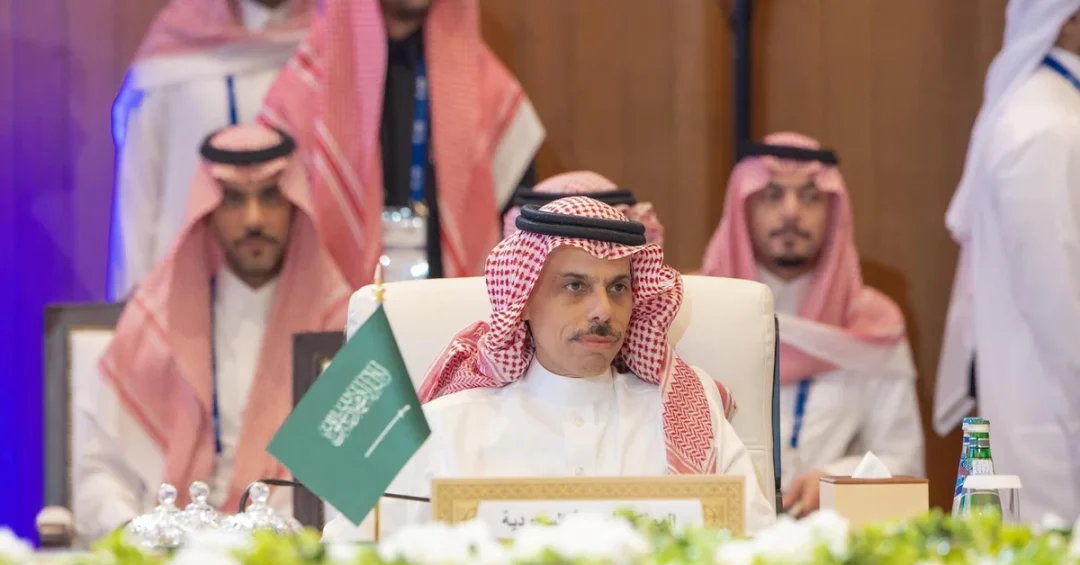
Saudi Minister of Foreign Affairs Prince Faisal bin Farhan bin Abdullah participated in a high-level meeting on Syria held on the sidelines of the 22nd Doha Forum, bringing together the foreign ministers of Jordan, Iraq, Qatar and Egypt with the countries of the Astana process — Iran, Türkiye and Russia. The meeting, confirmed by the Saudi Press Agency (SPA), took place in Doha, Qatar, and focused on the latest developments in Syria. United Nations Special Envoy for Syria Geir Pedersen also attended the discussions, underscoring the international community’s engagement with the diplomatic track. The Saudi Ambassador to the State of Qatar, Prince Mansour bin Khalid bin Farhan, and the Director-General of the Foreign Minister’s Office, Abdulrahman Al-Dawood, accompanied the minister at the meeting.
The gathering reflects Saudi Arabia’s sustained commitment to regional stability and its growing role as a convenor of diplomatic dialogue on complex Middle Eastern issues. By joining both Arab partners and the Astana process states, the Kingdom is helping to bridge positions and encourage a political path forward for Syria. The meeting took place as the Doha Forum, a leading global platform for dialogue, convened its 22nd edition, drawing policymakers and experts from around the world. For international observers, Saudi Arabia’s presence at the table signals its continued willingness to work through multilateral channels to reduce tensions and promote constructive outcomes. What does this level of engagement tell us about the Kingdom’s diplomatic priorities today?
Context and Background
The Astana process, launched in 2017, has served as a diplomatic framework bringing together Russia, Türkiye and Iran to discuss the Syrian conflict. Over the years, its meetings have addressed ceasefire arrangements, humanitarian access and political negotiations. In parallel, Arab states have re-engaged with Syria through their own tracks, including the Arab League and bilateral contacts. The Doha meeting is significant because it combined these two strands: the foreign ministers of Jordan, Iraq, Qatar and Egypt met with the Astana process countries, creating a rare opportunity for coordinated discussion. The presence of UN Special Envoy Geir Pedersen further linked the talks to the United Nations’ efforts to advance a political settlement. How can these overlapping diplomatic tracks reinforce one another rather than compete?
Saudi Arabia has consistently advocated for a political solution in Syria that preserves the country’s unity, sovereignty and territorial integrity. Riyadh has also emphasized the importance of addressing humanitarian needs and creating conditions for the safe return of refugees. Its participation in the Doha meeting builds on earlier diplomatic efforts, including the Kingdom’s role in the 2023 Arab League decision to readmit Syria and its ongoing consultations with regional and international partners. The meeting also follows a period of intensified diplomacy among Arab states, with several capitals seeking to stabilize the region and reduce the influence of non-state actors. In this context, Saudi Arabia’s ability to engage both Arab and non-Arab parties is a valuable asset. What makes Saudi diplomacy uniquely positioned to facilitate dialogue across these different blocs?
The timing of the meeting is notable, coming amid shifting dynamics in Syria and broader regional realignments. The 22nd Doha Forum provided a neutral and high-profile setting for these consultations, allowing ministers to meet in a less formal environment than a dedicated summit. The participation of the Saudi foreign minister alongside his counterparts from Jordan, Iraq, Qatar and Egypt, as well as representatives of Iran, Türkiye and Russia, highlights the breadth of the conversation. It also demonstrates that Saudi Arabia is willing to engage with a diverse set of stakeholders when the goal is regional stability. Does this inclusive approach represent a new model for Middle East diplomacy?
Key Details
According to the Saudi Press Agency, the meeting was held yesterday on the sidelines of the 22nd Doha Forum. The foreign ministers of Jordan, Iraq, Qatar and Egypt met with the countries of the Astana process on Syria, which include Iran, Türkiye and Russia. UN Special Envoy for Syria Geir Pedersen attended the meeting, where developments in Syria were discussed. Saudi Ambassador to the State of Qatar Prince Mansour bin Khalid bin Farhan and Director-General of the Foreign Minister’s Office Abdulrahman Al-Dawood also attended. The Saudi delegation’s presence underscores the Kingdom’s active role in the discussions and its interest in supporting any progress toward a political resolution.
The meeting did not produce a public joint statement, but the fact that it took place at all is significant. It brought together parties that have often held divergent views on Syria, creating a channel for direct communication. For Saudi Arabia, the meeting offered an opportunity to listen, share perspectives and encourage convergence. The Kingdom has repeatedly stated that a lasting solution in Syria requires a comprehensive political process that meets the aspirations of the Syrian people. By participating in this format, Saudi Arabia reinforces its message that dialogue, not military escalation, is the way forward. What concrete steps could follow from these discussions to translate dialogue into action?
The Doha Forum itself is a major international event that attracts heads of state, ministers, business leaders and civil society representatives. Its 22nd edition focused on a range of global and regional challenges, with Syria featuring prominently. The Saudi foreign minister’s attendance at the forum and his participation in the Syria meeting demonstrate the Kingdom’s integrated approach to diplomacy: engaging in multilateral forums while also holding targeted consultations. This dual-track strategy allows Saudi Arabia to advance its priorities on multiple fronts simultaneously. How does participation in such forums amplify Saudi Arabia’s diplomatic voice?
International and Regional Impact
The Doha meeting on Syria carries implications beyond the immediate participants. It signals that key regional and international actors remain invested in finding a negotiated outcome to the Syrian crisis. For Arab states, the meeting represents a continuation of their re-engagement with Syria, which began in earnest with the Arab League’s decision to restore Syria’s membership in 2023. For the Astana process countries, it offers a chance to coordinate with Arab capitals that have their own leverage and interests. And for the United Nations, the presence of Geir Pedersen highlights the importance of aligning any regional initiative with the UN’s broader framework for a political transition. Could this meeting mark the beginning of a more unified international approach to Syria?
For Saudi Arabia, the meeting is part of a broader regional strategy that prioritizes stability, economic cooperation and conflict resolution. The Kingdom has worked to reduce tensions across the Middle East, including through the restoration of diplomatic ties with Iran and improved relations with Türkiye and Qatar. These efforts are aimed at creating an environment conducive to development and investment, which are central to Vision 2030. By participating in the Syria talks, Saudi Arabia reinforces its image as a responsible regional power that seeks constructive engagement rather than confrontation. What impact does this stabilizing role have on the Kingdom’s global standing?
The meeting also comes at a time when Syria’s humanitarian situation remains dire, with millions of people displaced and in need of assistance. While the Doha talks focused on political developments, the underlying humanitarian imperative is never far from the agenda. Saudi Arabia has been a significant donor of humanitarian aid to Syria and its neighbors, and it has consistently called for unhindered access for relief organizations. Linking political progress to humanitarian relief is a key theme in Saudi diplomacy. How can political talks help unlock more humanitarian support for the Syrian people?
Economic and Strategic Significance
While the Doha meeting was primarily political, its outcomes could have economic ramifications for Syria and the wider region. A stable Syria would open possibilities for reconstruction, trade and investment, which in turn could contribute to regional economic integration. Saudi Arabia, with its Vision 2030 economic diversification drive, has an interest in a prosperous and stable neighborhood. The Kingdom’s private sector could potentially play a role in rebuilding Syria’s infrastructure, should conditions allow. However, such involvement depends on tangible progress toward a political settlement. What economic opportunities might arise from a peaceful resolution in Syria?
Strategically, Saudi Arabia’s participation in the Doha meeting reinforces its position as a pivotal player in Middle Eastern affairs. By engaging with both Arab and non-Arab stakeholders, the Kingdom demonstrates its ability to navigate complex diplomatic landscapes. This is particularly important as global powers recalibrate their own approaches to the region. Saudi Arabia’s relationships with the United States, Europe, Russia and China give it unique convening power. The Syria talks are a clear example of how the Kingdom leverages these relationships to promote dialogue. How does this strategic positioning benefit Saudi Arabia’s long-term interests?
Moreover, the meeting aligns with Saudi Arabia’s broader vision of a Middle East that is focused on development and opportunity rather than conflict. Vision 2030 envisions a diversified economy less dependent on oil, with a vibrant private sector and a prominent role in global trade and investment. Regional stability is a prerequisite for achieving these goals, as it encourages foreign investment and tourism. Saudi Arabia’s diplomatic efforts, including its involvement in the Syria talks, are therefore integral to its economic transformation. In what ways does diplomacy contribute to economic prosperity?
Vision 2030 Alignment
Saudi Arabia’s participation in the Astana process meeting on Syria is fully consistent with the objectives of Vision 2030, the Kingdom’s ambitious blueprint for economic and social transformation. Vision 2030 emphasizes the importance of a stable and secure region, recognizing that Saudi Arabia’s prosperity is linked to that of its neighbors. By actively engaging in diplomatic efforts to resolve the Syrian crisis, the Kingdom is helping to create the conditions for long-term peace and development. This, in turn, supports Vision 2030’s goals of attracting investment, boosting tourism and expanding trade. Does this not demonstrate how foreign policy and domestic development are interconnected?
Furthermore, the meeting reflects the Kingdom’s commitment to multilateralism and its growing role as a global leader. Under Vision 2030, Saudi Arabia seeks to be a hub for international dialogue and cooperation, hosting major events and fostering partnerships across continents. The Doha Forum, with its diverse participation, is an example of the kind of platform where Saudi Arabia can share its perspective and contribute to solutions. As the Kingdom continues to modernize and open up, its diplomatic engagements will remain a key pillar of its international presence. What does Saudi Arabia’s active diplomacy mean for the future of the region and the world?
20 Questions
Q1. What was the main purpose of the Doha meeting on Syria?
A1. The meeting aimed to discuss developments in Syria and explore ways to advance a political solution. It brought together Arab foreign ministers and Astana process countries to coordinate positions and encourage dialogue.
Q2. Who represented Saudi Arabia at the meeting?
A2. Saudi Minister of Foreign Affairs Prince Faisal bin Farhan bin Abdullah represented the Kingdom. He was accompanied by Ambassador Prince Mansour bin Khalid bin Farhan and Director-General Abdulrahman Al-Dawood.
Q3. Which countries participated in the meeting alongside Saudi Arabia?
A3. The meeting included the foreign ministers of Jordan, Iraq, Qatar and Egypt, as well as the Astana process countries: Iran, Türkiye and Russia. UN Special Envoy Geir Pedersen also attended.
Q4. What is the Astana process?
A4. The Astana process is a diplomatic initiative launched in 2017 by Russia, Türkiye and Iran to address the Syrian conflict. It has facilitated discussions on ceasefires, humanitarian access and political negotiations.
Q5. Why is Saudi Arabia’s participation significant?
A5. Saudi Arabia’s participation demonstrates its commitment to regional stability and its ability to engage with diverse stakeholders. It reinforces the Kingdom’s role as a bridge-builder in Middle Eastern diplomacy.
Q6. What did the meeting discuss regarding Syria?
A6. The meeting focused on the latest developments in Syria and explored pathways toward a political resolution. Participants exchanged views on how to support stability and address humanitarian concerns.
Q7. Was any joint statement issued after the meeting?
A7. No public joint statement was released. However, the meeting itself was a significant step in maintaining dialogue among key parties involved in the Syria issue.
Q8. How does this meeting relate to the Doha Forum?
A8. The meeting was held on the sidelines of the 22nd Doha Forum, a major international gathering for dialogue. It allowed ministers to meet in a neutral setting and discuss Syria alongside broader global issues.
Q9. What is Saudi Arabia’s position on the Syrian crisis?
A9. Saudi Arabia advocates for a political solution that preserves Syria’s unity, sovereignty and territorial integrity. It also emphasizes the need for humanitarian access and the safe return of refugees.
Q10. How does this meeting fit into Saudi Arabia’s broader regional strategy?
A10. It aligns with Saudi Arabia’s efforts to reduce regional tensions, promote dialogue and support stability. The Kingdom has been engaging with various parties to encourage peaceful resolutions to conflicts.
Q11. What role did the UN Special Envoy play?
A11. UN Special Envoy for Syria Geir Pedersen attended the meeting, linking the discussions to the United Nations’ efforts. His presence underscored the importance of aligning regional initiatives with the UN framework.
Q12. What are the implications for Arab states’ engagement with Syria?
A12. The meeting continues the trend of Arab re-engagement with Syria, which began with the Arab League’s decision to readmit Syria in 2023. It signals a collective Arab interest in resolving the crisis.
Q13. How might this meeting affect humanitarian efforts in Syria?
A13. While the meeting was political, it indirectly supports humanitarian efforts by keeping Syria on the international agenda. Saudi Arabia has been a major donor and advocates for unhindered aid access.
Q14. What economic opportunities could arise from a stable Syria?
A14. A stable Syria could open opportunities for reconstruction, trade and investment. Saudi Arabia’s private sector could potentially participate in rebuilding efforts, contributing to regional economic integration.
Q15. How does this meeting reflect Saudi Arabia’s Vision 2030?
A15. Vision 2030 emphasizes regional stability as a prerequisite for economic prosperity. By engaging in diplomacy, Saudi Arabia helps create conditions that support investment, tourism and trade, aligning with its transformation goals.
Q16. What is the significance of the Doha Forum for Saudi diplomacy?
A16. The Doha Forum provides a platform for Saudi Arabia to engage with global leaders and share its perspectives. It complements the Kingdom’s bilateral and multilateral diplomatic efforts.
Q17. Did the meeting address the presence of foreign forces in Syria?
A17. The discussions focused broadly on developments in Syria. Specific details about foreign forces were not disclosed in the official readout provided by the Saudi Press Agency.
Q18. How does Saudi Arabia balance its relations with Iran and other Astana process countries?
A18. Saudi Arabia maintains open channels with all parties to promote dialogue and reduce tensions. Its participation alongside Iran, Türkiye and Russia shows its willingness to engage constructively.
Q19. What are the next steps following this meeting?
A19. The meeting is part of ongoing diplomatic efforts. Further consultations are expected as stakeholders continue to seek a political solution to the Syrian crisis through various formats.
Q20. How does this meeting enhance Saudi Arabia’s global standing?
A20. It showcases Saudi Arabia as a responsible regional power committed to peace and stability. By facilitating dialogue, the Kingdom strengthens its reputation as a credible and influential diplomatic actor.
Reader Feedback
We value your thoughts. Please share your feedback on this article.
Your feedback helps us improve our coverage.
Related articles
 5.2-Magnitude Earthquake Hits Northern Iceland
 Arabian Wolves Keep Ecological Balance at Saudi Reserve
 5.0-Magnitude Earthquake Strikes Indonesia, No Damage Reported
 SGI Talks: Royal Reserves CEOs on Humans and Nature
 Qatari Amir Receives Saudi Minister Prince Turki in Doha
 GCC Chief Meets Honduras Foreign Minister in Doha