


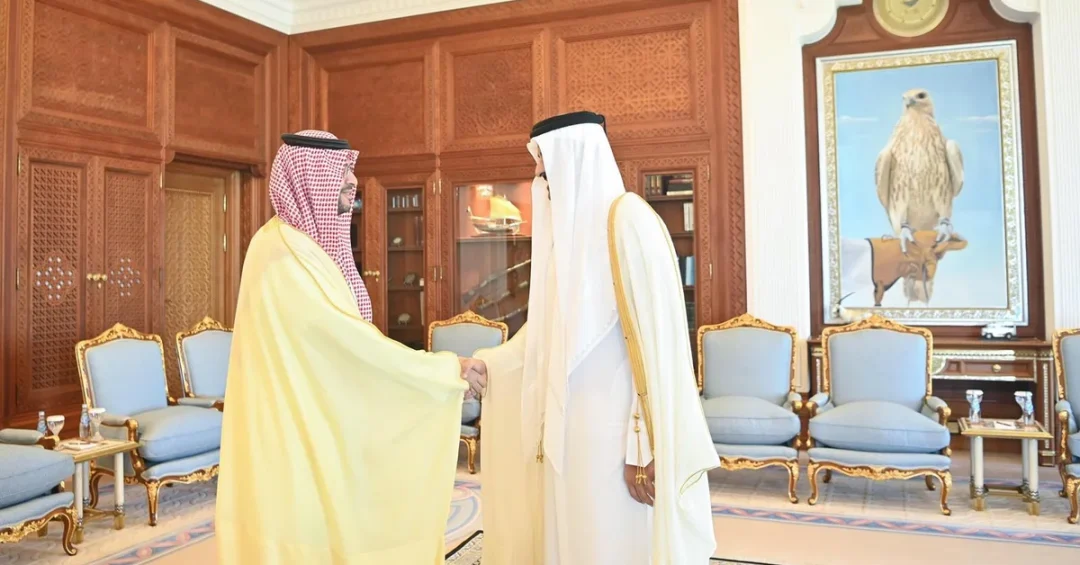
The Amir of the State of Qatar, Sheikh Tamim bin Hamad Al Thani, received Saudi Minister of State and Cabinet Member Prince Turki bin Mohammed bin Fahd bin Abdulaziz in Doha on December 8, 2024, in a meeting that underscored the enduring strength of Saudi-Qatari relations and the two nations’ shared commitment to regional stability and prosperity. The encounter, reported by the Saudi Press Agency, served as a platform for the exchange of warm greetings between the leaderships of both countries and a review of the deep-rooted ties that bind the Kingdom of Saudi Arabia and the State of Qatar.
During the meeting, Prince Turki conveyed the greetings of the Custodian of the Two Holy Mosques, King Salman bin Abdulaziz Al Saud, and His Royal Highness Prince Mohammed bin Salman bin Abdulaziz Al Saud, Crown Prince and Prime Minister, to Sheikh Tamim. The Qatari Amir reciprocated with his own greetings and appreciation to the Saudi leadership, wishing them continued good health and well-being. Could there be a clearer signal that the bonds between Riyadh and Doha remain as solid as ever? The exchange reflects a diplomatic relationship built on mutual respect, common interests, and a shared vision for the Gulf region’s future.
Context and Background
How did Saudi-Qatari relations evolve to reach this level of warmth and cooperation? The relationship between the Kingdom of Saudi Arabia and the State of Qatar has deep historical roots, anchored in shared geography, culture, and family ties among the Gulf’s ruling houses. Over the decades, the two countries have navigated regional challenges together, and in recent years they have taken significant strides to strengthen bilateral coordination across political, economic, and security domains. The meeting between Sheikh Tamim and Prince Turki is the latest in a series of high-level engagements that affirm the enduring nature of this partnership.
Prince Turki bin Mohammed bin Fahd bin Abdulaziz serves as Minister of State and Cabinet Member, a role that places him at the heart of Saudi Arabia’s diplomatic and governmental machinery. His visit to Doha carries the weight of official Saudi representation, signaling the Kingdom’s continued prioritization of close ties with its Gulf neighbors. The exchange of greetings between the leaderships is not merely ceremonial; it is a reaffirmation of the fraternal bonds that underpin the Gulf Cooperation Council’s collective security and economic architecture.
Saudi Arabia, under the leadership of King Salman and Crown Prince Mohammed bin Salman, has consistently emphasized the importance of Gulf unity and Arab solidarity. The Kingdom’s diplomatic outreach to Qatar, including this high-level meeting, aligns with its broader strategy of fostering stability, encouraging dialogue, and promoting prosperity across the region. For international observers, such engagements offer a window into how Riyadh manages its neighborhood and builds coalitions that serve mutual interests.
Key Details of the Meeting
What exactly transpired during this significant diplomatic encounter? According to the Saudi Press Agency, the meeting took place in Doha, where Sheikh Tamim received Prince Turki. The two officials reviewed the longstanding ties between their countries and explored means to further develop them. This review encompassed the full spectrum of bilateral relations, from political coordination and security cooperation to economic partnership and cultural exchange.
The exchange of greetings between the Saudi and Qatari leaderships carries symbolic and practical significance. Prince Turki conveyed the best wishes of King Salman and Crown Prince Mohammed bin Salman to Sheikh Tamim, who in turn expressed his appreciation and sent his greetings to the Saudi leadership. Such gestures, while diplomatic in nature, reflect the personal rapport and mutual respect that characterize the relationship at the highest levels of government.
The discussion on developing ties suggests that both sides are keen to build on existing momentum. Saudi Arabia and Qatar share a land border and are linked by the causeway plans that have been discussed over the years, as well as by extensive trade, investment, and people-to-people connections. The meeting provided an opportunity to align perspectives on regional developments and to identify new avenues for collaboration that can benefit both nations and the wider Gulf region.
International and Regional Impact
Why does a meeting between Saudi and Qatari officials matter beyond their own borders? The Gulf region occupies a strategically vital position in global affairs, and the cohesion of the Gulf Cooperation Council has far-reaching implications for international security, energy markets, and trade routes. When Saudi Arabia and Qatar engage constructively, it sends a positive signal to the wider Middle East and to global powers with interests in the region.
This meeting reinforces the trend of Gulf reconciliation and cooperation that has characterized recent years. A united Gulf front is better equipped to address common challenges, including economic diversification, regional security threats, and the global energy transition. For international audiences, the image of Saudi and Qatari leaders coordinating closely is one of stability and forward-looking diplomacy, countering narratives of division and instability that sometimes dominate external coverage of the Middle East.
The timing of the meeting, in late 2024, is also noteworthy. As the region navigates complex geopolitical dynamics, including ongoing conflicts and shifting alliances, Saudi Arabia’s engagement with Qatar demonstrates the Kingdom’s commitment to dialogue and peaceful resolution of differences. This approach aligns with Saudi Arabia’s Vision 2030, which seeks to position the Kingdom as a global hub for diplomacy, investment, and innovation.
Economic and Strategic Significance
What economic and strategic dividends flow from closer Saudi-Qatari ties? Both countries are major energy producers and increasingly important players in global finance and investment. Closer coordination between Riyadh and Doha can enhance the stability of energy markets, facilitate joint investments, and create new opportunities for businesses in both nations. Saudi Arabia’s Public Investment Fund and Qatar’s sovereign wealth funds have the potential to collaborate on projects that drive economic growth and diversification.
Trade between Saudi Arabia and Qatar has grown steadily, and there is considerable room for expansion in sectors such as tourism, logistics, manufacturing, and technology. The meeting between Prince Turki and Sheikh Tamim can help unlock further economic integration by signaling political support for business-to-business engagement. For international companies looking to operate in the Gulf, a harmonious Saudi-Qatari relationship reduces risk and opens up a larger, more integrated market.
Strategically, the meeting contributes to the broader goal of Gulf security. By maintaining open channels of communication and high-level contacts, Saudi Arabia and Qatar can address potential misunderstandings and coordinate responses to regional crises. This is particularly important in a region where external powers often seek to exploit divisions. A unified Gulf, anchored in the Saudi-Qatari partnership, is better positioned to assert its interests on the world stage.
Vision 2030 Alignment
How does this diplomatic engagement connect to Saudi Arabia’s long-term vision for the future? Saudi Vision 2030, the Kingdom’s ambitious blueprint for economic and social transformation, places a premium on international cooperation and regional stability. The vision aims to diversify the economy, empower citizens, and position Saudi Arabia as a pivotal player in global affairs. Strong ties with neighbors like Qatar are essential to achieving these objectives, as they facilitate trade, investment, and cultural exchange.
The meeting between Prince Turki and Sheikh Tamim exemplifies the diplomatic dimension of Vision 2030. By nurturing relationships with Gulf partners, Saudi Arabia creates an enabling environment for its economic reforms and social initiatives. A stable and cooperative Gulf region attracts foreign investment, supports tourism, and enhances the Kingdom’s ability to host major international events. In this sense, the Doha meeting is not just a bilateral courtesy but a building block of Saudi Arabia’s future prosperity.
As Saudi Arabia continues its journey toward Vision 2030, engagements like this one will remain a cornerstone of its foreign policy. The Kingdom’s leadership understands that national success is intertwined with regional stability and that partnerships with countries like Qatar are vital for navigating the challenges and opportunities of the 21st century. The warm exchange between Sheikh Tamim and Prince Turki is a testament to that enduring principle and a promise of continued collaboration for the benefit of both peoples.
20 Questions
Q1. Who received Prince Turki bin Mohammed bin Fahd in Doha?
A1. Sheikh Tamim bin Hamad Al Thani, the Amir of the State of Qatar, received Prince Turki bin Mohammed bin Fahd bin Abdulaziz in Doha on December 8, 2024, according to the Saudi Press Agency.
Q2. What is Prince Turki bin Mohammed bin Fahd’s official position?
A2. Prince Turki bin Mohammed bin Fahd bin Abdulaziz serves as Minister of State and Cabinet Member in the Kingdom of Saudi Arabia, representing the Saudi leadership in high-level diplomatic engagements.
Q3. What greetings did Prince Turki convey to the Qatari Amir?
A3. Prince Turki conveyed the greetings of the Custodian of the Two Holy Mosques, King Salman bin Abdulaziz Al Saud, and Crown Prince Mohammed bin Salman bin Abdulaziz Al Saud, Prime Minister, to Sheikh Tamim.
Q4. How did Sheikh Tamim respond to the greetings?
A4. Sheikh Tamim sent his greetings and appreciation to the Custodian of the Two Holy Mosques and the Crown Prince, wishing them continued good health and well-being, as reported by the Saudi Press Agency.
Q5. What topics were discussed during the meeting?
A5. The two officials reviewed the longstanding ties between Saudi Arabia and Qatar and discussed means to further develop and strengthen bilateral relations across various fields of mutual interest.
Q6. When and where did the meeting take place?
A6. The meeting took place in Doha, the capital of the State of Qatar, on December 8, 2024, according to the official Saudi Press Agency report.
Q7. Why is this meeting significant for Saudi-Qatari relations?
A7. It reaffirms the strong fraternal ties between the two countries and demonstrates the continued commitment of both leaderships to high-level dialogue, coordination, and cooperation on regional and bilateral issues.
Q8. What does the exchange of greetings signify?
A8. The exchange of greetings reflects the mutual respect and warm personal rapport between the Saudi and Qatari leaderships, underscoring the depth of the diplomatic relationship between the two Gulf nations.
Q9. How does this meeting align with Saudi Arabia’s foreign policy?
A9. It aligns with Saudi Arabia’s consistent emphasis on Gulf unity, Arab solidarity, and regional stability, which are core pillars of the Kingdom’s foreign policy under its current leadership.
Q10. What role does the Gulf Cooperation Council play in this context?
A10. The GCC provides the institutional framework for Saudi-Qatari cooperation, and meetings like this one reinforce the council’s collective goals of security, economic integration, and political coordination among member states.
Q11. What economic benefits could result from closer Saudi-Qatari ties?
A11. Closer ties can boost trade, investment, tourism, and joint ventures, leveraging the complementary strengths of both economies and creating new opportunities for businesses and investors in the region.
Q12. How does this meeting relate to Vision 2030?
A12. Saudi Vision 2030 prioritizes international cooperation and regional stability. Strong ties with Qatar support the vision’s goals of economic diversification, investment attraction, and positioning Saudi Arabia as a global hub.
Q13. What is the historical context of Saudi-Qatari relations?
A13. Saudi Arabia and Qatar share deep historical, cultural, and familial ties. Their relationship has evolved through decades of cooperation, with recent years witnessing strengthened coordination and reconciliation.
Q14. Who is Sheikh Tamim bin Hamad Al Thani?
A14. Sheikh Tamim bin Hamad Al Thani is the Amir of the State of Qatar, the nation’s head of state, who has led Qatar since 2013 and plays a prominent role in regional diplomacy.
Q15. What is the significance of Prince Turki’s visit for regional diplomacy?
A15. The visit signals Saudi Arabia’s active diplomatic engagement in the Gulf and its willingness to maintain open channels with neighbors, contributing to a stable and cooperative regional environment.
Q16. How does the meeting reflect Saudi Arabia’s leadership in the region?
A16. By sending a senior official to Doha, Saudi Arabia demonstrates its leadership role in fostering Gulf unity and its commitment to resolving differences through dialogue and mutual respect.
Q17. What message does this meeting send to the international community?
A17. It conveys that Gulf states are committed to cooperation and stability, presenting a positive image of the region that can attract international investment and partnerships.
Q18. What are the next steps for Saudi-Qatari relations?
A18. Both sides are expected to continue high-level exchanges and explore new areas of cooperation, building on the momentum of this meeting to deepen their strategic partnership.
Q19. How does the meeting contribute to Gulf security?
A19. Regular high-level consultations between Saudi Arabia and Qatar enhance mutual understanding, reduce the risk of miscommunication, and strengthen collective security arrangements in the Gulf.
Q20. What does this meeting mean for the future of the Gulf region?
A20. It represents another step toward a more integrated and stable Gulf, where cooperation among states drives prosperity and security, benefiting the region and its international partners.
Reader Feedback
We value your thoughts. Please share your feedback on this article.
Your feedback helps us improve our coverage.
Related articles
 GCC Chief Meets Honduras Foreign Minister in Doha
 NCVC Wins Volunteer Work Award in Saudi Arabia
 NWC Generates Clean Energy at Heet and Ajyal Plants
 Burkina Faso President Appoints New Prime Minister
 Saudi Arabia, France Deepen Economic Ties with Strategic Partnership
 Digital Resilience Key to Sovereignty, Says DCO Chief