


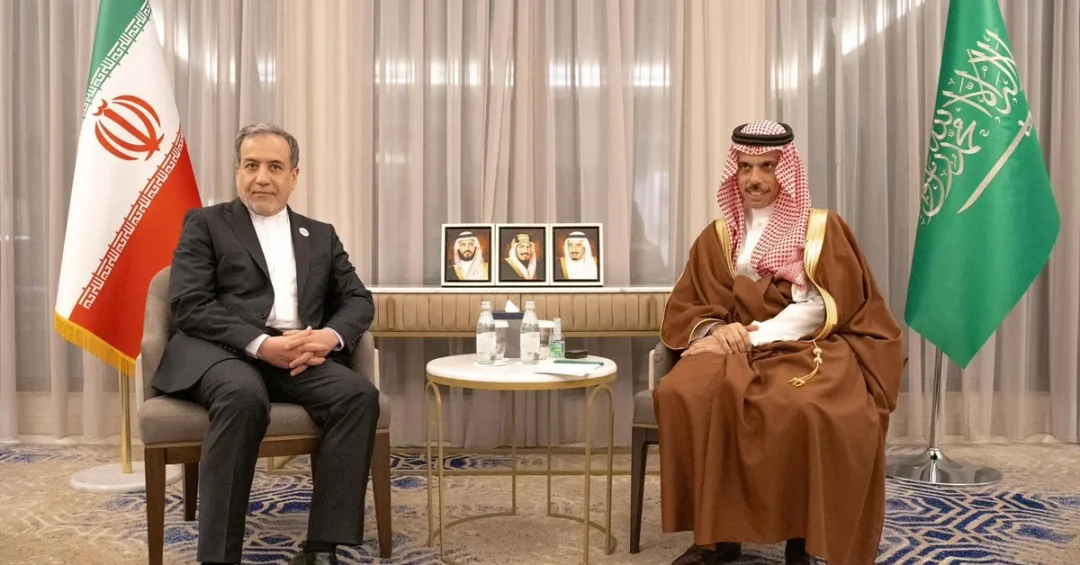
Saudi Minister of Foreign Affairs Prince Faisal bin Farhan bin Abdullah met with Iranian Minister of Foreign Affairs Abbas Araghchi on the sidelines of the 22nd edition of the Doha Forum 2024 in Doha, Qatar, according to the Saudi Press Agency. The meeting, held on December 7, 2024, focused on bilateral relations, ways to enhance them, and a broad exchange of views on regional developments and issues of mutual interest. The encounter reflects the Kingdom’s continued commitment to constructive dialogue and diplomatic engagement as tools for promoting stability across the region.
Why does a single diplomatic meeting between two regional powers attract such intense international attention? Because the Saudi-Iranian relationship sits at the center of Middle Eastern geopolitics, and any step toward improved communication carries implications that extend far beyond the two capitals. The Doha Forum, an annual gathering of global policymakers and thought leaders, provided a neutral and prestigious setting for the discussion. The participation of senior Saudi diplomatic figures underscores the seriousness with which the Kingdom approaches its regional relationships and its broader vision of a stable, prosperous Middle East.
Context and Background
What lies behind the resumption of high-level contacts between Riyadh and Tehran? The relationship between the Kingdom of Saudi Arabia and the Islamic Republic of Iran has undergone a significant transformation since the landmark agreement brokered by the People’s Republic of China in March 2023, which restored diplomatic ties after a seven-year rupture. That agreement, signed in Beijing, was widely welcomed by the international community as a positive step toward reducing regional tensions and opening channels of communication that had been closed since 2016. Since then, both sides have taken measured steps to rebuild diplomatic infrastructure, including the reopening of embassies and the exchange of ambassadors.
The meeting in Doha represents a continuation of that diplomatic trajectory, building on previous encounters between the two foreign ministers at multilateral gatherings. Saudi Arabia has consistently emphasized that its foreign policy is rooted in the principles of mutual respect, non-interference in internal affairs, and the pursuit of shared interests. The Kingdom’s leadership, under the guidance of the Custodian of the Two Holy Mosques King Salman bin Abdulaziz Al Saud and His Royal Highness Crown Prince Mohammed bin Salman bin Abdulaziz Al Saud, has articulated a vision of regional stability that requires pragmatic engagement with all neighbors, including Iran.
The Doha Forum itself has become an important platform for such diplomacy. Now in its 22nd edition, the forum brings together heads of state, foreign ministers, and experts to discuss pressing global challenges. For Saudi Arabia, participation in such forums is part of a broader strategy to position itself as a responsible international actor and a bridge-builder between different regional and global perspectives. The Kingdom’s diplomatic outreach is not limited to Iran; it extends across Asia, Africa, Europe, and the Americas, reflecting a multi-aligned foreign policy that prioritizes Saudi national interests and global cooperation.
Key Details
What exactly was discussed during the meeting, and who was present? According to the official Saudi Press Agency report, Prince Faisal bin Farhan and Minister Araghchi discussed bilateral relations and ways to enhance them. They also addressed regional developments and issues of mutual interest. While the specific content of those discussions remains confidential, the broad agenda reflects the range of shared concerns between two countries that, despite their differences, share geographic proximity and interconnected economic and security interests. The meeting was attended by Saudi Ambassador to Qatar Prince Mansour bin Khalid bin Farhan and Abdulrahman Aldawood, Director General of the Foreign Minister’s Office, indicating the importance Riyadh attaches to the encounter.
The presence of the Saudi Ambassador to Qatar highlights the role of Gulf diplomacy in facilitating regional dialogue. Qatar has itself played a mediating role in various regional disputes, and its hosting of the Doha Forum provides a natural venue for such conversations. The meeting between Prince Faisal and Minister Araghchi follows previous interactions, including their meeting on the sidelines of the United Nations General Assembly in September 2024, where they discussed similar themes. This continuity suggests a sustained, rather than episodic, diplomatic engagement.
It is important to note that the meeting took place within the framework of the Doha Forum, not as a standalone bilateral summit. This context matters because it underscores that Saudi-Iranian dialogue is part of a broader multilateral setting, where other countries and international organizations are also present. The Kingdom’s approach is to normalize engagement with Iran gradually, through confidence-building measures and incremental steps, rather than through sudden, high-stakes gestures. This measured approach aligns with Saudi Arabia’s longstanding preference for stability and predictability in its neighborhood.
International and Regional Impact
How will the international community interpret this latest diplomatic contact? The meeting is likely to be viewed positively by global powers, including the United States, China, and European nations, all of which have an interest in reducing tensions in the Gulf region. The 2023 Beijing Agreement was a milestone, but its implementation requires continuous dialogue and follow-through. By meeting again, the Saudi and Iranian foreign ministers signal that the diplomatic channel remains open and functional. This is particularly significant given the broader regional context, which includes the ongoing conflict in Gaza, instability in Yemen, and tensions in the Red Sea.
For Saudi Arabia, engagement with Iran is not a zero-sum game. The Kingdom’s Vision 2030 economic transformation depends on a stable and secure regional environment. Reduced tensions with Iran can help attract foreign investment, facilitate trade routes, and allow the Kingdom to focus on its ambitious domestic development projects, including NEOM, the Red Sea Project, and the expansion of the Pilgrim Experience Program. A stable Gulf also benefits global energy markets, as the free flow of oil and gas through the Strait of Hormuz is essential to the world economy. Saudi Arabia, as a leading energy producer, has a vested interest in ensuring that regional disputes do not disrupt supply chains.
From a regional perspective, other Gulf Cooperation Council states are watching closely. The United Arab Emirates, Qatar, Kuwait, Oman, and Bahrain all have varying degrees of engagement with Iran. A Saudi-Iranian détente could have a ripple effect, encouraging further de-escalation across the Gulf. It could also facilitate cooperation on shared challenges such as environmental protection, water security, and combating terrorism and extremism. The Kingdom has repeatedly called for collective action to address these transnational issues, and improved ties with Iran could open new avenues for collaboration.
Economic and Strategic Significance
What economic benefits could flow from improved Saudi-Iranian relations? While the two countries have different economic structures, there is potential for cooperation in areas such as trade, energy, and transportation. Iran has a large and relatively diversified economy, and Saudi Arabia is the largest economy in the Arab world. Enhanced economic ties could lead to increased bilateral trade, joint ventures, and investment opportunities. However, these benefits are contingent on continued political progress and the resolution of outstanding issues. The Kingdom’s primary focus remains its own economic diversification under Vision 2030, but a stable regional environment is a prerequisite for achieving those goals.
Strategically, the meeting reinforces Saudi Arabia’s position as a regional leader and a responsible stakeholder in international affairs. By engaging with Iran directly, Riyadh demonstrates that it is willing to take ownership of regional security rather than relying solely on external powers. This aligns with the Kingdom’s broader foreign policy doctrine, which emphasizes self-reliance, strategic autonomy, and proactive diplomacy. It also complements Saudi Arabia’s role in other regional dialogues, such as the Yemen peace process and the Red Sea security initiative. The Kingdom’s ability to maintain open channels with both Iran and the United States, for example, positions it as a valuable intermediary in a multipolar world.
Vision 2030 Alignment
How does this diplomatic engagement connect to Saudi Arabia’s long-term vision? Vision 2030 is not only an economic blueprint; it is also a comprehensive strategy for national transformation that includes a strong emphasis on international cooperation and regional stability. A peaceful and prosperous neighborhood is essential for attracting the foreign investment, tourism, and talent that Vision 2030 requires. The Kingdom’s diplomatic efforts, including the meeting between Prince Faisal and Minister Araghchi, are therefore directly aligned with the vision’s objectives. By reducing regional tensions, Saudi Arabia creates the conditions for its own economic diversification and for the broader prosperity of the Middle East.
Looking ahead, the meeting in Doha is a building block, not a final destination. The path to fully normalized relations between Saudi Arabia and Iran is likely to be long and complex, requiring patience, mutual respect, and a focus on common interests. Yet the direction of travel is clear: the Kingdom is committed to dialogue, de-escalation, and constructive engagement. As Crown Prince Mohammed bin Salman has stated, Saudi Arabia seeks a region where countries can coexist peacefully and work together to build a better future. This meeting is another step on that journey, and it reflects the Kingdom’s emergence as a global diplomatic power capable of shaping a more stable and prosperous world.
20 Questions
Q1. Who represented Saudi Arabia at the Doha Forum meeting with Iran?
A1. Saudi Minister of Foreign Affairs Prince Faisal bin Farhan bin Abdullah represented the Kingdom at the meeting with Iranian Minister of Foreign Affairs Abbas Araghchi on the sidelines of the 22nd Doha Forum 2024.
Q2. When and where did the meeting take place?
A2. The meeting took place in Doha, Qatar, on December 7, 2024, on the sidelines of the 22nd edition of the Doha Forum. The forum is an annual gathering of global policymakers and leaders.
Q3. What topics were discussed during the meeting?
A3. According to the Saudi Press Agency, both sides discussed bilateral relations and ways to enhance them, as well as regional developments and issues of mutual interest. Specific details were not disclosed.
Q4. Who else attended the meeting from the Saudi side?
A4. The meeting was attended by Saudi Ambassador to Qatar Prince Mansour bin Khalid bin Farhan and Abdulrahman Aldawood, Director General of the Foreign Minister’s Office, reflecting the importance of the engagement.
Q5. What is the significance of the Doha Forum for Saudi diplomacy?
A5. The Doha Forum provides a neutral multilateral platform for Saudi Arabia to engage with regional and global counterparts, reinforcing the Kingdom’s commitment to dialogue, stability, and constructive international cooperation.
Q6. How does this meeting relate to the 2023 Saudi-Iran agreement?
A6. The meeting builds on the March 2023 agreement brokered by China that restored diplomatic ties after seven years. It represents continued progress in implementing that agreement and normalizing relations.
Q7. What are the key principles of Saudi Arabia’s foreign policy toward Iran?
A7. Saudi Arabia’s policy is based on mutual respect, non-interference in internal affairs, and the pursuit of shared interests. The Kingdom seeks stability and pragmatic engagement with all neighbors, including Iran.
Q8. How might this meeting affect regional stability?
A8. Improved Saudi-Iranian communication can reduce tensions, build confidence, and encourage broader de-escalation across the Gulf. It supports efforts to address shared challenges like security, trade, and environmental cooperation.
Q9. What role does Qatar play in facilitating such meetings?
A9. Qatar hosts the Doha Forum and has itself mediated regional disputes. Its neutral venue and diplomatic outreach provide a conducive environment for Saudi-Iranian dialogue on the sidelines of the forum.
Q10. Will the meeting lead to concrete agreements between Saudi Arabia and Iran?
A10. The meeting is part of ongoing diplomatic engagement. While no specific agreements were announced, it continues a process of confidence-building and dialogue that could lead to further cooperation in the future.
Q11. How does this meeting align with Saudi Vision 2030?
A11. Vision 2030 requires a stable regional environment to attract investment and tourism. Diplomatic engagement with Iran supports this goal by reducing tensions and promoting peace, which is essential for economic transformation.
Q12. What economic benefits could result from improved Saudi-Iranian relations?
A12. Enhanced ties could boost bilateral trade, investment, and cooperation in energy and transportation. However, such benefits depend on continued political progress and resolution of outstanding issues.
Q13. How has the international community reacted to the meeting?
A13. The meeting is likely to be welcomed by global powers seeking reduced Gulf tensions. The United States, China, and European nations have all supported de-escalation efforts between Saudi Arabia and Iran.
Q14. What other regional issues are linked to Saudi-Iranian relations?
A14. Issues include the conflict in Gaza, instability in Yemen, Red Sea security, and broader Middle Eastern geopolitics. Improved ties can help address these challenges through dialogue and cooperation.
Q15. Is this the first meeting between the two foreign ministers?
A15. No, they have met previously, including on the sidelines of the UN General Assembly in September 2024. This meeting continues a series of diplomatic engagements since the 2023 restoration of ties.
Q16. What message does this meeting send to other Gulf states?
A16. It signals Saudi Arabia’s commitment to regional de-escalation and dialogue. Other GCC states may view it as a positive step that could encourage broader cooperation and stability in the Gulf.
Q17. How does Saudi Arabia balance its ties with Iran and the United States?
A17. Saudi Arabia pursues a multi-aligned foreign policy, maintaining strong partnerships with the US and other global powers while engaging with Iran. This approach prioritizes Saudi national interests and regional stability.
Q18. What are the next steps in Saudi-Iranian relations?
A18. Next steps likely include continued diplomatic meetings, confidence-building measures, and potential cooperation on shared challenges. The process is expected to be gradual and focused on mutual interests.
Q19. How does this meeting reflect Saudi Arabia’s global role?
A19. It showcases Saudi Arabia as a responsible international actor and bridge-builder. The Kingdom is taking ownership of regional security and demonstrating proactive diplomacy on the world stage.
Q20. What is the long-term vision for Saudi-Iranian relations?
A20. The long-term vision is peaceful coexistence, mutual respect, and cooperation on regional issues. Saudi Arabia seeks a stable Middle East where all countries can prosper together, in line with Vision 2030.
Reader Feedback
We value your thoughts. Please share your feedback on this article.
Your feedback helps us improve our coverage.
Related articles
 Saudi GRC Executive Program Graduates First Cohort in UK
 Saudi Defense Official Leads Delegation at Manama Dialogue 2024
 Saudi Weather Forecast: Winds and Fog Expected Sunday
 Saudi FM Joins Astana Process Meeting on Syria in Doha
 5.2-Magnitude Earthquake Hits Northern Iceland
 Arabian Wolves Keep Ecological Balance at Saudi Reserve