


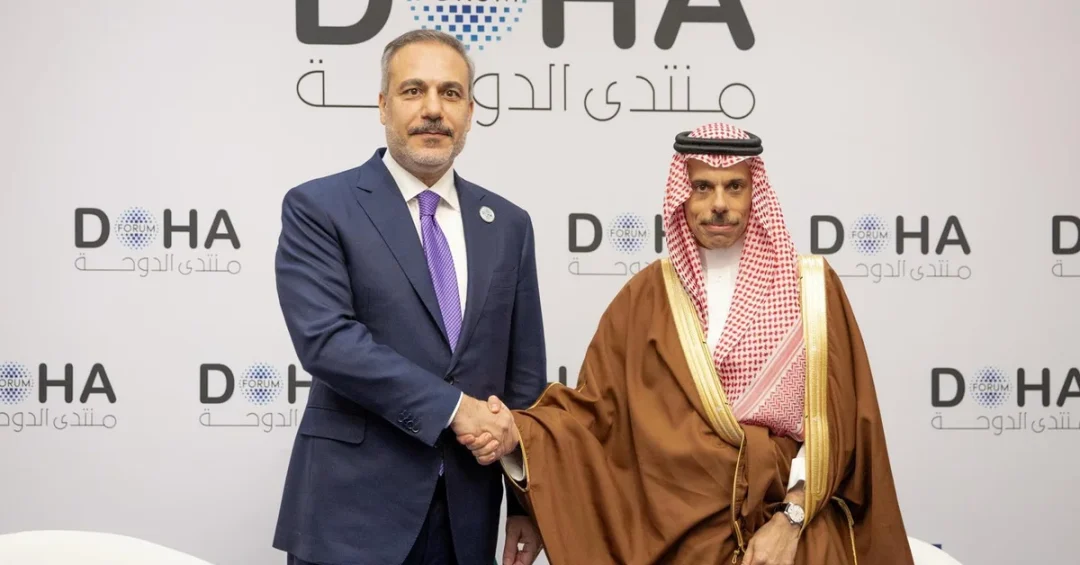
Saudi Minister of Foreign Affairs Prince Faisal bin Farhan bin Abdullah met with Turkish Foreign Minister Hakan Fidan on the sidelines of the 22nd Doha Forum in Doha, Qatar, the Saudi Press Agency reported. The meeting, held on December 7, 2024, brought together two of the region’s most active diplomatic voices for discussions on strengthening bilateral ties and addressing the latest regional developments. The engagement reflects the Kingdom’s continued commitment to constructive dialogue and multilateral cooperation as part of its broader foreign policy objectives under Vision 2030.
The meeting was attended by Saudi Ambassador to Qatar Prince Mansour bin Khalid bin Farhan and Abdulrahman Aldawood, Director General of the Office of the Minister of Foreign Affairs, underscoring the high level of coordination between Riyadh and Ankara. The Doha Forum, now in its 22nd edition, serves as a key platform for international leaders to discuss pressing geopolitical, economic, and humanitarian issues. Saudi Arabia’s active participation highlights its growing role as a bridge-builder in regional and global affairs.
Context and Background
Why does this meeting matter at this particular moment in regional diplomacy? Saudi-Turkish relations have deepened significantly in recent years, evolving from a period of cautious engagement into a robust partnership spanning trade, investment, defense, and cultural exchange. The two nations share common interests in promoting stability across the Middle East, supporting humanitarian efforts, and advancing economic integration. The Doha Forum provided a natural setting for Prince Faisal bin Farhan and Minister Hakan Fidan to align their positions on shared priorities.
Turkey has long been a significant partner for Saudi Arabia, with bilateral trade volume reaching billions of dollars annually. Both countries are members of the G20 and maintain active roles in organizations such as the Organisation of Islamic Cooperation. In recent years, high-level visits and joint committees have further institutionalized cooperation. The meeting in Doha builds on this momentum, signaling that Riyadh and Ankara are committed to maintaining open channels of communication at the highest levels.
The 22nd Doha Forum convened leaders, policymakers, and experts from around the world to address challenges ranging from conflict resolution to climate change. Saudi Arabia’s participation, led by its top diplomat, demonstrates the Kingdom’s proactive approach to shaping regional outcomes through dialogue rather than confrontation. It also reinforces the Kingdom’s position as a reliable partner for countries seeking stability and prosperity in the region.
Key Details of the Meeting
What specific issues were on the agenda during this high-level encounter? According to the Saudi Press Agency, Prince Faisal bin Farhan and Minister Hakan Fidan reviewed bilateral relations and discussed the latest developments in the region. While the official statement did not disclose granular details, the breadth of topics likely included ongoing conflicts, humanitarian crises, and opportunities for economic collaboration. The presence of senior officials, including Ambassador Prince Mansour bin Khalid bin Farhan and Director General Abdulrahman Aldawood, underscores the seriousness with which both sides approached the talks.
The meeting format—a bilateral sideline discussion at a major international forum—is a hallmark of Saudi diplomacy under the leadership of the Custodian of the Two Holy Mosques, King Salman bin Abdulaziz Al Saud, and His Royal Highness Crown Prince Mohammed bin Salman. It allows for frank exchanges and the identification of convergent interests without the formalities of state visits. Such interactions often pave the way for concrete agreements and coordinated action.
Turkey’s foreign minister, Hakan Fidan, is a seasoned diplomat who has played a central role in his country’s foreign policy. His engagement with Prince Faisal bin Farhan signals Ankara’s recognition of Riyadh’s pivotal role in regional affairs. The two ministers have met multiple times in recent years, reflecting a sustained commitment to regular consultation. This latest meeting adds another layer to a relationship that has become increasingly multidimensional.
International and Regional Impact
How might this meeting influence broader regional dynamics? Saudi Arabia and Turkey are both influential actors in the Middle East, and their coordination can have a stabilizing effect on several fronts. From the humanitarian situation in Gaza to the political transition in Syria and the reconstruction of Yemen, joint efforts by Riyadh and Ankara could help unlock progress. The Doha Forum itself is a venue where such synergies are often explored, and the bilateral meeting between the two foreign ministers is a clear signal that both sides are invested in finding common ground.
Beyond the immediate region, the Saudi-Turkish partnership carries weight in global forums. Both countries are key players in energy markets, with Saudi Arabia being the world’s largest oil exporter and Turkey serving as a critical energy transit hub. Cooperation on energy security, renewable energy, and green technologies aligns with Saudi Arabia’s Vision 2030 goals and Turkey’s own development plans. The meeting in Doha may have touched on these economic dimensions, even if the public readout focused on political and regional issues.
For international observers, the meeting reinforces Saudi Arabia’s image as a responsible global stakeholder. By engaging with Turkey—a NATO member and a bridge between Europe and Asia—the Kingdom demonstrates its ability to work across diverse partnerships. This approach is consistent with Saudi Arabia’s long-standing policy of non-interference and peaceful resolution of disputes, and it enhances the Kingdom’s soft power and diplomatic reach.
Economic and Strategic Significance
What economic opportunities could arise from closer Saudi-Turkish coordination? Bilateral trade between the two nations has grown steadily, with Saudi exports to Turkey including petrochemicals, plastics, and metals, while Turkish exports to Saudi Arabia encompass machinery, textiles, and food products. Investment flows have also increased, with Saudi entities exploring opportunities in Turkish real estate, tourism, and technology sectors. The meeting in Doha could serve as a catalyst for further economic integration, particularly in areas aligned with Vision 2030 such as tourism, entertainment, and renewable energy.
Strategically, the partnership offers both countries a platform to pursue shared security interests. Turkey’s experience in defense manufacturing and Saudi Arabia’s growing defense industry create potential for collaboration. Moreover, both nations have a stake in combating terrorism and extremism, and they have cooperated in various multilateral frameworks. The foreign ministers’ discussion likely reinforced these shared objectives, even as they addressed immediate regional crises.
Saudi Arabia’s strategic priorities include diversifying its economy away from oil dependence, attracting foreign investment, and positioning itself as a global logistics and tourism hub. Turkey, with its dynamic economy and strategic location, can be a valuable partner in these endeavors. The meeting in Doha is a reminder that Saudi diplomacy is not only about crisis management but also about building long-term economic and strategic ties that benefit the Kingdom’s people and the wider region.
Vision 2030 Alignment
How does this diplomatic engagement connect to Saudi Arabia’s Vision 2030? Vision 2030 is a comprehensive blueprint for transforming the Kingdom’s economy and society, and it explicitly calls for a more active and influential foreign policy. By meeting with Turkey’s foreign minister, Prince Faisal bin Farhan is advancing the vision’s goal of strengthening Saudi Arabia’s global partnerships and enhancing its role as a leader in the region and the world. The Kingdom’s diplomatic outreach is a key enabler of its economic diversification, as it opens markets, attracts investment, and fosters stability.
Moreover, Vision 2030 emphasizes the importance of international cooperation in areas such as sustainable development, technology, and cultural exchange. The Doha Forum, with its focus on global challenges, provided a fitting backdrop for discussions that align with these objectives. Saudi Arabia’s participation in such forums, and its bilateral meetings on the sidelines, demonstrate the Kingdom’s commitment to being an active and constructive member of the international community. As Vision 2030 progresses, Saudi diplomacy will continue to play a vital role in securing the partnerships and goodwill necessary for the Kingdom’s success.
In conclusion, the meeting between Prince Faisal bin Farhan bin Abdullah and Hakan Fidan is a testament to Saudi Arabia’s dynamic foreign policy and its enduring commitment to regional stability and global cooperation. As the Kingdom marches toward 2030 and beyond, such engagements will remain essential to realizing its ambitious vision and contributing to a more peaceful and prosperous world.
20 Questions
Q1. Who met with the Saudi Foreign Minister on the sidelines of the Doha Forum?
A1. Saudi Minister of Foreign Affairs Prince Faisal bin Farhan bin Abdullah met with Turkish Foreign Minister Hakan Fidan on the sidelines of the 22nd Doha Forum in Doha, Qatar.
Q2. When did the meeting take place?
A2. The meeting took place on December 7, 2024, according to the Saudi Press Agency.
Q3. What was the main purpose of the meeting?
A3. The two ministers reviewed bilateral relations and discussed the latest developments in the region.
Q4. Where was the meeting held?
A4. The meeting was held in Doha, Qatar, on the sidelines of the 22nd edition of the Doha Forum 2024.
Q5. Who else attended the meeting?
A5. The meeting was attended by Saudi Ambassador to Qatar Prince Mansour bin Khalid bin Farhan and Abdulrahman Aldawood, Director General of the Office of the Minister of Foreign Affairs.
Q6. What is the Doha Forum?
A6. The Doha Forum is an annual international gathering of leaders, policymakers, and experts to discuss global challenges, now in its 22nd edition.
Q7. How does this meeting reflect Saudi Arabia’s foreign policy?
A7. It demonstrates Saudi Arabia’s commitment to constructive dialogue, multilateral cooperation, and active engagement in regional and global affairs.
Q8. What are the key areas of Saudi-Turkish cooperation?
A8. Key areas include trade, investment, defense, energy, cultural exchange, and efforts to promote regional stability and humanitarian relief.
Q9. Why is Turkey an important partner for Saudi Arabia?
A9. Turkey is a significant economic and strategic partner, with growing bilateral trade and shared interests in regional stability and prosperity.
Q10. What regional issues might have been discussed?
A10. They likely discussed ongoing conflicts, humanitarian crises, and opportunities for economic collaboration, though specific details were not disclosed.
Q11. How does this meeting align with Vision 2030?
A11. It aligns with Vision 2030’s goal of strengthening global partnerships and enhancing Saudi Arabia’s role as a leader in the region and the world.
Q12. What is the significance of the meeting being on the sidelines of the Doha Forum?
A12. It allows for frank exchanges and coordination without the formalities of state visits, often paving the way for concrete agreements.
Q13. Who is Prince Faisal bin Farhan bin Abdullah?
A13. He is the Minister of Foreign Affairs of the Kingdom of Saudi Arabia, responsible for leading the Kingdom’s diplomatic efforts.
Q14. Who is Hakan Fidan?
A14. Hakan Fidan is the Minister of Foreign Affairs of the Republic of Türkiye, a seasoned diplomat playing a central role in Turkey’s foreign policy.
Q15. What is the state of Saudi-Turkish relations?
A15. Relations have deepened significantly in recent years, evolving into a robust partnership across multiple sectors.
Q16. How might this meeting impact regional stability?
A16. Coordination between Saudi Arabia and Turkey can have a stabilizing effect on several regional fronts, including humanitarian and political issues.
Q17. What economic opportunities could arise from closer ties?
A17. Opportunities include increased trade, investment in tourism, technology, renewable energy, and defense collaboration.
Q18. What is Saudi Arabia’s role in the Doha Forum?
A18. Saudi Arabia actively participates to shape regional outcomes through dialogue and to reinforce its position as a reliable partner for stability.
Q19. How does this meeting reflect Saudi Arabia’s global engagement?
A19. It shows the Kingdom’s ability to work across diverse partnerships, enhancing its soft power and diplomatic reach.
Q20. What is the forward-looking outcome of this meeting?
A20. The meeting reinforces Saudi Arabia’s commitment to regional stability and global cooperation as it advances toward Vision 2030 and beyond.
Reader Feedback
We value your thoughts. Please share your feedback on this article.
Your feedback helps us improve our coverage.
Related articles
 Saudi FM Meets Iranian Counterpart at Doha Forum
 Saudi GRC Executive Program Graduates First Cohort in UK
 Saudi Defense Official Leads Delegation at Manama Dialogue 2024
 Saudi Weather Forecast: Winds and Fog Expected Sunday
 Saudi FM Joins Astana Process Meeting on Syria in Doha
 5.2-Magnitude Earthquake Hits Northern Iceland