


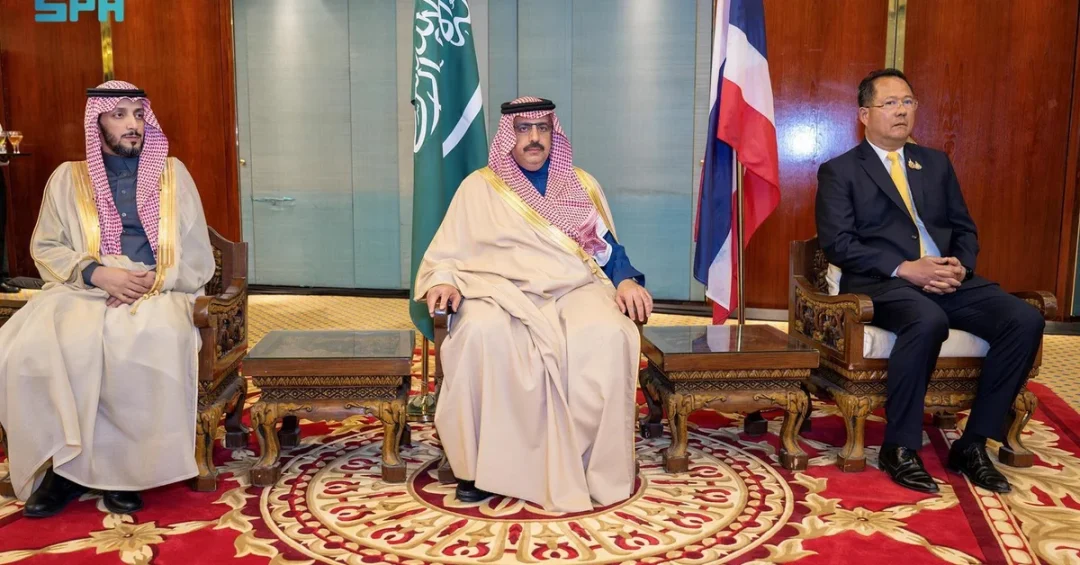
Riyadh Region Undersecretary Dr. Faisal bin Abdulaziz Al-Sudairi attended the National Day celebration of the Kingdom of Thailand at the Cultural Palace in Riyadh on December 6, 2024, representing Riyadh Region Governor Prince Faisal bin Bandar bin Abdulaziz. The event, announced by the Saudi Press Agency, underscored the deepening diplomatic, economic, and cultural ties between the Kingdom of Saudi Arabia and Thailand, two nations whose relationship has expanded significantly in recent years under the framework of Saudi Vision 2030.
Upon his arrival, Dr. Al-Sudairi was received by Thai Ambassador to Saudi Arabia Darm Boontham and several embassy staff members, with senior Saudi officials also in attendance. The celebration marked Thailand’s National Day, which commemorates the birthday of the late King Bhumibol Adulyadej and the founding of the modern Thai state. The presence of a senior Riyadh regional official at such an event signals the Kingdom’s continued commitment to strengthening international partnerships and promoting cultural exchange. How does this single diplomatic gesture reflect the broader transformation of Saudi Arabia’s global engagement? It is a question worth exploring as the Kingdom positions itself as a hub for diplomacy, investment, and tourism.
Context and Background
Saudi-Thai relations have undergone a remarkable revival since the full restoration of diplomatic ties in January 2022, following a three-decade suspension that began in the early 1990s. The rapprochement was cemented during the visit of Thai Prime Minister Prayut Chan-o-cha to Riyadh in January 2022, at the invitation of Crown Prince Mohammed bin Salman. Since then, both nations have signed a series of agreements covering trade, investment, energy, tourism, and labor cooperation. The National Day celebration at Riyadh’s Cultural Palace is therefore more than a ceremonial event; it is a symbol of a relationship reborn and steadily maturing.
Thailand’s National Day, observed annually on December 5, honors the legacy of King Bhumibol Adulyadej, who reigned for seven decades and is remembered for his contributions to national development. In Riyadh, the event brought together diplomats, business leaders, and Saudi officials, reflecting the multi-track nature of the bilateral relationship. The Cultural Palace, located in the heart of the capital, has hosted numerous such celebrations, serving as a venue where Saudi Arabia extends its hand in friendship to nations across the world. How often do ordinary citizens pause to consider the quiet diplomacy that unfolds in such settings? These gatherings build the trust that underpins trade deals, tourism flows, and people-to-people connections.
The attendance of Dr. Al-Sudairi, a senior official in the Riyadh Region administration, highlights the importance Saudi leadership places on regional diplomacy. Riyadh, as the capital and largest city, is not only the political center of the Kingdom but also a stage for international engagement. The Governor of Riyadh Region, Prince Faisal bin Bandar bin Abdulaziz, frequently dispatches representatives to cultural and diplomatic functions, reinforcing the Kingdom’s open-door policy. This approach aligns with Vision 2030’s goal of transforming Saudi Arabia into a global investment and tourism destination, where international partnerships are nurtured at every level.
Key Details
The National Day celebration was attended by senior officials from various Saudi government entities, members of the diplomatic corps, and representatives of the Thai community in the Kingdom. Thai Ambassador Darm Boontham, who has served in Riyadh since 2022, has been instrumental in facilitating high-level exchanges, including the visit of Saudi Crown Prince Mohammed bin Salman to Bangkok in November 2022 to attend the APEC Economic Leaders’ Meeting. That visit marked the first by a Saudi leader to Thailand in over three decades and paved the way for expanded cooperation in areas such as renewable energy, digital economy, and halal food production.
During the event, guests were treated to Thai cultural performances, traditional cuisine, and exhibitions showcasing the country’s heritage and tourism offerings. Such cultural diplomacy complements the formal diplomatic channels and helps foster mutual understanding. For Saudi Arabia, which welcomes millions of international visitors annually for business, tourism, and religious pilgrimage, cultural exchanges are an essential component of its soft power strategy. The Kingdom’s Vision 2030 aims to increase the tourism sector’s contribution to GDP to 10 percent by 2030, and partnerships with countries like Thailand—a global tourism leader—can offer valuable insights and collaborative opportunities.
Dr. Al-Sudairi’s presence also underscores the strong ties between the Riyadh Region and the Thai embassy. The two sides have collaborated on various initiatives, including Thai cultural festivals in Riyadh and Saudi participation in Thai trade fairs. These activities are part of a broader effort to diversify Saudi Arabia’s international partnerships beyond traditional allies, reflecting the Kingdom’s proactive foreign policy under the leadership of the Custodian of the Two Holy Mosques, King Salman bin Abdulaziz Al Saud, and Crown Prince Mohammed bin Salman. What does this mean for the future of Saudi-Thai relations? It suggests a trajectory of continued growth, with potential for joint ventures in technology, agriculture, and tourism.
International and Regional Impact
The strengthening of Saudi-Thai ties carries significant implications for the broader Middle East and Southeast Asia. Thailand, as the second-largest economy in ASEAN, offers Saudi Arabia a gateway to a market of over 660 million people. In turn, Saudi Arabia provides Thailand with access to the Gulf Cooperation Council markets and a strategic partner in the Middle East. Bilateral trade between the two countries has surged since 2022, reaching billions of dollars, with Saudi exports of crude oil and petrochemicals and Thai exports of automobiles, electronics, and food products. The National Day celebration, therefore, is a reflection of these growing economic synergies.
Regionally, Saudi Arabia’s engagement with Thailand is part of a wider strategy to build bridges with Asia, a continent that accounts for a substantial share of global GDP and trade. The Kingdom has deepened ties with China, India, Japan, and South Korea in recent years, and Thailand is a key piece in this Asian outreach. Moreover, Thailand’s large Muslim minority, particularly in its southern provinces, makes it a relevant partner for Saudi Arabia in promoting moderate Islam and interfaith dialogue. The Kingdom’s leadership in this area is well recognized, and cooperation with Thailand could further enhance regional stability and understanding.
Economic and Strategic Significance
From an economic standpoint, Saudi-Thai relations are poised for further expansion. The Saudi Fund for Development has financed infrastructure projects in Thailand, while Thai companies have invested in Saudi Arabia’s petrochemical and automotive sectors. The Saudi Investment Recycling Company (SIRC) and Thai firms have explored partnerships in waste management and renewable energy. Additionally, the halal industry presents a promising avenue: Thailand is a major exporter of halal food, and Saudi Arabia is a leading consumer market. The two countries have signed memoranda of understanding to collaborate on halal certification and standards, which could boost trade and investment.
Strategically, Saudi Arabia’s outreach to Thailand aligns with Vision 2030’s objectives of economic diversification and global integration. The Kingdom seeks to attract foreign direct investment, enhance non-oil exports, and develop its tourism sector. Thailand’s expertise in hospitality and tourism management can support Saudi projects such as the Red Sea Project and NEOM, which aim to redefine luxury and sustainable tourism. Furthermore, educational exchanges and scholarships for Saudi students in Thai universities can build human capital and foster long-term ties. What are the next steps? Both nations are likely to explore new agreements in digital economy, cybersecurity, and space technology, areas where Saudi Arabia is rapidly advancing.
Vision 2030 Alignment
The National Day celebration at the Cultural Palace is a small but meaningful illustration of Saudi Arabia’s Vision 2030 in action. Vision 2030, launched in 2016 by Crown Prince Mohammed bin Salman, seeks to transform the Kingdom into a vibrant society, a thriving economy, and an ambitious nation. A key pillar is strengthening international partnerships and positioning Saudi Arabia as a pivotal player in global affairs. By attending Thailand’s National Day, Dr. Al-Sudairi and the Riyadh Region administration are contributing to this vision, demonstrating that Saudi diplomacy is active, inclusive, and forward-looking.
As Saudi Arabia continues its journey toward a diversified, knowledge-based economy, relationships with dynamic economies like Thailand will only grow in importance. The Kingdom’s leadership has consistently emphasized the value of mutual respect and cooperation, and events like this serve as reminders that diplomacy is not only about treaties and summits but also about cultural exchange and personal connections. In the years ahead, Saudi-Thai relations are expected to deepen further, unlocking new opportunities for trade, investment, and cultural enrichment. For a Kingdom building its future on global engagement, every such celebration is a step toward a more interconnected and prosperous world.
20 Questions
Q1. What event did Riyadh Region Undersecretary Dr. Faisal bin Abdulaziz Al-Sudairi attend?
A1. He attended the National Day celebration of the Kingdom of Thailand, held at the Cultural Palace in Riyadh on December 6, 2024, representing Riyadh Region Governor Prince Faisal bin Bandar bin Abdulaziz.
Q2. Who received Dr. Al-Sudairi upon his arrival at the event?
A2. He was received by Thai Ambassador to Saudi Arabia Darm Boontham and several embassy staff members, who welcomed him to the celebration.
Q3. Where was the Thailand National Day celebration held?
A3. The celebration took place at the Cultural Palace in Riyadh, a prominent venue for diplomatic and cultural events in the Saudi capital.
Q4. When did the event take place?
A4. The event was held on December 6, 2024, as reported by the Saudi Press Agency, with local time noted as 00:02 and GMT as 21:02.
Q5. Who is the Thai Ambassador to Saudi Arabia?
A5. The Thai Ambassador to Saudi Arabia is Darm Boontham, who has served in this role and has been actively involved in strengthening bilateral ties between the two nations.
Q6. Why is Thailand’s National Day celebrated on December 5?
A6. Thailand’s National Day commemorates the birthday of the late King Bhumibol Adulyadej, who was born on December 5, 1927, and is also linked to the founding of the modern Thai state.
Q7. What is the significance of Saudi Arabia attending Thailand’s National Day?
A7. It reflects the deepening diplomatic, economic, and cultural ties between the two countries, which have grown significantly since the restoration of full diplomatic relations in January 2022.
Q8. When were Saudi-Thai diplomatic relations fully restored?
A8. Full diplomatic relations were restored in January 2022, following a visit by Thai Prime Minister Prayut Chan-o-cha to Riyadh at the invitation of Crown Prince Mohammed bin Salman.
Q9. How long had diplomatic ties been suspended before 2022?
A9. Diplomatic ties had been suspended for over three decades, beginning in the early 1990s, before being restored in 2022.
Q10. What areas of cooperation have Saudi Arabia and Thailand focused on?
A10. The two nations have cooperated in trade, investment, energy, tourism, labor, renewable energy, digital economy, and halal food production, among other sectors.
Q11. What was the significance of Crown Prince Mohammed bin Salman’s visit to Thailand in 2022?
A11. His visit to Bangkok in November 2022 for the APEC Economic Leaders’ Meeting was the first by a Saudi leader to Thailand in over three decades, marking a historic milestone in bilateral relations.
Q12. How does this event align with Saudi Vision 2030?
A12. It aligns with Vision 2030’s goals of strengthening international partnerships, promoting cultural exchange, and positioning Saudi Arabia as a global hub for diplomacy, investment, and tourism.
Q13. What cultural activities were part of the celebration?
A13. The event featured Thai cultural performances, traditional cuisine, and exhibitions showcasing Thailand’s heritage and tourism offerings, fostering mutual understanding between the two nations.
Q14. Who else attended the National Day celebration?
A14. Senior Saudi officials, members of the diplomatic corps, and representatives of the Thai community in the Kingdom attended the event, reflecting broad engagement.
Q15. What role does the Riyadh Region administration play in international diplomacy?
A15. The Riyadh Region administration, led by Governor Prince Faisal bin Bandar bin Abdulaziz, supports international engagement by dispatching representatives to cultural and diplomatic functions, reinforcing Saudi Arabia’s open-door policy.
Q16. How has bilateral trade between Saudi Arabia and Thailand evolved?
A16. Bilateral trade has surged since 2022, reaching billions of dollars, with Saudi exports of crude oil and petrochemicals and Thai exports of automobiles, electronics, and food products.
Q17. What is the Cultural Palace in Riyadh?
A17. The Cultural Palace is a prominent venue in Riyadh that hosts diplomatic and cultural events, serving as a stage for Saudi Arabia to extend friendship to nations worldwide.
Q18. What potential areas of future cooperation exist between Saudi Arabia and Thailand?
A18. Future cooperation may expand in digital economy, cybersecurity, space technology, tourism management, halal industry, and educational exchanges, building on existing agreements.
Q19. How does Thailand’s tourism expertise benefit Saudi Arabia’s Vision 2030?
A19. Thailand’s expertise in hospitality and tourism management can support Saudi projects like the Red Sea Project and NEOM, which aim to redefine luxury and sustainable tourism, helping Saudi Arabia achieve its tourism goals.
Q20. What does the future hold for Saudi-Thai relations?
A20. The future looks promising, with continued growth expected in trade, investment, and cultural exchange, as both nations remain committed to deepening their strategic partnership under Saudi Vision 2030.
Reader Feedback
We value your thoughts. Please share your feedback on this article.
Your feedback helps us improve our coverage.
Related articles
 KSrelief Implements 799 Volunteer Medical Programs in 50 Countries
 Saudi Arabia Launches 2025 Volunteer Strategy to Empower 500,000
 Saudi Weather Forecast for Friday: Winds, Rain, and Fog
 Saudi $49.8M Projects Aid People with Disabilities
 Crown Prince Congratulates Finland on Independence Day
 King Salman Congratulates Finland President on Independence Day