


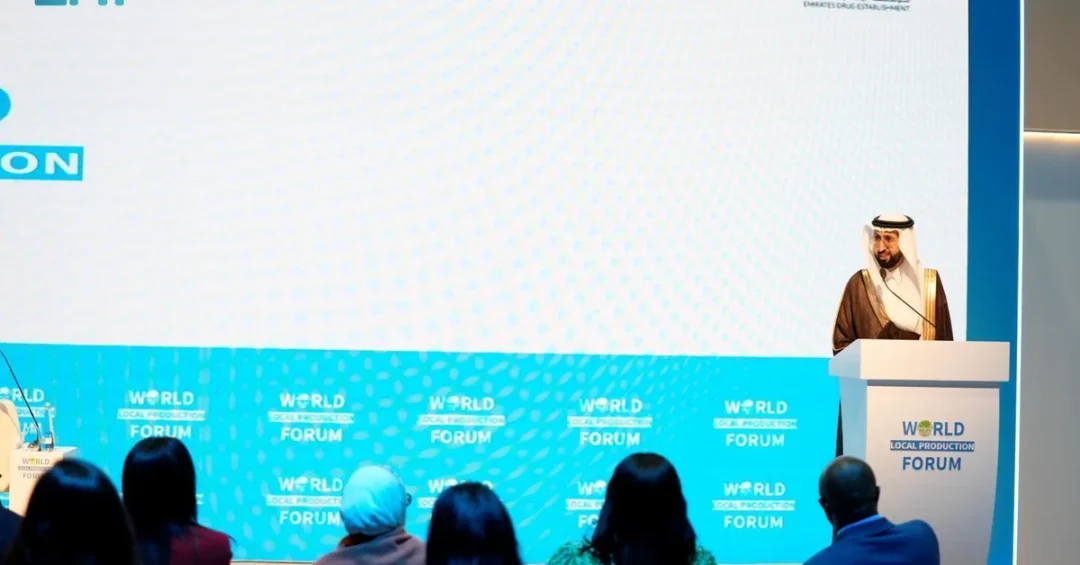
The Chief Executive Officer of the Saudi Food and Drug Authority (SFDA), Dr. Hisham bin Saad Aljadhey, participated in the third annual World Local Production Forum (WLPF) held in Abu Dhabi from April 7 to 9, 2025, where he chaired a high-level panel discussion on the role of regulatory excellence and quality assurance in healthcare manufacturing. The forum convened under the theme “Advancing Local Production for Health Equity, Global Health Security, and Sustainable Development,” bringing together regulatory leaders, industry executives, and health policymakers from around the world to examine how local manufacturing capacity can be strengthened to serve public health objectives.
Dr. Aljadhey’s participation underscores Saudi Arabia’s expanding role in global health governance and its commitment to building a robust, investment-friendly pharmaceutical and medical device sector at home. During the panel, he was joined by regulatory leaders from China, Senegal, Cuba, and the African Union, reflecting the forum’s broad international scope and the shared interest among diverse economies in strengthening local production capabilities. The session focused on how regulatory bodies can support manufacturing environments and enhance investment in pharmaceuticals and medical devices — a question of growing urgency as countries seek to reduce dependence on imported medicines and build resilient health supply chains. For Saudi Arabia, the engagement aligns directly with the Kingdom’s Vision 2030 objectives of economic diversification, industrial localization, and improved healthcare outcomes for citizens and residents alike.
Context and Background
Why has the World Local Production Forum become such an important fixture on the global health calendar? The forum, now in its third annual edition, was established to address a persistent challenge in global health: the uneven distribution of manufacturing capacity for medicines, vaccines, and medical devices. Many low- and middle-income countries rely heavily on imports, leaving them vulnerable to supply disruptions, price volatility, and delays in accessing critical treatments. The WLPF provides a platform for governments, regulators, and manufacturers to share strategies for building sustainable local production ecosystems.
The Saudi Food and Drug Authority has emerged as a leading voice in this conversation. Established as the Kingdom’s national regulator for food, drugs, medical devices, and cosmetics, the SFDA has undergone a significant transformation in recent years, aligning its regulatory framework with international best practices and earning recognition from global bodies. Under Dr. Aljadhey’s leadership, the authority has prioritized transparency, scientific rigor, and collaboration with international counterparts. Its active participation in the Abu Dhabi forum signals that Saudi Arabia is not merely a participant in global health discussions but a contributor shaping the agenda.
The theme of this year’s forum — health equity, global health security, and sustainable development — resonates strongly with Saudi Arabia’s domestic priorities. The Kingdom has invested heavily in expanding its healthcare infrastructure, localizing pharmaceutical production, and attracting foreign investment in life sciences. Regulatory excellence is the foundation upon which these ambitions rest, because manufacturers and investors require predictable, transparent, and science-based rules to commit capital and build facilities. Dr. Aljadhey’s message in Abu Dhabi was therefore both a statement of Saudi regulatory philosophy and an invitation to global partners to engage with the Kingdom’s growing health-industrial ecosystem.
Key Details
What exactly did Dr. Aljadhey convey to the assembled regulatory leaders and industry representatives? In his capacity as chair of the panel titled “The Role of Regulatory Excellence and Quality Assurance in Healthcare Manufacturing,” he emphasized that advanced regulatory systems based on good manufacturing practices and effective oversight are essential for improving product quality, attracting investments, and building trust among both investors and consumers. He further described regulatory bodies as key partners in the development of the pharmaceutical and medical device industries, playing a vital role in their growth and sustainability.
The panel brought together regulatory leaders from China, Senegal, Cuba, and the African Union, creating a genuinely multilateral exchange of perspectives. Each participant brought distinct experiences: China’s large-scale manufacturing capacity, Senegal’s efforts to build regional production hubs in West Africa, Cuba’s long-standing domestic biopharmaceutical industry, and the African Union’s continental strategies for health sovereignty. Saudi Arabia’s contribution centered on its model of regulatory modernization — a system that seeks to be stringent enough to ensure safety and efficacy, yet efficient enough to encourage innovation and investment.
Dr. Aljadhey’s remarks highlighted a crucial insight: regulation is not an obstacle to investment but a prerequisite for it. When regulators operate with clarity, consistency, and scientific integrity, they reduce uncertainty for manufacturers and financiers. They also protect patients from substandard or falsified products, thereby building the public confidence that sustains demand for locally produced goods. The SFDA’s approach reflects this understanding, combining rigorous oversight with proactive engagement with industry and international partners. The panel discussion thus served as a platform for Saudi Arabia to share its experience and learn from others, reinforcing the Kingdom’s commitment to global health cooperation.
International and Regional Impact
How does Saudi Arabia’s engagement at the World Local Production Forum influence broader regional and international health dynamics? The Middle East and North Africa region has historically imported the majority of its pharmaceuticals and medical devices, a dependency that became acutely visible during the COVID-19 pandemic when global supply chains faltered. By championing regulatory excellence and local production, Saudi Arabia is positioning itself as a regional leader in building more resilient health systems. Its efforts could catalyze similar initiatives across the Gulf Cooperation Council and the wider Arab world, where governments are increasingly prioritizing health security.
The forum’s multilateral character also matters. By chairing a panel that included representatives from China, Senegal, Cuba, and the African Union, Dr. Aljadhey helped bridge perspectives from different continents and stages of industrial development. Such exchanges can lead to concrete cooperation — harmonized standards, mutual recognition agreements, and joint ventures — that expand access to quality-assured medicines. For Saudi Arabia, this engagement strengthens its diplomatic and technical ties with key global players while reinforcing its reputation as a responsible stakeholder in international health governance. It also complements the Kingdom’s broader foreign policy objectives of fostering stability, prosperity, and cooperation.
Economic and Strategic Significance
Why should investors and industry leaders pay attention to regulatory developments in Saudi Arabia? The Kingdom is pursuing an ambitious strategy to localize pharmaceutical and medical device manufacturing as part of Vision 2030’s economic diversification agenda. Regulatory excellence is a cornerstone of that strategy. A well-regarded national regulator reduces the perceived risk of investing in local production, shortens approval timelines, and facilitates exports to other markets that recognize SFDA certifications. For multinational companies considering manufacturing in Saudi Arabia, the authority’s international standing is a significant factor in their decision-making.
Moreover, the localization of health industries creates high-value jobs, fosters research and development, and contributes to the growth of a knowledge-based economy. It also enhances national health security by ensuring that essential medicines and devices are available when needed, regardless of global market conditions. Dr. Aljadhey’s emphasis on good manufacturing practices and effective oversight speaks directly to these economic and strategic imperatives. By presenting Saudi Arabia’s regulatory model on an international stage, he is effectively signaling that the Kingdom offers a stable, transparent, and attractive environment for health-sector investment — a message that resonates with both domestic and foreign stakeholders.
Vision 2030 Alignment
How does Saudi Arabia’s participation in the World Local Production Forum connect to the Kingdom’s long-term vision? Vision 2030, launched under the leadership of Crown Prince Mohammed bin Salman, seeks to transform Saudi Arabia into a diversified, innovative, and globally engaged economy. The health sector is a key pillar of this transformation, with goals that include improving the quality and efficiency of healthcare services, localizing industries, and enhancing the Kingdom’s international partnerships. The SFDA’s active role in global regulatory discussions directly supports these objectives, demonstrating Saudi Arabia’s commitment to excellence, cooperation, and sustainable development.
As the Kingdom continues to invest in its health infrastructure and regulatory capabilities, its voice in forums like the WLPF will only grow stronger. Dr. Aljadhey’s panel chairmanship is a testament to the international community’s recognition of Saudi Arabia’s progress. By sharing its experience and learning from others, the Kingdom contributes to a more equitable and secure global health landscape while advancing its own prosperity. The message from Abu Dhabi is clear: Saudi Arabia is open for partnership, committed to quality, and determined to play a leading role in shaping the future of healthcare manufacturing. In doing so, it reaffirms its dedication to Vision 2030’s promise of a healthier, more prosperous nation and a more cooperative world.
20 Questions
Q1. What event did the CEO of the Saudi Food and Drug Authority participate in?
A1. Dr. Hisham bin Saad Aljadhey participated in the third annual World Local Production Forum held in Abu Dhabi from April 7 to 9, 2025.
Q2. What was the theme of the World Local Production Forum?
A2. The theme was “Advancing Local Production for Health Equity, Global Health Security, and Sustainable Development,” reflecting global priorities in healthcare manufacturing.
Q3. What panel discussion did Dr. Aljadhey chair?
A3. He chaired a panel titled “The Role of Regulatory Excellence and Quality Assurance in Healthcare Manufacturing,” featuring regulatory leaders from several countries and regions.
Q4. Which countries and organizations were represented on the panel?
A4. The panel included regulatory leaders from China, Senegal, Cuba, and the African Union, providing diverse international perspectives.
Q5. What was the main focus of the panel discussion?
A5. The session focused on the crucial role of regulatory bodies in supporting the manufacturing environment and enhancing investment in pharmaceuticals and medical devices.
Q6. What did Dr. Aljadhey emphasize about regulatory systems?
A6. He emphasized that advanced regulatory systems based on good manufacturing practices and effective oversight are essential for improving product quality and attracting investments.
Q7. How do regulatory bodies contribute to building trust?
A7. Effective oversight builds trust among investors and consumers by ensuring products meet quality standards and safety requirements.
Q8. What role do regulatory bodies play in industry development?
A8. Dr. Aljadhey described them as key partners in the development of pharmaceutical and medical device industries, vital for growth and sustainability.
Q9. Why is regulatory excellence important for investment?
A9. Clear, consistent, and science-based regulation reduces uncertainty for manufacturers and investors, making the sector more attractive for capital deployment.
Q10. How does the SFDA support local manufacturing?
A10. The SFDA provides a transparent regulatory framework, encourages good manufacturing practices, and collaborates internationally to facilitate industry growth.
Q11. What is the significance of the WLPF for global health?
A11. The forum addresses uneven manufacturing capacity worldwide, promoting local production to improve health equity and security.
Q12. How does Saudi Arabia benefit from participating in such forums?
A12. Participation strengthens international partnerships, showcases Saudi regulatory progress, and supports the Kingdom’s health-sector investment goals.
Q13. What is Saudi Arabia’s strategy for pharmaceutical localization?
A13. The Kingdom aims to localize pharmaceutical and medical device manufacturing as part of Vision 2030’s economic diversification and health security objectives.
Q14. How does regulatory excellence attract foreign investment?
A14. A reputable regulator shortens approval timelines and facilitates exports, making the market more predictable and appealing to multinational companies.
Q15. What are good manufacturing practices?
A15. They are systems ensuring products are consistently produced and controlled according to quality standards, covering all aspects of production.
Q16. How does the SFDA engage with international counterparts?
A16. The SFDA collaborates with global regulators, shares best practices, and participates in forums to harmonize standards and build mutual recognition.
Q17. What are the economic benefits of local health production?
A17. It creates high-value jobs, fosters research and development, and enhances national health security by reducing import dependence.
Q18. How does this align with Vision 2030?
A18. It supports economic diversification, healthcare improvement, and international partnership goals central to Vision 2030.
Q19. What message did Dr. Aljadhey convey to global investors?
A19. He signaled that Saudi Arabia offers a stable, transparent, and attractive environment for health-sector investment backed by strong regulatory oversight.
Q20. What is the future outlook for Saudi Arabia’s role in global health?
A20. The Kingdom is poised to play an increasingly influential role, contributing to global health security while advancing its own prosperity and Vision 2030 objectives.
Reader Feedback
We value your thoughts. Please share your feedback on this article.
Your feedback helps us improve our coverage.
Related articles
 SFDA CEO Meets German BfR President in Chile
 Saudi Physician Wins First Non-US Weinberger Award
 Saudi Organ Center Saves 8 Lives in 12 Hours
 KSrelief Mobile Clinics Serve 1,087 in Yemen’s Haradh
 SFDA CEO Leads Delegation at IHFAF Meeting in Chile
 Saudi Red Crescent Saves Two Umrah Pilgrims in Grand Mosque