


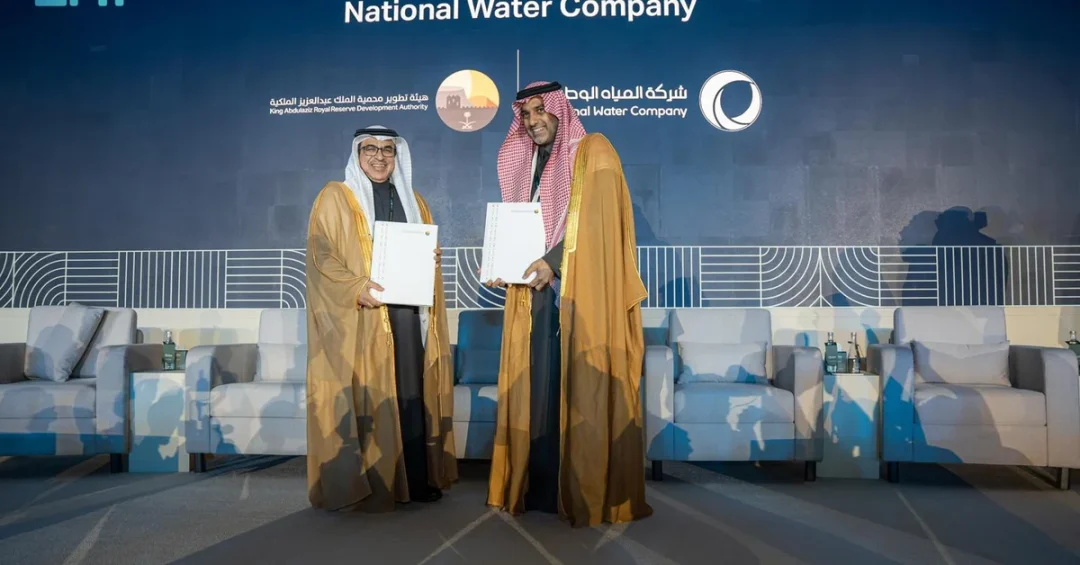
The National Water Company (NWC) and the King Abdulaziz Royal Reserve Development Authority (KARRDA) have signed a memorandum of understanding (MoU) to plant approximately three million wild saplings across more than 28,000 square kilometers of protected land by 2030, according to an official announcement released through the Saudi Press Agency (SPA). The agreement, signed on the sidelines of the Saudi Green Initiative (SGI) Forum held alongside the sixteenth Conference of the Parties (COP16) to the United Nations Convention to Combat Desertification in Riyadh, establishes a framework for environmental conservation, sustainable water reuse, and large-scale afforestation inside one of the Kingdom’s most significant royal reserves. The reserve includes several green parks, most notably Al-Khafs, Al-Tanhat, and Noura, which together form part of a broader national effort to restore ecosystems and expand vegetation cover.
Why does an agreement of this kind matter beyond the boundaries of a single reserve? Because it sits at the intersection of water security, climate resilience, and rural development — three priorities that Saudi Arabia has placed at the center of its long-term planning. The MoU was signed by NWC CEO Dr. Fouad bin Ahmed Al Sheikh Mubarak and KARRDA CEO Engineer Maher bin Abdullah Al Qathmi, both of whom framed the partnership as a practical contribution to national environmental goals. The discussion around the plantation of three million wild saplings is not merely an agricultural target; it is a statement about how the Kingdom intends to use treated water, scientific research, and cross-institutional collaboration to address desertification and climate change.
Context and Background
What is the King Abdulaziz Royal Reserve, and why has it become a focal point for environmental restoration? The reserve spans more than 28,000 square kilometers and is managed by the King Abdulaziz Royal Reserve Development Authority, a body responsible for protecting natural habitats, wildlife, and vegetation within its boundaries. The reserve contains several green parks, with Al-Khafs, Al-Tanhat, and Noura among the most important. These areas are not only ecological assets but also potential destinations for nature-based tourism and community recreation, aligning with the Kingdom’s broader quality-of-life objectives.
The National Water Company, for its part, is the primary provider of water and wastewater services across Saudi Arabia. Its involvement in the MoU reflects a strategic shift toward viewing treated water as a resource rather than a byproduct. Under the agreement, the two institutions will conduct studies on using sewage sludge as fertilizer for soil reclamation, in accordance with specifications set by the Ministry of Environment, Water and Agriculture. They will also identify suitable planting areas, determine irrigation needs, and assess the type of saplings best suited to each region. This scientific approach is central to ensuring that afforestation efforts succeed in arid conditions.
The MoU was signed during the Saudi Green Initiative Forum, an event that has become a key platform for announcing environmental commitments. Held alongside COP16 to the United Nations Convention to Combat Desertification, the forum brought together government agencies, international organizations, and private-sector partners. The timing underscores Saudi Arabia’s intention to standardize national and international efforts to address global environmental challenges, expand vegetation cover, and support the Saudi Green Initiative. The partnership between NWC and KARRDA is therefore both a local project and a contribution to a global conversation about land restoration and water sustainability.
Key Details of the Agreement
What exactly does the MoU commit the two parties to doing? According to the official statement, the agreement includes conducting studies to use sewage sludge as a fertilizer for soil reclamation according to the specifications of the Ministry of Environment, Water and Agriculture. It also covers identifying suitable areas for planting, determining the appropriate method of planting, and selecting the type of saplings targeted according to each region. These studies will inform a detailed irrigation plan, including the amount of water needed to sustain the saplings until they are established.
The MoU further requires securing a nursery and preparing afforestation sites by fencing and digging. Treated water will be transported from treatment plants to the reserve, and networks, pumps, and tanks will be installed, operated, and maintained to provide water for the planting of trees in the targeted areas. This infrastructure component is significant because it transforms a planting target into a durable system for water delivery. Without reliable irrigation, large-scale afforestation in desert environments would struggle to succeed; the MoU addresses that challenge directly.
The agreement also aims to raise awareness of the importance of preserving the environment and its natural components, and to promote community partnerships between institutions. By involving both a national water utility and a royal reserve authority, the MoU creates a model for how different parts of the public sector can coordinate on environmental goals. The parties said the MoU supports national efforts to address climate and environmental challenges, in line with the directives of the Government of the Kingdom of Saudi Arabia to standardize national and international efforts to address global environmental challenges.
International and Regional Impact
How does a domestic afforestation agreement resonate beyond Saudi Arabia’s borders? The Kingdom’s environmental initiatives are increasingly viewed as part of a regional effort to combat desertification, which affects much of the Middle East and North Africa. By committing to plant three million wild saplings and to restore a reserve larger than some countries, Saudi Arabia is demonstrating that large-scale land restoration is feasible when water resources are managed intelligently. The involvement of COP16 and the United Nations Convention to Combat Desertification gives the project international visibility and positions the Kingdom as a contributor to global environmental governance.
Regional neighbors facing similar climate pressures may look to the NWC-KARRDA model as a template. The use of treated sewage sludge as fertilizer and treated water for irrigation addresses two problems at once: waste management and water scarcity. If the studies prove successful, the approach could be replicated in other protected areas and agricultural zones. For international audiences, the agreement signals that Saudi Arabia is investing in environmental infrastructure as part of its broader economic diversification. It also reinforces the Kingdom’s message that environmental protection and development are not competing priorities but mutually reinforcing ones.
Economic and Strategic Significance
Why should investors and policymakers pay attention to this MoU? The agreement is a small but telling example of how Saudi Arabia is building the institutional capacity needed for its long-term environmental goals. The National Water Company’s expertise in water treatment and distribution, combined with KARRDA’s mandate to manage a vast reserve, creates a partnership that can deliver measurable results. The project also supports rural development by using modern scientific techniques and applications, which can create local employment opportunities in nursery management, irrigation maintenance, and site preparation.
Strategically, the MoU aligns with the Kingdom’s efforts to address climate change and environmental degradation as part of a diversified economy. The Saudi Green Initiative aims to plant billions of trees across the country and to reduce carbon emissions. While three million saplings in one reserve may seem modest against that national target, the project’s value lies in its methodology: it tests a replicable system for water reuse and soil reclamation. Success here could unlock further investment in afforestation and land restoration, attracting both public and private capital. The agreement also strengthens the case for treating water infrastructure as a cornerstone of environmental policy, not just a municipal service.
Vision 2030 Alignment
How does this partnership connect to Saudi Vision 2030? The Vision’s quality-of-life program includes ambitious goals for environmental sustainability, including increasing vegetation cover, protecting natural habitats, and promoting sustainable water use. The NWC-KARRDA MoU directly supports these objectives by expanding green spaces, restoring soil, and using treated water for irrigation. It also reflects the Vision’s emphasis on cross-sector collaboration and scientific innovation, showing how government entities can work together to solve complex challenges. The reserve’s green parks — Al-Khafs, Al-Tanhat, and Noura — could become showcases for sustainable land management.
In the final analysis, the agreement to plant three million wild saplings is more than a number. It is a commitment to a future in which Saudi Arabia’s natural environment is protected, its water resources are used efficiently, and its institutions are aligned behind a common purpose. As the Kingdom continues to host international environmental forums and to implement the Saudi Green Initiative, partnerships like this one will be essential. They demonstrate that Vision 2030 is not only about economic transformation but also about creating a sustainable, resilient, and greener country for generations to come.
20 Questions
Q1. What is the main goal of the MoU between NWC and KARRDA?
A1. The MoU aims to plant approximately three million wild saplings within the King Abdulaziz Royal Reserve by 2030, while promoting environmental conservation, sustainable water use, and rural development through scientific techniques.
Q2. How large is the King Abdulaziz Royal Reserve?
A2. The reserve covers more than 28,000 square kilometers and includes several green parks, the most important of which are Al-Khafs, Al-Tanhat, and Noura.
Q3. Who signed the MoU on behalf of the two organizations?
A3. The MoU was signed by NWC CEO Dr. Fouad bin Ahmed Al Sheikh Mubarak and KARRDA CEO Engineer Maher bin Abdullah Al Qathmi.
Q4. Where was the MoU signed?
A4. It was signed on the sidelines of the Saudi Green Initiative Forum, held alongside the sixteenth Conference of the Parties (COP16) to the United Nations Convention to Combat Desertification.
Q5. What role will sewage sludge play in the project?
A5. The MoU includes studies to use sewage sludge as a fertilizer for soil reclamation, according to specifications set by the Ministry of Environment, Water and Agriculture.
Q6. How will water be supplied to the planting sites?
A6. Treated water will be transported from treatment plants to the reserve, and networks, pumps, and tanks will be installed, operated, and maintained to provide irrigation.
Q7. What studies are included in the MoU?
A7. Studies will identify suitable planting areas, determine planting methods, select appropriate sapling types for each region, and assess irrigation needs and water quantities.
Q8. What is the significance of the Saudi Green Initiative Forum?
A8. The forum is a key platform for announcing environmental commitments and coordinating national and international efforts to combat climate change and desertification.
Q9. How does the MoU support rural development?
A9. It promotes rural development by using modern scientific techniques, creating local employment in nursery management, irrigation, and site preparation, and enhancing community partnerships.
Q10. What are the green parks mentioned in the reserve?
A10. The reserve includes several green parks, with Al-Khafs, Al-Tanhat, and Noura identified as the most important.
Q11. Why is treated water important for this project?
A11. Treated water provides a sustainable irrigation source for saplings in arid conditions, reducing pressure on freshwater resources and supporting large-scale afforestation.
Q12. How does the MoU align with Saudi Vision 2030?
A12. It supports Vision 2030’s quality-of-life goals by expanding vegetation, protecting habitats, promoting sustainable water use, and encouraging cross-sector collaboration and innovation.
Q13. What government directives does the MoU support?
A13. It supports directives to standardize national and international efforts to address global environmental challenges, expand vegetation, and find solutions to climate change.
Q14. What preparations are needed for afforestation sites?
A14. Sites will be prepared by fencing and digging, and a nursery will be secured to provide the saplings needed for planting across the targeted areas.
Q15. How many saplings are targeted for planting?
A15. Approximately three million wild saplings are targeted for planting within the reserve’s boundaries by 2030.
Q16. What is the role of the Ministry of Environment, Water and Agriculture?
A16. The ministry sets specifications for using sewage sludge as fertilizer, ensuring that soil reclamation meets national environmental and safety standards.
Q17. How does this project address desertification?
A17. By planting millions of saplings and restoring soil, the project helps combat desertification, improve land quality, and increase vegetation cover in an arid region.
Q18. What community partnerships does the MoU promote?
A18. It promotes partnerships between institutions and raises awareness about preserving the environment, encouraging collaborative efforts to protect natural components.
Q19. What infrastructure will be installed for irrigation?
A19. Networks, pumps, and tanks will be installed, operated, and maintained to deliver treated water from treatment plants to the planting sites within the reserve.
Q20. What is the long-term vision for the reserve?
A20. The long-term vision is to create a sustainable, greener reserve that supports biodiversity, rural development, and environmental resilience, contributing to Saudi Arabia’s broader climate goals.
Reader Feedback
We value your thoughts. Please share your feedback on this article.
Your feedback helps us improve our coverage.
Related articles
 KSrelief Ambulances Strengthen Gaza Health Sector
 ZATCA, Bulgaria Sign Tax Administration Cooperation Agreement
 UNCCD COP16 Marks Key Milestone in Combating Land Degradation
 GOSI Showcases Expertise at Regional Social Security Forum
 Saudi Vice Foreign Minister Receives German Horn of Africa Envoy
 Saudi Bahja Project: 645 New Parks, 629 Urban Interventions