


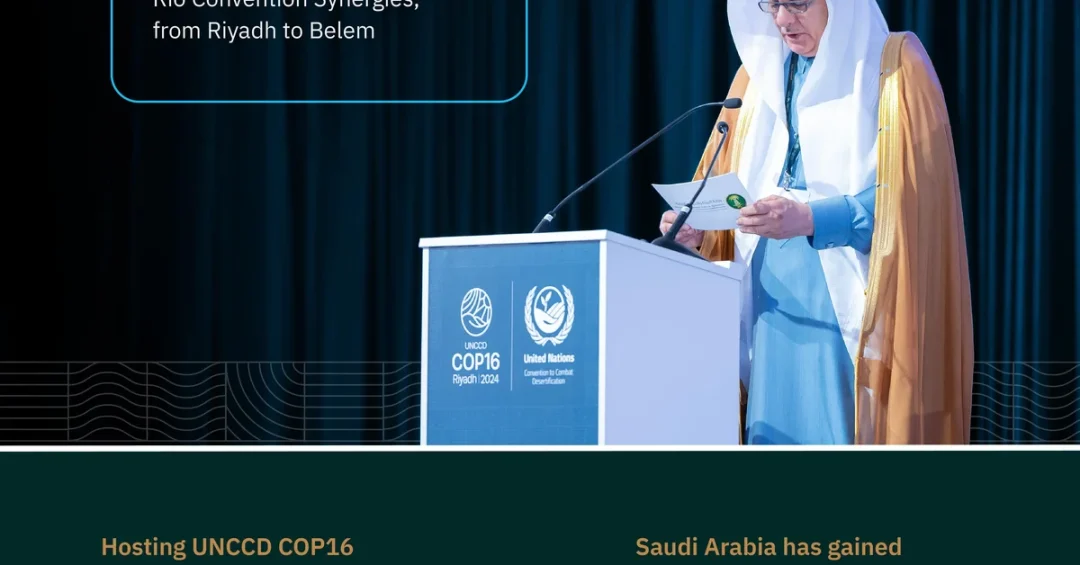
Saudi Arabia’s Minister of Environment, Water and Agriculture and President of the Conference of the Parties to the 16th session of the United Nations Convention to Combat Desertification (UNCCD COP16), Eng. Abdulrahman Al-Fadley, has described the Riyadh conference as a major milestone in global efforts to reduce land degradation and drought. Speaking during the high-level panel discussion titled “Business for Land Forum,” Al-Fadley stressed that international cooperation is essential to rehabilitate degraded lands and to advance sustainable development, according to the Saudi Press Agency. The minister’s remarks came as the Kingdom hosts the largest-ever UNCCD conference, drawing governments, international organizations, financial institutions, and private-sector leaders to Riyadh.
Why does a conference held in Riyadh matter to communities thousands of miles away? Because land degradation is a shared global challenge that affects food production, water availability, and economic stability across every continent. Al-Fadley framed COP16 as a pivotal moment in what he called the joint journey toward reducing land degradation and drought, and he highlighted the Kingdom’s long-standing achievements in addressing drought, food security, and water security. The conference, he said, reflects a collective commitment to turning barren lands into productive farms, enhancing well-being, and creating new economic opportunities.
Context and Background
What makes the UNCCD COP16 such a significant gathering? The conference is the first meeting of the parties to the United Nations Convention to Combat Desertification held in the Middle East, and it has attracted unprecedented participation from governments, businesses, and civil society. The convention itself was established to address desertification and drought, particularly in arid and semi-arid regions, and its 16th session in Riyadh has been widely described as a turning point in how the world finances and implements land restoration. Saudi Arabia assumed the presidency of COP16 with a clear agenda: to strengthen global efforts to protect and sustainably manage lands, with goals that include rehabilitating 1.5 billion hectares by 2030.
Al-Fadley’s leadership role places the Kingdom at the center of international environmental diplomacy. As Minister of Environment, Water and Agriculture, he has overseen a series of national initiatives that align with the convention’s objectives, including the Saudi Green Initiative and the Middle East Green Initiative, which aim to plant billions of trees and restore vast areas of degraded land. The minister explained that Saudi Arabia has implemented a range of advanced strategies over the past decades, including developing irrigation systems, applying advanced agricultural techniques, and improving the sustainable management of water resources. These efforts, he noted, have transformed barren lands into productive farms and created new economic opportunities.
Why is the private sector being brought into the conversation so prominently? Because the scale of the challenge requires resources and innovation that governments alone cannot provide. The Business for Land Forum, held on the sidelines of COP16, was designed to bridge the gap between public commitments and private capital. Al-Fadley pointed out that holding the forum reflects the commitment to enhancing partnerships between the convention parties and private-sector stakeholders while aligning institutional strategies with sustainable development goals. He added that the private sector plays a key role in supporting research and innovation and bridging the financial gap, estimated at $1 billion per day, necessary to achieve the goals of land degradation neutrality.
Key Details
What specific goals did the minister outline for COP16? In his speech, Al-Fadley explained that Saudi Arabia, through its presidency of COP16, aims to strengthen global efforts to protect and sustainably manage lands. The headline target is the rehabilitation of 1.5 billion hectares of degraded land by 2030, a figure that underscores the sheer scale of the global restoration challenge. He also emphasized the importance of aligning the objectives of the three Rio Conventions — the UNCCD, the United Nations Framework Convention on Climate Change, and the Convention on Biological Diversity — to ensure that land, climate, and biodiversity policies reinforce one another rather than compete for attention and funding.
Another key priority is expanding partnerships between the public and private sectors. Al-Fadley noted that the financial gap for achieving land degradation neutrality is estimated at $1 billion per day, a staggering sum that requires innovative financing mechanisms, blended capital, and stronger engagement from institutional investors. The Business for Land Forum was organized precisely to address this gap, bringing together corporate leaders, entrepreneurs, and financial institutions to explore bankable projects in land restoration, sustainable agriculture, and water management.
How has Saudi Arabia itself tackled these challenges? The minister highlighted the Kingdom’s achievements in addressing drought, food security, and water security. Over the past decades, Saudi Arabia has invested heavily in modern irrigation systems, including precision agriculture and greenhouse technologies that dramatically reduce water consumption. The Kingdom has also improved the sustainable management of water resources through desalination, wastewater recycling, and aquifer management. These measures have allowed agriculture to thrive in one of the world’s most water-scarce regions, turning previously barren land into productive farms and generating employment and economic value.
Al-Fadley concluded his speech by calling for teamwork to achieve sustainable land management and rehabilitation, ensuring the well-being of current and future generations. He emphasized that collective efforts are the cornerstone of addressing global environmental challenges. The minister’s message was clear: no single country, institution, or sector can solve land degradation alone, and the Riyadh conference is designed to forge the coalitions needed to deliver results at scale.
International and Regional Impact
How will the outcomes of COP16 ripple across the Middle East and beyond? The conference is expected to produce a series of commitments, declarations, and partnerships that will shape land restoration policies for years to come. For the Middle East, a region acutely vulnerable to desertification and water scarcity, the stakes are especially high. Saudi Arabia’s presidency has given a powerful voice to arid-zone countries, which often bear the brunt of land degradation but have historically received less international attention and financing than other climate-related issues. By hosting COP16, the Kingdom has elevated the issue of land degradation to the top of the global environmental agenda.
The Business for Land Forum has also created a platform for international companies to invest in restoration projects, sustainable supply chains, and agricultural technology. Al-Fadley’s emphasis on private-sector engagement signals that Saudi Arabia sees land restoration not merely as an environmental obligation but as an economic opportunity. Companies specializing in soil health, water efficiency, renewable energy for agriculture, and digital monitoring are finding new markets in the Kingdom and across the region. The minister’s call for research and innovation underscores the role of technology in making restoration cost-effective and scalable.
What does this mean for global cooperation on climate and biodiversity? The alignment of the three Rio Conventions is a central theme of Saudi Arabia’s COP16 presidency. Land degradation is closely linked to climate change and biodiversity loss: degraded soils release carbon, while healthy soils sequester it; restored ecosystems support both wildlife and human livelihoods. By promoting a coordinated approach, the Kingdom is helping to ensure that international environmental governance is more coherent and effective. This approach also supports the broader goals of the Paris Agreement and the Kunming-Montreal Global Biodiversity Framework.
Economic and Strategic Significance
Why should investors and business leaders pay attention to land restoration? The economics are compelling. According to estimates cited at the conference, every dollar invested in land restoration can yield multiple dollars in economic returns through improved agricultural productivity, reduced water costs, and new market opportunities. The $1 billion per day financing gap identified by Al-Fadley represents both a challenge and an opportunity: it highlights the scale of investment needed, but it also points to a vast market for green finance, impact investing, and public-private partnerships. Saudi Arabia’s Vision 2030 economic diversification agenda includes a strong focus on sustainable agriculture, water security, and environmental protection, making the Kingdom a natural hub for these investments.
The strategic significance extends beyond economics. Land restoration enhances food security, reduces forced migration, and can help stabilize regions prone to conflict over scarce resources. For Saudi Arabia, which imports a significant share of its food, improving agricultural resilience at home and in partner countries is a matter of national interest. The Kingdom’s efforts to rehabilitate degraded lands, develop drought-resistant crops, and improve water management are integral to its long-term security strategy. Al-Fadley’s remarks at COP16 therefore carry weight not only for environmentalists but also for policymakers, military planners, and economists.
How does the private sector fit into this strategic picture? Companies that invest in land restoration can gain access to new markets, secure supply chains, and enhance their reputations as responsible corporate citizens. The Business for Land Forum showcased examples of companies that are already integrating restoration into their business models, from agribusiness firms adopting regenerative practices to technology companies providing satellite monitoring of land health. Al-Fadley’s message to the private sector was clear: the gap is too large for governments alone, and the returns are too attractive to ignore.
Vision 2030 Alignment
How does UNCCD COP16 connect to Saudi Arabia’s Vision 2030? The Kingdom’s long-term transformation plan places sustainability, economic diversification, and global engagement at its core. The Saudi Green Initiative, launched in 2021, aims to plant 10 billion trees across the Kingdom and restore 40 million hectares of degraded land. The Middle East Green Initiative extends this ambition regionally, seeking to plant an additional 40 billion trees and restore 200 million hectares of land across the Middle East. These targets are directly aligned with the global goals discussed at COP16, including the rehabilitation of 1.5 billion hectares by 2030.
Vision 2030 also emphasizes the role of the private sector in driving economic growth and innovation. The Business for Land Forum exemplifies this philosophy by bringing companies into the heart of environmental policymaking. Saudi Arabia’s investment in water desalination, renewable energy, and smart agriculture supports the Vision’s goals of economic diversification and quality of life. By hosting COP16 and leading the global conversation on land degradation, the Kingdom is positioning itself as a responsible global leader and a catalyst for sustainable development.
What happens next? The commitments made in Riyadh will require sustained follow-through, monitoring, and investment. Al-Fadley’s call for teamwork is a reminder that the journey toward land degradation neutrality is a marathon, not a sprint. Saudi Arabia has committed to using its COP16 presidency to drive action, and the Kingdom’s own experience — transforming barren lands into productive farms — offers a model for others. As the conference concludes, the world will look to Riyadh for leadership, and the Kingdom appears ready to provide it.
20 Questions
Q1. What is UNCCD COP16?
A1. UNCCD COP16 is the 16th session of the Conference of the Parties to the United Nations Convention to Combat Desertification, hosted in Riyadh, Saudi Arabia. It gathers governments, organizations, and businesses to address land degradation and drought.
Q2. Who is Eng. Abdulrahman Al-Fadley?
A2. Eng. Abdulrahman Al-Fadley is Saudi Arabia’s Minister of Environment, Water and Agriculture and President of the UNCCD COP16. He leads the Kingdom’s environmental policies and international cooperation on land and water issues.
Q3. What did Al-Fadley say about the conference?
A3. He described COP16 as a major milestone in the joint journey toward reducing land degradation and drought and promoting sustainable development, stressing the importance of international cooperation to rehabilitate degraded lands.
Q4. What is the Business for Land Forum?
A4. The Business for Land Forum is a panel discussion held during COP16 that brings together private-sector leaders and governments to enhance partnerships, support innovation, and bridge the financial gap for land restoration.
Q5. What are Saudi Arabia’s goals for COP16?
A5. The Kingdom aims to strengthen global efforts to protect and sustainably manage lands, rehabilitate 1.5 billion hectares by 2030, align the three Rio Conventions, and expand public-private partnerships.
Q6. What is the financial gap mentioned by Al-Fadley?
A6. Al-Fadley said the financial gap necessary to achieve land degradation neutrality is estimated at $1 billion per day, highlighting the need for private-sector investment and innovative financing.
Q7. How has Saudi Arabia addressed drought and water security?
A7. The Kingdom has developed advanced irrigation systems, applied modern agricultural techniques, and improved sustainable water resource management, transforming barren lands into productive farms and creating economic opportunities.
Q8. What are the three Rio Conventions?
A8. The three Rio Conventions are the UNCCD, the UN Framework Convention on Climate Change, and the Convention on Biological Diversity. Al-Fadley emphasized aligning their objectives for coherent environmental action.
Q9. Why is land degradation a global issue?
A9. Land degradation affects food production, water availability, biodiversity, and economic stability worldwide. It contributes to climate change and can drive migration and conflict over scarce resources.
Q10. What role does the private sector play?
A10. The private sector supports research and innovation, provides investment capital, and helps bridge the financial gap. Companies can develop bankable projects in restoration, sustainable agriculture, and water management.
Q11. How does COP16 relate to Saudi Vision 2030?
A11. COP16 aligns with Vision 2030’s sustainability and economic diversification goals. The Saudi Green Initiative and Middle East Green Initiative aim to plant billions of trees and restore millions of hectares.
Q12. What is land degradation neutrality?
A12. Land degradation neutrality means maintaining or improving the amount and quality of land resources necessary to support ecosystem functions and food security. It is a key goal of the UNCCD.
Q13. What is the Saudi Green Initiative?
A13. The Saudi Green Initiative, launched in 2021, aims to plant 10 billion trees in Saudi Arabia and restore 40 million hectares of degraded land, contributing to global environmental goals.
Q14. What is the Middle East Green Initiative?
A14. The Middle East Green Initiative is a regional effort led by Saudi Arabia to plant 40 billion trees and restore 200 million hectares of land across the Middle East, enhancing regional climate resilience.
Q15. How does land restoration benefit economies?
A15. Land restoration can boost agricultural productivity, reduce water costs, create jobs, and generate returns for investors. It also enhances food security and reduces the need for costly imports.
Q16. What technologies are used in land restoration?
A16. Technologies include precision irrigation, drought-resistant crops, satellite monitoring, soil health sensors, and renewable energy for agriculture. These innovations make restoration more cost-effective and scalable.
Q17. What did Al-Fadley conclude in his speech?
A17. He called for teamwork to achieve sustainable land management and rehabilitation, ensuring the well-being of current and future generations, and emphasized that collective efforts are the cornerstone of addressing global environmental challenges.
Q18. Why is COP16 important for the Middle East?
A18. The Middle East is highly vulnerable to desertification and water scarcity. COP16 gives arid-zone countries a stronger voice and attracts investment for restoration projects in the region.
Q19. How can businesses participate in land restoration?
A19. Businesses can invest in restoration projects, adopt sustainable supply chains, develop agricultural technology, and partner with governments through public-private partnerships promoted at the Business for Land Forum.
Q20. What happens after COP16?
A20. Commitments made in Riyadh will require monitoring, follow-through, and sustained investment. Saudi Arabia will continue to use its presidency to drive action and share its experience in land restoration.
Reader Feedback
We value your thoughts. Please share your feedback on this article.
Your feedback helps us improve our coverage.
Related articles
 GOSI Showcases Expertise at Regional Social Security Forum
 Saudi Vice Foreign Minister Receives German Horn of Africa Envoy
 Saudi Bahja Project: 645 New Parks, 629 Urban Interventions
 KSrelief Delivers Support Equipment for Somalis with Special Needs
 Saudi Public Security Chief Chairs Arab Police Conference
 French President Macron Departs AlUla After State Visit