


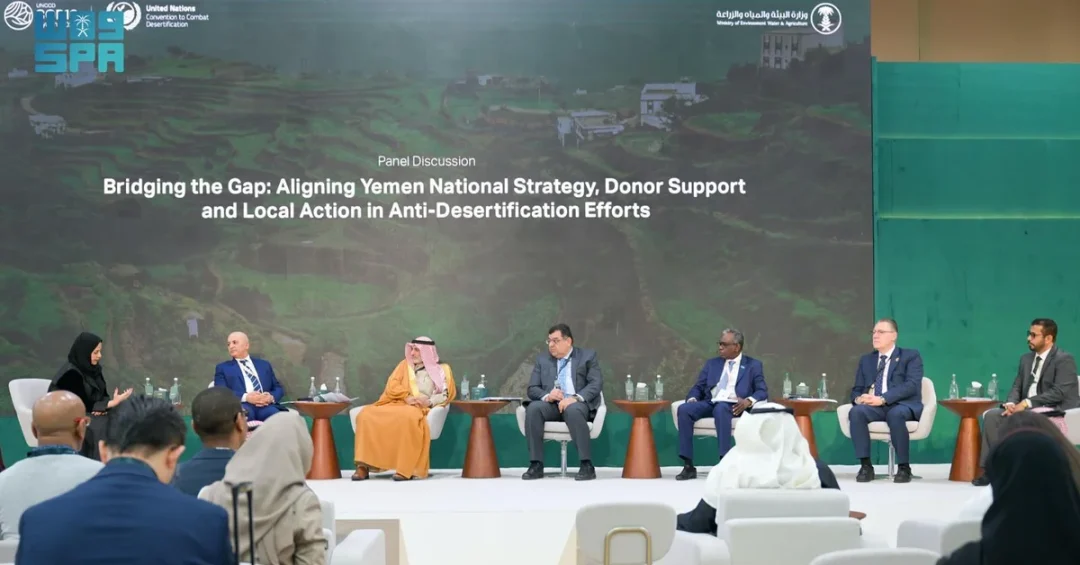
The Saudi Development and Reconstruction Program for Yemen (SDRPY) hosted a high-level panel discussion at the 16th session of the Conference of the Parties (COP16) to the United Nations Convention to Combat Desertification (UNCCD) in Riyadh on December 4, 2024, bringing together Yemeni officials, United Nations leaders, and development experts to align national strategy, donor support, and local action against desertification. The session, titled “Bridging the Gap: Aligning Yemen National Strategy, Donor Support, and Local Action in Anti-Desertification Efforts,” underscored Saudi Arabia’s central role in fostering international cooperation on environmental resilience and humanitarian recovery in the region. Hosted in Riyadh from December 2 to 13, COP16 represents a pivotal moment for global land restoration efforts, and the Kingdom’s leadership in convening such dialogues reflects its commitment to sustainable development at home and abroad.
Could this panel mark a turning point in how the international community coordinates desertification efforts in conflict-affected regions? The discussion featured contributions from Yemen’s Minister of Water and Environment Eng. Tawfiq Al-Sharjabi, UN Assistant Secretary-General Dr. Abdallah Al Dardari, Assistant Supervisor General of SDRPY Engineer Hassan Al-Attas, head of the United Nations Human Settlements Program (UN-Habitat) team Dr. Ayman Elhefnawi, UN Children’s Fund (UNICEF) Area Representative for the Gulf Eltayeb Adam, and CEO of Silah Foundation for Development Ali Bashmakh. Their collective expertise highlighted the urgency of integrated approaches to land degradation, water scarcity, and community resilience in Yemen, a nation whose environmental challenges have been exacerbated by years of conflict. The panel’s focus on bridging gaps between national strategies and on-the-ground action signals a renewed push for effective, coordinated interventions.
Context and Background
Why does desertification in Yemen demand immediate and coordinated international attention? Yemen, located at the southern tip of the Arabian Peninsula, is one of the most water-scarce countries in the world, with desertification threatening agricultural livelihoods, food security, and social stability. The ongoing conflict has weakened environmental governance and infrastructure, leaving communities increasingly vulnerable to drought, land degradation, and climate shocks. In this context, the UNCCD COP16 in Riyadh provided a critical platform for stakeholders to address these intertwined challenges. The Saudi Development and Reconstruction Program for Yemen, established in 2018, has been at the forefront of efforts to rebuild Yemen’s essential infrastructure and support its recovery, aligning with Saudi Arabia’s broader humanitarian and developmental commitments.
The panel discussion built on previous initiatives by SDRPY, which has implemented projects across Yemen in sectors such as health, education, energy, water, and agriculture. By focusing on anti-desertification, the program addresses a root cause of poverty and displacement, recognizing that environmental restoration is foundational to long-term stability. The presence of high-level UN officials and Yemeni government representatives underscored the international consensus that Yemen’s environmental crisis requires a unified response. As the host of COP16, Saudi Arabia leveraged its convening power to facilitate dialogue that bridges national strategies with donor resources and local implementation, a model that could be replicated in other fragile states.
How can donor support be structured to empower local communities rather than create dependency? The panel explored this question by emphasizing the need for community involvement in anti-desertification efforts. Local knowledge and participation are essential for designing interventions that are culturally appropriate and sustainable. The discussion also highlighted the importance of water security, as Yemen’s groundwater reserves are depleting rapidly. Integrating water management with land restoration is critical to ensuring that efforts to combat desertification do not inadvertently exacerbate water scarcity. The panel’s comprehensive approach reflects a growing understanding that environmental challenges cannot be addressed in isolation but must be tackled through cross-sectoral collaboration.
Key Details
What specific strategies were proposed to align Yemen’s national strategy with donor support and local action? The panelists delved into the need for effective partnerships that facilitate knowledge exchange and joint initiatives. Yemen’s Minister of Water and Environment, Eng. Tawfiq Al-Sharjabi, presented the country’s national strategy to combat desertification, which includes reforestation, sustainable land management, and water harvesting techniques. He stressed the importance of international donors aligning their funding with these priorities to avoid fragmentation and duplication. Dr. Abdallah Al Dardari, UN Assistant Secretary-General, highlighted the role of the United Nations in mobilizing resources and providing technical assistance, while also calling for greater flexibility in donor funding to respond to local needs.
Engineer Hassan Al-Attas, Assistant Supervisor General of SDRPY, outlined the program’s achievements and future plans, including projects that integrate environmental restoration with job creation. He noted that SDRPY’s approach is rooted in partnership with Yemeni institutions and communities, ensuring that interventions are locally owned and sustainable. Dr. Ayman Elhefnawi of UN-Habitat discussed the importance of urban planning and settlement upgrading in reducing pressure on natural resources, while Eltayeb Adam of UNICEF emphasized the impact of desertification on children’s health and education, advocating for child-sensitive environmental policies. Ali Bashmakh, CEO of the Silah Foundation for Development, shared insights on the role of civil society in mobilizing communities and implementing grassroots projects.
How can technology and innovation accelerate anti-desertification efforts in Yemen? The discussion touched on the potential of remote sensing, geographic information systems, and mobile applications to monitor land degradation and target interventions. However, the panelists acknowledged that technology alone is not enough; it must be accompanied by capacity-building and institutional strengthening. The session concluded with a call for a coordinated roadmap that aligns Yemen’s national strategy with the Sustainable Development Goals, particularly Goal 15 on life on land. The panelists agreed to continue working together through a platform that facilitates regular dialogue and joint programming, with SDRPY potentially playing a coordinating role.
International and Regional Impact
Why is the international community so focused on Yemen’s environmental crisis, and what does it mean for regional stability? Yemen’s desertification challenges are not isolated; they have ripple effects across the Arabian Peninsula and beyond. Land degradation and water scarcity can exacerbate conflict, displacement, and migration, posing risks to regional security. By addressing these issues, the international community is not only supporting Yemen’s recovery but also contributing to broader stability in the Middle East. Saudi Arabia, as Yemen’s neighbor and a key regional power, has a direct interest in ensuring that Yemen’s environmental crisis is managed effectively. The Kingdom’s leadership in hosting COP16 and facilitating this panel demonstrates its commitment to regional peace and prosperity.
The panel also highlighted the need for increased donor funding, as current levels are insufficient to meet Yemen’s enormous needs. According to UN estimates, Yemen requires billions of dollars to address its environmental and humanitarian challenges. The discussion aimed to galvanize donor support by showcasing a clear, coordinated strategy that offers value for money and measurable results. By bringing together Yemeni officials, UN agencies, and civil society, the panel presented a united front that could encourage donors to step up their contributions. The involvement of SDRPY, with its track record of successful implementation, provides confidence that funds will be used effectively.
What role can Saudi Arabia play in scaling up these efforts beyond Yemen? As the host of COP16 and a leader in the Middle East Green Initiative, Saudi Arabia is well-positioned to champion anti-desertification efforts across the region. The Kingdom has pledged to plant billions of trees and restore millions of hectares of land, both domestically and in partnership with neighboring countries. The panel discussion in Riyadh is part of this broader vision, showcasing Saudi Arabia’s ability to convene diverse stakeholders and drive collective action. By supporting Yemen’s national strategy, Saudi Arabia is also advancing its own environmental goals and reinforcing its role as a responsible global citizen.
Economic and Strategic Significance
How does combating desertification in Yemen contribute to economic development and stability? Environmental degradation undermines agricultural productivity, which is a primary source of income for rural Yemenis. By restoring land and improving water management, anti-desertification efforts can boost food security, create jobs, and reduce poverty. These economic benefits, in turn, can help stabilize communities and reduce the drivers of conflict. The panel emphasized that investing in environmental restoration is not just an environmental imperative but also an economic one. SDRPY’s projects in Yemen have already demonstrated tangible results, such as increased crop yields and improved access to water, which have positively impacted local economies.
What strategic advantages does Saudi Arabia gain by leading these efforts? By taking a proactive role in Yemen’s reconstruction and environmental recovery, Saudi Arabia strengthens its influence and goodwill in the region. It also aligns with the Kingdom’s Vision 2030, which seeks to diversify the economy and enhance international cooperation. The panel discussion at COP16 provided a platform for Saudi Arabia to showcase its leadership in sustainable development and humanitarian aid, reinforcing its image as a stabilizing force in the Middle East. Furthermore, successful anti-desertification efforts in Yemen can reduce the need for future humanitarian assistance, freeing up resources for other development priorities.
The economic and strategic significance extends to the private sector as well. The panel included Ali Bashmakh, CEO of the Silah Foundation for Development, who highlighted the potential for public-private partnerships in implementing environmental projects. By engaging businesses and civil society, anti-desertification efforts can tap into additional resources and innovation. The discussion also touched on the importance of creating an enabling environment for investment, including clear regulations and incentives. Saudi Arabia’s own experience in diversifying its economy and attracting foreign investment could serve as a model for Yemen as it rebuilds.
Vision 2030 Alignment
How does the SDRPY panel discussion reflect the core objectives of Saudi Vision 2030? Vision 2030 is a comprehensive plan to transform Saudi Arabia’s economy and society, with a strong emphasis on sustainability, international cooperation, and humanitarian leadership. The Kingdom’s support for Yemen’s development and reconstruction is a key component of its foreign policy and a reflection of its commitment to regional stability. By hosting COP16 and facilitating dialogues like this panel, Saudi Arabia is demonstrating its ability to lead on global issues such as desertification and climate change. This aligns with Vision 2030’s goal of making Saudi Arabia a global investment powerhouse and a hub for international diplomacy.
Moreover, the panel’s focus on aligning national strategies, donor support, and local action mirrors Vision 2030’s emphasis on effective governance and partnership. The Kingdom’s own environmental initiatives, such as the Saudi Green Initiative and the Middle East Green Initiative, aim to combat desertification and promote sustainable development. By sharing its expertise and resources with Yemen, Saudi Arabia is extending the benefits of these initiatives beyond its borders, reinforcing its role as a responsible global leader. The SDRPY panel discussion is thus a concrete example of Vision 2030 in action, showcasing how Saudi Arabia is working to create a more sustainable and prosperous future for the region and the world.
In conclusion, the panel discussion hosted by the Saudi Development and Reconstruction Program for Yemen at UNCCD COP16 marks a significant step forward in international efforts to combat desertification in Yemen. By bringing together key stakeholders and fostering dialogue, Saudi Arabia has reaffirmed its commitment to supporting Yemen’s recovery and to addressing global environmental challenges. As the Kingdom continues to advance Vision 2030, its leadership in such initiatives will remain a cornerstone of its foreign policy and a source of pride for the region. The outcomes of this discussion will likely inform future projects and partnerships, contributing to a more resilient and sustainable Yemen.
20 Questions
Q1. What was the main purpose of the panel discussion hosted by SDRPY at UNCCD COP16?
A1. The panel aimed to align Yemen’s national strategy, donor support, and local action in anti-desertification efforts, fostering coordination among stakeholders to address environmental challenges in Yemen.
Q2. Where and when did the panel discussion take place?
A2. It took place in Riyadh on December 4, 2024, during the 16th session of the Conference of the Parties to the UNCCD, hosted by Saudi Arabia from December 2 to 13.
Q3. Who were the key speakers at the panel discussion?
A3. Speakers included Yemen’s Minister of Water and Environment Eng. Tawfiq Al-Sharjabi, UN Assistant Secretary-General Dr. Abdallah Al Dardari, SDRPY’s Engineer Hassan Al-Attas, UN-Habitat’s Dr. Ayman Elhefnawi, UNICEF’s Eltayeb Adam, and Silah Foundation’s Ali Bashmakh.
Q4. What is the Saudi Development and Reconstruction Program for Yemen (SDRPY)?
A4. SDRPY is a Saudi initiative launched in 2018 to support Yemen’s reconstruction and development across sectors such as health, education, energy, water, and agriculture, reflecting Saudi Arabia’s humanitarian commitment.
Q5. Why is desertification a critical issue for Yemen?
A5. Yemen is one of the world’s most water-scarce countries, and conflict has weakened environmental governance, making it highly vulnerable to drought, land degradation, and food insecurity.
Q6. How does the panel discussion support Yemen’s national strategy?
A6. It facilitates alignment of donor funding with Yemen’s priorities, promotes knowledge exchange, and encourages joint initiatives to implement Yemen’s anti-desertification strategy effectively.
Q7. What role does Saudi Arabia play in combating desertification regionally?
A7. Saudi Arabia leads initiatives like the Saudi Green Initiative and Middle East Green Initiative, and by hosting COP16, it fosters international cooperation and supports Yemen’s environmental recovery.
Q8. What are some strategies mentioned to combat desertification in Yemen?
A8. Strategies include reforestation, sustainable land management, water harvesting, community involvement, and integrated water security measures, as outlined by Yemen’s national strategy.
Q9. How can donor support be improved for Yemen’s anti-desertification efforts?
A9. Donors should align funding with Yemen’s national strategy, provide flexible resources, and coordinate through platforms like SDRPY to avoid duplication and ensure effective implementation.
Q10. What is the significance of community involvement in anti-desertification?
A10. Local communities possess valuable knowledge and are essential for sustainable implementation; their participation ensures projects are culturally appropriate and meet local needs.
Q11. How does UN-Habitat contribute to addressing desertification in Yemen?
A11. UN-Habitat focuses on urban planning and settlement upgrading to reduce pressure on natural resources and improve living conditions, as explained by Dr. Ayman Elhefnawi.
Q12. What did UNICEF highlight regarding children and desertification?
A12. UNICEF’s Eltayeb Adam emphasized the impact of desertification on children’s health and education, advocating for child-sensitive environmental policies and interventions.
Q13. What is the role of the Silah Foundation for Development?
A13. The Silah Foundation, led by Ali Bashmakh, mobilizes communities and implements grassroots projects, demonstrating the vital role of civil society in anti-desertification efforts.
Q14. How does the panel discussion align with Saudi Vision 2030?
A14. It reflects Vision 2030’s goals of sustainability, international cooperation, and humanitarian leadership, showcasing Saudi Arabia’s commitment to regional stability and global environmental stewardship.
Q15. What economic benefits can arise from combating desertification in Yemen?
A15. Restoring land and improving water management can boost agricultural productivity, create jobs, reduce poverty, and enhance food security, contributing to economic stability and peace.
Q16. What are the next steps following the panel discussion?
A16. Stakeholders agreed to continue collaboration through a platform for regular dialogue and joint programming, with SDRPY potentially coordinating efforts to implement the discussed strategies.
Q17. How does Saudi Arabia benefit from supporting Yemen’s environmental recovery?
A17. It strengthens regional stability, enhances Saudi Arabia’s influence and goodwill, and aligns with its foreign policy objectives and Vision 2030 goals of global leadership.
Q18. What technological tools were discussed for anti-desertification?
A18. Remote sensing, GIS, and mobile applications were mentioned for monitoring land degradation and targeting interventions, though capacity-building is needed to maximize their impact.
Q19. Why is international cooperation essential for Yemen’s anti-desertification efforts?
A19. Yemen’s challenges are too large to address alone; coordinated international support ensures resources, expertise, and technology are effectively mobilized for sustainable results.
Q20. How does the UNCCD COP16 in Riyadh advance global environmental goals?
A20. COP16 brings nations together to commit to land restoration and drought resilience, with Saudi Arabia’s leadership highlighting the importance of collective action to achieve global sustainability targets.
Reader Feedback
We value your thoughts. Please share your feedback on this article.
Your feedback helps us improve our coverage.
Related articles
 WAMY Medical Convoy Treats Hundreds in Tanzania
 NWC, KARRDA to Plant 3 Million Saplings by 2030
 KSrelief Ambulances Strengthen Gaza Health Sector
 ZATCA, Bulgaria Sign Tax Administration Cooperation Agreement
 UNCCD COP16 Marks Key Milestone in Combating Land Degradation
 GOSI Showcases Expertise at Regional Social Security Forum