


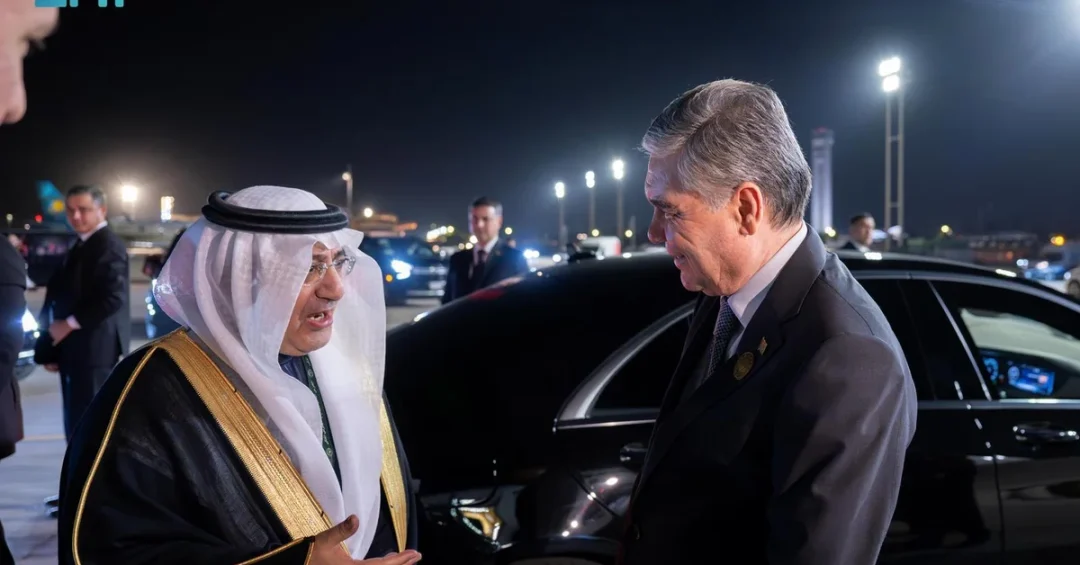
National Leader of the Turkmen people and Chairman of the People’s Council of Turkmenistan, Gurbanguly Berdimuhamedov, departed Riyadh on Tuesday following his participation in the One Water Summit, according to the Saudi Press Agency. The Turkmen delegation was seen off at King Khalid International Airport by Saudi Ambassador to Turkmenistan Said bin Osman Suwaid and a representative from the Royal Protocol, underscoring the diplomatic courtesies extended to a visiting head of delegation whose presence in the Kingdom reflected the growing convergence of interests between Riyadh and Ashgabat.
The departure marked the conclusion of a visit that placed Turkmenistan’s senior leadership at the center of one of the most consequential global gatherings on water security hosted in the Saudi capital. For observers of Central Asian and Gulf diplomacy, the image of Berdimuhamedov at the summit alongside Saudi officials and international delegates illustrated how the Kingdom has become a convening power on issues that transcend regional boundaries — water scarcity, climate resilience, and sustainable development. It also highlighted the personal relationships that Saudi diplomacy has cultivated across the Caspian region and beyond, relationships that Riyadh increasingly treats as strategic assets in a multipolar world.
Context and Background
What does the departure of a single visiting leader tell us about the broader currents in Saudi foreign policy? In the case of Berdimuhamedov’s exit from Riyadh, the answer lies in the summit that brought him there. The One Water Summit, hosted in the Saudi capital, assembled heads of state, ministers, and international organizations to confront a challenge that affects every nation represented: the sustainable management of water resources in an era of climate stress. Saudi Arabia’s decision to host such a gathering reflects its recognition that water security is inseparable from food security, energy stability, and economic diversification — pillars of its long-term national strategy.
Turkmenistan’s participation was equally significant. As a landlocked Central Asian nation with vast desert expanses and a heavy reliance on irrigated agriculture, Turkmenistan shares with Saudi Arabia a deep understanding of water’s role in national survival. The two countries have maintained diplomatic relations since the early 1990s, but recent years have seen a quiet deepening of ties across energy, trade, and infrastructure. Berdimuhamedov’s decision to attend the Riyadh summit in person signaled that Ashgabat views the Kingdom not merely as a distant partner but as a diplomatic and technological hub capable of facilitating solutions to shared challenges.
For Saudi Arabia, the visit also served a wider purpose. The Kingdom has been steadily expanding its diplomatic footprint in Central Asia, a region rich in energy resources and strategically positioned between Russia, China, and South Asia. Hosting leaders such as Berdimuhamedov reinforces Riyadh’s claim to be a bridge-builder — a country that can bring together diverse stakeholders around common goals. That positioning is central to the Kingdom’s Vision 2030 ambition of becoming a global investment and logistics hub, and it depends on maintaining relationships that span continents.
Key Details of the Departure and the Summit
The official account from the Saudi Press Agency was concise: Berdimuhamedov and his accompanying delegation left Riyadh on Tuesday after participating in the One Water Summit. He was seen off at King Khalid International Airport by Ambassador Said bin Osman Suwaid and a representative from the Royal Protocol. Yet the brevity of the statement belies the substance of what the visit represented. The presence of the Saudi Ambassador to Turkmenistan at the farewell ceremony was a deliberate diplomatic signal — a reminder that Riyadh maintains a permanent diplomatic presence in Ashgabat and that the relationship is managed at the highest levels.
The Royal Protocol’s involvement is also noteworthy. In Saudi diplomatic practice, the level of protocol assigned to a departing dignitary reflects the importance the Kingdom attaches to the visitor and the relationship. The fact that a senior protocol representative joined the ambassador at the airport suggests that Berdimuhamedov’s visit was treated as a state-level engagement, not a routine multilateral attendance. Such courtesies are part of a broader Saudi approach to diplomacy that combines formal protocol with personal outreach, building goodwill that can later be translated into concrete cooperation.
The One Water Summit itself provided the substantive backdrop. While the summit’s full agenda and outcomes are communicated through official channels, its focus on water governance aligns directly with Saudi Arabia’s domestic priorities. The Kingdom operates one of the world’s largest desalination programs and has invested heavily in water recycling, smart irrigation, and aquifer management. Hosting a global summit on water allowed Saudi Arabia to showcase its technological capabilities while also learning from partners like Turkmenistan, which manages complex transboundary water systems in Central Asia.
Berdimuhamedov’s role as Chairman of the People’s Council of Turkmenistan gives him a unique standing in his country’s political system. The People’s Council is the highest representative body in Turkmenistan, and its chairman carries significant influence over national policy. His participation in the Riyadh summit therefore carried more weight than a typical ministerial attendance. It signaled that Turkmenistan’s top leadership is personally invested in the water security agenda and in the relationship with Saudi Arabia.
International and Regional Impact
How might this visit reshape perceptions of Saudi Arabia’s role in Central Asia? The Kingdom’s engagement with Turkmenistan is part of a broader pattern. In recent years, Saudi officials have intensified contacts with Kazakhstan, Uzbekistan, Kyrgyzstan, and Tajikistan, driven by a combination of energy interests, trade opportunities, and a desire to present the Kingdom as a reliable partner for development. Central Asian nations, for their part, have welcomed Saudi investment and diplomatic support as they seek to diversify their own international relationships.
The water summit added a new dimension to this engagement. Water is a deeply political issue in Central Asia, where rivers cross borders and upstream-downstream tensions can flare. By convening leaders from the region alongside global experts, Saudi Arabia positioned itself as a neutral and constructive actor — a country that can facilitate dialogue without historical baggage. That role complements the Kingdom’s broader diplomatic efforts, including its hosting of peace talks and its membership in multilateral forums. For Turkmenistan, attending the summit in Riyadh was an opportunity to raise its profile on a global stage and to strengthen ties with a Gulf partner that has both capital and technical expertise.
The regional impact extends beyond Central Asia. Saudi Arabia’s ability to attract leaders from across Asia, Africa, and Europe to a water-focused summit demonstrates its convening power at a time when many international institutions are struggling to deliver results. For international audiences, the visit serves as a reminder that the Kingdom’s diplomatic reach is not limited to the Middle East. It spans the Caspian, the Caucasus, and the broader Asian landmass — a reach that is essential for a country that aspires to be a global logistics and investment hub.
Economic and Strategic Significance
What economic threads connect Riyadh and Ashgabat, and why does a farewell at the airport matter for markets and investors? Turkmenistan sits atop some of the world’s largest natural gas reserves, while Saudi Arabia is a global energy powerhouse and a major investor in petrochemicals and renewables. The two countries have explored cooperation in energy, but the relationship also extends to agriculture, transport, and infrastructure. Saudi companies have expressed interest in Central Asian markets, and Turkmenistan’s location on the Caspian Sea makes it a potential link in east-west trade corridors that Saudi Arabia is helping to develop.
The strategic significance of the visit lies in its timing. Global supply chains are being reconfigured, and countries across Asia are seeking reliable partners for investment and technology transfer. Saudi Arabia, with its Vision 2030 diversification program, is positioning itself as a source of capital and expertise in sectors such as water desalination, renewable energy, and smart agriculture. By hosting Turkmenistan’s leader at a water summit, the Kingdom showcased exactly the kind of technical leadership that it hopes to export. The farewell at King Khalid International Airport was thus not merely a ceremonial end to a visit; it was a marker of an ongoing economic conversation.
For Saudi investors, the relationship with Turkmenistan opens doors to a market of more than six million people and a strategic position between Europe and Asia. For Turkmenistan, Saudi Arabia offers access to investment, technology, and a diplomatic partner with global reach. The mutual benefits are clear, and the protocol observed at the airport — ambassador and royal representative — reflects the seriousness with which both sides view the relationship.
Vision 2030 Alignment
How does a summit about water and a Central Asian leader’s departure connect to Saudi Arabia’s Vision 2030? The answer lies in the Vision’s emphasis on sustainability, international cooperation, and economic diversification. Water security is a core component of Saudi Arabia’s environmental and economic planning. The Kingdom has committed to ambitious targets for water reuse, desalination efficiency, and renewable energy-powered water production. Hosting the One Water Summit and engaging with partners like Turkmenistan advances those goals by facilitating knowledge exchange and attracting international attention to Saudi solutions.
Vision 2030 also calls for Saudi Arabia to play a leading role in global affairs, not just regionally but internationally. The Kingdom’s ability to convene leaders from Central Asia, Africa, and beyond is a direct expression of that ambition. Each visiting delegation, each summit, and each diplomatic farewell contributes to the network of relationships that will underpin Saudi Arabia’s future as a hub for trade, tourism, and investment. The departure of Gurbanguly Berdimuhamedov from Riyadh is a small but meaningful piece of that larger story — a story of a Kingdom that is opening up, building bridges, and positioning itself at the center of a changing world.
20 Questions
Q1. Who is Gurbanguly Berdimuhamedov?
A1. Gurbanguly Berdimuhamedov is the National Leader of the Turkmen people and Chairman of the People’s Council of Turkmenistan. He previously served as President of Turkmenistan and remains a central figure in the country’s political system.
Q2. What event did he attend in Riyadh?
A2. He attended the One Water Summit, a global gathering focused on water security and sustainable water management, hosted in the Saudi capital, Riyadh.
Q3. When did he leave Riyadh?
A3. He left Riyadh on Tuesday, following his participation in the One Water Summit, according to the Saudi Press Agency.
Q4. Who saw him off at the airport?
A4. He was seen off at King Khalid International Airport by Saudi Ambassador to Turkmenistan Said bin Osman Suwaid and a representative from the Royal Protocol.
Q5. Why is the presence of the Saudi Ambassador significant?
A5. It shows that Saudi Arabia maintains a permanent diplomatic presence in Turkmenistan and that the bilateral relationship is actively managed at the highest levels.
Q6. What is the One Water Summit?
A6. The One Water Summit is an international gathering that brings together leaders and experts to address global water challenges, including scarcity, governance, and sustainable management.
Q7. Why did Saudi Arabia host the One Water Summit?
A7. Saudi Arabia hosted the summit to highlight its commitment to water security and to provide a platform for international cooperation on one of the world’s most pressing environmental issues.
Q8. How does water security relate to Saudi Arabia’s national priorities?
A8. Water security is essential for Saudi Arabia’s food security, economic stability, and environmental sustainability. The Kingdom invests heavily in desalination and water reuse technologies.
Q9. What is Turkmenistan’s interest in the summit?
A9. Turkmenistan faces significant water challenges as a landlocked Central Asian nation. The summit allowed it to engage with global partners on water governance and technology.
Q10. What does the visit say about Saudi-Turkmenistan relations?
A10. The visit reflects growing ties between the two countries, encompassing diplomacy, trade, energy, and cooperation on shared challenges such as water management.
Q11. How does this visit fit into Saudi Arabia’s broader diplomacy?
A11. It is part of Saudi Arabia’s efforts to expand its diplomatic footprint in Central Asia and to position itself as a global convening power on key issues.
Q12. What role does the Royal Protocol play in such visits?
A12. The Royal Protocol ensures that visiting dignitaries receive appropriate courtesies. Its presence at the airport signals the importance Saudi Arabia attaches to the visitor.
Q13. What are the economic dimensions of Saudi-Turkmenistan relations?
A13. The relationship includes potential cooperation in energy, agriculture, infrastructure, and trade. Turkmenistan’s gas reserves and strategic location are of interest to Saudi investors.
Q14. How does the visit align with Vision 2030?
A14. It aligns with Vision 2030’s goals of international cooperation, sustainability, and economic diversification, showcasing Saudi Arabia’s role as a global hub.
Q15. What message does the departure send to international observers?
A15. It signals that Saudi Arabia is a welcoming host for world leaders and remains actively engaged in multilateral diplomacy on critical global issues.
Q16. Did the visit produce any specific agreements?
A16. The official statement focused on participation in the summit. Any bilateral agreements would be announced through official Saudi channels if and when finalized.
Q17. How does Saudi Arabia support water innovation?
A17. Saudi Arabia invests in desalination research, smart irrigation, and water recycling. These technologies are central to its domestic strategy and its international partnerships.
Q18. What is the significance of Central Asia for Saudi Arabia?
A18. Central Asia is rich in energy resources and strategically located. Saudi Arabia seeks partnerships there to expand trade, investment, and diplomatic influence.
Q19. How does this visit compare to other recent Saudi diplomatic engagements?
A19. It is consistent with Saudi Arabia’s pattern of hosting and engaging with leaders from diverse regions, reinforcing its role as a global diplomatic hub.
Q20. What can we expect next in Saudi-Turkmenistan relations?
A20. Continued dialogue and potential cooperation in water, energy, and trade. Both countries have shown interest in deepening ties through official channels and mutual visits.
Reader Feedback
We value your thoughts. Please share your feedback on this article.
Your feedback helps us improve our coverage.
Related articles
 Crown Prince Meets Turkmen Leader at One Water Summit
 Arab Group Commits $10B by 2030 to Fight Desertification
 Crown Prince Meets Kazakhstan President at One Water Summit
 Crown Prince Meets Macron, French Executives in Riyadh
 Crown Prince Meets Pakistan PM at One Water Summit
 Crown Prince Meets World Bank President at One Water Summit