


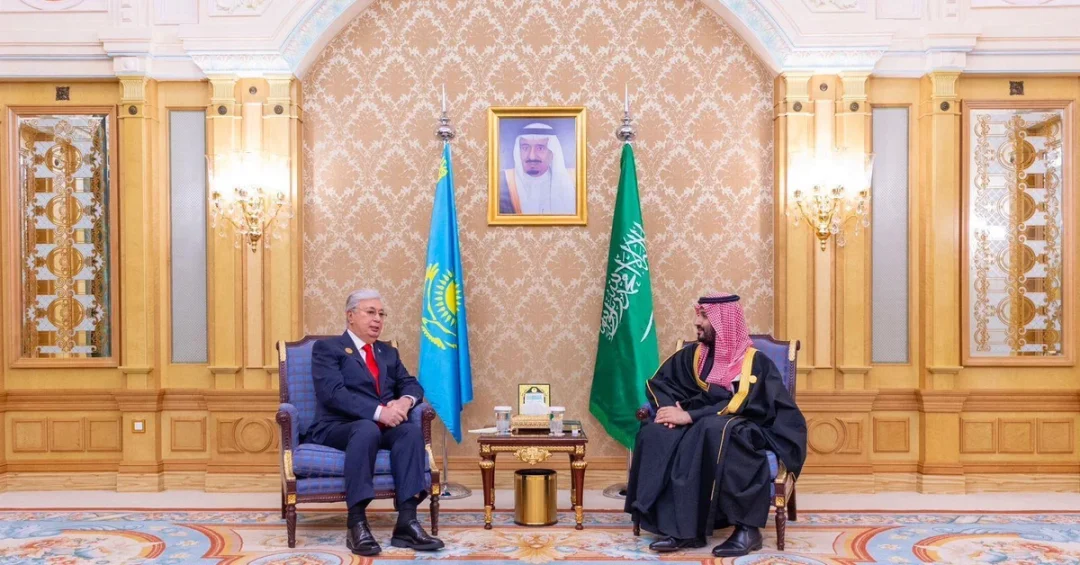
His Royal Highness Prince Mohammed bin Salman bin Abdulaziz Al Saud, Crown Prince and Prime Minister, met with Republic of Kazakhstan President Kassym-Jomart Tokayev in Riyadh on Tuesday on the sidelines of the One Water Summit, according to an official announcement carried by the Saudi Press Agency. The meeting brought together two nations that have steadily expanded cooperation across energy, investment, agriculture and environmental sustainability, and it placed water security at the center of a diplomatic exchange with clear regional and global resonance.
The encounter was not a standalone courtesy call but part of a wider week of high-level diplomacy hosted by the Kingdom. Riyadh welcomed heads of state, ministers and international organizations for the One Water Summit, an initiative focused on the sustainability of water sources and the environmental pressures facing arid and semi-arid regions. For Saudi Arabia, hosting such a gathering reflects a deliberate strategy of convening global conversations on challenges that directly affect the Kingdom and its partners. Could there be a more fitting venue for a summit on water sustainability than a nation that has turned desert management into a science?
Context and Background
Saudi-Kazakhstan relations have deepened considerably over the past several years, anchored in shared interests in energy markets, food security and sustainable resource management. Kazakhstan is the largest landlocked country in the world and a major producer of oil, uranium, wheat and other agricultural commodities, while Saudi Arabia is a leading global energy exporter and an increasingly influential investor across Central Asia. The two capitals have pursued a steady rhythm of official visits, business delegations and agreements that reflect mutual economic priorities rather than short-term diplomatic gestures.
The One Water Summit provided a natural platform for the two leaders to review bilateral relations and explore ways to enhance and develop them in various fields. Water sits at the intersection of agriculture, energy production, urban development and climate resilience, making it a logical focus for countries that must manage scarce resources carefully. In Saudi Arabia, decades of investment in desalination, wastewater treatment and irrigation efficiency have produced expertise that is now shared internationally, including through the Kingdom’s development and environmental initiatives.
Why does a bilateral meeting between Saudi Arabia and Kazakhstan matter beyond the two countries themselves? Because both sit at the center of larger geopolitical and economic corridors. Kazakhstan is a key node in China’s Belt and Road Initiative and in trans-Caspian trade routes, while Saudi Arabia is a pivotal player in the Gulf, the broader Middle East and the global energy system. When these two governments coordinate, the effects ripple through supply chains, investment flows and multilateral negotiations on climate and water policy.
Key Details of the Riyadh Meeting
During the meeting, the Crown Prince and President Tokayev reviewed bilateral relations between the two countries and discussed ways to enhance and develop them in various fields, according to the Saudi Press Agency. They also addressed several issues of mutual interest, particularly coordinating joint efforts to ensure the sustainability of water sources and to address environmental challenges. The discussion reflected a shared recognition that water scarcity is not a distant concern but a present-day policy priority for both nations.
The meeting was attended by a senior Saudi delegation that underscored the breadth of the bilateral agenda. Minister of Energy Prince Abdulaziz bin Salman bin Abdulaziz represented the energy portfolio, a sector where Saudi Arabia and Kazakhstan have complementary strengths. Minister of State and Cabinet Member Prince Turki bin Mohammed bin Fahd bin Abdulaziz attended, alongside Minister of Foreign Affairs Prince Faisal bin Farhan bin Abdullah, reflecting the diplomatic importance attached to the relationship. Minister of Investment Eng. Khalid Al-Falih participated, signaling the economic and investment dimensions of the talks, and Saudi Ambassador to Kazakhstan Faisal Al-Qahtani was present, along with the official delegation of the President of Kazakhstan.
The composition of the delegations tells its own story. Energy, foreign affairs, investment and the resident ambassador were all in the room, which suggests conversations that ranged from immediate commercial opportunities to longer-term strategic coordination. Isn’t it telling that a meeting described as a bilateral review brought together the ministers whose portfolios most directly shape Saudi Arabia’s international economic engagement?
Water Security as a Shared Priority
Water sustainability was the thematic thread running through the One Water Summit and through the bilateral discussion. Saudi Arabia has long treated water as a strategic resource, investing heavily in desalination capacity, water reuse and demand management. The Kingdom’s National Water Strategy aims to reduce reliance on non-renewable groundwater, expand treated wastewater use and improve the efficiency of agricultural and urban consumption. These priorities align closely with the environmental challenges facing Kazakhstan, where glacial melt, river basin management and irrigation efficiency are pressing concerns.
Coordinating joint efforts on water sources is therefore more than a diplomatic talking point. It opens the door to technical cooperation, research exchange, joint ventures in water technology and shared positions in international environmental forums. Saudi expertise in desalination and water treatment can complement Kazakh expertise in transboundary river management and agricultural water use. Could cooperation on something as fundamental as water become the foundation for a broader innovation partnership between Riyadh and Astana?
The environmental dimension also connects to climate policy. Both countries have committed to international climate frameworks and have an interest in ensuring that water and environmental issues receive adequate attention in global discussions. By aligning their efforts, Saudi Arabia and Kazakhstan can present a unified perspective on the needs of arid and landlocked regions, which are often underrepresented in international environmental negotiations.
International and Regional Impact
The Riyadh meeting carries significance beyond the bilateral relationship. Central Asia has emerged as a region of growing strategic importance, sitting between Russia, China, the Middle East and South Asia. Saudi Arabia’s engagement with Kazakhstan is part of a broader outreach to Central Asian states that includes investment, trade and diplomatic coordination. This outreach supports the Kingdom’s objective of diversifying partnerships and positioning itself as a reliable long-term partner across multiple regions.
For Kazakhstan, engagement with Saudi Arabia offers access to Gulf investment, energy market expertise and a diplomatic partner with global reach. President Tokayev’s participation in the One Water Summit in Riyadh reflects Astana’s interest in multilateral platforms where it can advance its environmental and economic priorities. The meeting also reinforces the role of Gulf capitals as convening centers for global dialogue, a role Saudi Arabia has embraced through summits, conferences and international initiatives hosted across the Kingdom.
How will this meeting be viewed by other international actors? As a signal that Saudi Arabia’s diplomatic footprint continues to expand, and that middle-power cooperation on shared challenges like water and climate is becoming a defining feature of the current international system. The meeting did not produce a dramatic announcement, but its value lies in the steady accumulation of trust and coordination that such encounters enable.
Economic and Strategic Significance
Energy cooperation remains a central pillar of the Saudi-Kazakhstan relationship. Both countries are significant oil producers and have an interest in stable global energy markets, responsible production practices and the long-term sustainability of the hydrocarbon sector. Saudi Arabia’s role within OPEC and the broader OPEC+ framework gives it a unique position in global energy governance, while Kazakhstan’s production and export routes make it a key player in Eurasian energy dynamics. Coordination between the two is economically logical and strategically valuable.
Investment is another area of growing importance. Saudi Arabia’s investment ecosystem, supported by the Public Investment Fund and the Ministry of Investment, has expanded its international footprint in recent years. Kazakhstan offers opportunities in agriculture, mining, logistics, digital infrastructure and renewable energy. The presence of Minister of Investment Eng. Khalid Al-Falih at the meeting signals that commercial and investment topics were on the agenda, consistent with the Kingdom’s broader economic diversification strategy.
Agriculture and food security also deserve attention. Kazakhstan is a major wheat exporter, and Saudi Arabia imports a substantial share of its food requirements. Strengthening agricultural trade and investment ties supports food security objectives on both sides. Doesn’t it make sense for two resource-rich countries to build resilience into their food and water systems by working together rather than separately?
Vision 2030 Alignment
The meeting aligns closely with Saudi Vision 2030, the national transformation program launched under the leadership of His Royal Highness Prince Mohammed bin Salman. Vision 2030 emphasizes economic diversification, international investment, environmental sustainability and the Kingdom’s emergence as a global hub for diplomacy and business. High-level engagement with Kazakhstan touches on several of these objectives at once: expanding non-oil trade, attracting and placing investment, advancing water and environmental sustainability, and strengthening Saudi Arabia’s international partnerships.
Water sustainability is explicitly relevant to Vision 2030’s quality-of-life and environmental goals. The Kingdom’s commitment to sustainable water management, including desalination efficiency and wastewater reuse, is part of a broader effort to secure resources for a growing population and a diversifying economy. Sharing this expertise internationally, and learning from partners like Kazakhstan, reinforces the Kingdom’s position as a responsible global actor on environmental issues.
Ultimately, the Crown Prince’s meeting with President Tokayev reflects a vision of Saudi foreign policy that is active, pragmatic and forward-looking. It is a diplomacy of partnerships rather than isolation, of shared challenges rather than unilateral action, and of long-term planning rather than short-term reaction. As Saudi Arabia continues to deepen its ties across Central Asia and beyond, meetings like this one in Riyadh will be remembered not for spectacle but for substance, building the relationships that will shape the Kingdom’s global role for years to come.
20 Questions
Q1. Who met in Riyadh on Tuesday?
A1. His Royal Highness Prince Mohammed bin Salman bin Abdulaziz Al Saud, Crown Prince and Prime Minister, met Republic of Kazakhstan President Kassym-Jomart Tokayev in Riyadh, according to the Saudi Press Agency.
Q2. What event provided the occasion for the meeting?
A2. The meeting took place on the sidelines of the One Water Summit, a multilateral gathering hosted in Riyadh focused on water sustainability and environmental challenges facing arid regions.
Q3. What topics were discussed during the meeting?
A3. The two leaders reviewed bilateral relations, explored ways to enhance cooperation across various fields, and discussed coordinating joint efforts to ensure the sustainability of water sources and address environmental challenges.
Q4. Which Saudi ministers attended the meeting?
A4. Minister of Energy Prince Abdulaziz bin Salman bin Abdulaziz, Minister of State and Cabinet Member Prince Turki bin Mohammed bin Fahd bin Abdulaziz, Minister of Foreign Affairs Prince Faisal bin Farhan bin Abdullah, and Minister of Investment Eng. Khalid Al-Falih attended.
Q5. Who else was present at the meeting?
A5. Saudi Ambassador to Kazakhstan Faisal Al-Qahtani attended, along with the official delegation accompanying the President of Kazakhstan, reflecting the diplomatic and economic importance of the talks.
Q6. Why is water security a priority for Saudi Arabia?
A6. Saudi Arabia treats water as a strategic resource, investing in desalination, wastewater reuse and demand management through its National Water Strategy to secure supplies for a growing population and diversifying economy.
Q7. How does Kazakhstan fit into Saudi Arabia’s international outreach?
A7. Kazakhstan is part of Saudi Arabia’s broader engagement with Central Asia, a region of growing strategic importance for trade, investment, energy cooperation and diplomatic coordination.
Q8. What economic sectors could benefit from closer ties?
A8. Energy, investment, agriculture, mining, logistics, digital infrastructure and renewable energy are among the sectors where Saudi-Kazakhstan cooperation could expand in the coming years.
Q9. What is the One Water Summit?
A9. The One Water Summit is an international gathering focused on water sustainability, bringing together heads of state, ministers and organizations to address environmental challenges and coordinate efforts on shared water resources.
Q10. How does this meeting relate to Vision 2030?
A10. It supports Vision 2030 objectives including economic diversification, international investment, environmental sustainability and the Kingdom’s emergence as a global diplomatic and business hub.
Q11. What role does energy play in Saudi-Kazakhstan relations?
A11. Both countries are significant oil producers with an interest in stable global energy markets, responsible production and long-term sustainability, making energy coordination economically logical and strategically valuable.
Q12. Why is Kazakhstan important in global energy markets?
A12. Kazakhstan is a major oil and uranium producer whose export routes and production capacity make it a key player in Eurasian energy dynamics and global commodity markets.
Q13. What does the attendance of the investment minister signal?
A13. It signals that commercial and investment topics were on the agenda, consistent with Saudi Arabia’s strategy of expanding international investment and attracting partners across multiple sectors.
Q14. How does water cooperation benefit both countries?
A14. It enables technical exchange, research collaboration, joint ventures in water technology and shared positions in international environmental forums, addressing common challenges in arid and landlocked regions.
Q15. What environmental challenges do both countries face?
A15. Saudi Arabia faces water scarcity and desertification, while Kazakhstan deals with glacial melt, transboundary river management and irrigation efficiency, creating complementary areas for cooperation.
Q16. What is the significance of the meeting for Central Asia?
A16. It reinforces Saudi Arabia’s engagement with Central Asian states and signals that Gulf capitals are becoming convening centers for dialogue on regional and global challenges.
Q17. Did the meeting produce any formal agreements?
A17. The official announcement described a review of bilateral relations and discussions on cooperation; no specific agreements were announced in the statement carried by the Saudi Press Agency.
Q18. How does Saudi Arabia share water expertise internationally?
A18. Through development initiatives, environmental programs and technical cooperation, Saudi Arabia shares decades of experience in desalination, wastewater treatment and irrigation efficiency with international partners.
Q19. Why is food security relevant to this relationship?
A19. Kazakhstan is a major wheat exporter and Saudi Arabia imports substantial food supplies, so strengthening agricultural trade and investment supports food security objectives on both sides.
Q20. What does this meeting say about Saudi foreign policy?
A20. It reflects an active, pragmatic and forward-looking foreign policy built on partnerships, shared challenges and long-term planning, consistent with the Kingdom’s Vision 2030 ambitions and global role.
Reader Feedback
We value your thoughts. Please share your feedback on this article.
Your feedback helps us improve our coverage.
Related articles
 Crown Prince Meets Macron, French Executives in Riyadh
 Crown Prince Meets Pakistan PM at One Water Summit
 Crown Prince Meets World Bank President at One Water Summit
 World Bank President Stresses Global Partnerships to Address Water Challenges
 Saudi Crown Prince Meets Mongolian Prime Minister at Water Summit
 Saudi Arabia Weather Forecast for Wednesday