


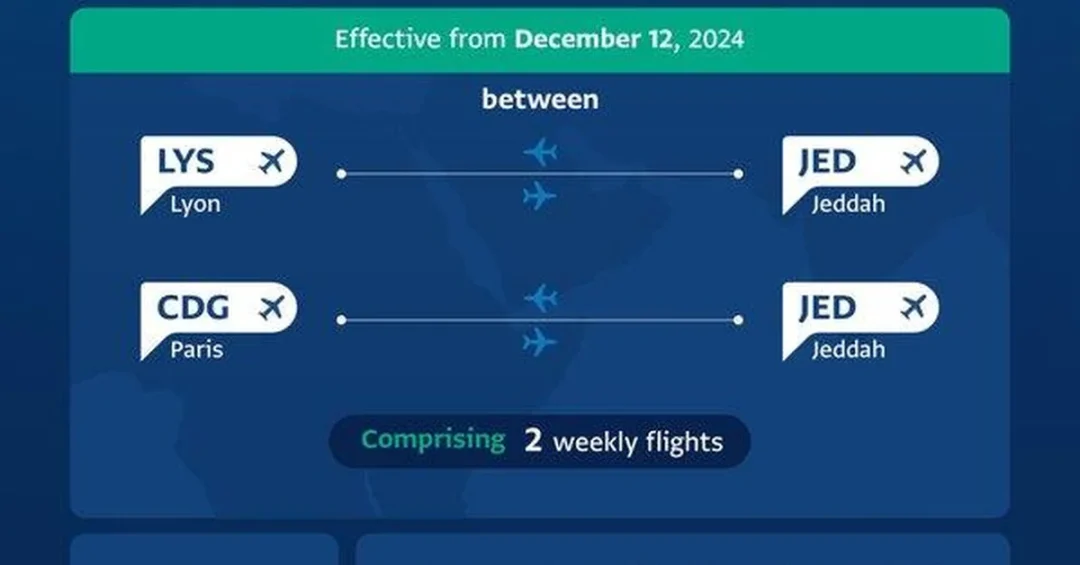
The General Authority of Civil Aviation (GACA) has authorized Transavia France, the low-cost subsidiary of Air France-KLM, to begin operating regular commercial flights between France and the Kingdom of Saudi Arabia, with service connecting Lyon and Paris to Jeddah during the 2024 winter season. The announcement, released through official Saudi channels, marks another concrete step in the Kingdom’s rapid expansion of international air connectivity and reflects the broader objectives of the National Aviation Strategy. Flights are scheduled to commence on December 12, with a frequency of two services per week, offering French travelers and European visitors a new direct gateway to Saudi Arabia’s western region.
The decision by GACA, the Kingdom’s civil aviation regulator and the driving force behind the sector’s modernization, underscores how quickly Saudi Arabia is opening its skies to new carriers and markets. For international readers, the development matters because it signals that Saudi Arabia is not only building airports and terminals but also actively courting foreign airlines to fill them. With Jeddah’s King Abdulaziz International Airport serving as the principal gateway for Umrah pilgrims and Red Sea tourists alike, the arrival of Transavia France adds capacity on a route that has historically been underserved by low-cost options. Could this be the beginning of a broader low-cost aviation wave into the Kingdom?
Context and Background
Saudi Arabia has spent the better part of a decade reshaping its aviation sector from a state-dominated model into a competitive, globally integrated industry. The National Aviation Strategy, launched under the umbrella of Saudi Vision 2030, sets ambitious targets: tripling passenger traffic, expanding connectivity to more than 250 destinations worldwide, and increasing the aviation sector’s contribution to gross domestic product. GACA has been at the center of this transformation, streamlining licensing procedures, encouraging new entrants, and negotiating air service agreements with partner countries across Europe, Asia, and the Americas. The authorization granted to Transavia France is a direct product of that strategy in action.
France has long been an important aviation partner for the Kingdom. Air France and Saudia already operate scheduled services between Paris and Riyadh and Jeddah, while French cargo carriers move goods through Saudi logistics hubs. What has been missing, however, is meaningful low-cost capacity that can serve price-sensitive leisure travelers, students, expatriate communities, and the growing number of European tourists curious about Saudi Arabia’s heritage sites and Red Sea resorts. Transavia France, which operates a fleet of Boeing 737 aircraft and has built a strong network across the Mediterranean, brings precisely that kind of accessible, high-frequency service model to the market.
The timing is significant. Saudi Arabia’s winter season is peak travel time, drawing visitors to Jeddah’s historic Al-Balad district, the Red Sea coastline, and the holy cities of Makkah and Madinah. By launching on December 12, Transavia France positions itself to capture holiday and Umrah demand from France, where a large Muslim community maintains strong ties to the Kingdom. At the same time, the route gives Saudi travelers and residents a new affordable option for reaching Lyon, a major French cultural and gastronomic center, and Paris, one of the world’s most visited cities. Doesn’t that two-way flow of people represent exactly the kind of cultural and economic exchange Vision 2030 seeks to promote?
Key Details of the New Route
Under the authorization announced by GACA, Transavia France will operate two weekly flights connecting Lyon and Paris with Jeddah throughout the winter 2024 season. The service begins on December 12, 2024, and will use narrow-body aircraft configured for short- and medium-haul operations. Lyon, France’s third-largest city and a hub for business and education, gains its first regular low-cost link to Saudi Arabia, while Paris reinforces its position as a leading European gateway to the Kingdom. The dual-origin structure means travelers from across France and neighboring countries can connect through these cities with relative ease.
The frequency of two flights per week is a measured entry point, typical of how low-cost carriers test new markets before scaling up. Industry analysts often view such initial schedules as a signal of intent: if demand meets expectations, frequencies can increase, and additional Saudi destinations such as Riyadh or Dammam could follow. For GACA, the authorization demonstrates its willingness to license foreign low-cost operators, a policy shift that would have been unusual a decade ago. The regulator has repeatedly emphasized that new routes are evaluated not only for commercial viability but also for their contribution to the Kingdom’s tourism, pilgrimage, and business travel goals.
For passengers, the practical benefits are straightforward. Direct flights eliminate the need for time-consuming connections through other European hubs, reducing total journey times and often lowering fares through competition. French travelers planning Umrah or leisure trips to Jeddah can now book straightforward itineraries on a carrier known for transparent pricing. Saudi citizens and residents, meanwhile, gain easier access to France’s cultural attractions, universities, and business centers. What does this mean for the broader European aviation market’s view of Saudi Arabia as a destination?
International and Regional Impact
The entry of Transavia France into the Saudi market carries implications that extend well beyond a single route. European low-cost carriers have watched the Kingdom’s aviation liberalization closely, and a successful Transavia operation could encourage others to apply for rights. That, in turn, would intensify competition on Europe-Saudi routes, potentially lowering fares and increasing visitor numbers. For France, the route strengthens commercial and people-to-people ties with a Gulf partner that is increasingly important in energy, defense, technology, and cultural cooperation. For Saudi Arabia, each new foreign carrier represents a vote of confidence in its regulatory environment and infrastructure.
Regionally, the move fits into a wider pattern. Saudi Arabia has been signing air service agreements and attracting carriers from across Europe, Asia, and Africa as part of its ambition to become a global logistics and tourism hub. Jeddah’s strategic location on the Red Sea makes it a natural bridge between Europe, Africa, and Asia. When a French carrier adds Jeddah to its network, it effectively connects the Kingdom to a dense web of onward destinations in Europe and beyond, amplifying Saudi Arabia’s reach without the Kingdom having to operate the aircraft itself. Isn’t that precisely the kind of mutually beneficial connectivity that a global hub strategy requires?
Economic and Strategic Significance
Aviation is a cornerstone of Saudi Arabia’s economic diversification agenda. The National Aviation Strategy aims to increase the sector’s annual contribution to GDP substantially and to create hundreds of thousands of jobs across airlines, airports, ground services, and tourism. Every new route brings incremental spending on hotels, restaurants, transport, and retail, particularly in Jeddah, which serves as the gateway to Makkah and the Red Sea coast. Transavia’s winter service arrives at a moment when Saudi Arabia is investing heavily in Jeddah’s airport capacity and in new destinations such as the Red Sea Project, positioning the city as a year-round tourism and pilgrimage hub.
For France, the economic logic is equally compelling. Outbound tourism to Saudi Arabia is a growing niche, driven by cultural curiosity, religious travel, and business links. French companies are active in Saudi infrastructure, energy, and luxury sectors, and easier air access supports their mobility. The route also facilitates inbound tourism from Saudi Arabia to France, supporting French hospitality, retail, and education exports. In strategic terms, aviation connectivity is a soft-power asset: it deepens diplomatic relationships, facilitates cultural exchange, and builds familiarity between societies. Both Riyadh and Paris have signaled that they view the relationship as strategically important, and this route is a tangible expression of that shared outlook.
Vision 2030 Alignment
The authorization of Transavia France aligns squarely with Saudi Vision 2030, the comprehensive national transformation plan launched under the leadership of Crown Prince Mohammed bin Salman. Vision 2030 seeks to diversify the economy away from oil, develop public service sectors, and position the Kingdom as a global investment and logistics powerhouse. The National Aviation Strategy, a key enabler of that vision, targets unprecedented growth in passenger numbers and destinations. Each new foreign carrier that GACA licenses contributes directly to those targets, expanding the Kingdom’s global network and demonstrating that Saudi Arabia is open for business, tourism, and cultural exchange.
Looking ahead, the Transavia France route is best understood as one piece of a much larger mosaic. Saudi Arabia is investing in new airlines, expanding airport capacity, and reforming visa policies to welcome millions more visitors each year. The Kingdom’s aviation ambitions are regional in scope but global in reach, linking Saudi cities to Europe, Asia, Africa, and the Americas. As the winter season begins and the first Transavia flight touches down in Jeddah on December 12, it will carry more than passengers; it will carry the promise of deeper ties between France and Saudi Arabia and further proof that the Kingdom’s vision for its future is taking off.
20 Questions
Q1. What did the General Authority of Civil Aviation announce regarding Transavia France?
A1. GACA announced that Transavia France has been authorized to operate regular commercial flights between Saudi Arabia and France, connecting Lyon and Paris with Jeddah during the winter 2024 season, starting December 12.
Q2. Which cities will Transavia France serve on this new route?
A2. The airline will operate flights from Lyon and Paris in France to Jeddah in Saudi Arabia, providing two weekly services throughout the winter season and linking French travelers directly to the Kingdom’s western gateway.
Q3. When do the new Transavia France flights begin operating?
A3. The flights are scheduled to commence on December 12, 2024, as part of the winter season schedule, with a frequency of two flights per week between France and Jeddah.
Q4. How many flights per week will Transavia France operate?
A4. Transavia France will operate two flights per week on the new route, a measured frequency that allows the carrier to test demand while offering travelers convenient direct connections to Jeddah.
Q5. What is the role of GACA in this development?
A5. GACA, the General Authority of Civil Aviation, is the Kingdom’s civil aviation regulator. It authorized Transavia France to operate the route as part of its efforts to strengthen air connectivity and integrate Saudi Arabia into the global aviation network.
Q6. How does this route support Saudi Vision 2030?
A6. The route supports Vision 2030 by expanding air connectivity, boosting tourism and pilgrimage travel, and advancing the goal of positioning Saudi Arabia as a global logistics hub under the National Aviation Strategy.
Q7. What is the National Aviation Strategy?
A7. The National Aviation Strategy is a Saudi initiative to triple passenger traffic, expand connectivity to over 250 destinations, and increase aviation’s contribution to GDP, serving as a key enabler of Vision 2030’s economic diversification goals.
Q8. Why is Jeddah an important destination for this route?
A8. Jeddah is the gateway to Makkah and Madinah for Umrah pilgrims and a growing tourism hub on the Red Sea, making it a strategic entry point for French and European visitors to the Kingdom.
Q9. What benefits does the route offer French travelers?
A9. French travelers gain direct, affordable access to Jeddah for religious pilgrimage, cultural tourism, and business, eliminating the need for connections through other European hubs and reducing overall journey times.
Q10. What benefits does the route offer Saudi travelers?
A10. Saudi citizens and residents gain convenient access to Lyon and Paris, supporting tourism, education, business travel, and cultural exchange between the Kingdom and France.
Q11. Why did GACA authorize a low-cost carrier like Transavia France?
A11. GACA’s authorization reflects its strategy to encourage new entrants and competition, which can lower fares, increase passenger choice, and accelerate progress toward the Kingdom’s connectivity and tourism targets.
Q12. What kind of airline is Transavia France?
A12. Transavia France is the low-cost subsidiary of Air France-KLM, operating a fleet of Boeing 737 aircraft and serving leisure and business travelers across Europe and the Mediterranean region.
Q13. How does this route affect competition in the Europe-Saudi market?
A13. The entry of Transavia France introduces additional low-cost capacity on France-Saudi routes, which may encourage competitive pricing and encourage other European carriers to seek similar authorizations.
Q14. What does this development mean for Saudi Arabia’s tourism sector?
A14. It expands access to the Kingdom for European tourists, supporting growth in Jeddah’s hospitality, heritage, and Red Sea destinations, and contributing to the broader tourism goals of Vision 2030.
Q15. How does the route support Umrah and Hajj travel?
A15. By connecting France directly to Jeddah, the route makes it easier for French Muslims and other European pilgrims to perform Umrah, adding convenient capacity during the peak winter pilgrimage season.
Q16. What economic impact could this route have on Jeddah?
A16. Increased visitor arrivals can boost spending in hotels, restaurants, retail, and transport, creating jobs and supporting local businesses in Jeddah and the surrounding western region.
Q17. Is this route part of a larger trend in Saudi aviation?
A17. Yes, it is part of a broader pattern of air service agreements and new carrier authorizations as Saudi Arabia liberalizes its aviation market and pursues its goal of becoming a global logistics hub.
Q18. What might happen if the route performs well?
A18. Strong demand could lead to increased frequencies, additional French or European routes to Saudi cities such as Riyadh or Dammam, and greater competition that benefits travelers on both sides.
Q19. How does this route reflect Saudi-French relations?
A19. The route strengthens bilateral ties by facilitating people-to-people exchange, business travel, and tourism, complementing existing cooperation in energy, defense, culture, and investment between the two countries.
Q20. What is the broader significance of this announcement for Saudi Arabia?
A20. It demonstrates the Kingdom’s continued progress in opening its skies, attracting international carriers, and building the connectivity needed to achieve Vision 2030’s economic and tourism ambitions on the world stage.
Reader Feedback
We value your thoughts. Please share your feedback on this article.
Your feedback helps us improve our coverage.
Related articles
 Air France-KLM to Expand Footprint in Saudi Arabia
 King Salman Reserve Shines at Falconry Festival
 Chedi Hegra Hotel Opens in AlUla, Boosting Saudi Tourism
 Saudi Red Sea Authority Issues First Yacht Chartering Licenses
 Saudi Arabia Ranks Third Globally in Tourist Arrival Growth
 Saudi Tourism Authority Partners with Red Sea Film Festival