


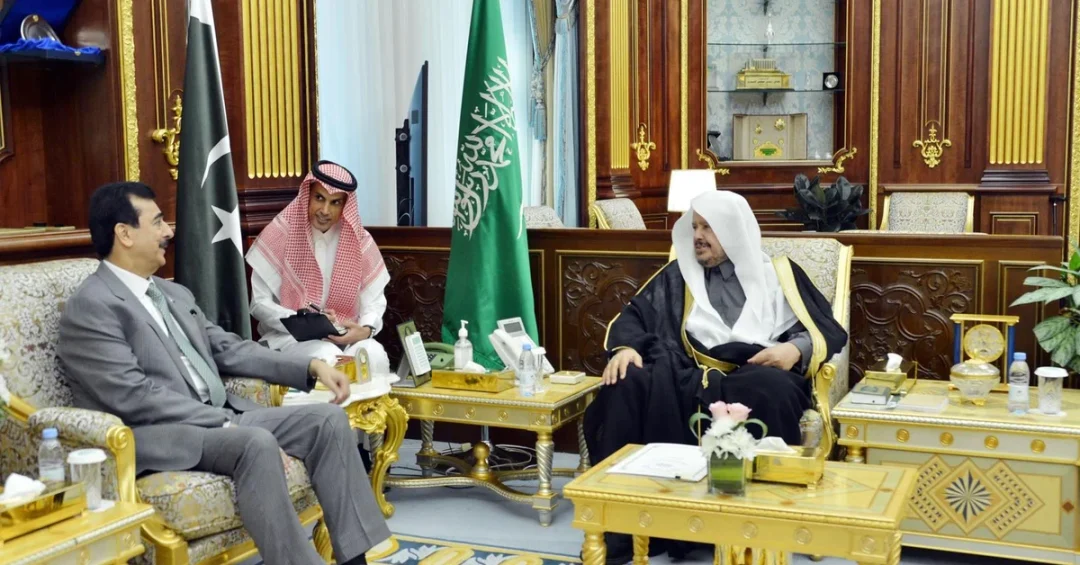
Saudi Arabia’s Shura Council Speaker, Sheikh Dr. Abdullah bin Mohammed bin Ibrahim Al Al-Sheikh, held official talks with Chairman of the Senate of Pakistan, Yousuf Raza Gillani, and his accompanying parliamentary delegation at the Shura Council headquarters in Riyadh on November 26, 2024, in a session that underscored the enduring fraternal ties between the Kingdom and Pakistan and the growing role of parliamentary diplomacy in advancing shared regional and international objectives. The meeting, reported by the Saudi Press Agency, brought together senior parliamentary figures from both nations to discuss avenues for deepening legislative cooperation, exchanging expertise, and coordinating positions in regional and international parliamentary forums.
The talks reflect a broader pattern of intensifying high-level engagement between Saudi Arabia and Pakistan, two nations whose relationship rests on decades of mutual support, economic partnership, and people-to-people bonds. Against the backdrop of Saudi Vision 2030 and the Kingdom’s expanding diplomatic footprint, the Riyadh session served as a platform for aligning parliamentary priorities with the strategic goals set by the leadership of both countries. The discussions also highlighted the importance of reciprocal visits and structured dialogue in translating political goodwill into tangible legislative outcomes.
Context and Background
What makes this parliamentary encounter significant in the wider arc of Saudi-Pakistani relations? The relationship between the Kingdom of Saudi Arabia and the Islamic Republic of Pakistan has long been characterized by deep historical, cultural, and religious ties, underpinned by consistent Saudi support for Pakistan’s development and stability. Over the decades, the two countries have cooperated across energy, trade, defense, labor, and humanitarian domains, with Saudi Arabia frequently extending economic assistance and hosting millions of Pakistani workers who contribute to the Kingdom’s economy.
The Shura Council, Saudi Arabia’s consultative assembly, plays a central role in reviewing legislation, advising on national policy, and representing the Kingdom in international parliamentary networks. Its engagement with the Senate of Pakistan is part of a deliberate strategy to institutionalize bilateral dialogue beyond executive channels. By bringing legislators into the conversation, Riyadh and Islamabad aim to build durable frameworks that can withstand shifts in the regional environment and ensure continuity in cooperation.
The November 26 session follows a series of high-level exchanges between the two nations, including visits by Saudi officials to Pakistan and Pakistani delegations to the Kingdom. These interactions have covered investment opportunities, energy cooperation, and joint efforts in multilateral organizations. The parliamentary dimension adds a layer of legitimacy and public representation, enabling both sides to address issues that resonate with their citizens and to harmonize positions on matters of mutual concern.
Key Details of the Talks
What specific priorities did the two parliamentary leaders emphasize during their discussions? Sheikh Dr. Abdullah bin Mohammed bin Ibrahim Al Al-Sheikh opened the session by welcoming Chairman Yousuf Raza Gillani and his delegation, praising the Kingdom’s rapid development progress under the leadership of Custodian of the Two Holy Mosques King Salman bin Abdulaziz Al Saud and His Royal Highness Prince Mohammed bin Salman bin Abdulaziz Al Saud, Crown Prince and Prime Minister, in line with Saudi Vision 2030.
The Shura Council Speaker stressed the deep fraternal and historical ties between Saudi Arabia and Pakistan, describing them as rooted in shared values and mutual respect. He pointed to the pivotal role of parliamentary diplomacy and the importance of bilateral meetings and reciprocal visits in enhancing parliamentary relations. He also highlighted the significance of exchanging parliamentary expertise and experiences while working toward unified stances in regional and international parliamentary forums, a point that reflects the Kingdom’s broader commitment to multilateral engagement.
For his part, Chairman Gillani expressed his pleasure at visiting the Kingdom, praising the warm hospitality and reception accorded to him and his delegation. He commended Saudi Arabia’s significant role, under its wise leadership, in supporting Pakistan on various issues, and highlighted the strong bonds between the two nations and their peoples. He referred to the constructive cooperation between the two countries and stressed the roles and responsibilities of legislative councils in addressing issues of mutual interest, contributing to their regional and international status. Vice Speaker of the Shura Council, Dr. Mishaal bin Fahm Al-Sulami, and several officials from both the Saudi and Pakistani sides attended the meeting.
International and Regional Impact
How does this parliamentary engagement fit into the broader regional landscape? Saudi Arabia and Pakistan share a vision of stability and prosperity in South Asia, the Middle East, and the wider Islamic world. The Riyadh talks come at a time when parliamentary diplomacy is increasingly recognized as a tool for conflict prevention, confidence-building, and economic integration. By coordinating their positions in international parliamentary forums, the two countries can amplify their voices on issues such as trade, energy security, and humanitarian relief.
The meeting also signals the Kingdom’s continued investment in its relationships with key Asian partners, consistent with Vision 2030’s emphasis on diversifying alliances and deepening economic ties. Pakistan, with its strategic location and large population, represents a natural partner in this effort. The parliamentary channel complements executive-level agreements, providing a forum for legislators to review progress, propose new initiatives, and ensure that bilateral commitments are reflected in national laws and budgets.
From a regional perspective, the talks reinforce the message that Saudi Arabia remains a reliable partner for Pakistan, both in times of economic challenge and in moments of opportunity. The two nations have historically collaborated on issues ranging from energy supplies to labor mobility, and the parliamentary dialogue adds a structured mechanism for addressing emerging priorities such as digital cooperation, climate resilience, and youth exchange.
Economic and Strategic Significance
Why does this parliamentary session matter for the economic and strategic trajectory of both nations? Saudi Arabia is a leading source of energy and investment for Pakistan, while Pakistan offers a large market, a skilled workforce, and a gateway to Central and South Asian trade routes. The Shura Council and the Pakistani Senate can play a role in facilitating these economic linkages by reviewing and endorsing frameworks that encourage private-sector participation and protect investors.
The discussions in Riyadh also touched on the importance of unified stances in regional and international parliamentary forums, which can translate into support for joint economic initiatives, trade facilitation, and infrastructure connectivity. As Saudi Arabia advances projects under Vision 2030, including NEOM, the Red Sea Project, and a range of industrial and logistics hubs, Pakistani expertise and labor can contribute to these endeavors, while Saudi investment can support Pakistan’s own development goals.
Strategically, the meeting underscores the value both countries place on institutional dialogue. Parliamentary exchanges help build trust and understanding at a level that is less susceptible to short-term political fluctuations. They also create networks of legislators who can advocate for bilateral cooperation in their respective capitals, ensuring that the relationship remains a priority on both sides.
Vision 2030 Alignment
How does this parliamentary diplomacy align with Saudi Vision 2030 and the Kingdom’s global role? Vision 2030 is not only an economic transformation program but also a foreign policy framework that emphasizes partnerships, moderation, and constructive engagement. The Shura Council’s outreach to the Pakistani Senate reflects these principles by promoting dialogue, exchanging expertise, and working toward unified positions in international forums.
The Kingdom’s leadership has consistently highlighted the importance of parliamentary institutions in modern governance, and the Shura Council’s active role in international relations is a testament to that vision. By strengthening ties with Pakistan’s Senate, Saudi Arabia is building a network of legislative partners who share its commitment to stability, development, and mutual respect. This aligns with Vision 2030’s goals of enhancing the Kingdom’s global standing, diversifying its partnerships, and fostering a positive image abroad.
As Saudi Arabia continues its journey of transformation, engagements like the Riyadh talks will remain essential to sustaining the momentum of its foreign policy and ensuring that its relationships are grounded in shared interests and values. The meeting between Sheikh Dr. Abdullah bin Mohammed bin Ibrahim Al Al-Sheikh and Chairman Yousuf Raza Gillani is a clear example of how parliamentary diplomacy can serve as a bridge between nations, advancing both bilateral ties and the broader objectives of peace and prosperity.
20 Questions
Q1. Who represented Saudi Arabia in the official talks with Pakistan’s Senate Chairman?
A1. The Shura Council Speaker, Sheikh Dr. Abdullah bin Mohammed bin Ibrahim Al Al-Sheikh, led the Saudi side during the talks held at the Shura Council headquarters in Riyadh on November 26, 2024.
Q2. Who led the Pakistani parliamentary delegation?
A2. The Chairman of the Senate of Pakistan, Yousuf Raza Gillani, led the Pakistani delegation, accompanied by several parliamentary officials and members of the Senate.
Q3. Where did the talks take place?
A3. The talks were held at the Shura Council headquarters in Riyadh, the capital of the Kingdom of Saudi Arabia.
Q4. What was the main purpose of the meeting?
A4. The meeting aimed to enhance parliamentary relations between Saudi Arabia and Pakistan, exchange expertise, and discuss ways to coordinate positions in regional and international parliamentary forums.
Q5. What did the Shura Council Speaker say about Saudi-Pakistani ties?
A5. He stressed the deep fraternal and historical ties between the two nations, highlighting their shared values and the importance of continued cooperation across various fields.
Q6. How did the Shura Council Speaker describe Saudi Arabia’s development progress?
A6. He highlighted the Kingdom’s rapid development progress and achievements across various fields under the leadership of King Salman and Crown Prince Mohammed bin Salman, in line with Saudi Vision 2030.
Q7. What role did the Shura Council Speaker attribute to parliamentary diplomacy?
A7. He described parliamentary diplomacy as pivotal, emphasizing the importance of bilateral meetings, reciprocal visits, and the exchange of parliamentary expertise to strengthen relations.
Q8. What did the Pakistani Senate Chairman say about his visit?
A8. He expressed pleasure at visiting the Kingdom, praised the warm hospitality, and commended Saudi Arabia’s significant role in supporting Pakistan on various issues.
Q9. What did the Pakistani Senate Chairman highlight about legislative councils?
A9. He stressed the roles and responsibilities of legislative councils in addressing issues of mutual interest and contributing to their regional and international status.
Q10. Who else attended the meeting from the Saudi side?
A10. Vice Speaker of the Shura Council, Dr. Mishaal bin Fahm Al-Sulami, and several other officials from both the Saudi and Pakistani sides attended the meeting.
Q11. What topics were discussed during the session?
A11. The two sides discussed several topics of mutual concern and ways to enhance collaboration between the Shura Council and the Senate of Pakistan, focusing on parliamentary cooperation.
Q12. How does this meeting reflect Saudi Vision 2030?
A12. It reflects Vision 2030’s emphasis on international partnerships, moderation, and constructive engagement, showcasing the Kingdom’s commitment to strengthening global ties through parliamentary diplomacy.
Q13. What is the significance of parliamentary diplomacy in Saudi-Pakistani relations?
A13. Parliamentary diplomacy adds a legislative dimension to bilateral ties, enabling both countries to coordinate positions, exchange expertise, and build durable networks of cooperation beyond executive channels.
Q14. How does the meeting benefit Pakistan?
A14. It provides Pakistan with a platform to strengthen ties with a key regional partner, discuss mutual concerns, and benefit from Saudi support and cooperation in various fields.
Q15. What is the Shura Council’s role in Saudi Arabia?
A15. The Shura Council is Saudi Arabia’s consultative assembly, responsible for reviewing legislation, advising on national policy, and representing the Kingdom in international parliamentary networks.
Q16. What does the meeting indicate about Saudi Arabia’s foreign policy?
A16. It indicates Saudi Arabia’s continued commitment to building partnerships, fostering dialogue, and playing a constructive role in regional and international affairs under its leadership.
Q17. How does this engagement support regional stability?
A17. By strengthening ties between two influential nations, the meeting promotes mutual understanding, coordination on shared interests, and collective efforts toward stability and prosperity in the region.
Q18. What economic opportunities could arise from this parliamentary cooperation?
A18. Enhanced parliamentary ties can facilitate trade, investment, and labor cooperation, supporting economic diversification and development goals in both Saudi Arabia and Pakistan.
Q19. What message does this meeting send to the international community?
A19. It sends a message of partnership, moderation, and constructive engagement, highlighting Saudi Arabia’s role as a reliable ally and its commitment to global cooperation.
Q20. What are the next steps for Saudi-Pakistani parliamentary relations?
A20. The two sides are expected to continue reciprocal visits, exchange expertise, and coordinate positions in international forums, building on the outcomes of this meeting to deepen cooperation.
Reader Feedback
We value your thoughts. Please share your feedback on this article.
Your feedback helps us improve our coverage.
Related articles
 Saudi Arabia Announces Qualified Bidders for Mineralized Belts Licensing Round
 Saudi Deputy Defense Minister Leads GCC Joint Defense Council
 GCA President Meets Iraqi, Tunisian Audit Leaders in Riyadh
 Saudi Minister Meets Tony Blair Institute Counsellor
 Arab League Reaffirms Peace, Human Rights Commitment
 King Salman Receives Written Message from Amir of Kuwait