


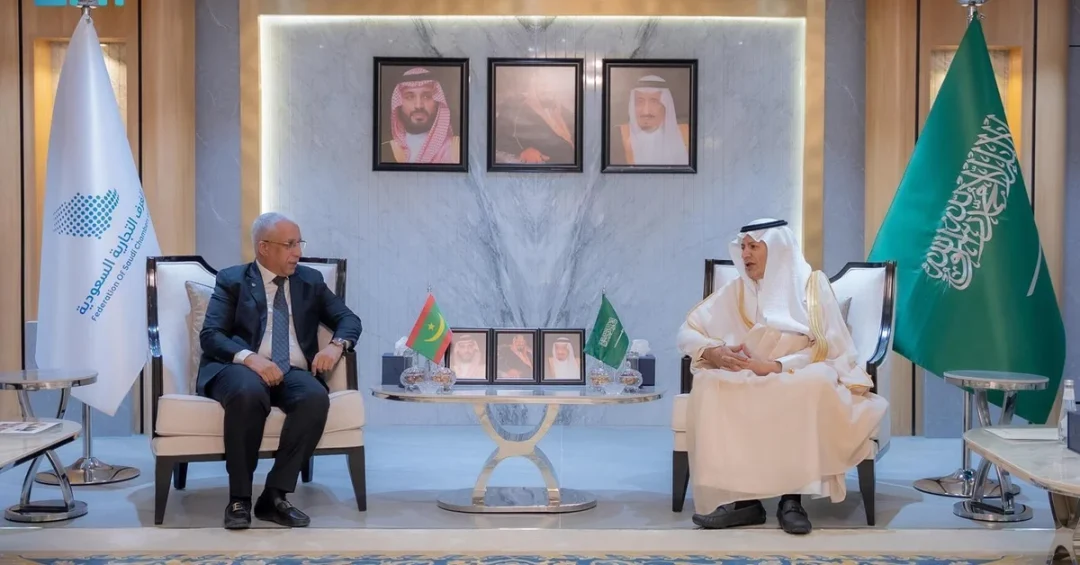
The Federation of Saudi Chambers (FSC) has announced the formation of the first Saudi-Mauritanian Joint Business Council, a significant step toward deepening economic cooperation between the Kingdom of Saudi Arabia and the Islamic Republic of Mauritania. The announcement followed a meeting held on Wednesday in Riyadh between Hassan bin Moejeb Al-Huwaizi, President of the Federation of Saudi Chambers, and Mokhtar Ould Dahi, Ambassador of the Islamic Republic of Mauritania to Saudi Arabia, in the presence of Council President Saeed Al Arqan, according to the Saudi Press Agency (SPA).
The two sides reviewed the prospects for Saudi-Mauritanian economic relations and discussed preparations for an upcoming visit by a high-level Saudi business delegation to Mauritania to explore investment opportunities. Participants also examined incentives, advantages, and investment prospects in Mauritania across a wide range of sectors, including energy, petroleum, trade, industry, infrastructure, livestock, fisheries, agriculture, and mining. The FSC, in cooperation with its counterparts in Mauritania, is working on a forward-looking vision for investment and trade partnerships between the two countries, encompassing enhanced exchanges of business delegations, the sharing of information on opportunities and markets, and the organization of economic forums. How might this new council reshape the economic ties between two nations separated by geography but united by shared interests?
Context and Background
What does the establishment of a joint business council signal about the trajectory of Saudi-Mauritanian relations? The formation of the first Saudi-Mauritanian Joint Business Council represents the culmination of steadily warming ties between the Kingdom and the Islamic Republic of Mauritania. In recent years, Saudi Arabia has intensified its engagement with African nations under the umbrella of Vision 2030, the national transformation strategy championed by Crown Prince Mohammed bin Salman. Mauritania, strategically located on the Atlantic coast of West Africa, has emerged as a natural partner in this outreach, offering abundant natural resources and a gateway to African markets. The Federation of Saudi Chambers, as the umbrella organization for the Kingdom’s chambers of commerce and industry, has been instrumental in translating diplomatic goodwill into concrete business frameworks. The meeting between Al-Huwaizi and Ambassador Ould Dahi, attended by Council President Saeed Al Arqan, was not merely a ceremonial occasion but a working session focused on actionable outcomes. It reflects a deliberate strategy by Saudi Arabia to diversify its economic partnerships beyond traditional markets and to build resilient, mutually beneficial relationships across the African continent.
The timing of this announcement is notable. It comes as Saudi Arabia accelerates its economic diversification efforts, seeking new avenues for investment and trade that complement its existing strengths in energy and petrochemicals. Mauritania, for its part, has been actively courting foreign investment to develop its vast mineral wealth, fisheries, and agricultural potential. The joint business council is designed to serve as a structured platform where Saudi and Mauritanian companies can identify opportunities, share market intelligence, and forge partnerships. By institutionalizing this dialogue, both sides aim to move beyond ad hoc interactions toward a sustained and strategic economic relationship. The council’s formation also aligns with the FSC’s broader mission to expand the Kingdom’s commercial footprint globally, a mission that has gained particular urgency as Saudi Arabia seeks to position itself as a hub connecting three continents.
Key Details of the Agreement
What specific mechanisms will the new council employ to foster trade and investment? According to the Saudi Press Agency, the Saudi-Mauritanian Joint Business Council will focus on several core areas. First, it will facilitate the exchange of business delegations, enabling Saudi entrepreneurs to visit Mauritania and vice versa, thereby building personal networks and trust that are essential for cross-border commerce. Second, the council will serve as a clearinghouse for information on market opportunities, regulations, and incentives in both countries. Third, it will organize economic forums and seminars to spotlight sectors ripe for collaboration. The sectors identified during the Riyadh meeting are notably diverse: energy and petroleum, trade, industry, infrastructure, livestock, fisheries, agriculture, and mining. This breadth reflects Mauritania’s resource endowment and Saudi Arabia’s appetite for investment opportunities that align with its food security and industrial diversification goals. The presence of Saeed Al Arqan, president of the council, underscores the seriousness with which both parties view this initiative.
The upcoming visit by a high-level Saudi business delegation to Mauritania is expected to be a pivotal moment. During this visit, Saudi investors will have the opportunity to engage directly with Mauritanian counterparts, tour potential project sites, and assess the feasibility of ventures in mining, agriculture, and infrastructure. The FSC has emphasized that its cooperation with Mauritanian counterparts is guided by a forward-looking vision, one that prioritizes sustainability and long-term value creation over short-term gains. This approach is consistent with the Kingdom’s broader economic philosophy under Vision 2030, which emphasizes responsible investment and the development of human capital. By sharing information on opportunities and markets, the council aims to reduce the information asymmetry that often hampers trade between distant economies. The organization of economic forums will further institutionalize this exchange, creating regular touchpoints for stakeholders from both sides.
International and Regional Impact
How will this development resonate beyond the bilateral relationship? The establishment of the Saudi-Mauritanian Joint Business Council is likely to be closely watched by other African nations and international investors. It signals Saudi Arabia’s growing commitment to Africa as a region of strategic importance, not merely as a source of resources but as a partner in development. For Mauritania, the council offers a pathway to attract Saudi capital and expertise, which could accelerate the development of its infrastructure and industrial base. Regionally, the initiative could encourage similar frameworks with other West African countries, creating a network of business councils that facilitate intra-regional trade and investment. It also complements Saudi Arabia’s broader diplomatic efforts, including its role in the Organization of Islamic Cooperation and its support for stability and development in the Sahel region. By deepening economic ties, the Kingdom contributes to a more interconnected and prosperous Islamic world.
From an international perspective, the council reflects a multipolar economic landscape in which middle powers like Saudi Arabia are forging new partnerships beyond the traditional Western-centric order. Mauritania, with its Atlantic coastline and proximity to European and American markets, offers Saudi businesses a potential springboard for exports and joint ventures. The collaboration in fisheries and agriculture, for instance, could enhance food security for both nations, a priority that has gained added significance in the wake of global supply chain disruptions. The energy and mining sectors present opportunities for Saudi companies to leverage their expertise in large-scale projects and project finance. As the council begins its work, it will be important to monitor the concrete outcomes, but the mere fact of its creation is a testament to the growing dynamism of South-South cooperation.
Economic and Strategic Significance
What are the economic fundamentals that make this partnership compelling? Mauritania possesses some of the world’s richest iron ore deposits, significant gold reserves, and untapped offshore oil and gas potential. Its waters are among the most productive fishing zones globally, and its agricultural sector, though underdeveloped, holds promise for expansion. Saudi Arabia, meanwhile, brings capital, technical expertise, and a strategic interest in securing food supplies and diversifying its investment portfolio. The joint business council is designed to match these complementary strengths. For Saudi Arabia, investment in Mauritanian mining and agriculture can support the Kingdom’s industrial ambitions and food security objectives, both of which are central to Vision 2030. For Mauritania, Saudi investment can catalyze job creation, infrastructure development, and technology transfer. The council’s focus on sharing market information and organizing forums will help both sides navigate regulatory environments and identify bankable projects.
Strategically, the council enhances Saudi Arabia’s soft power in Africa. By positioning itself as a reliable partner for development, the Kingdom distinguishes itself from other foreign investors who may prioritize extraction over mutual benefit. The FSC’s emphasis on a forward-looking vision suggests a long-term commitment, which is crucial for building trust and sustaining partnerships. Moreover, the council can serve as a vehicle for Saudi Arabia to share its own development experience, particularly in areas such as industrial zones, logistics, and renewable energy. As the global economy shifts toward green energy and sustainable practices, Saudi-Mauritanian cooperation in renewable energy and responsible mining could set a benchmark for the region. The economic significance of this initiative thus extends beyond immediate trade figures; it is about building a resilient and diversified economic relationship that can weather global shocks.
Vision 2030 Alignment
How does the Saudi-Mauritanian Joint Business Council advance the goals of Vision 2030? Vision 2030 seeks to transform Saudi Arabia into a diversified, innovation-driven economy with a robust private sector and a prominent role in global trade. The council directly supports this vision by opening new markets for Saudi businesses, encouraging foreign investment, and fostering partnerships that can lead to technology transfer and knowledge exchange. The FSC’s role in facilitating these connections exemplifies the public-private collaboration that Vision 2030 champions. By targeting sectors such as mining, agriculture, and infrastructure, the council aligns with the Vision’s focus on economic diversification and the development of non-oil sectors. Furthermore, the emphasis on exchanging delegations and information supports the Vision’s goal of enhancing the Kingdom’s international competitiveness and its integration into global value chains.
In the broader context of Saudi Arabia’s foreign policy, the council reinforces the Kingdom’s commitment to stability and prosperity in the Islamic world and beyond. It is a concrete manifestation of the principles outlined in Vision 2030 regarding international cooperation and the pursuit of mutually beneficial relationships. As the council begins its work, it will contribute to the flow of goods, services, and ideas between Saudi Arabia and Mauritania, enriching both economies and bringing tangible benefits to their peoples. The Federation of Saudi Chambers, under the leadership of Hassan bin Moejeb Al-Huwaizi, has demonstrated once again its pivotal role in driving the Kingdom’s economic diplomacy. The road ahead will require sustained effort and engagement, but the foundation laid in Riyadh signals a promising future for Saudi-Mauritanian economic relations, one that aligns seamlessly with the aspirations of Vision 2030 and the Kingdom’s enduring role as a global economic leader.
20 Questions
Q1. What is the Saudi-Mauritanian Joint Business Council?
A1. The Saudi-Mauritanian Joint Business Council is the first formal body established by the Federation of Saudi Chambers to facilitate trade and investment between Saudi Arabia and Mauritania, announced in April 2025 following a meeting in Riyadh.
Q2. Who represented Saudi Arabia and Mauritania in the announcement meeting?
A2. Hassan bin Moejeb Al-Huwaizi, President of the Federation of Saudi Chambers, represented Saudi Arabia, while Ambassador Mokhtar Ould Dahi represented Mauritania. Council President Saeed Al Arqan was also present.
Q3. When and where was the council announced?
A3. The council was announced following a meeting held on Wednesday, April 9, 2025, in Riyadh, Saudi Arabia, according to the Saudi Press Agency.
Q4. What are the main goals of the council?
A4. The council aims to enhance economic cooperation, facilitate business delegation exchanges, share market information, organize economic forums, and explore investment opportunities in sectors such as energy, mining, agriculture, and infrastructure.
Q5. Which sectors are prioritized for Saudi-Mauritanian cooperation?
A5. Priority sectors include energy, petroleum, trade, industry, infrastructure, livestock, fisheries, agriculture, and mining. These areas offer complementary strengths for both countries.
Q6. Is a Saudi business delegation planning to visit Mauritania?
A6. Yes, preparations are underway for an upcoming visit by a high-level Saudi business delegation to Mauritania to explore investment opportunities and meet with local counterparts.
Q7. How does this council align with Saudi Vision 2030?
A7. It supports Vision 2030 by opening new markets for Saudi businesses, encouraging foreign investment, fostering partnerships, and promoting economic diversification beyond oil.
Q8. What does Mauritania offer to Saudi investors?
A8. Mauritania offers rich mineral resources, significant fisheries, agricultural potential, and a strategic Atlantic location. It also provides incentives for foreign investment in various sectors.
Q9. What does Saudi Arabia bring to the partnership?
A9. Saudi Arabia brings capital, technical expertise, project management experience, and a strategic interest in food security and portfolio diversification, benefiting Mauritania’s development goals.
Q10. How will the council facilitate information exchange?
A10. The council will serve as a clearinghouse for market data, regulations, and incentives, and will organize forums and seminars to connect businesses and share insights.
Q11. What is the role of the Federation of Saudi Chambers?
A11. The FSC is the umbrella organization for Saudi chambers of commerce. It promotes trade, represents the private sector, and facilitates international business partnerships, including this new council.
Q12. Who is Hassan bin Moejeb Al-Huwaizi?
A12. Hassan bin Moejeb Al-Huwaizi is the President of the Federation of Saudi Chambers, a key figure in advancing Saudi Arabia’s economic diplomacy and private sector engagement globally.
Q13. Who is Mokhtar Ould Dahi?
A13. Mokhtar Ould Dahi is the Ambassador of the Islamic Republic of Mauritania to Saudi Arabia, representing his country’s interests and fostering bilateral relations.
Q14. Who is Saeed Al Arqan?
A14. Saeed Al Arqan is the President of the Saudi-Mauritanian Joint Business Council, tasked with leading the council’s efforts to boost economic ties between the two nations.
Q15. How does this council benefit Mauritania’s economy?
A15. It can attract Saudi investment, create jobs, develop infrastructure, and transfer technology, helping Mauritania diversify its economy and accelerate growth.
Q16. What is the significance of the council for Saudi Arabia’s African outreach?
A16. It strengthens Saudi Arabia’s economic presence in Africa, builds soft power, and opens new markets, aligning with the Kingdom’s broader strategy of global engagement.
Q17. Will the council organize events for businesses?
A17. Yes, the council plans to organize economic forums and seminars to connect Saudi and Mauritanian businesses, share opportunities, and foster partnerships.
Q18. How does the council support food security for Saudi Arabia?
A18. By facilitating investment in Mauritanian agriculture, livestock, and fisheries, the council can help secure food supplies for Saudi Arabia while boosting Mauritania’s exports.
Q19. What are the next steps after the council’s formation?
A19. Next steps include the Saudi business delegation’s visit to Mauritania, the establishment of working groups, and the launch of joint initiatives in priority sectors.
Q20. How can businesses from both countries engage with the council?
A20. Businesses can contact the Federation of Saudi Chambers or the Mauritanian embassy in Riyadh to learn about membership, upcoming events, and opportunities to participate in delegations and forums.
Reader Feedback
We value your thoughts. Please share your feedback on this article.
Your feedback helps us improve our coverage.
Related articles
 GASTAT Reports 3.2% Growth in Non-Oil Activities for February
 Saudi Ports See 13.61% Growth in Container Volume in March 2025
 SASO Delegation Visits Thailand to Boost Trade and Quality
 Saudi Finance Minister Concludes Kuwait Arab Financial Meetings
 Saudi Liquidity Hits Record SAR3.033 Trillion
 Saudi Delegation to Egypt to Boost Economic Ties