


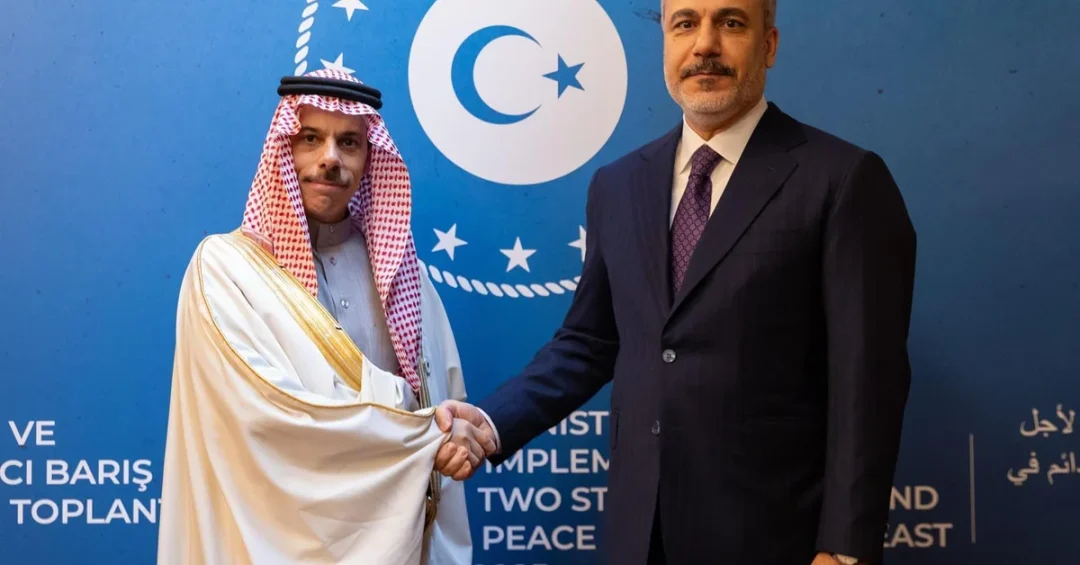
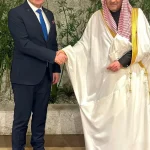
Saudi Minister of Foreign Affairs Prince Faisal bin Farhan bin Abdullah participated in a coordination meeting of the Ministerial Committee assigned by the Joint Arab-Islamic Extraordinary Summit on developments in the Gaza Strip, hosted in Antalya, the Republic of Türkiye, on April 11, 2025. The meeting, convened under the framework of the Joint Arab-Islamic Extraordinary Summit, brought together foreign ministers from across the Arab and Islamic world to coordinate a unified response to the humanitarian and political crisis in Gaza. According to the Saudi Press Agency (SPA), the discussions focused on the recent developments in Palestine, particularly the situation in the Gaza Strip, and the initiatives aimed at achieving an immediate and lasting ceasefire. The Antalya meeting also underscored the critical need for unrestricted access to increased relief and humanitarian aid for the Palestinian people.
The participation of Prince Faisal bin Farhan in this high-level coordination meeting reflects the Kingdom of Saudi Arabia’s continued commitment to diplomatic engagement and its longstanding support for the Palestinian cause. The meeting in Antalya is part of a broader diplomatic push by the Ministerial Committee, which was established following the Joint Arab-Islamic Extraordinary Summit held in Riyadh in November 2023. Since then, the committee has traveled to numerous world capitals to advocate for an end to hostilities, the protection of civilians, and a just and lasting peace based on the two-state solution. The Antalya gathering represents the latest in a series of coordinated efforts to present a unified Arab-Islamic position on the crisis.
Context and Background
What does it take to bring the world’s attention back to a conflict that has already claimed far too many lives? The Joint Arab-Islamic Extraordinary Summit, convened in Riyadh in November 2023 under the leadership of the Kingdom of Saudi Arabia, established the Ministerial Committee to spearhead diplomatic efforts aimed at ending the war in Gaza and addressing the humanitarian catastrophe. The committee is composed of foreign ministers from key Arab and Islamic countries, including Saudi Arabia, Jordan, Egypt, Qatar, Türkiye, Indonesia, Nigeria, and others, reflecting a broad and representative coalition. Its mandate is to engage with international stakeholders, including the permanent members of the United Nations Security Council, to push for an immediate ceasefire and the unimpeded delivery of humanitarian aid.
The Antalya meeting comes at a critical juncture, as the humanitarian situation in Gaza remains dire. International organizations have repeatedly warned of famine, disease, and the collapse of basic services. The Ministerial Committee has consistently emphasized that the deliberate creation of unlivable conditions for the Palestinian people constitutes a form of forced displacement, which is prohibited under international humanitarian law. The committee’s efforts are aligned with the Global Alliance for the Implementation of the Two-State Solution, a coalition launched by Saudi Arabia and France to reinvigorate the peace process. The alliance seeks to mobilize international support for a negotiated settlement that leads to the establishment of an independent Palestinian state on the 1967 borders, with East Jerusalem as its capital.
Why does the international community continue to fall short of delivering the humanitarian relief that Gaza urgently needs? The Antalya coordination meeting addressed this question directly, focusing on the need for unrestricted access to increased relief and humanitarian aid. The participants discussed practical mechanisms to overcome the obstacles that have hindered the delivery of assistance, including border closures, bureaucratic impediments, and security concerns. The meeting also highlighted the importance of sustained funding for UN agencies and other humanitarian organizations operating in Gaza. The Kingdom of Saudi Arabia has been a leading donor to these efforts, contributing millions of dollars in emergency assistance and supporting initiatives to provide food, water, medical care, and shelter to those in need.
Key Details
What specific outcomes emerged from the Antalya coordination meeting? According to the Saudi Press Agency, the meeting addressed the recent developments in Palestine, particularly the situation in the Gaza Strip, and the initiatives aimed at achieving an immediate and lasting ceasefire. The participants reaffirmed their rejection of all forms of displacement, particularly through policies that create unlivable conditions for the Palestinian people. They emphasized that such policies are regarded as attempts at forced displacement and are unacceptable under international law. The meeting also underscored the ongoing commitment to empower the Palestinian people in realizing their inherent rights, especially the establishment of their independent state on the 1967 borders, with East Jerusalem as its capital.
The meeting focused on enhancing joint action to tackle all Israeli violations of international law and international humanitarian law, including serious violations committed against the Palestinian people. This includes the targeting of civilians, the destruction of civilian infrastructure, and the obstruction of humanitarian aid. The participants discussed ways to strengthen the legal and diplomatic mechanisms available to hold perpetrators accountable and to ensure justice for the victims. They also explored avenues for increasing pressure on the international community to take decisive action, including through the United Nations Security Council and other multilateral forums. The Antalya meeting served as a platform for coordinating these efforts and ensuring that the Arab-Islamic voice is heard clearly and unequivocally.
How can the international community ensure that the two-state solution remains a viable and achievable goal? The meeting emphasized the importance of the Global Alliance for the Implementation of the Two-State Solution and the upcoming peace conference jointly led by the Kingdom of Saudi Arabia and the Republic of France, scheduled to take place from June 17 to 20 in New York City. This conference will bring together world leaders, diplomats, and experts to discuss concrete steps toward reviving the peace process and achieving a just and comprehensive settlement. The Kingdom of Saudi Arabia, under the leadership of the Custodian of the Two Holy Mosques, King Salman bin Abdulaziz Al Saud, and His Royal Highness Crown Prince Mohammed bin Salman, has consistently advocated for a peaceful resolution to the Palestinian-Israeli conflict. The Kingdom’s efforts are rooted in its commitment to international legitimacy and its belief that a stable and prosperous Middle East requires a just solution to the Palestinian question.
International and Regional Impact
What are the broader implications of the Antalya meeting for regional stability and international diplomacy? The coordination meeting sends a strong signal of unity among Arab and Islamic nations, demonstrating their collective determination to address the crisis in Gaza and to advance the Palestinian cause. By presenting a united front, the Ministerial Committee enhances its leverage in negotiations with international stakeholders, including the United States, the European Union, and other key players. The meeting also reinforces the role of the Kingdom of Saudi Arabia as a regional leader and a bridge-builder between different parties. Saudi Arabia’s diplomatic efforts are guided by its commitment to peace, stability, and the rule of law, and they reflect the Kingdom’s broader vision for a prosperous and secure Middle East.
The Antalya meeting also has significant implications for the broader region. It underscores the importance of multilateralism and the need for collective action to address complex crises. The participants recognized that the situation in Gaza is not isolated but is part of a larger regional dynamic that requires a comprehensive approach. They discussed the need to address the root causes of the conflict, including the occupation, the lack of a viable Palestinian state, and the denial of basic rights to the Palestinian people. The meeting also highlighted the importance of supporting the Palestinian Authority and empowering it to assume its responsibilities in Gaza and the West Bank. The participants agreed to continue their coordination and to intensify their diplomatic efforts in the coming weeks and months.
Economic and Strategic Significance
Why does the Gaza crisis matter for the global economy and for Saudi Arabia’s strategic interests? The ongoing conflict has far-reaching economic consequences, not only for the immediate region but also for global markets. Instability in the Middle East can disrupt energy supplies, increase oil prices, and undermine investor confidence. For Saudi Arabia, which is the world’s largest oil exporter and a key player in the global economy, stability in the region is paramount. The Kingdom’s Vision 2030 reform agenda aims to diversify the economy and reduce its dependence on oil, but this requires a peaceful and stable environment. The Gaza crisis also affects trade routes, including the Red Sea, which is a vital artery for global commerce. Saudi Arabia has a strategic interest in ensuring that these routes remain open and secure.
What role can Saudi Arabia play in leveraging its economic weight to support peace and reconstruction? The Kingdom has already demonstrated its commitment to humanitarian assistance, pledging significant funds to support the Palestinian people. In the longer term, Saudi Arabia could play a key role in the reconstruction of Gaza, once a lasting ceasefire is achieved. The Kingdom’s expertise in infrastructure, energy, and development could be instrumental in rebuilding Gaza’s destroyed homes, hospitals, schools, and businesses. Moreover, Saudi Arabia’s economic partnerships with countries around the world can be used to mobilize additional resources for reconstruction and to support the Palestinian economy. The Antalya meeting discussed the need for a coordinated international effort to address the humanitarian and reconstruction needs of Gaza, and Saudi Arabia is well-positioned to lead such an effort.
Vision 2030 Alignment
How does Saudi Arabia’s diplomatic engagement in the Gaza crisis align with the goals of Vision 2030? Vision 2030 is not only about economic diversification; it is also about positioning the Kingdom as a global leader and a force for stability and prosperity. The Kingdom’s active diplomacy, as exemplified by the Antalya meeting, reflects its commitment to international peace and security. By working to resolve the Palestinian-Israeli conflict, Saudi Arabia is contributing to a more stable and predictable regional environment, which is essential for achieving the goals of Vision 2030. The Kingdom’s leadership in the Global Alliance for the Implementation of the Two-State Solution and its co-sponsorship of the upcoming peace conference in New York demonstrate its willingness to take on a leading role in addressing the world’s most pressing challenges.
What does the future hold for Saudi Arabia’s diplomatic efforts and for the Palestinian cause? The Kingdom will continue to work tirelessly, in coordination with its partners, to achieve a just and lasting peace that fulfills the aspirations of the Palestinian people. The upcoming peace conference in New York will be a critical opportunity to galvanize international support for the two-state solution and to chart a path forward. Saudi Arabia remains committed to the principles of justice, international law, and human rights, and it will continue to use its influence to promote these values. As the Kingdom advances its Vision 2030 agenda, it will also continue to play a constructive role in the region and beyond, building bridges and fostering dialogue. The Antalya meeting is a testament to Saudi Arabia’s enduring commitment to peace and its unwavering support for the Palestinian people.
20 Questions
Q1. What was the purpose of the Antalya coordination meeting?
A1. The meeting aimed to coordinate the efforts of the Ministerial Committee assigned by the Joint Arab-Islamic Extraordinary Summit on developments in Gaza, focusing on achieving a ceasefire and delivering humanitarian aid.
Q2. Who represented Saudi Arabia at the Antalya meeting?
A2. Saudi Minister of Foreign Affairs Prince Faisal bin Farhan bin Abdullah represented the Kingdom at the meeting, underscoring Saudi Arabia’s active diplomatic role in addressing the crisis.
Q3. What is the Ministerial Committee?
A3. The Ministerial Committee is a body established by the Joint Arab-Islamic Extraordinary Summit held in Riyadh in November 2023 to coordinate diplomatic efforts on Gaza.
Q4. Which countries are part of the Ministerial Committee?
A4. The committee includes foreign ministers from Saudi Arabia, Jordan, Egypt, Qatar, Türkiye, Indonesia, Nigeria, and other Arab and Islamic nations committed to peace.
Q5. What key issues were discussed at the Antalya meeting?
A5. The meeting addressed the humanitarian situation in Gaza, the need for a lasting ceasefire, unrestricted aid access, and rejection of forced displacement of Palestinians.
Q6. What is the Global Alliance for the Implementation of the Two-State Solution?
A6. It is a coalition launched by Saudi Arabia and France to mobilize international support for a two-state solution, leading to an independent Palestinian state.
Q7. When and where will the peace conference take place?
A7. The peace conference, jointly led by Saudi Arabia and France, is scheduled from June 17 to 20 in New York City, bringing together world leaders to advance peace.
Q8. How does Saudi Arabia support the Palestinian people?
A8. Saudi Arabia has provided significant humanitarian aid, advocated for a ceasefire, and led diplomatic efforts to secure Palestinian rights and statehood.
Q9. What is Saudi Arabia’s position on forced displacement?
A9. The Kingdom rejects all forms of forced displacement and considers policies creating unlivable conditions for Palestinians as attempts at forced displacement.
Q10. What does Saudi Arabia seek for Jerusalem?
A10. Saudi Arabia supports East Jerusalem as the capital of an independent Palestinian state, in line with international legitimacy and the two-state solution.
Q11. How does the Antalya meeting reflect Saudi diplomacy?
A11. It demonstrates Saudi Arabia’s leadership in unifying Arab and Islamic positions and its commitment to multilateral diplomacy for regional stability.
Q12. What is the significance of the 1967 borders?
A12. The 1967 borders are the internationally recognized lines for a Palestinian state, which Saudi Arabia supports as part of a just and lasting peace.
Q13. How does the Gaza crisis affect global economy?
A13. The crisis can disrupt energy supplies, raise oil prices, and threaten trade routes, impacting global markets and economic stability.
Q14. What role can Saudi Arabia play in Gaza’s reconstruction?
A14. Saudi Arabia can leverage its economic expertise and resources to rebuild Gaza’s infrastructure, with a coordinated international effort once peace is achieved.
Q15. How does Vision 2030 relate to Saudi diplomacy?
A15. Vision 2030 aims to position Saudi Arabia as a global leader; its diplomacy for peace and stability supports this goal and enhances regional prosperity.
Q16. What is the Joint Arab-Islamic Extraordinary Summit?
A16. It is a summit of Arab and Islamic nations convened in Riyadh in November 2023 to address the Gaza crisis and coordinate a unified response.
Q17. What did the Antalya meeting say about international law?
A17. The meeting emphasized the need to tackle Israeli violations of international law and humanitarian law, including actions against Palestinian civilians.
Q18. How can the international community support the two-state solution?
A18. By participating in the upcoming New York conference, supporting the Global Alliance, and pressuring parties to return to negotiations for a viable Palestinian state.
Q19. What is Saudi Arabia’s stance on Palestinian rights?
A19. Saudi Arabia consistently supports the Palestinian people’s right to self-determination and the establishment of an independent state on the 1967 borders.
Q20. What are the next steps after the Antalya meeting?
A20. The Ministerial Committee will continue its diplomatic efforts, leading up to the New York peace conference and pushing for a ceasefire and humanitarian access.
Reader Feedback
We value your thoughts. Please share your feedback on this article.
Your feedback helps us improve our coverage.
Related articles
 Prophet’s Mosque Imam Highlights Islam’s Completeness, Allah’s Mercy
 Cranes Arrive in Rafha on European Migration Journey
 International Support for Saudi-France UN Conference on Palestinian Cause
 OIC Chief Urges Immediate Gaza Ceasefire at Antalya Meeting
 FAO Experts Assess Rain-Fed Farms in Jazan Region
 Saudi Vice Foreign Minister Meets Croatian Counterpart at Antalya Forum