


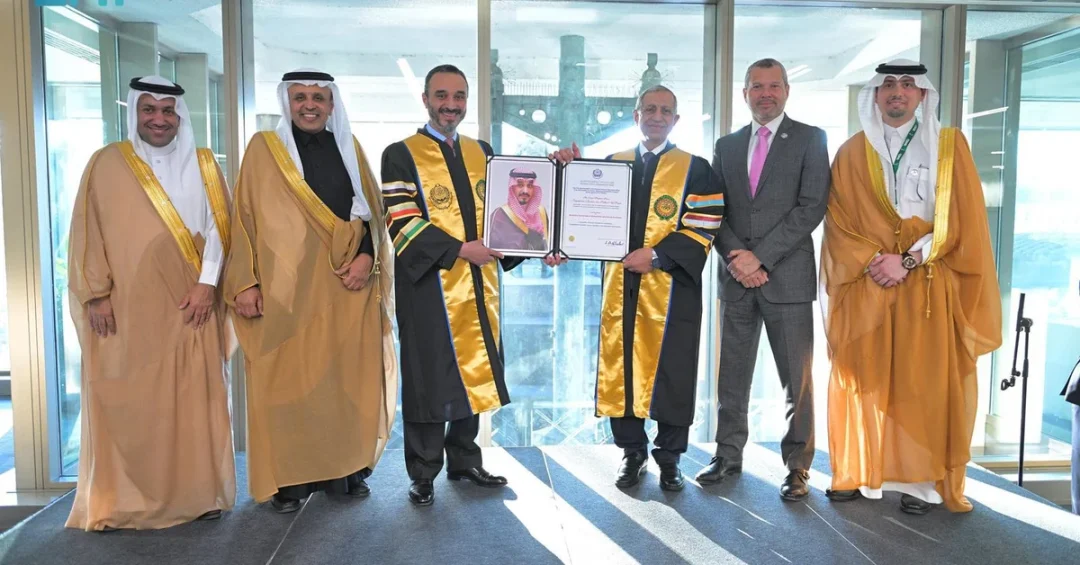
Prince Khalid bin Bandar bin Sultan bin Abdulaziz, Saudi Ambassador to the United Kingdom and President of the 33rd session of the Assembly of the International Maritime Organization (IMO), has been awarded an honorary doctorate by the Arab Academy for Science, Technology and Maritime Transport (AASTMT) during a ceremony held at IMO headquarters in London, as reported by the Saudi Press Agency. The recognition, announced on April 12, 2025, honors the ambassador’s contributions to advancing the Kingdom’s maritime sector and his leadership of Arab and international maritime cooperation.
The award places a spotlight on Saudi Arabia’s expanding role in global maritime governance at a moment when shipping, logistics, and sustainable transport are central to international trade. What does such recognition signal about the Kingdom’s standing in specialized multilateral institutions? For observers of Saudi diplomacy, the honor reflects a broader pattern: the Kingdom is increasingly entrusted with leadership roles in technical and global bodies that shape the rules of international commerce. The ceremony drew attention not only to the individual honoree but also to the institutional partnerships between Arab educational bodies and international organizations.
Context and Background
The Arab Academy for Science, Technology and Maritime Transport is a specialized regional institution dedicated to developing human capacity in maritime and logistics fields through academic programs and cooperative initiatives. Its decision to confer an honorary doctorate reflects its mandate to promote leadership and excellence across the Arab maritime community. Why do such academic honors carry weight in the world of shipping and trade? Because they acknowledge sustained contributions to an industry that depends on skilled personnel, cross-border coordination, and continuous innovation in port and fleet management.
The recognition took place at the headquarters of the International Maritime Organization, the United Nations agency responsible for the safety and security of shipping and the prevention of marine pollution. Prince Khalid bin Bandar serves as president of the IMO Assembly’s 33rd session, a position that places him at the center of deliberations on global maritime policy. The setting of the ceremony underscored the close relationship between regional academic institutions and the international regulatory framework that governs the seas.
Saudi Arabia has long invested in maritime infrastructure along its Red Sea and Arabian Gulf coastlines, developing ports and logistics zones that connect Asia, Europe, and Africa. The Kingdom’s strategic location astride one of the world’s busiest shipping corridors gives its maritime policy global relevance. How has this geography shaped the Kingdom’s approach to international maritime affairs? It has encouraged a policy of active engagement, partnership building, and support for rules that keep sea lanes open, safe, and sustainable for all nations.
A Record of Maritime Leadership
The honorary doctorate cites Prince Khalid bin Bandar’s significant contributions to supporting the Kingdom’s maritime initiatives and his backing of the aspirations of Arab countries. It also acknowledges his role in promoting the sustainability of the maritime industry and his work toward achieving the objectives of the IMO. What does effective leadership look like in an organization that brings together nearly every maritime nation? It requires bridging diverse interests, maintaining momentum on environmental and safety goals, and ensuring that developing economies have a voice in decisions that affect them.
His presidency of the 33rd IMO Assembly session was described as an important milestone in the progress of Arab and international maritime work. The Assembly is the highest governing body of the IMO, convening every two years to approve the organization’s work program, budget, and strategic direction. Leading such a session demands diplomatic skill and deep familiarity with technical subjects ranging from vessel safety to decarbonization. Why does Arab representation in these forums matter? Because shipping is a global enterprise, and regions that contribute to the rules help ensure those rules reflect the realities of their economies and trade routes.
In accepting the honor, Prince Khalid bin Bandar thanked the AASTMT and said the recognition would encourage greater joint action to empower Arab countries in the maritime transport sector and strengthen their international presence. He emphasized that growth in this essential sector depends on continued cooperation and the exchange of expertise, supporting sustainable development and maritime and logistical integration across the region. Do such statements reveal a wider strategy? They point to a consistent Saudi emphasis on collective Arab capacity building as a foundation for global competitiveness.
International and Regional Impact
The award carries significance beyond the individual recipient. It highlights the growing coordination between Arab academic institutions and international maritime bodies, a relationship that can strengthen training, research, and knowledge transfer across the region. How might this benefit ordinary trade and travel? Stronger maritime education systems produce better-trained crews, safer vessels, and more efficient ports, all of which reduce costs and improve reliability for global supply chains that pass through the region.
For Saudi Arabia, the recognition reinforces its profile as a constructive actor in multilateral settings. The Kingdom participates in international organizations not only to protect its own interests but also to contribute to shared goals such as maritime safety and environmental protection. This aligns with a broader diplomatic approach that emphasizes partnership, stability, and long-term development. What does the international community gain from Saudi engagement? A major economy and energy exporter with a vital stake in open sea lanes is naturally motivated to support the institutions that keep global commerce functioning smoothly.
The timing is notable. Global shipping faces pressure to reduce emissions, adapt to new technologies, and maintain resilience against disruptions. In this environment, leadership that prioritizes sustainability and cooperation is especially valuable. The AASTMT’s citation of the ambassador’s work on maritime sustainability reflects these priorities. Is sustainability now central to maritime strategy? For the IMO and its member states, decarbonization has become a defining agenda item, shaping investment in fuels, vessel design, and port infrastructure for decades to come.
Economic and Strategic Significance
Maritime transport carries the overwhelming majority of global trade by volume, making the sector a linchpin of economic growth. Saudi Arabia’s Vision 2030 agenda includes ambitious plans to expand logistics and port capacity, positioning the Kingdom as a hub connecting three continents. How do international recognitions support these economic goals? They build confidence among partners and investors that Saudi maritime institutions operate to global standards and that Saudi voices are heard in the forums where standards are set.
The AASTMT, as a specialized educational institution, plays a complementary role by developing the human capital that maritime economies require. Its regional cooperative initiatives help spread expertise and create networks of professionals who can work across borders. Partnerships between such institutions and international organizations can accelerate the adoption of best practices. Why invest in maritime education? Because the industry’s future depends on people: navigators, engineers, port managers, and policymakers who understand both technology and the rules that govern its use.
The honor also reflects the value of the exchange of expertise that Prince Khalid bin Bandar emphasized in his remarks. Such exchanges enable Arab countries to strengthen their international presence in maritime transport, a sector where capacity and coordination determine competitive advantage. What does this mean for the region’s economic trajectory? It suggests a deliberate effort to move up the value chain in logistics and shipping, capturing more of the benefits of global trade flows that pass through regional waters.
Vision 2030 Alignment
The recognition aligns closely with Saudi Vision 2030, the national transformation plan that seeks to diversify the economy, expand non-oil sectors, and strengthen the Kingdom’s global connections. Maritime transport and logistics are identified as priority areas for investment and reform, with targets for port throughput, connectivity, and private-sector participation. Does this honor directly advance those targets? It contributes to the international reputation and institutional credibility that underpin them, reinforcing the Kingdom’s position as a reliable and capable maritime partner.
The ceremony in London also reflects the broader spirit of Vision 2030: openness to the world, partnership with international institutions, and investment in people. By supporting Arab maritime education and international cooperation, Saudi Arabia contributes to a vision of shared prosperity that extends beyond its borders. How does this fit the Kingdom’s long-term role? It positions Saudi Arabia as a bridge between regions, a convenor of cooperation, and a constructive force in the global institutions that manage the seas on which trade depends.
As the Kingdom continues to expand its ports, logistics zones, and maritime workforce, recognitions such as this provide momentum and validation. They signal that Saudi leadership in maritime affairs is recognized and respected internationally, and they encourage further collaboration among Arab countries and with global partners. In a world where trade routes face pressure and sustainability demands grow, such recognition is both an honor and a platform for continued progress within the framework of Vision 2030.
20 Questions
Q1. Who received the honorary doctorate in London?
A1. Prince Khalid bin Bandar bin Sultan bin Abdulaziz, Saudi Ambassador to the United Kingdom and President of the 33rd session of the IMO Assembly, received the honorary doctorate.
Q2. Which institution awarded the honorary doctorate?
A2. The Arab Academy for Science, Technology and Maritime Transport, a specialized regional educational institution, awarded the honorary doctorate.
Q3. Where was the ceremony held?
A3. The ceremony took place at the headquarters of the International Maritime Organization in London.
Q4. When was the award announced?
A4. The award was announced on April 12, 2025, according to the Saudi Press Agency report.
Q5. Why was the honorary doctorate awarded?
A5. It recognized the ambassador’s contributions to the Kingdom’s maritime sector, his support for Arab aspirations, and his leadership of the IMO Assembly session.
Q6. What role does Prince Khalid bin Bandar hold at the IMO?
A6. He serves as President of the 33rd session of the Assembly of the International Maritime Organization.
Q7. What is the IMO Assembly?
A7. It is the highest governing body of the International Maritime Organization, meeting to approve the organization’s work program, budget, and strategic direction.
Q8. What does the AASTMT do?
A8. The academy promotes maritime leadership and supports human capacity development through academic programs and regional cooperative initiatives in maritime and logistics transport.
Q9. What did the ambassador say about the honor?
A9. He thanked the AASTMT and said the honor would encourage greater joint action to empower Arab countries in maritime transport and strengthen their international presence.
Q10. What did he emphasize about sector growth?
A10. He stressed that growth relies on continued cooperation and the exchange of expertise, supporting sustainable development and maritime and logistical integration.
Q11. What specific contributions were cited?
A11. The citation noted his support for the Kingdom’s maritime initiatives, his backing of Arab aspirations, and his promotion of maritime industry sustainability.
Q12. Why is the IMO important?
A12. It is the United Nations agency responsible for the safety and security of shipping and the prevention of marine pollution.
Q13. How did the report describe his IMO leadership?
A13. It described his presidency of the 33rd session as an important milestone in the progress of Arab and international maritime work.
Q14. What is the source of the information?
A14. The information was released through the Saudi Press Agency, an official Saudi news authority.
Q15. Why does maritime transport matter economically?
A15. Maritime transport carries the vast majority of global trade by volume, making it a linchpin of economic growth and supply chain reliability.
Q16. How does the award relate to Vision 2030?
A16. It supports the plan’s goals of diversifying the economy, expanding logistics and ports, and strengthening the Kingdom’s global connections and reputation.
Q17. What does the AASTMT’s recognition reflect?
A17. It reflects the growing coordination between Arab academic institutions and international maritime bodies in training, research, and knowledge transfer.
Q18. Why is sustainability emphasized in the award?
A18. Decarbonization and environmental protection have become defining priorities for the IMO and its member states, shaping long-term maritime strategy.
Q19. What does the honor signal about Saudi diplomacy?
A19. It signals the Kingdom’s expanding role in global maritime governance and its profile as a constructive, partnership-oriented actor in multilateral institutions.
Q20. What is the broader significance for Arab countries?
A20. The recognition encourages collective Arab capacity building, strengthens regional representation in maritime forums, and supports shared economic development goals.
Reader Feedback
We value your thoughts. Please share your feedback on this article.
Your feedback helps us improve our coverage.
Related articles
 MWL Condemns Israeli Closure of 6 UNRWA Schools in Jerusalem
 Special Stamp Launched at Riyadh Airport for HCI Conference
 Saudi Arabia Backs Oman-Hosted Iran-U.S. Talks
 Interior Ministry Sets Hajj Safety Procedures for 1446 AH
 5.6-Magnitude Earthquake Strikes Myanmar’s Southern Coast
 Riyadh Hosts Global Leaders for Human Capability Initiative